
A decrease in the demand for soft drinks due to changes in consumer tastes,
accompanied by an increase in the supply of soft drinks as a result of reductions in
input prices, will result in
A) a decrease in the equilibrium quantity of soft drinks and no change in the
equilibrium price.
B) a decrease in the equilibrium price of soft drinks and no change in the equilibrium
quantity.
C) a decrease in the equilibrium price of soft drinks; the equilibrium quantity may
increase or decrease.
D) an increase in the equilibrium quantity of soft drinks; the equilibrium price may
increase or decrease.
Figure 19-7
If the Indian government pegs its currency to the dollar at a value below $.02/rupee, we
would say the currency is
A) undervalued.
B) overvalued.
C) parity valued.
D) equilibrium valued.
Assuming no change in the nominal exchange rate, how will a lower rate of inflation in
the United States relative to Canada affect the real exchange rate between the two
countries? (Assume the United States is the “domestic” country.)
A) The real exchange rate will rise.
B) The real exchange rate will fall.
C) The real exchange rate will be unaffected.
D) The impact on the real exchange rate cannot be predicted.
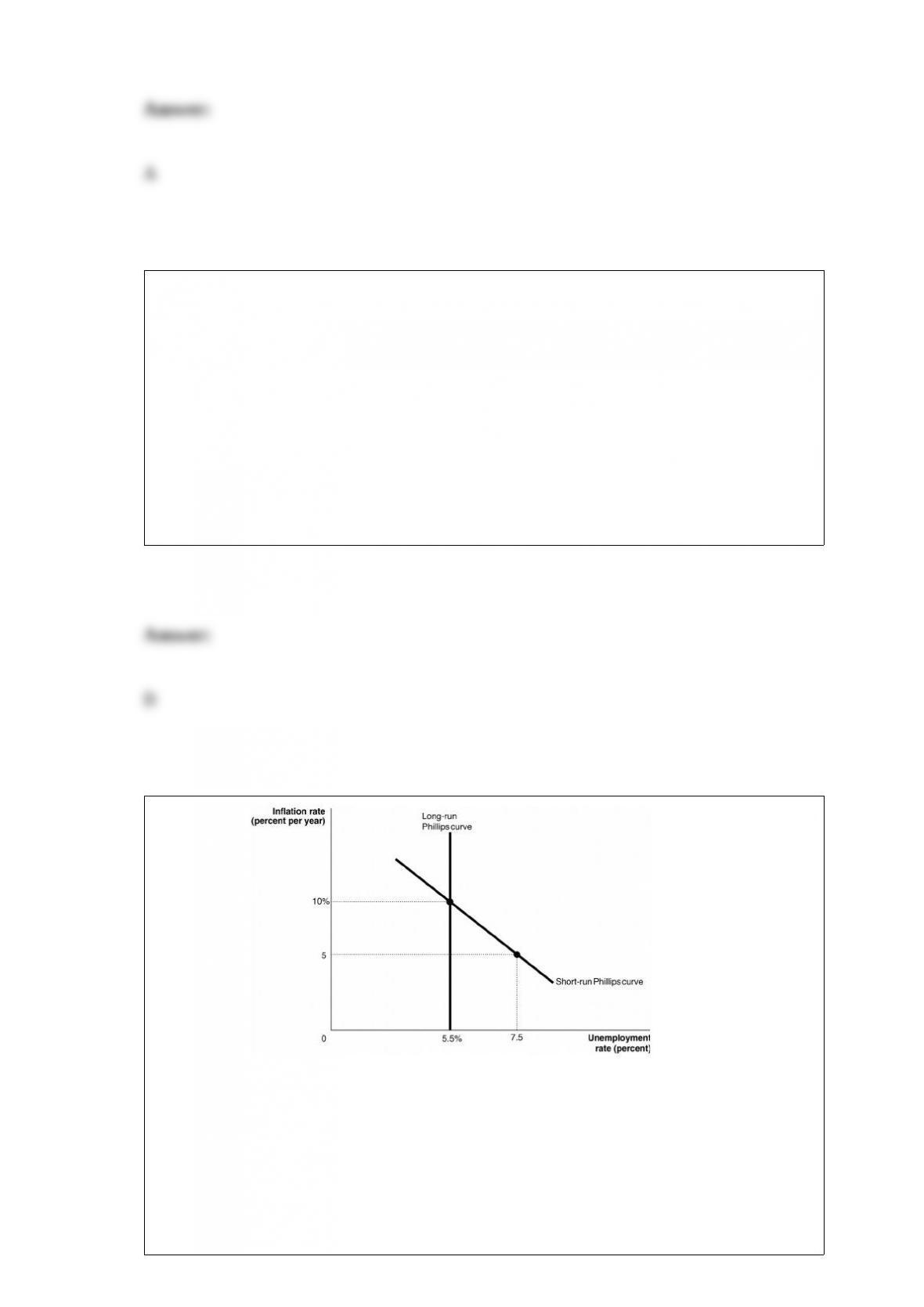
Figure 17-7
Consider the Phillips curves depicted in the graph above. The Fed announces its
intention to decrease inflation from 10 percent to 5 percent per year, and it succeeds. If
the assumptions of the rational expectations school hold true, and the Fed’s
announcement is credible, the rate of unemployment will be ________ in the short run.
A) less than 5.5 percent

B) 5.5 percent
C) between 5.5 and 7.5 percent
D) 7.5 percent
A firm’s expansion path
A) is the same thing as its long-run average cost curve.
B) is a curve that shows a firm’s cost-minimizing combination of inputs for every level
of output, holding input prices constant.
C) shows the targeted growth rate in sales over the long run.
D) is a curve that shows expected profits at various price levels.
Which of the following antitrust laws forbade firms to engage in price discrimination if
the effect would lessen competition or create a monopoly?
A) the Sherman Act
B) the Clayton Act
C) the Robinson-Patman Act
D) the Cellar-Kefauver Act
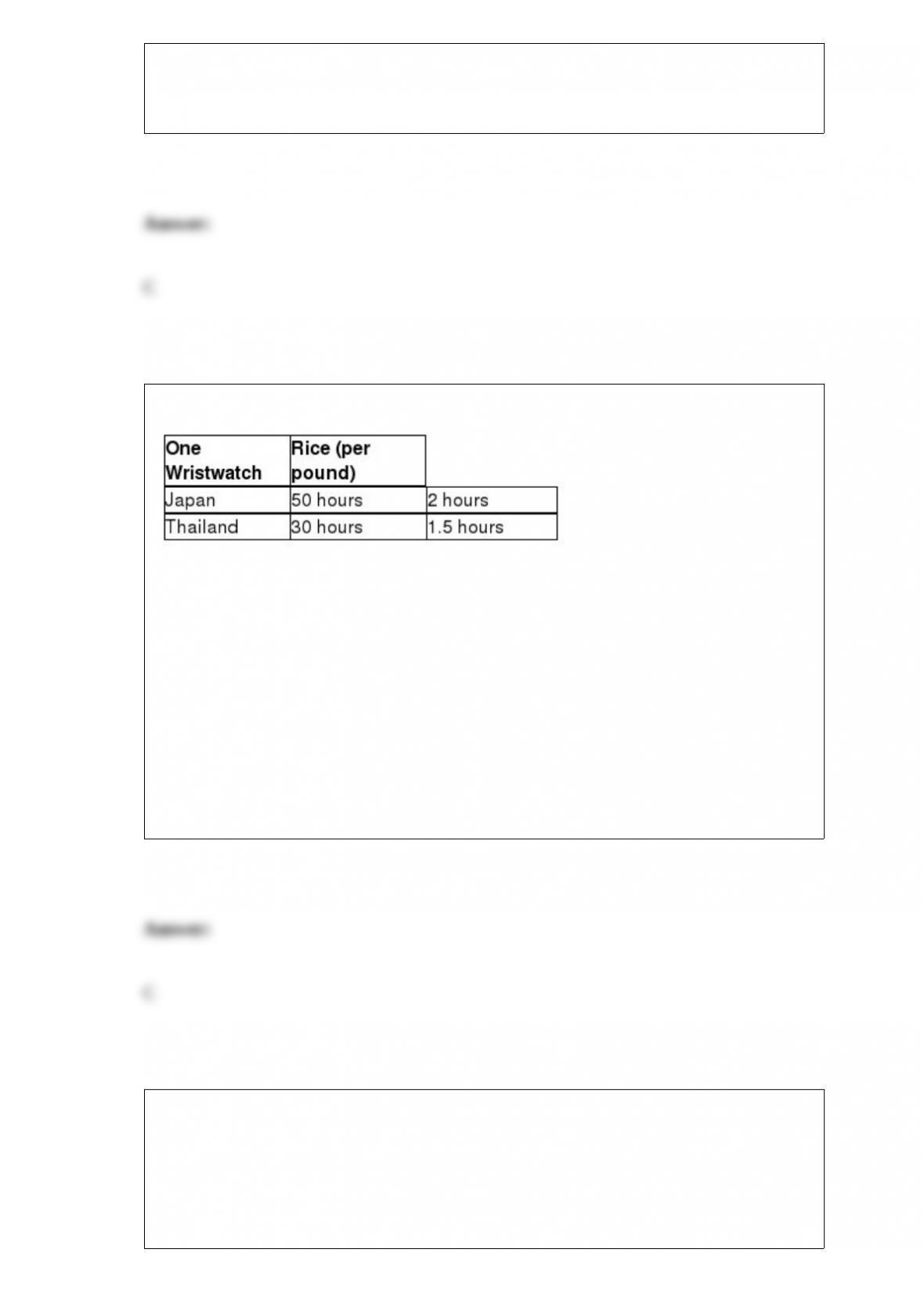
Table 2-20
Table 2-20 shows the number of labor hours required to produce a wristwatch and a
pound of rice in Japan and Thailand.
What is Japan’s opportunity cost of producing one wristwatch?
A) 0.04 pounds of rice
B) 4 pounds of rice
C) 25 pounds of rice
D) 40 pounds of rice
Giffen goods
A) are theoretical and have never been discovered in the real world.
B) have not existed since prior to the Industrial Revolution.

C) were proven to exist in the 1890s by Sir Robert Giffen.
D) were not shown to actually exist until 2006.
The price elasticity of supply measures
A) the responsiveness of quantity supplied to changes in input prices.
B) the responsiveness of quantity supplied to changes in technology.
C) the responsiveness of quantity supplied to changes in price.
D) a supplier’s ability to produce a good in the face of scarcity.
Gross domestic product is generally ________ national income.
A) greater than
B) less than
C) equal to
D) unrelated to
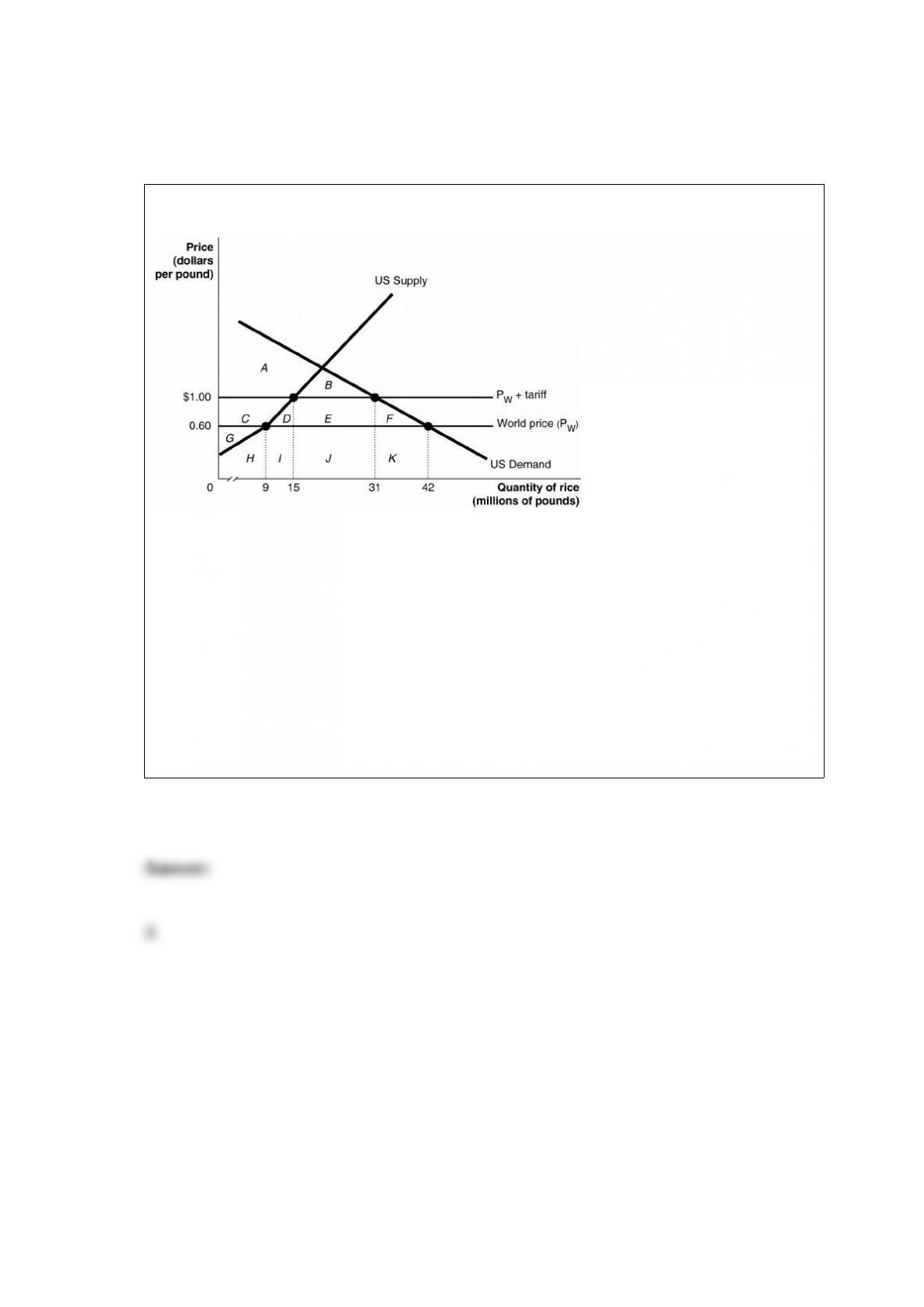
Figure 9-2
Suppose the U.S. government
imposes a $0.40 per pound tariff on rice imports. Figure 9-2 shows the impact of this
tariff. The increase in domestic producer surplus as a result of the tariff is equal to the
area
A) C.
B) C + G.
C) A + C + G.
D) C + D + G + H + I.
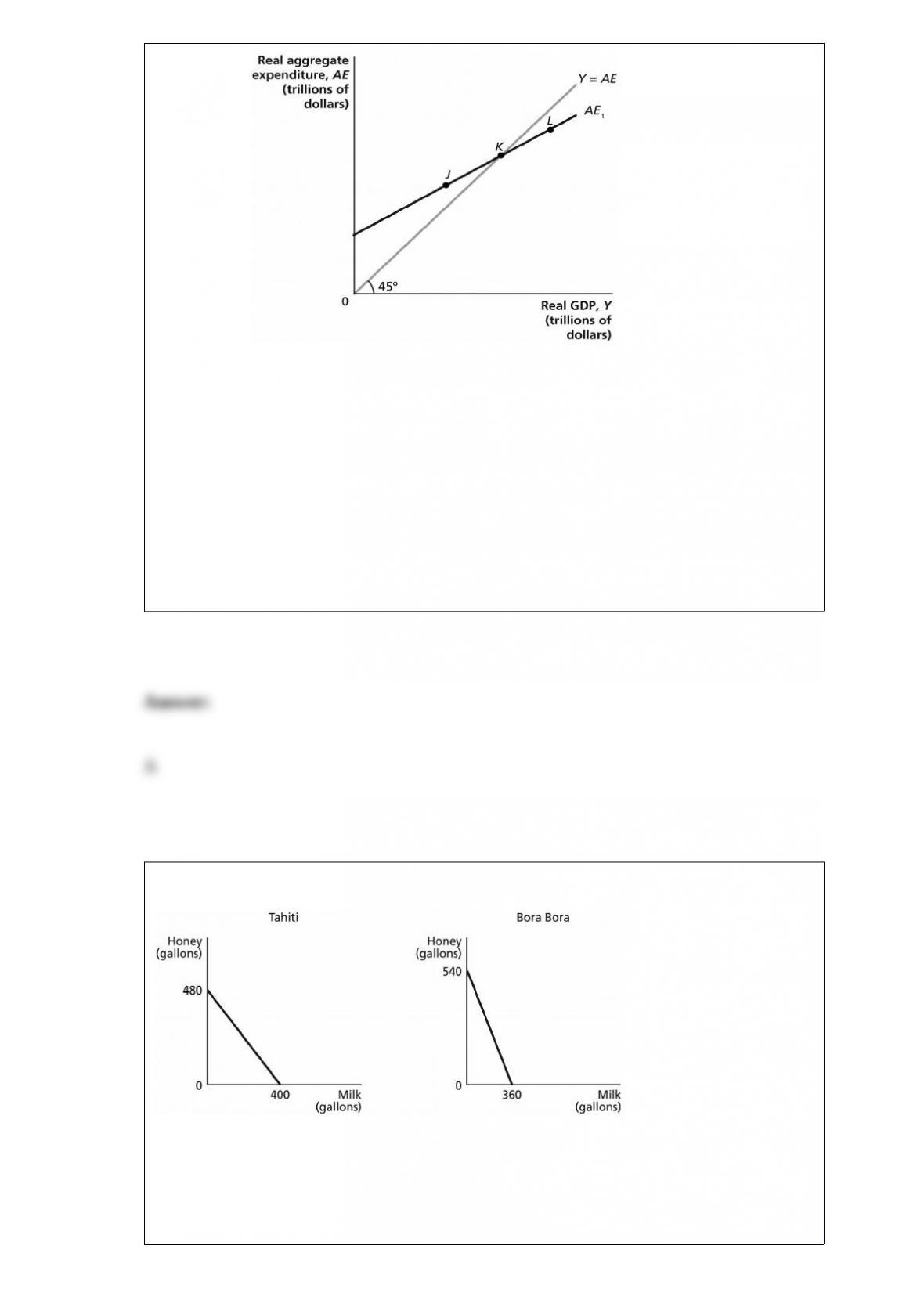
Figure 12-1
According to the figure above, at what point is aggregate expenditure greater than
GDP?
A) J
B) K
C) L
D) none of the above
Figure 2-10
Figure 2-10 shows the
production possibilities frontiers for Tahiti and Bora Bora. Each country produces two
goods, milk and honey.
What is the opportunity cost of producing one gallon of honey in Tahiti?

A) 5/6 gallon of milk
B) 0.9 gallon of milk
C) 1.2 gallons of milk
D) 1 1/3 gallons of milk
Which of the following is not part of the “regulation of health insurance” provision of
the Patient Protection and Affordable Care Act (ACA)?
A) Individuals with pre-existing medical conditions will be able to acquire health
insurance.
B) All policies must provide coverage for dependent children up to age 26.
C) Lifetime dollar maximums on coverage will be prohibited.
D) Limits on the size of deductibles and on waiting periods before coverage takes effect
will be eliminated.
A linear downward-sloping demand curve has price elasticities (in absolute values) that
A) increase as price decreases.
B) remain constant along the demand curve.
C) decrease as price decreases.
D) are greater than or equal to 1.

An increase in government purchases, ceteris paribus, will
A) increase public saving.
B) increase the supply of loanable funds.
C) reduce investment.
D) reduce real GDP.
Borrowers are ________ of loanable funds, and lenders are ________ of loanable
funds.
A) demanders; suppliers
B) suppliers; demanders
C) suppliers; suppliers
D) demanders; demanders

A supply curve shows
A) the quantities sold at different prices.
B) the marginal cost of producing one more unit of a good or service.
C) the marginal benefit from buying one more unit of a good or service.
D) the total cost of producing different quantities of a good or service.