
A decrease in the unemployment rate which is accompanied by an decrease in the
inflation rate is represented by a ________ the Phillips curve.
A) movement down
B) movement up
C) upward shift of
D) downward shift of
An American insurance company hires a call center in India to handle customer service
calls in order to cut costs. Other things equal, this will ________ of the United States.
A) decrease the financial account balance
B) decrease net exports
C) decrease the capital account balance
D) increase the current account balance
The Fed conducts open market operations with the primary goal of
A) affecting the federal funds rate.
B) affecting the discount rate.
C) stabilizing the foreign-exchange market.
D) adjusting reserve requirements.
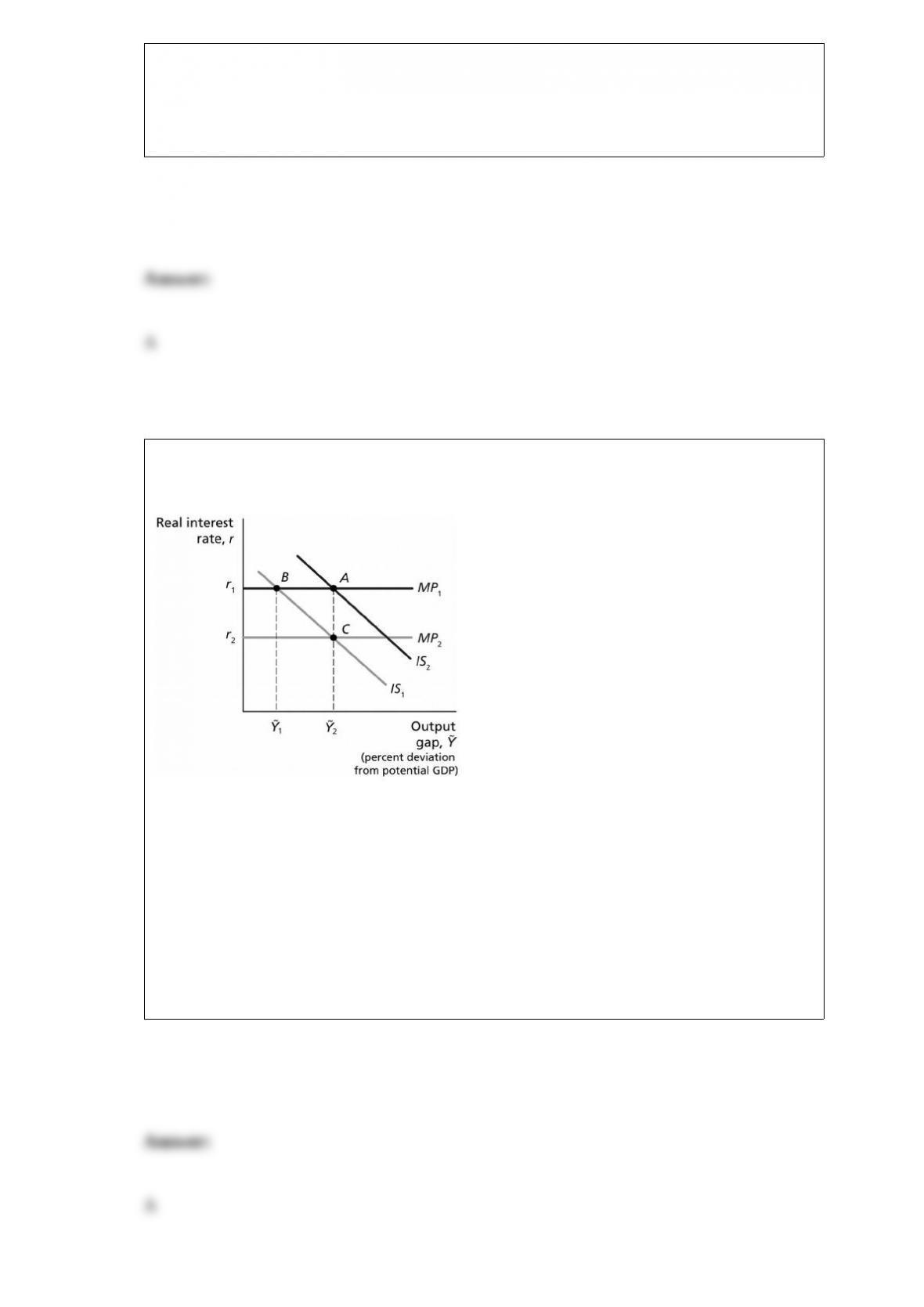
Figure 13.1
Refer to Figure 13.1. All else equal, a decrease in government purchases would best be
represented by a movement from
A) point A to point B.
B) point B to point A.
C) point B to point C.
D) point C to point B.

If cyclical unemployment is eliminated in the economy, then
A) the unemployment rate is below the natural rate of unemployment.
B) the unemployment rate is above the natural rate of unemployment.
C) the unemployment rate is equal to the natural rate of unemployment.
D) the economy must be close to entering a recession.
If households spend $0.95 of each additional dollar of increased income, the
expenditure multiplier will be
A) 1.05
B) 5
C) 20
D) 9.5
In the steady state in the Solow growth model, the economy is in equilibrium with the
capital-labor ratio and real GDP per worker ________, and with capital, labor, and real
GDP ________.
A) constant; constant

B) growing; constant
C) constant; growing
D) growing; growing
When you borrow money from a bank, your bank charges you interest on the loan to
compensate for all of the following except
A) inflation.
B) liquidity risk.
C) the risk of default.
D) the opportunity cost of other uses for the loaned money.
The Federal Reserve System (The Fed) is the ________ incarnation of a central bank in
the United States.
A) first
B) second
C) third

D) fourth
If you put $2,000 in a saving account that earns 3% interest per year, what is the
formula you should use to determine the account’s future value in one year?
A) Future value = $2,000 × 0.03.
B) Future value = $2,000 / 0.03.
C) Future value = $2,000 / (1 + 0.03).
D) Future value = $2,000 × (1 + 0.03).
Household consumption as a percentage of GDP in the United States is
A) less than that in other high-income countries.
B) greater than that in low-income countries.
C) equal to that in middle-income countries.
D) greater than the average for countries around the world.
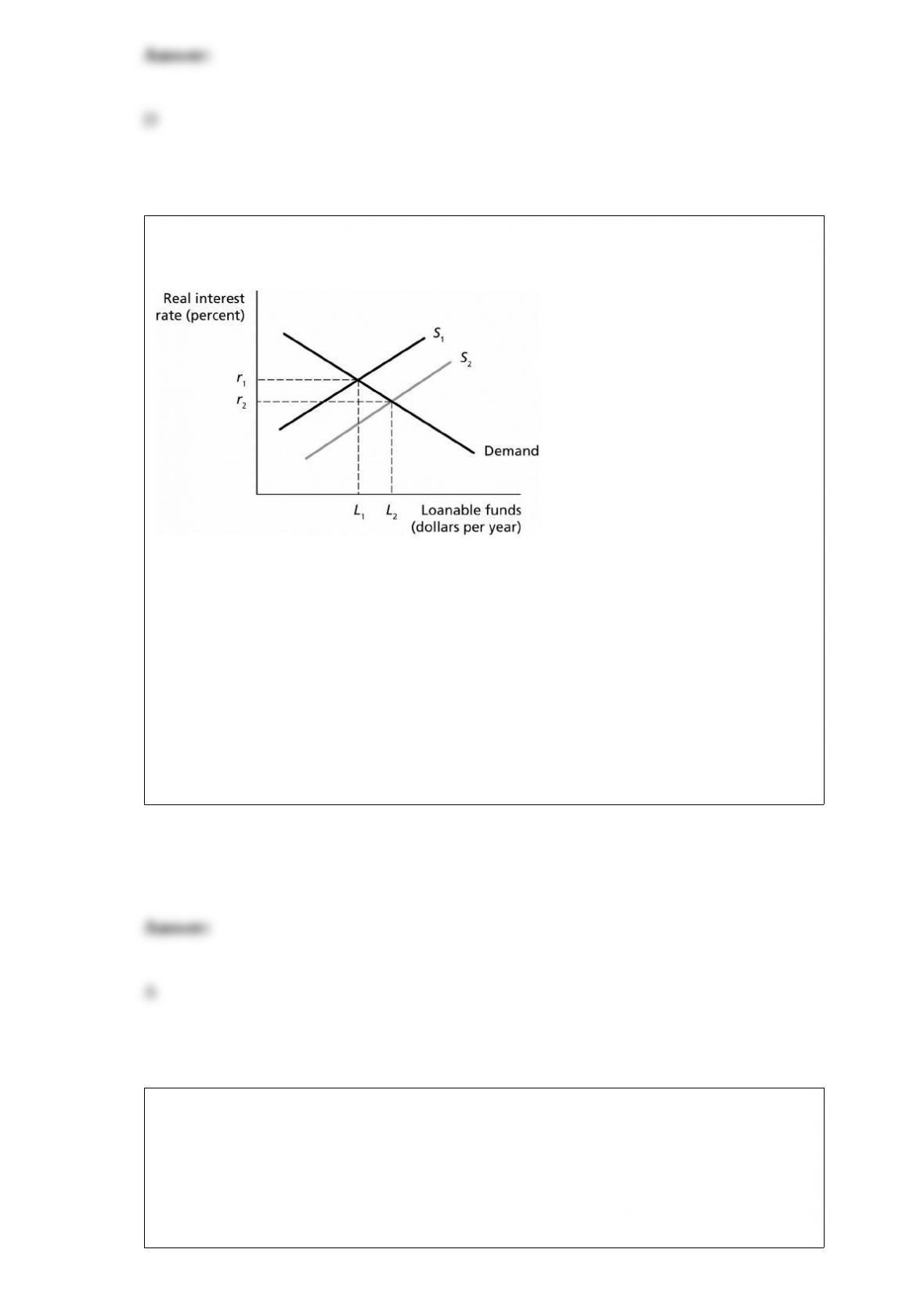
Figure 4.1
Refer to Figure 4.1. All else equal, a decrease in the government’s budget deficit will
cause
A) a shift from S1 to S2.
B) a shift from S2 to S1.
C) a change in the interest rate from r2 to r1.
D) a change in loanable funds from L2 to L1.
Under a fixed exchange rate system, an expansionary fiscal policy such as an increase
in government expenditures will lead to a(n) ________ in real GDP and a ________
inflation rate.
A) increase; higher

B) increase; lower
C) decrease; higher
D) decrease; lower
Suppose the Fed has a target inflation rate of 3%, the Fed always hits its target, and the
inflation rate has been 3% for several years. Furthermore, assume Amazon sets the price
of its Kindle Fire at $140 in 2012 and wants to keep the real price of the Kindle
constant in order to maximize profits. Now suppose that the Fed announces on January
1, 2013 that it will decrease its target rate for inflation to 1%. The profit maximizing
price for the Kindle in 2013 will be
A) $137.20.
B) $140.00.
C) $141.40.
D) $144.20.
If the Fed focuses on price stability, the aggregate demand curve will be relatively
________, which shows that aggregate expenditure is ________ to changes in the
inflation rate.
A) flat; very sensitive

B) flat; very insensitive
C) steep; very sensitive
D) steep; very insensitive
Suppose for every dollar change in household wealth, consumption expenditures
change by $0.10. If real household wealth increases by $200 billion and potential GDP
is $950 billion, what is the total change in output relative to potential for:
a. the first year, if the multiplier effect for the first year after an expenditure shock is
1.7?
b. the second year, if the multiplier effect for the second year after an expenditure shock
is 1.3?
c. the third year, if the multiplier effect for the third year after an expenditure shock is
0.9?
Suppose y = Ak1/4, the capital-labor ratio is $40,000 per worker, the level of total factor
productivity is 800, 70% of the population works, and there are 70 million workers.
Real GDP per capita is
A) $3,500.00.
B) $5,543.72.
C) $7919.60.
D) $9,899.50.
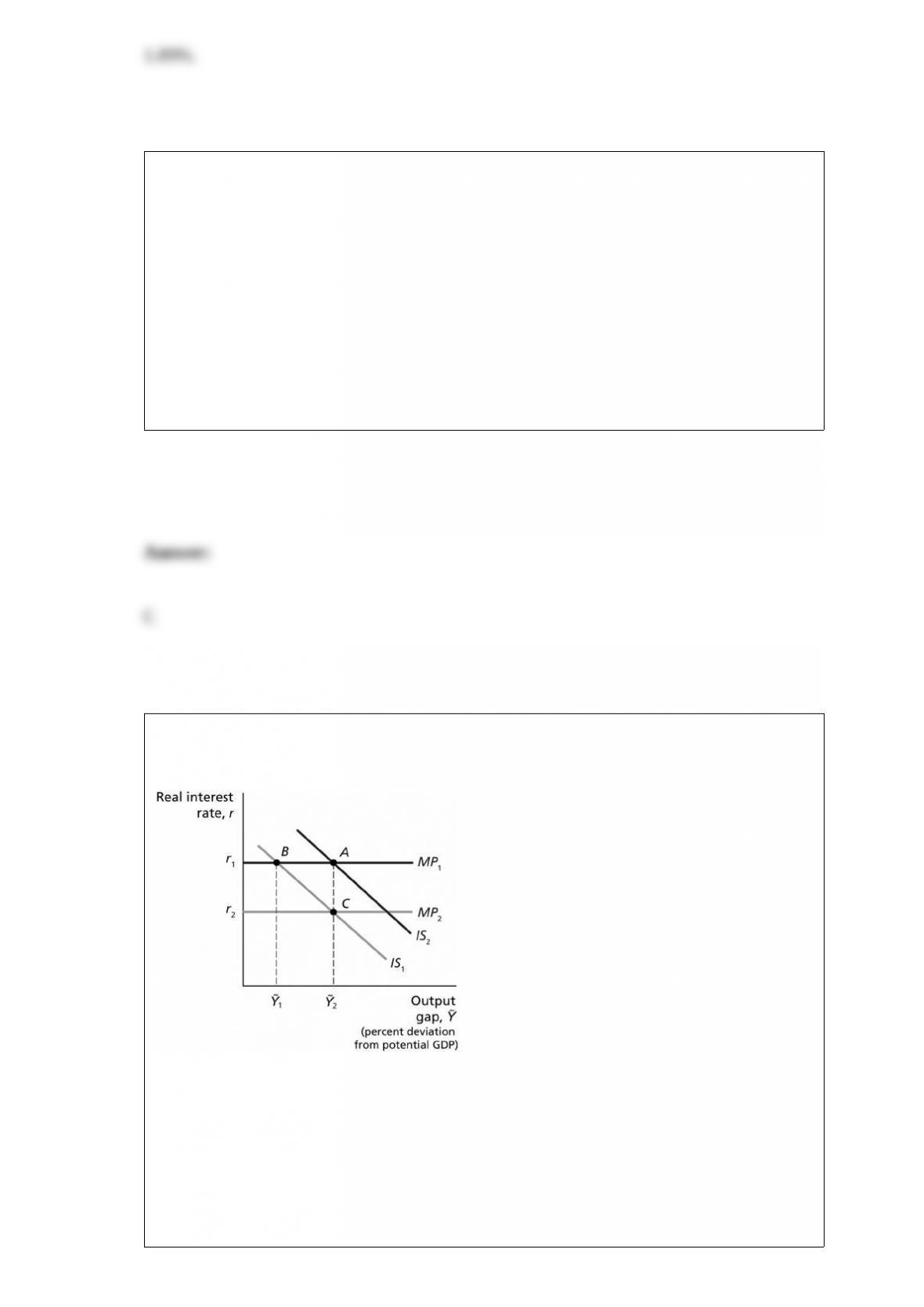
Figure 13.1
Refer to Figure 13.1. All else equal, an increase in transfer payments would best be
represented by a movement from
A) point A to point B.
B) point B to point A.
C) point B to point C.
D) point C to point B.
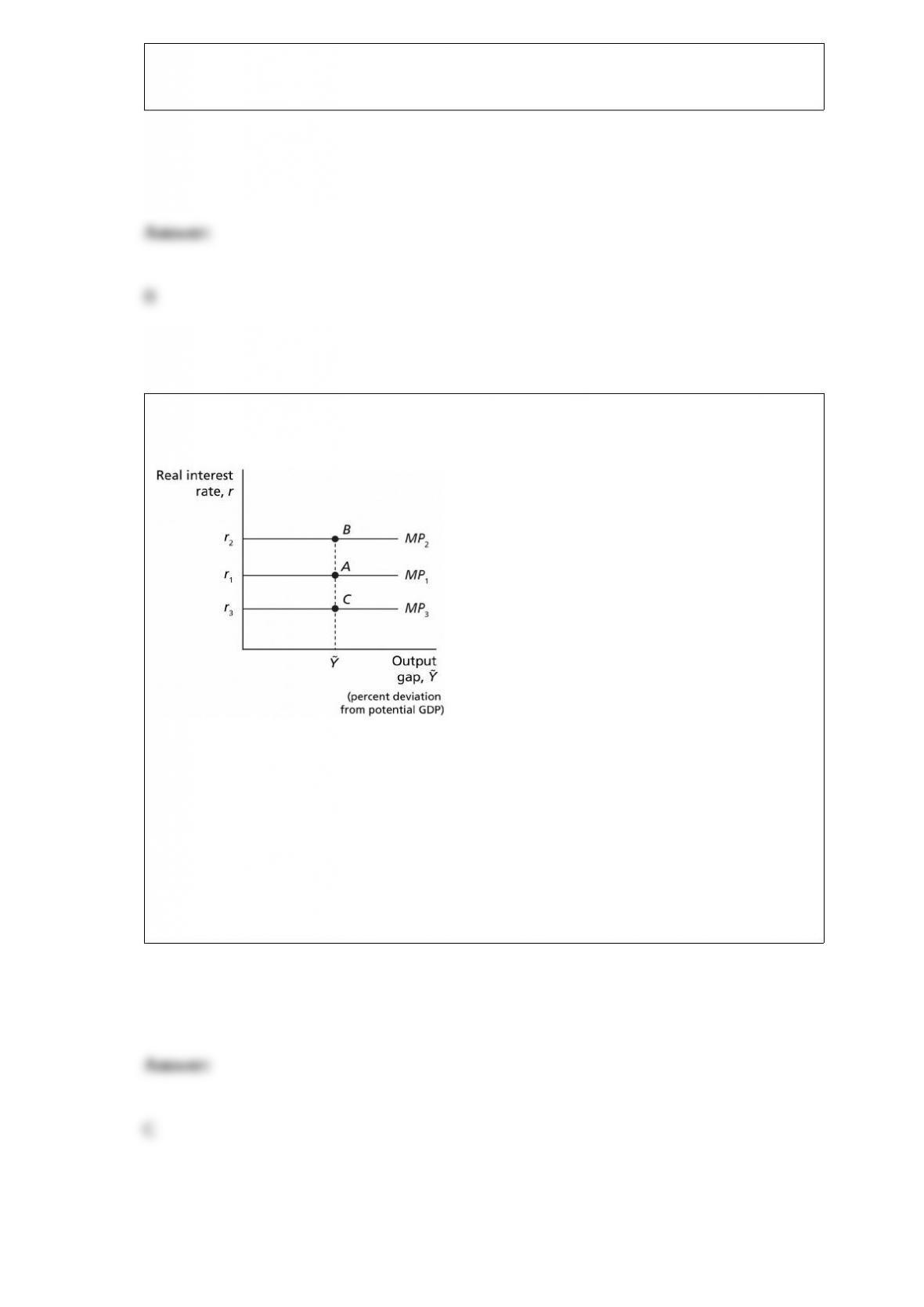
Figure 10.5
Refer to Figure 10.5. A shift from MP1 to MP3 will occur if
A) investors increase the short-term interest they expect in the future.
B) investors increase the term premium they require on long-term bonds.
C) the Fed decreases its target for the short-term nominal interest rate.
D) the expected inflation rate decreases.

With adaptive expectations, the expected inflation rate for the current year ________
the actual inflation rate for the previous year.
A) is greater than
B) is less than
C) is equal to
D) is unrelated to
Typically, as an economy begins to emerge from a recession,
A) unemployment falls immediately.
B) inflation begins to fall.
C) unemployment continues to rise.
D) investment begins to fall.
The government’s budget deficit is best represented by which of the following
equations?
A) Budget deficit = Government purchases of goods and services + Transfer payments
+ Interest payments on existing debt + Seigniorage

B) Budget deficit = Government purchases of goods and services + Transfer payments
+ Tax revenue+ Newly issued government bonds
C) Budget deficit = Government purchases of goods and services + Interest payments
on existing debt + Newly issued government bonds + Seigniorage + Transfer payments
– Tax revenue
D) Budget deficit = Government purchases of goods and services + Transfer payments –
Tax revenue + Interest payments on existing debt
If the excess reserves-to-deposit ratio decreases and the monetary base is unchanged,
the value of the money multiplier will ________ and the value of the money supply will
________
A) decline; decline
B) decline; increase
C) increase; decline
D) increase; increase
Suppose that the production function for the economy is: Y = AK1/4L3/4. Assume that
real GDP is $8,000 billion, capital stock is $32,000 billion, and the labor supply is 120
million (or 0.120 billion) workers. The value of the marginal product of capital is
________ per dollar of capital.

A) $0.0625
B) $0.133
C) $0.16
D) $1.00
If the actual inflation rate is less than the expected inflation rate, the actual real interest
rate will be ________ than the expected real interest rate. When this happens, ________
will lose and ________ will gain.
A) less; borrowers; lenders
B) less; lenders; borrowers
C) greater; borrowers; lenders
D) greater; lenders; borrowers
As the capital-labor ratio increases, real GDP per worker ________, and investment per
worker ________.
A) increases; decreases
B) decreases; increases

C) increases; increases
D) decreases; decreases
Since the late 1970s, China’s growth rate in real GDP per capita has been more than 3.5
times higher than that in the United States. Much of China’s growth is likely due to the
transition from a communist economy to a market economy. This transition is
equivalent to
A) moving China’s balanced growth path higher.
B) returning China to its original balanced growth path.
C) increasing China’s balanced growth path to a level 3.5 times greater than the
balanced growth path in the United States.
D) reducing China’s balanced growth path to compensate for the increase in real GDP
per capita.
Keynesian economics refers to the perspective that the business cycle represents
A) equilibrium.
B) disequilibrium.
C) long-run macroeconomic fluctuations.
D) short-run macroeconomic stability.
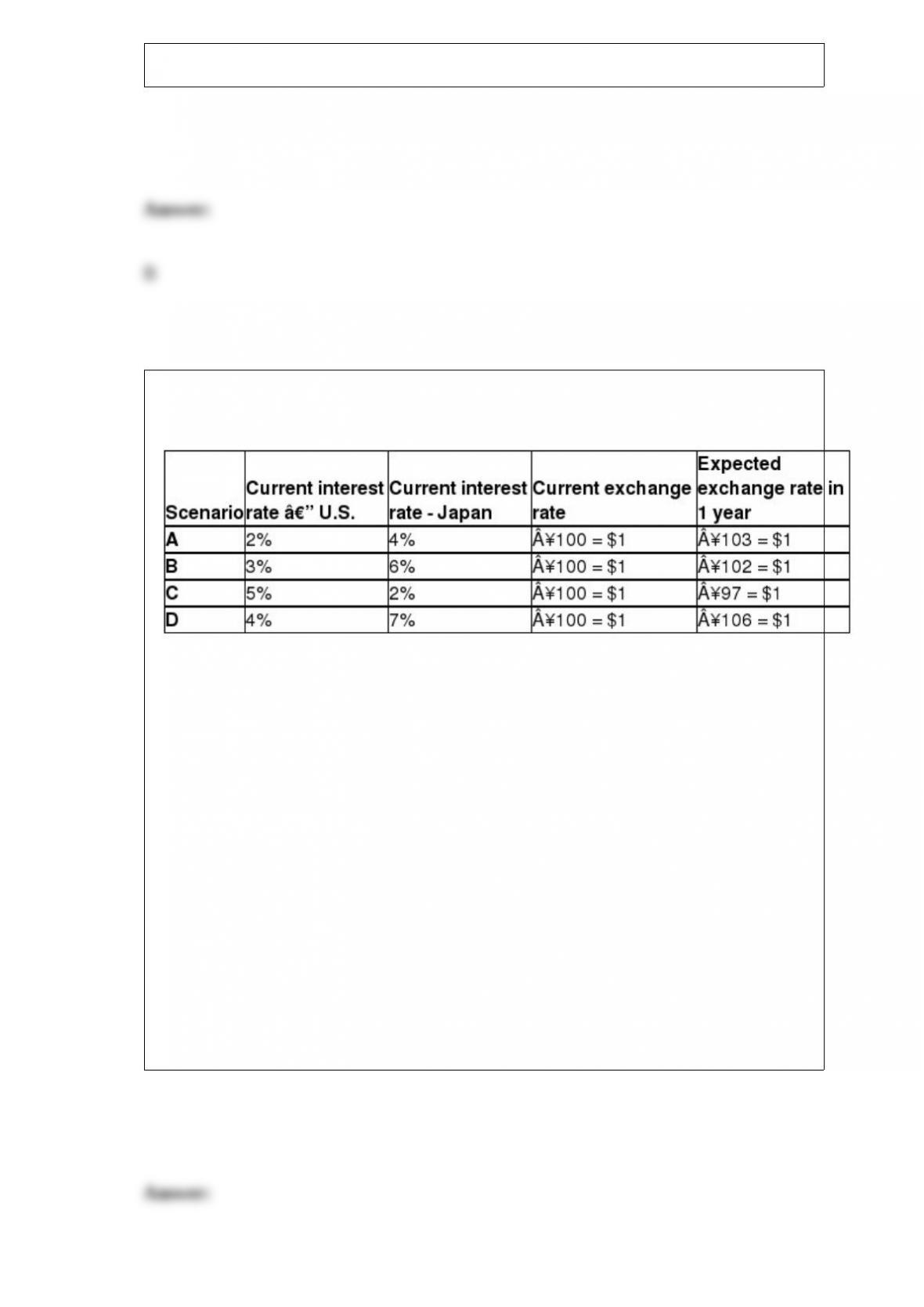
Table 4.2
Suppose that you intend to invest $10,000 in one-year government bonds. You are
looking for the highest return on your investment and do not care whether you
invest in the United States or Japan, but as U.S. resident, you want your
investment return to be in U.S. dollars. The Table lists 4 scenarios, each showing
the current interest rate for one-year government bonds in the United States and
Japan, the current exchange rate between the dollar and the yen, and the expected
exchange rate in one year. Other than the interest rates, you assume the bonds
from each country to be identical.
Refer to Table 4.2. If you choose to invest in Japanese bonds, your investment return
from Scenario D will be
A) 1%.
B) 3%.
C) 7%.
D) 13%.
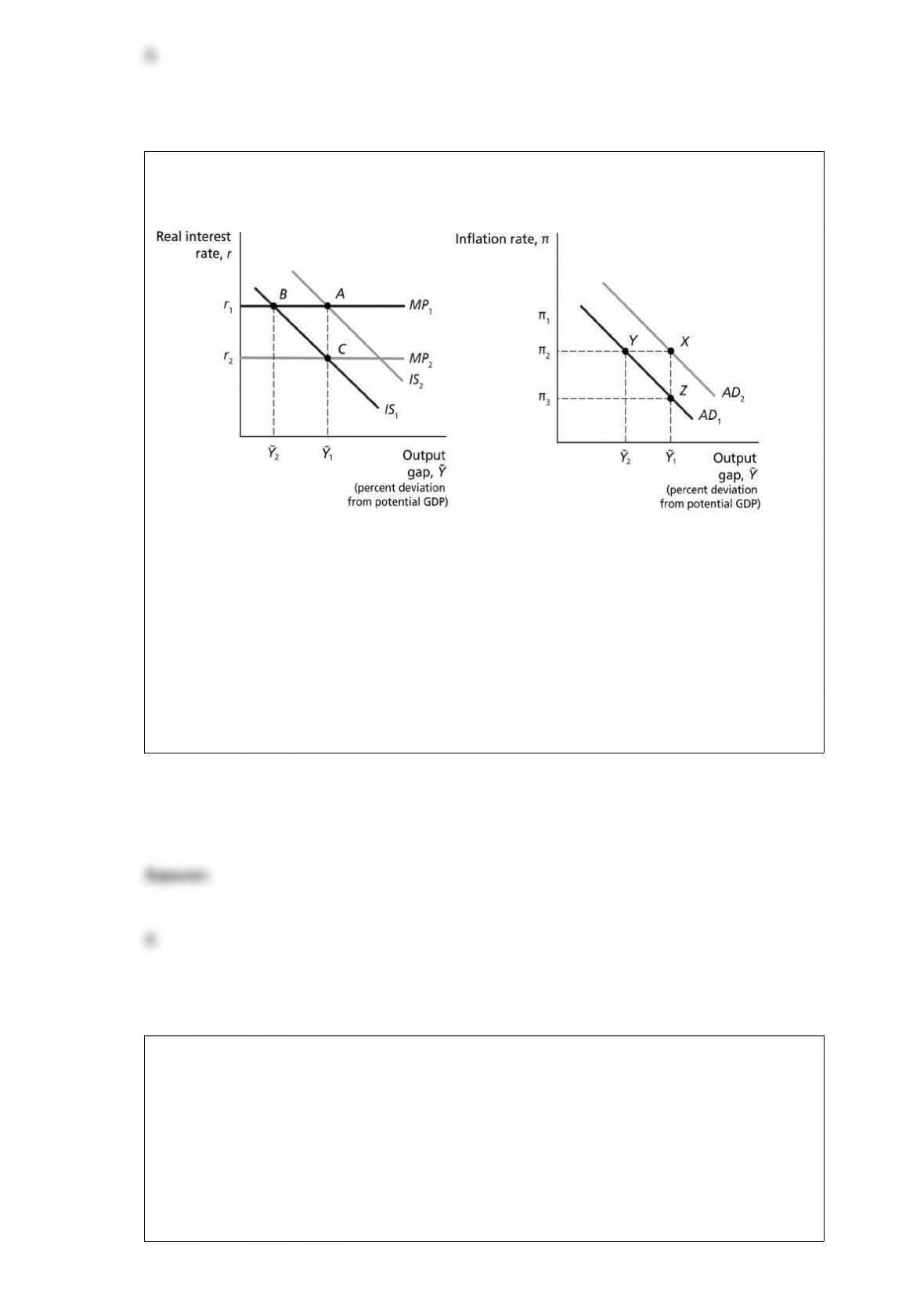
Figure 14.1
Refer to Figure 14.1. Other things equal, if the U.S. dollar increases in value relative to
other currencies, this is best represented as a movement from
A) point X to point Y.
B) point X to point Z.
C) point Y to point Z.
D) point Y to point X.
The financial market shock which occurred during the recession of 2007-2009
increased the default-risk premium, and the housing shock which occurred during the
recession of 2007-2009 reduced wealth and residential construction. These two events
would result in
A) a movement up along the Phillips curve.
B) a movement down along the Phillips curve.

C) an upward shift of the Phillips curve.
D) a downward shift of the Phillips curve.
The relationship among interest rates on bonds that are otherwise similar but that have
different maturities is known as the
A) term structure of interest rates.
B) risk structure of interest rates.
C) term premium.
D) Treasury bond coupon.
Figure 10.7
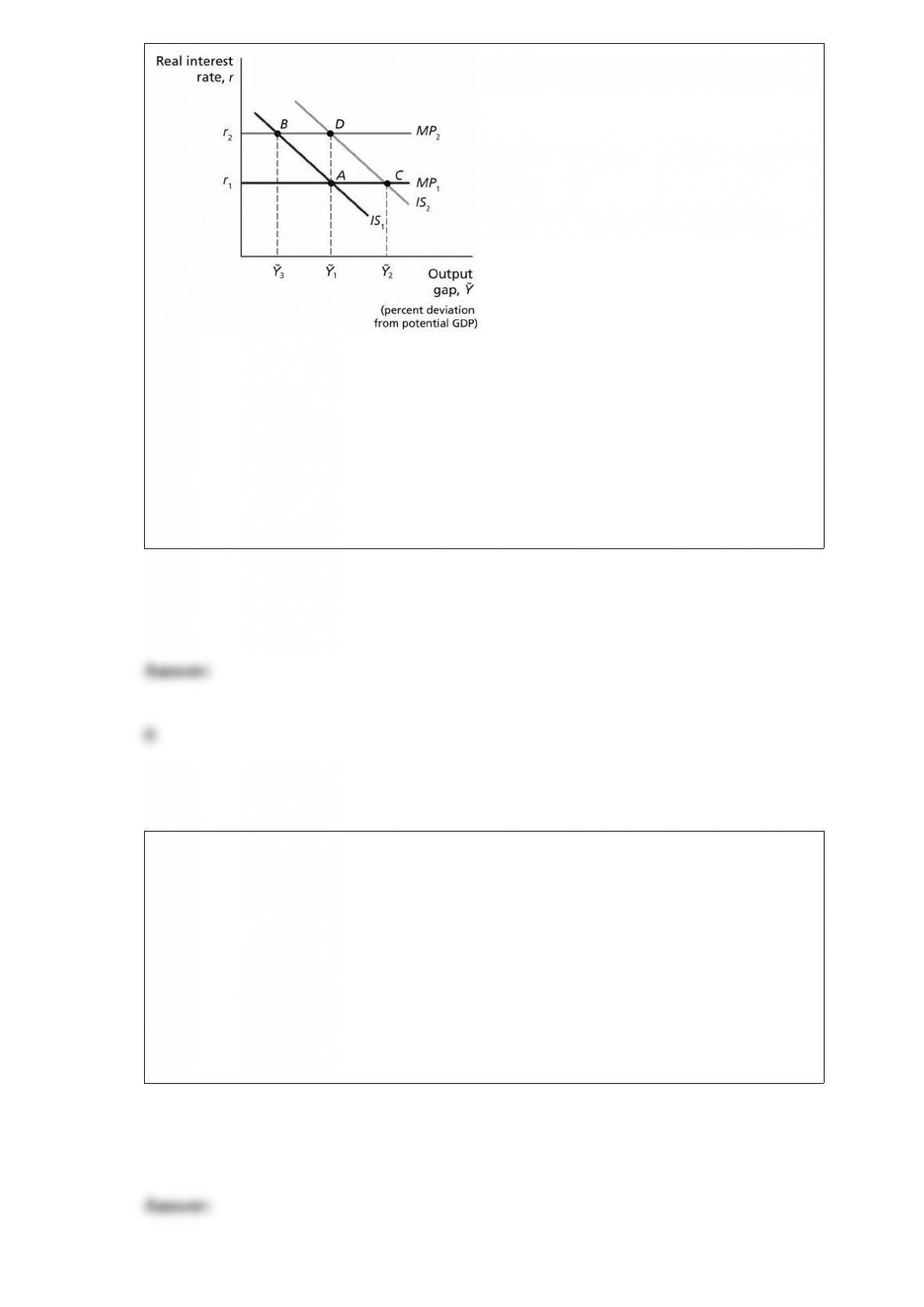
Refer to Figure 10.7. A movement from point B to point D could be caused by
A) an increase in the target interest rate.
B) an increase in consumer confidence.
C) an increase in the term structure effect.
D) a decrease in the expected rate of inflation.
A decrease in the real interest rate in the United States will cause the dollar to ________
relative to other currencies and ________ net exports and real GDP.
A) appreciate; increase
B) appreciate; reduce
C) depreciate; increase
D) depreciate; reduce

C = $40 million + 0.6(1 – 0.2)Y
I = $35 million
G = $31 million
NX = -$6 million
Based on the above data, the equilibrium level of GDP is
A) $113.6 million.
B) $192.3 million.
C) $208.3 million.
D) $833.3 million.
Explain why asymmetric information can cause the real interest rate to increase, and
why increases in the real interest rate can actually make lending more risky for financial
institutions.

What is the Phillips curve? Explain the difference in movements along the Phillips
curve and shifts in the Phillips curve, and explain what can cause these movements and
shifts.
Explain what is happening to spending on Social Security and Medicare as the U.S.
population continues to age. Why might this spending change pose problems for the
U.S. economy?

Explain how a well-functioning financial system can increase total factor productivity
and promote economic growth.
What is meant by the statement that investment projects are irreversible? How does the
idea that investment projects are irreversible affect the volatility of investment in capital
goods?

Countries with a low standard of living have low levels of total factor productivity. List
5 reasons that account for the low levels of total factor productivity.
Explain the reason why the debt-to-GDP ratio in the United States is expected to
explode between now and the year 2042.

What is the difference between nominal exchange rates and real exchange rates?
What would happen to the availability of credit if banks chose to either increase or
decrease the percentage of deposits they hold as reserves?
Explain how the standard of living of the average person in an economy can increase?

Suppose that the production function is Y = AK0.7L0.3, the number of workers equals
800, the capital stock is $150,000, and total factor productivity is 3. What is the value of
real GDP? What will happen to real GDP if total factor productivity doubles?
Explain why price and wage stickiness in the short run are reasons that macroeconomic
shocks can result in fluctuations in total employment and total production.
Explain the differences between expansionary and contractionary fiscal policies, and
list the typical actions that are used for expansionary and contractionary fiscal policies.

What two factors determine labor productivity? Explain which of the two is more
important.
Explain why GDP per capita varies among countries even though countries eventually
converge to their balanced growth paths.

How might unemployment insurance increase the efficiency of labor markets and the
economy? How might it reduce the efficiency of labor markets and the economy?
Explain what causes the three types of unemployment. What advice for finding a job
would be appropriate for someone in each type of unemployment?