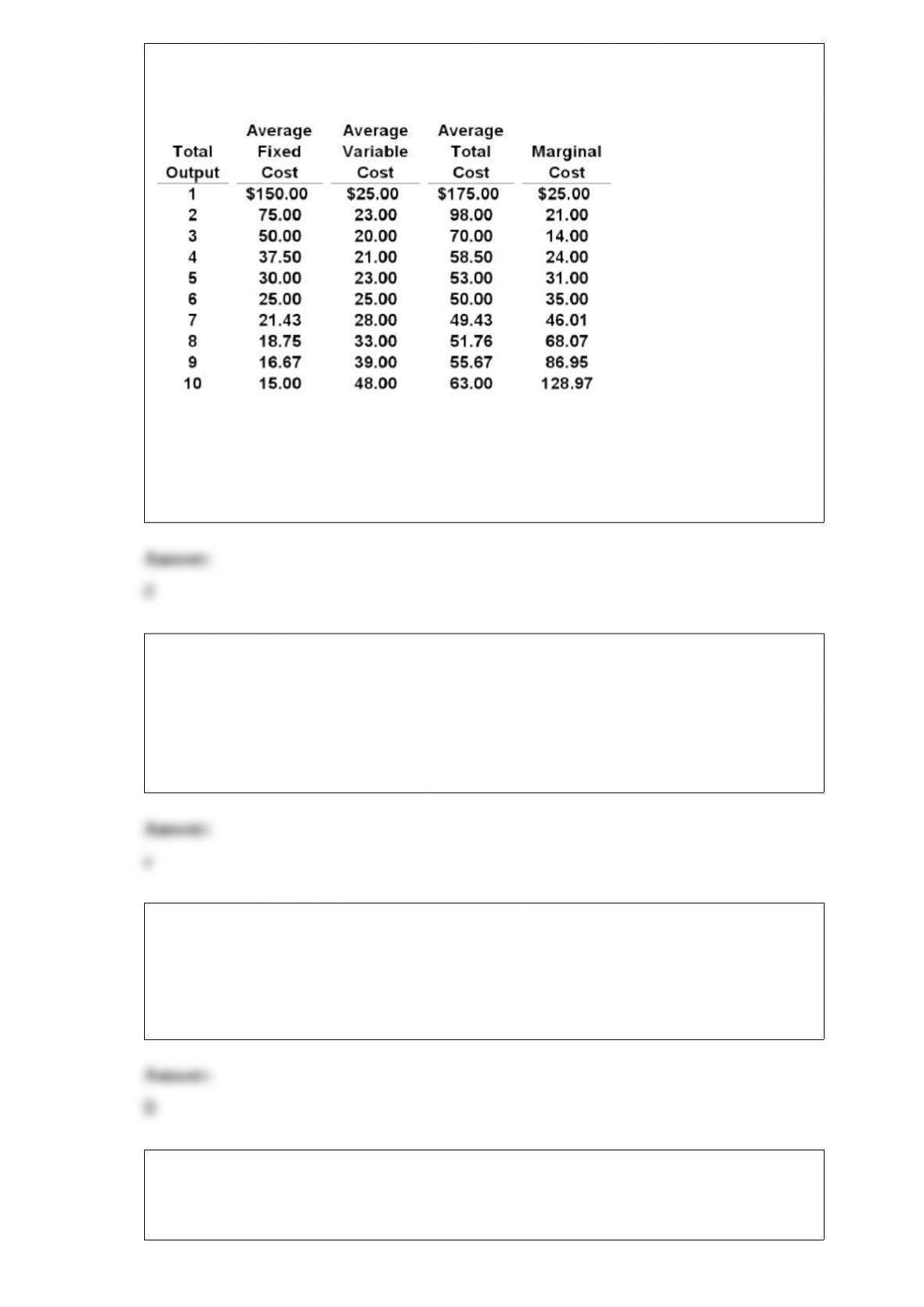
1) the following cost data for a firm that is selling in a purely competitive market.
refer to the above data. if the market price for this firm’s product is $24, it will produce:
a.4 units at a loss of $150.
b.6 units at a loss of $90.
c.3 units at an economic profit of zero.
d.4 units at a loss of $138.
2) through specialization and international trade a nation:
a.can attain some combination of goods lying outside its production possibilities curve.
b.can move from a high consumption-low investment to a high investment-low
consumption point on its production possibilities curve.
c.will attain some combination of goods lying within its production possibilities curve.
d.will cause its production possibilities curve to shift leftward.
3) Other things equal, if the required reserve ratio was lowered:
A.banks would have to reduce their lending.
B.the size of the monetary multiplier would increase.
C.the actual reserves of banks would increase.
D.the Federal funds interest rate would rise.
4) The equilibrium level of GDP in a private closed economy is where:
A.MPC = APC.
B.unemployment is about 3 percent of the labor force.
C.consumption equals saving.
D.aggregate expenditures equal GDP.
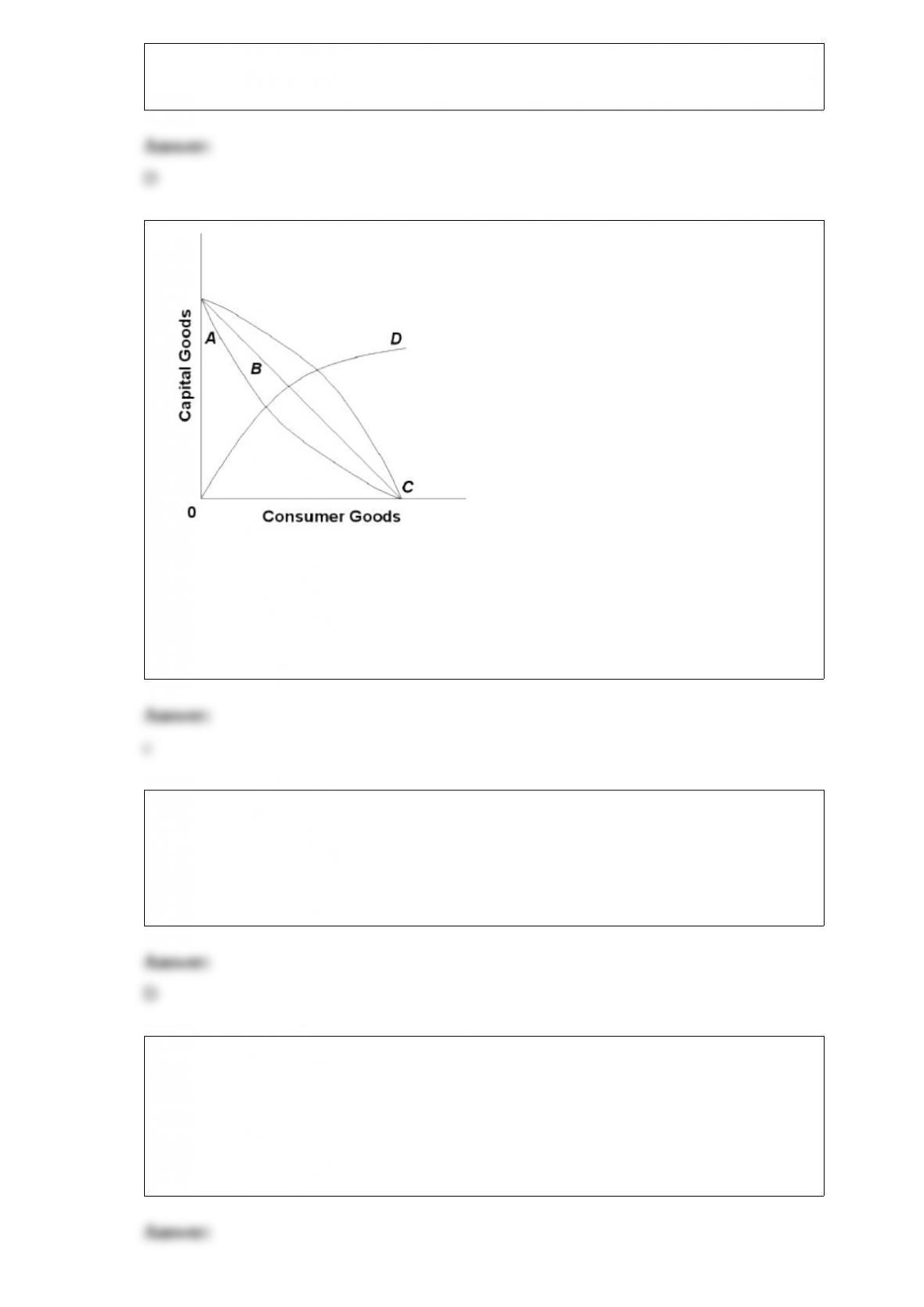
5)
refer to the above diagram. curve c
a.reflects increasing opportunity costs because the slope of the curve becomes less steep
as one moves down along the curve.
b.is a less desirable production possibilities curve for an economy than curve b.
c.is a more desirable production possibilities curve for an economy than curve a.
d.has a steeper slope throughout than curve b.
6) Modern mainstream macroeconomists agree with the monetarists that:
A.the Fed should increase the money supply at a fixed annual rate.
B.velocity is highly stable.
C.fiscal policy is largely ineffective.
D.”money matters” in the macroeconomy.
7) The Clean Air Act of 1990:
A.places taxes on utilities emitting sulfur dioxide, the major cause of acid rain.
B.sets aside billions of dollars to promote recycling.
C.allows utilities to buy and sell sulfur dioxide emission credits provided by
government.
D.places taxes on producers who emit toxic chemicals.

8) (Consider This) According to The Economist magazine, growing income inequality
is less of a concern because:
A.it is increasing at a decreasing rate.
B.the poor have increasingly better access to goods and services once only available to
the rich.
C.poverty rates have fallen below 10 percent.
D.government transfers eliminate virtually all consumption inequality.
9) illegal immigration tends to:
a.increase average wages and employment where illegal workers are complements to
domestic-born workers.
b.increase average wages and employment where illegal workers are substitutes for
domestic-born workers.
c.increase average wages and employment whether illegal workers are complements to
or substitutes for domestic-born workers.
d.reduce average wages and employment whether illegal workers are complements to
or substitutes for domestic-born workers.
10) Describe the change in aggregate supply that should result from each of the
following changes in determinants. Assume that nothing else is changing besides the
identified change. (Use Decrease or Increase.) (a) A rise in the average price of inputs;
(b) An increase in worker productivity; (c) Government antipollution regulations
become stricter; (d) A new subsidy program is enacted for new business investment in
productive equipment; (e) Energy prices decline.
11) In the 1990s:
A.direct private investment to the DVCs increased and government-provided foreign
aid decreased.
B.both direct private investment and government-provided foreign aid to the DVCs
increased.
C.both direct private investment and government-provided foreign aid to the DVCs
decreased.
D.direct private investment to the DVCs decreased and government-provided foreign
aid increased.
12) Give examples of the stickiness of prices based on the average number of months
between price changes for selected goods and services.
13) Give the three categories which comprise gross investment and explain the
difference between them.
14) How are producer and consumer surpluses maximized in a competitive market?
15) How do expectations about the future by households and businesses affect the
effectiveness of fiscal policy? Cite examples.
16) Is the public debt a burden on future generations? Explain.
17) Suppose that real interest rates increase. What would be the likely effect on
household consumption and saving?
18) Explain the effect of a discretionary cut in taxes of $40 billion on the economy
when the economys marginal propensity to consume is .75. How does this discretionary
fiscal policy differ from a discretionary increase in government spending of $40 billion?
19) Give a definition of technological advance. What role does time play in the
definition according to economists?
20) Why might many R&D expenditures be affordable, but not worthwhile? Are
outcomes from R&D guaranteed?