
If the substitution effect of a wage increase dominates the income effect, the labor
supply curve has a positive slope.
Answer:
Expansionary monetary policy lowers interest rates and forces a real appreciation of the
dollar in international currency markets.
Answer:
If there is public dissaving, investment spending in the economy will decline, holding
everything else constant.
Answer:
Adverse selection is a situation in which one party to an economic transaction has less
information than the other party.
Answer:

If the marginal propensity to save is 0.35, the multiplier is 2.86.
Answer:
Productive efficiency does not hold for a profit-maximizing, monopolistically
competitive firm in the long-run equilibrium because the firm operates along the
diseconomies-of-scale region of its average total cost curve.
Answer:
A shortage is defined as the situation that exists when the quantity of a good supplied is
greater than the quantity demanded.
Answer:
A firm’s short-run average total cost curve is parallel to its short-run average variable
cost curve.
Answer:

The Social Security and Medicare programs have been a failure in terms of reducing
poverty among elderly U.S. citizens.
Answer:
Disposable personal income is equal to personal income minus personal tax payments.
Answer:
The term “market” refers only to trading arrangements that have been approved by the
government.
Answer:
The government makes all economic decisions in a centrally planned economy.
Answer:

Advertising is the action of a firm that is intended to maintain the differentiation of its
product over time.
Answer:
A majority of people in the United States have private health insurance.
Answer:
An increase in the number of firms in a market will cause the quantity of a good
supplied to increase.
Answer:
Which of the following would increase GNP in the United States?
A) an increase in the production of U.S.-owned General Motors cars made in Mexico
B) an increase in the production of Japanese-owned Toyota cars in Mexico

C) an increase in the production of Japanese-owned Toyota cars in the U.S.
D) an increase in the production of Mexican-owned Grupo Minsa corn in the U.S.
Answer:
Economic efficiency in a competitive market is achieved when
A) economic surplus is equal to consumer surplus.
B) consumers and producers are satisfied.
C) the marginal benefit equals the marginal cost from the last unit sold.
D) producer surplus equals the total amount firms receive from consumers minus the
cost of production.
Answer:
Table 9-2
Sarita and Gabriel own S&G Bakery. Table 9-2 lists the number of pies and cakes Sarita
and Gabriel can each bake in one day. Select the statement that accurately interprets the
data in the table.
A) Sarita has a greater opportunity cost than Gabriel for baking cakes.
B) Sarita’s opportunity cost for baking cakes is less than Gabriel’s.
C) Gabriel has a greater opportunity cost than Sarita for baking pies.
D) Gabriel’s opportunity cost for baking cakes and baking pies are both greater than
Sarita’s.
Answer:
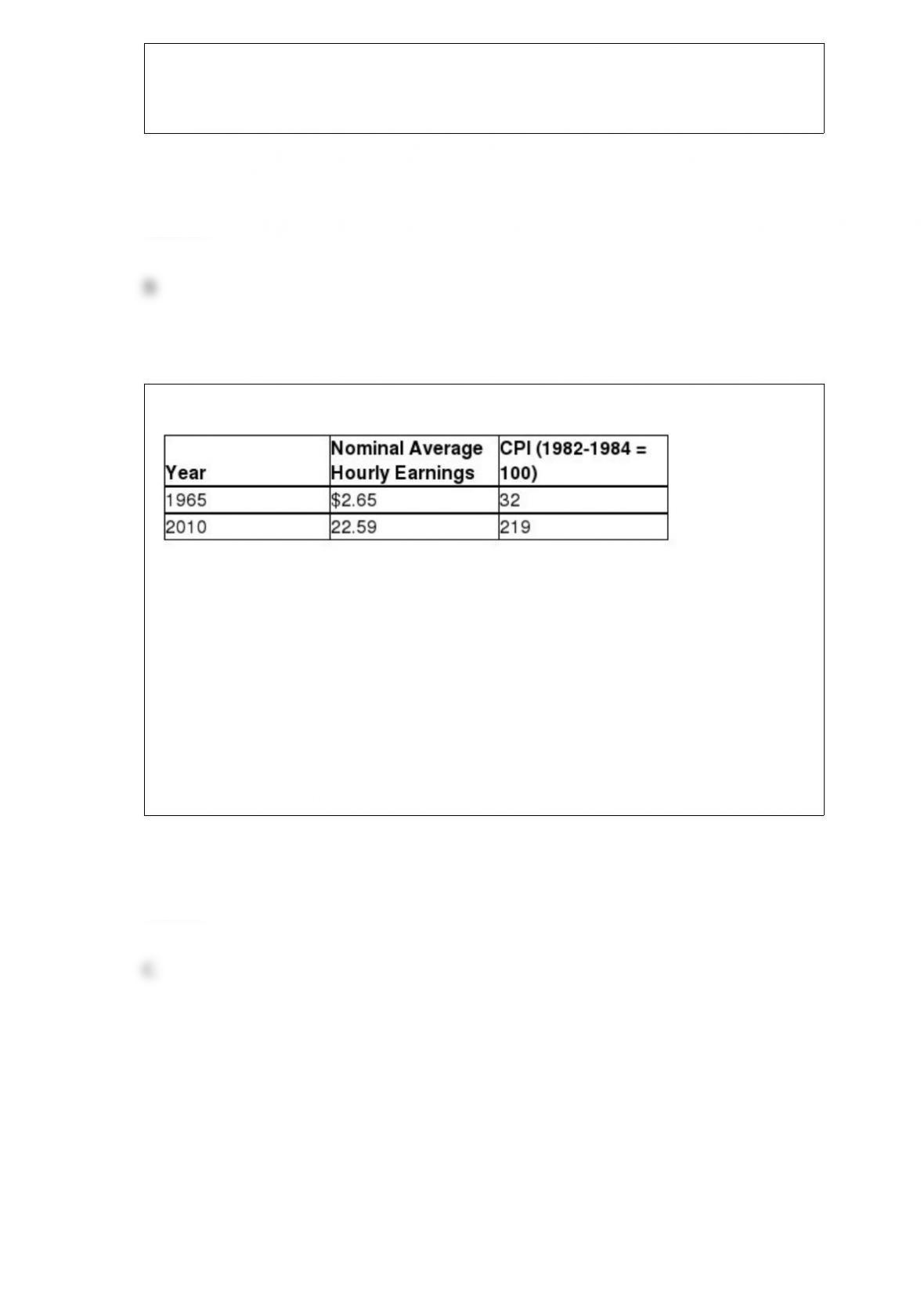
Table 20-14
The table above reports the nominal average hourly earnings in private industry and the
consumer price index for 1965 and 2010. The percentage change in real average
earnings from 1965 to 2010 equals
A) 2.0 percent.
B) 19.7 percent.
C) 24.5 percent.
D) 80.3 percent.
Answer:
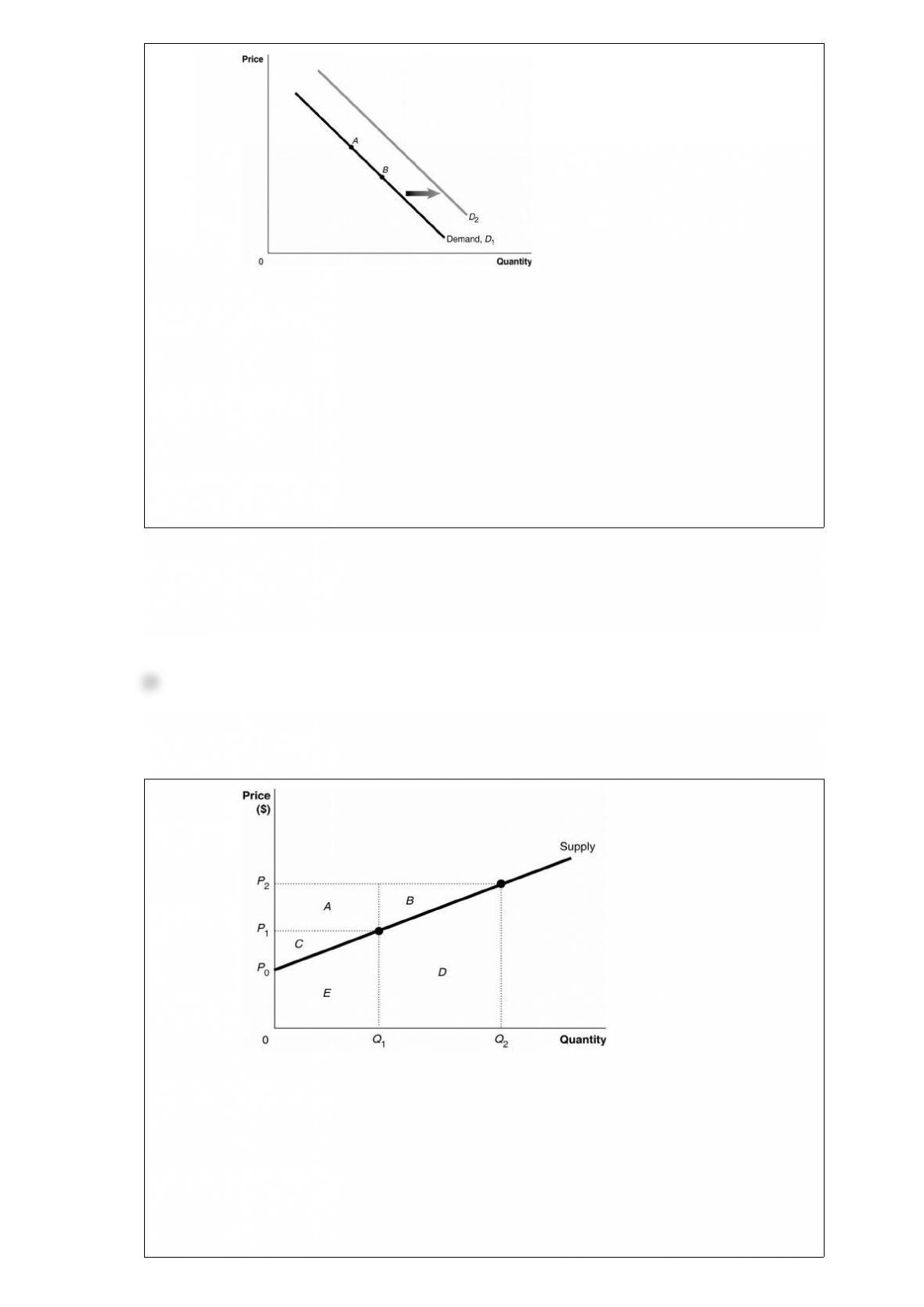
Figure 3-1
A decrease in taste or preference would be represented by a movement from
A) A to B.
B) B to A.
C) D1 to D2.
D) D2 to D1.
Answer:
Figure 4-2
What area represents producer surplus at a price of P1?
A) C
B) A + C
C) C + E
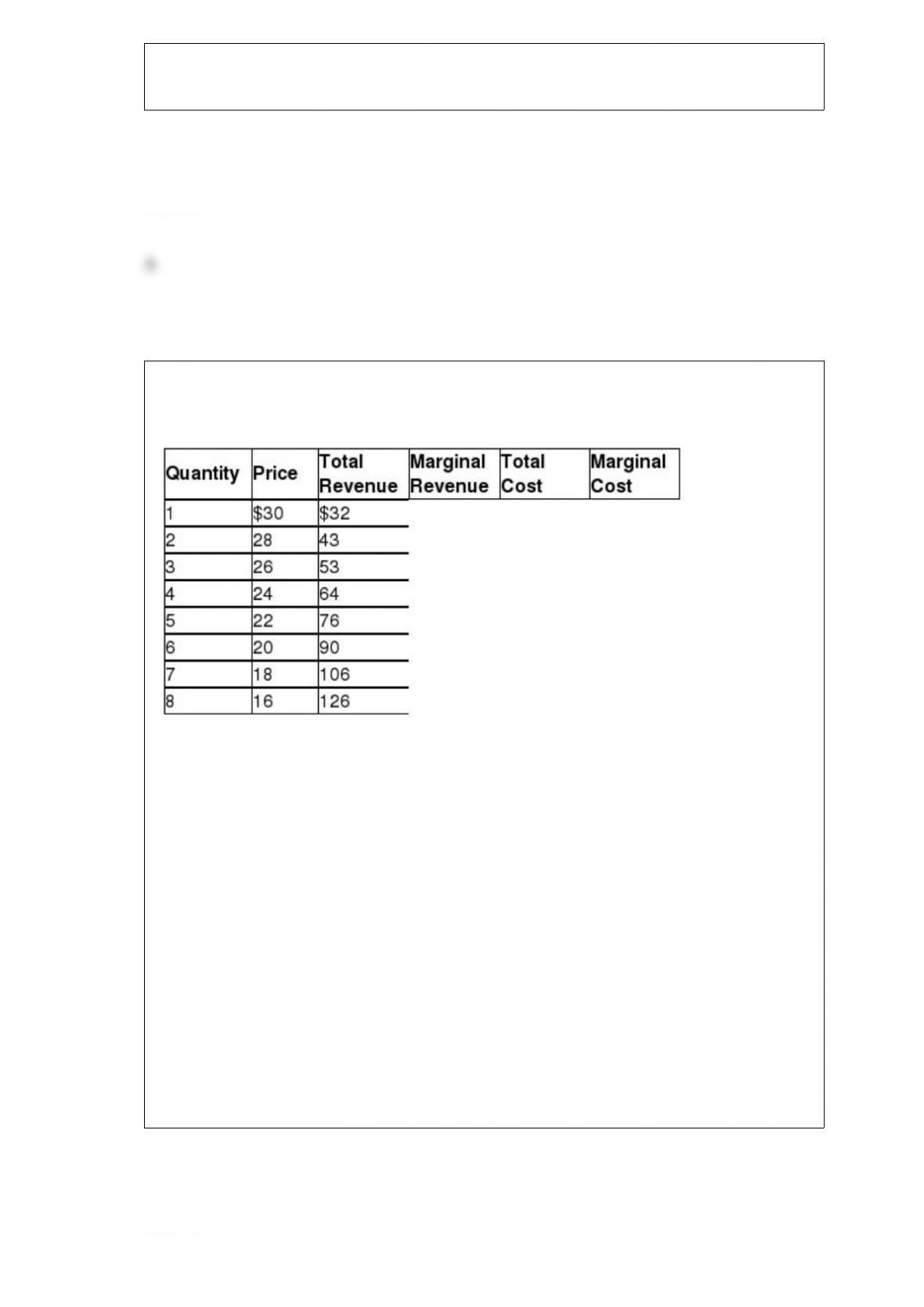
D) A + C + E
Answer:
The table below shows the demand and cost data facing “Velvet Touches,” a
monopolistically competitive producer of velvet throw pillows.
Use the data to answer the following questions.
a. Complete the Total Revenue (TR), Marginal Revenue (MR) and Marginal Cost (MC)
columns above.
b. What are the profit-maximizing price and quantity for Velvet Touches?
c. Is the firm making a profit or a loss? How much is the profit or loss? Show your
work.
d. Is this firm operating in the long run or in the short run? Explain your answer.
e. If the firm’s profit or loss is typical of all firms in the market for throw pillows, what
is likely to happen in the future? Will there be more firms or will some existing firms
leave the industry? Explain your answer.
f. What will happen to the typical firm’s profit or loss after all entry/exit adjustments?
Answer:
A merger between the Ford Motor Company and General Motors would be an example
of a
A) vertical merger.
B) horizontal merger.
C) conglomerate merger.
D) trust.
Answer:
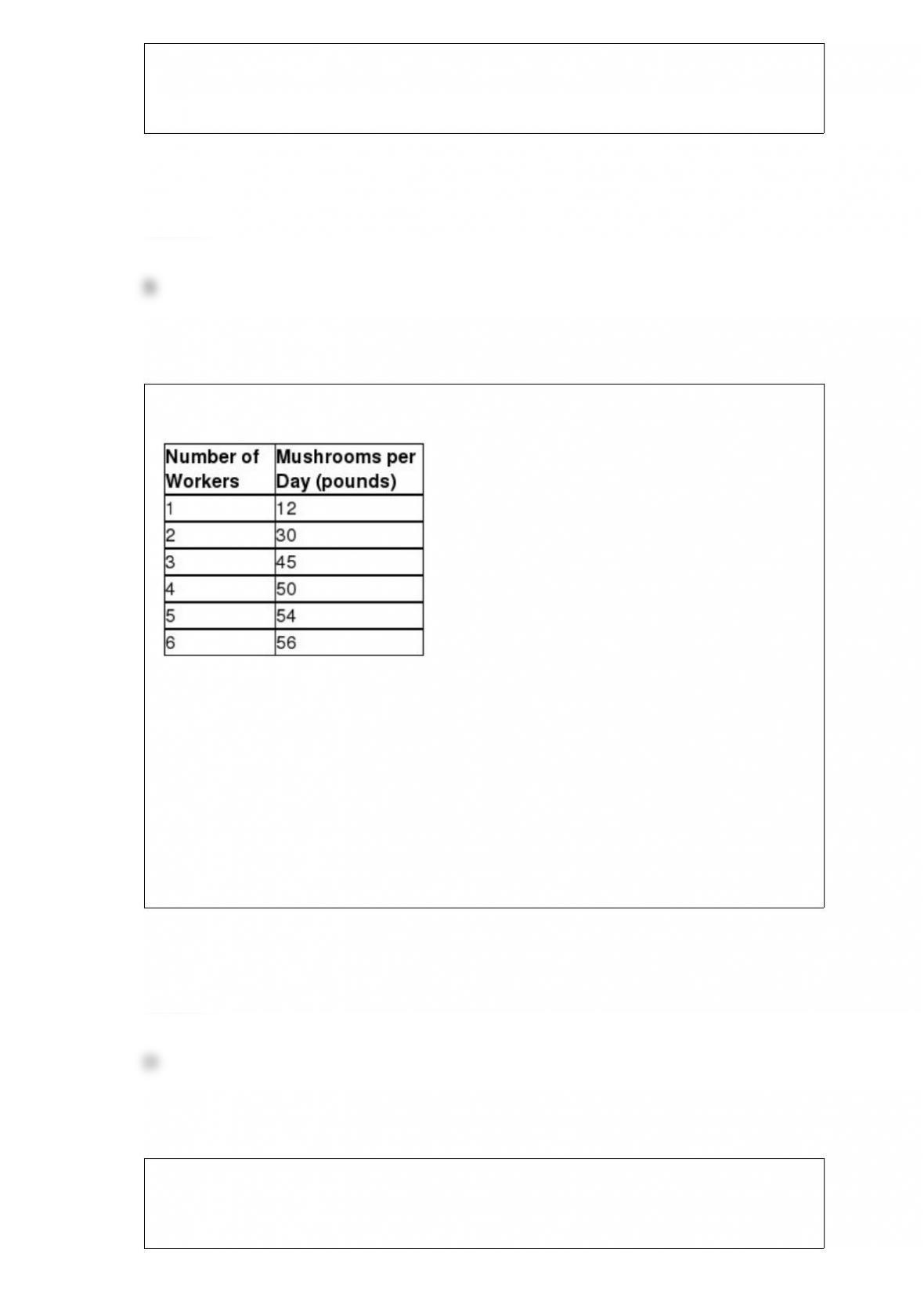
Table 11-1
Table 11-1 shows the technology of production at the Matsuko’s Mushroom Farm for
the month of May. What is the marginal product of the 4th worker?
A) 137 pounds
B) 50 pounds
C) 12.5 pounds
D) 5 pounds
Answer:
A study by Price Fishback and Shawn Kantor of the University of Arizona shows that
after the passage of workers’ compensation laws, wages received by workers in the coal
and lumber industries fell.

Source: Price V. Fishback and Shawn Everett Kantor, “Did Workers Pay for the
Passage of Workers’ Compensation Laws?” Quarterly Journal of Economics, Vol.
100, No. 3, August 1995, pp. 713-742. Which of the following could explain why
passage of workers’ compensation laws led to a fall in wages in some industries?
A) The passage of the workers’ compensation laws made it more expensive for firms to
employ workers, thus reducing the demand for workers.
B) The passage of the workers’ compensation laws allowed employers in hazardous
industries to reduce compensating differentials which, in turn, reduce wages.
C) Employers reduced wages to partially offset the cost of having to purchase insurance
that would compensate workers for injuries suffered on the job.
D) The supply of labor in these hazardous industries increased following the passage of
the workers’ compensation laws because jobs in these industries now pose less risk.
Answer:
Which of the following statements is true about profit?
A) Profit refers to the revenue received from the sale of a quantity of goods.
B) Profit is calculated by multiplying price and quantity sold.
C) The terms “accounting profit” and “economic profit” can be used interchangeably.
D) Profit is the difference between revenue and cost.
Answer:
When aggregate expenditure is less than GDP, which of the following is true?
A) There was an unplanned increase in inventories.
B) Firms spent more on capital goods than they anticipated.
C) Households bought more new homes than they anticipated.
D) All of the above must be true when aggregate expenditure is less than GDP.
Answer:
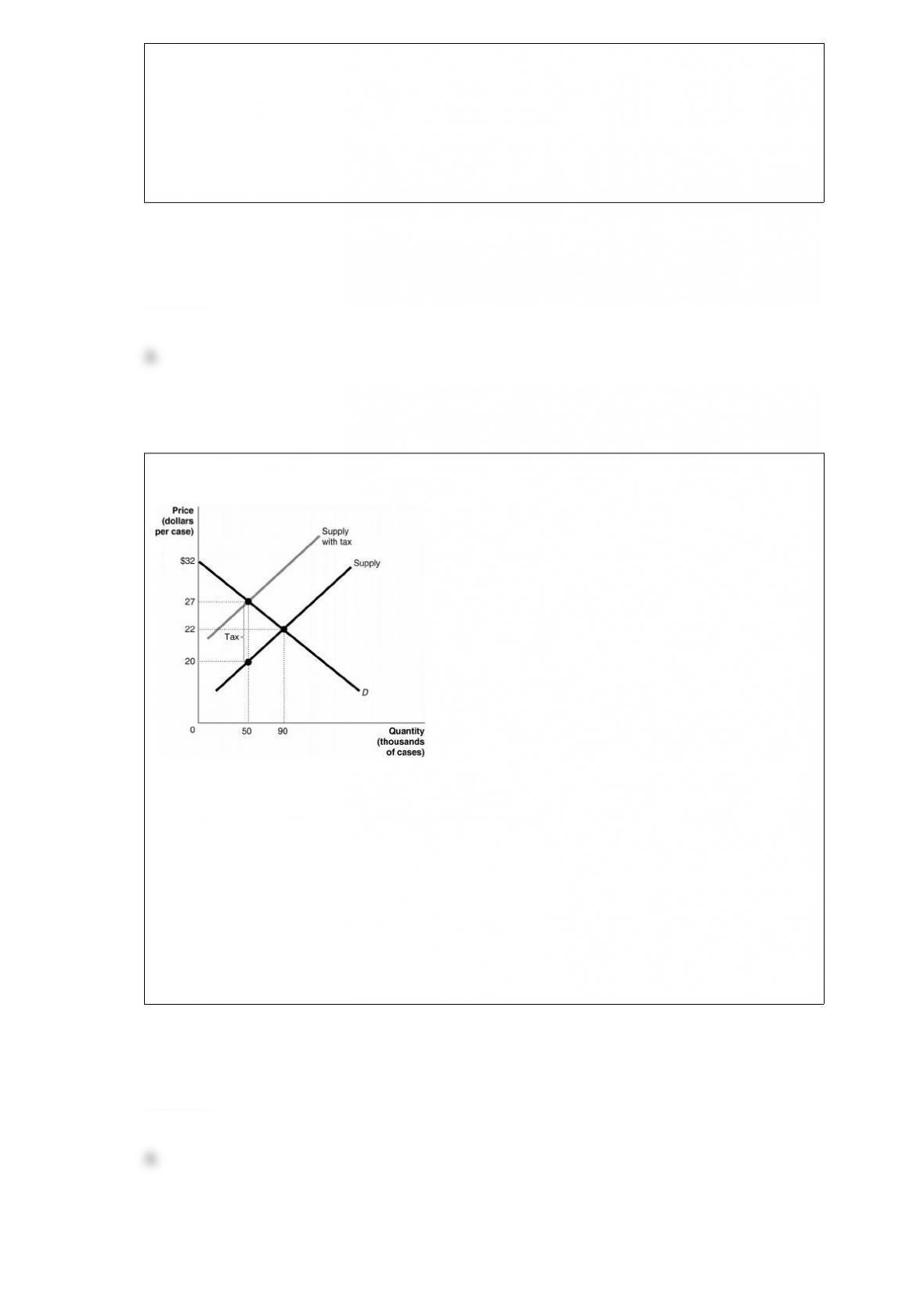
Figure 4-8
Figure 4-8 shows the market for beer. The
government plans to impose a unit tax in this market. As a result of the tax, is there a
loss in consumer surplus?
A) Yes, because consumers paying a price above the economically efficient price.
B) No, because the producer pays the tax.
C) No, because the market reaches a new equilibrium
D) No, because consumers are charged a lower price to cover their tax burden.
Answer:

List three different price indices and explain how they differ in terms of the market
basket on which they are based.
Answer:
Trade-offs force society to make choices when answering what three fundamental
questions?
Answer:
Arnold’s Airport Transport provides passenger transportation to and from the local
airport. Arnold charges a flat rate of $30 per person for round-trip service, and he gives
a $5 discount to senior citizens. Assume Arnold’s marginal cost is $3.00 per person.
Draw two graphs, one showing demand and marginal cost for his $30 customers, of
which he has 300 per month, and the other graph showing demand and marginal cost
for his senior citizen customers, of which he has 100 per month. If Arnold charged all of
his customers $30, he would have 325 customers per month.

Answer:
What is equity, and how does it differ from efficiency?
Answer:
What is the connection between the gold held at the Fort Knox Bullion Depository in
Kentucky and the U.S. money supply?
Answer:

Why are foreign investors more likely to invest in U.S. government bonds than in U.S.
corporate stocks and bonds?
Answer:
Cole was discussing the market for cocoa beans with his friend John Schmidt. Cole
said, “Ever since Venezuela announced that its cocoa harvest was its lowest ever in
fifteen years, the price of cocoa beans has been rising and rising and people are buying
more and more. I think the demand for cocoa beans must be upward sloping.” Is Cole
right? Briefly explain why or why not.
Answer: