In market economies, income distribution is always going to be completely equitable.
Answer:
The median voter theorem states that the outcome of a majority vote is likely to
represent the preferences of the voter who is in the political middle.
Answer:
If a country is producing efficiently and is on the production possibilities frontier, the
only way to produce more of one good is with an advance in technology.
Answer:
A college must decide if it wants to offer more adult literacy classes. This decision
involves answering the economic question of “for whom to produce.”
Answer:

The saving and investment equation holds only when the federal budget is balanced.
Answer:
The social cost of a good or service is the cost borne by the producer.
Answer:
The price elasticity of demand for Kellogg’s Raisin Bran is larger in absolute value than
the price elasticity for all breakfast cereals.
Answer:
The ability of a firm or country to produce a good or service at a lower opportunity cost
than other producers is called comparative advantage.
Answer:
The larger the MPS, the smaller the value of the multiplier.
Answer:
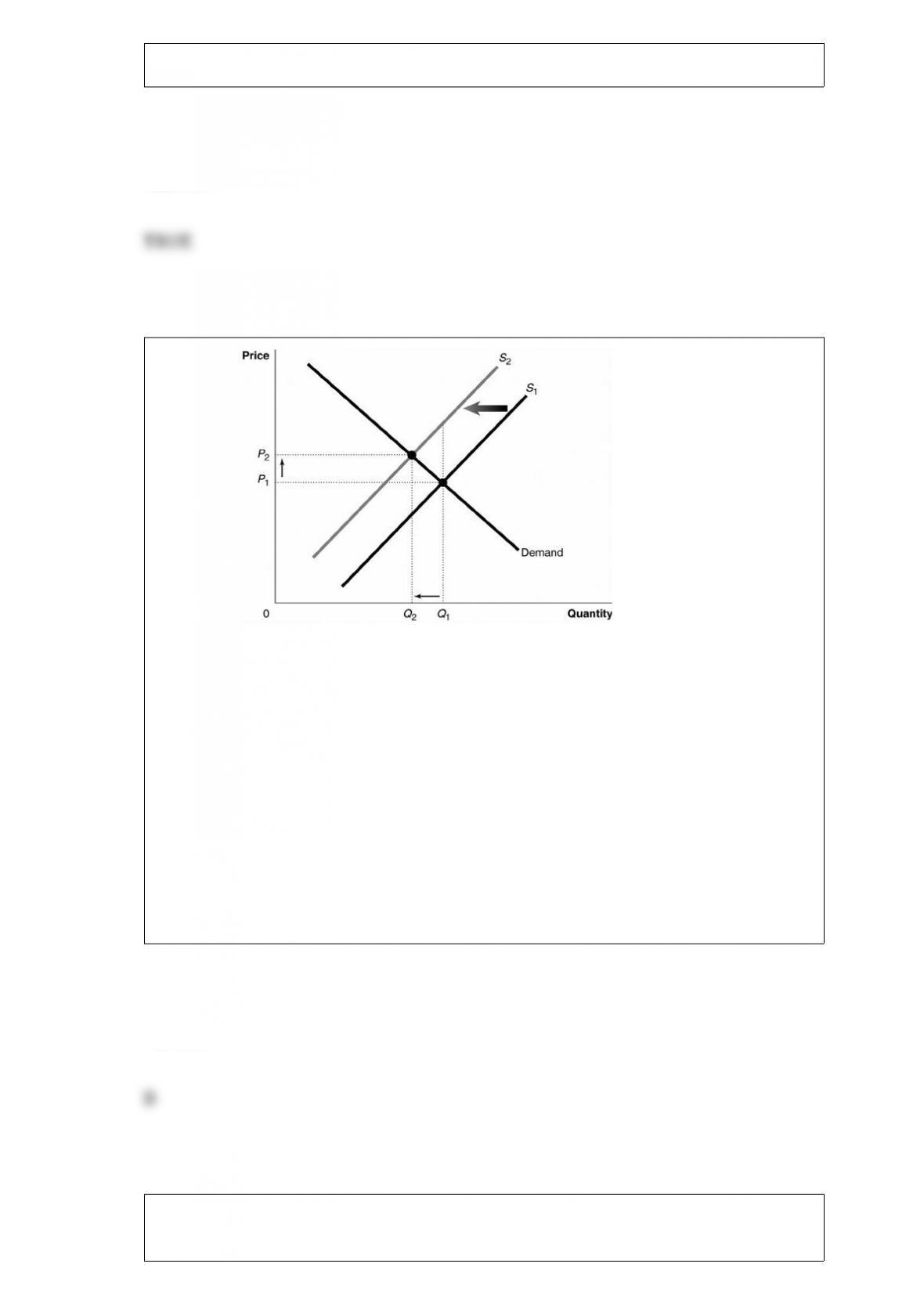
Figure 5-1 Figure 5-1 shows a
market with an externality. The current market equilibrium output of Q1 is not the
economically efficient output. The economically efficient output is Q2. If, because of an
externality, the economically efficient output is Q2 and not the current equilibrium
output of Q1, what does S2 represent?
A) the market supply curve reflecting private cost
B) the market supply curve reflecting social cost
C) the market supply curve reflecting external cost
D) the market supply curve reflecting implicit cost
Answer:
Knowledge capital is

A) rival.
B) nonrival.
C) nonexcludable.
D) both B and C
Answer:
The provision of the Patient Protection and Affordable Care Act (ACA) Insurance
companies are required to participate in a high-risk pool that will insure individuals
with pre-existing medical conditions who have been unable to buy health insurance for
at least six months is the ________ provision.
A) employer mandate
B) state health exchanges
C) individual mandate
D) regulation of health insurance
Answer:
Hurricane Katrina damaged a large portion of oil refining and pipeline capacity in the
Gulf coast states. In the market for gasoline,
A) the supply curve shifted to the left resulting in an increase in the equilibrium price.
B) the supply curve shifted to the right resulting in an increase in the equilibrium price.
C) the demand curve shifted to the left resulting in a decrease in the equilibrium price.
D) the demand curve shifted to the right resulting in an increase in the equilibrium
price.
Answer:
When a monopolistically competitive firm cuts its price to increase its sales, it
experiences a gain in revenue due to the
A) substitution effect.
B) income effect.
C) price effect.
D) output effect.
Answer:
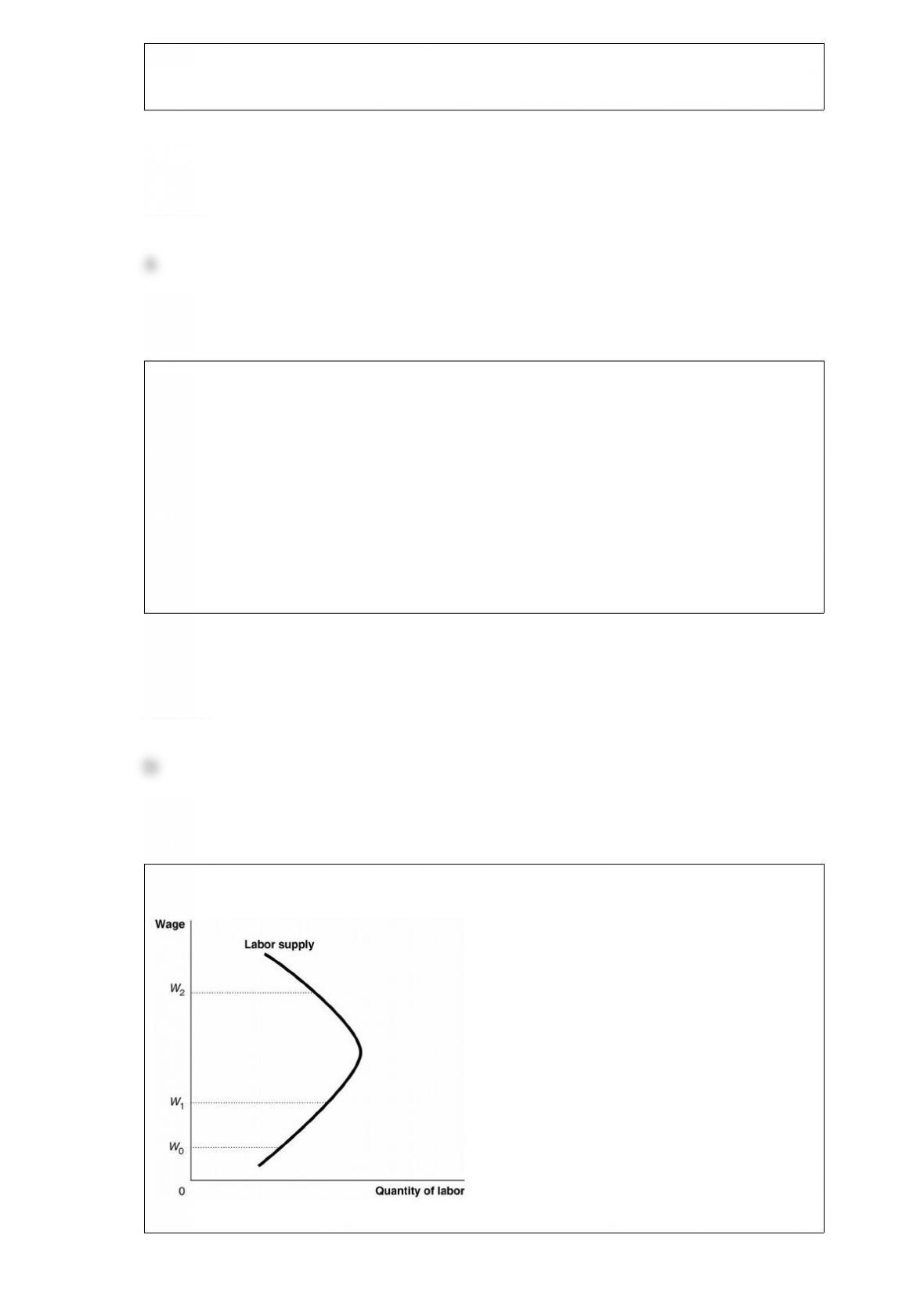
Figure 17-4

Which of the following is true at W2?
A) The income effect is larger than the substitution effect.
B) The substitution effect is larger than the income effect.
C) The income effect and the substitution effect are equal.
D) The supply curve is positively sloped.
Answer:
Competition among sellers generates
A) productive efficiency.
B) allocative efficiency.
C) equity.
D) scarcity.
Answer:
If an increase in income leads to an decrease in the demand for salami, then salami is
A) an inferior good.
B) a neutral good.
C) a necessity.
D) a normal good.

Answer:
Anyone can purchase sulfur dioxide emissions allowances on the Chicago Mercantile
Exchange. Several environmental groups have raised money to buy allowances (which
they subsequently destroy). As part of their fund-raising, these groups have urged
contributors to buy the allowances as gifts. As one newspaper story put it, “For the
environmentalist in your life, here’s a gift that is sold by the ton, fits in an envelope and
will last forever.”
Source for quote: Randall Edwards, “Dear Santa: Please Bring Me Sulfur Dioxide for
Christmas,” Columbus Dispatch, December 19, 1999. What would be the impact on the
price of the emission allowances in the market?
A) The price rises.
B) The price falls to zero.
C) The price falls but not to zero.
D) The price remains unchanged because the allowances purchased by the
environmental groups are destroyed.
Answer:
Refer to Table 9-1. Select the statement that accurately interprets the data in the table.
A) Sandy has a comparative advantage in dog grooming.
B) Linda has a comparative advantage in dog grooming.
C) Linda has a comparative advantage in dog grooming and dog bathing.
D) Sandy has a comparative advantage in dog bathing.

Answer:
If the U.S. dollar increases in value relative to other currencies, how does this affect the
aggregate demand curve?
A) This will move the economy up along a stationary aggregate demand curve.
B) This will move the economy down along a stationary aggregate demand curve.
C) This will shift the aggregate demand curve to the left.
D) This will shift the aggregate demand curve to the right.
Answer:
Net worth is
A) a measure of a firm’s profits.
B) part of stockholders’ equity.
C) the difference between a firm’s assets and liabilities.
D) listed on the asset side of a firm’s balance sheet.
Answer:
Higher isocost lines correspond to higher

A) profits.
B) total costs of production.
C) input prices.
D) sales revenue.
Answer:
The processes used to produce goods and services describes
A) innovation.
B) entrepreneurship.
C) technology.
D) capital.
Answer:
Which of the following is an implicit cost of production?
A) interest paid on a loan to a bank
B) wages paid to labor plus the cost of carrying benefits for workers
C) the utility bill paid to water, electricity, and natural gas companies
D) rent that could have been earned on a building owned and used by the firm
Answer:
Suppose the total cost of producing 40,000 flash drives is $120,000, and the fixed cost
is $30,000.
a. What is the variable cost?
b. When output is 40,000, what are the average variable cost and the average fixed cost?
c. Assuming the cost curves have the usual shape, is the dollar difference between the
average total cost and the average variable cost greater when the output is 40,000 flash
drives or when the output is 60,000 flash drives? Explain.
Answer:
What is technology and what factors does it depend on?
Answer:
Does the saving and investment equation imply that a country’s national saving must
always equal its domestic investment? Explain.
Answer:
Suppose the current price of oil is $90 a barrel and the quantity supplied is 800 million
barrels per day. If the price elasticity of supply for oil in the short run is estimated at
0.5, use the midpoint formula to calculate the percentage change in quantity supplied
when the price of oil rises to $98 a barrel.
Answer:
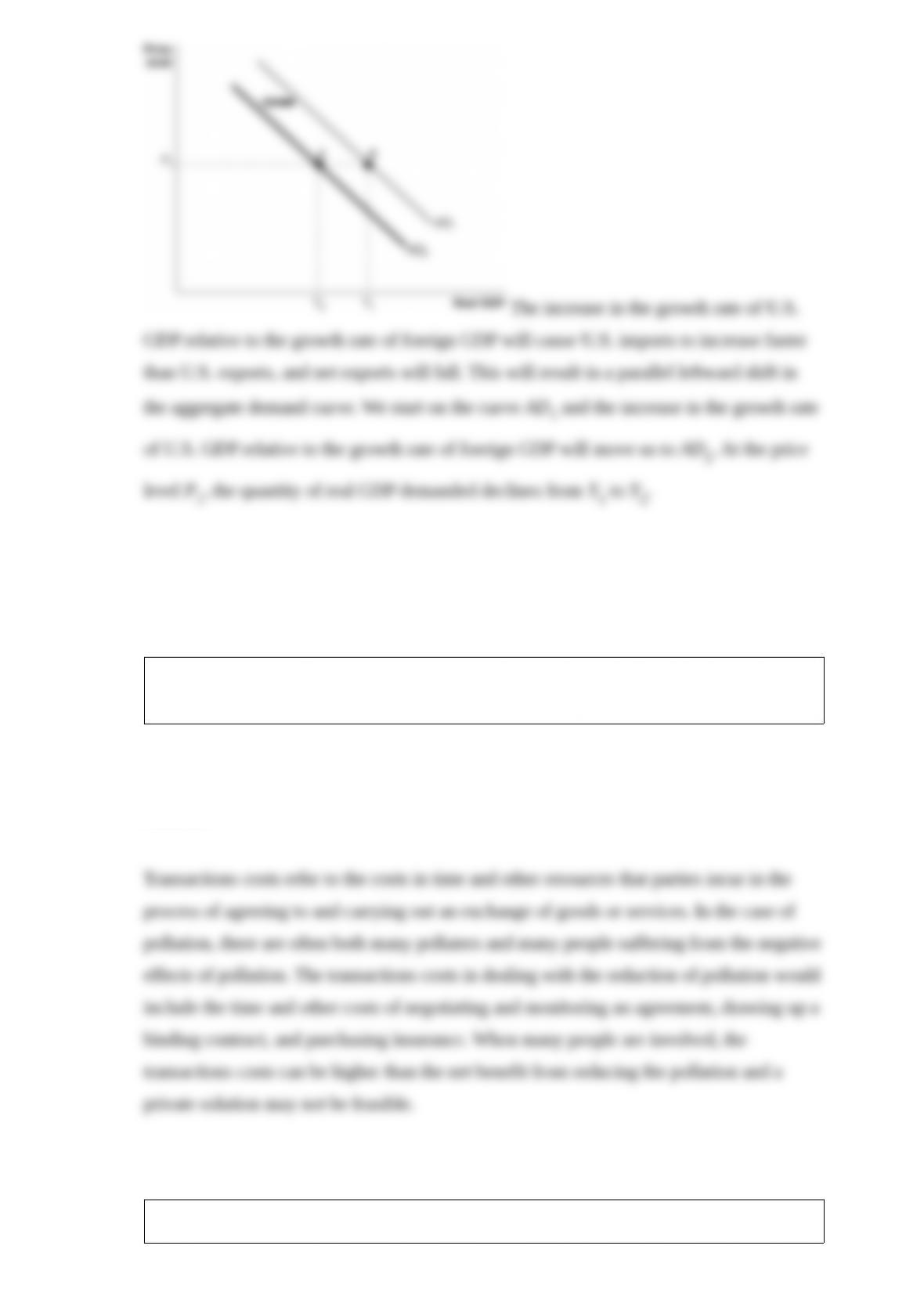
Using an aggregate demand graph, illustrate the impact of an increase in the growth rate
of U.S. GDP relative to the growth rate of foreign GDP.
Answer:
What are transactions costs? Why do transactions costs create difficulties in finding a
private solution to the problem of pollution?
Answer:
Table 8-23 2007 2013
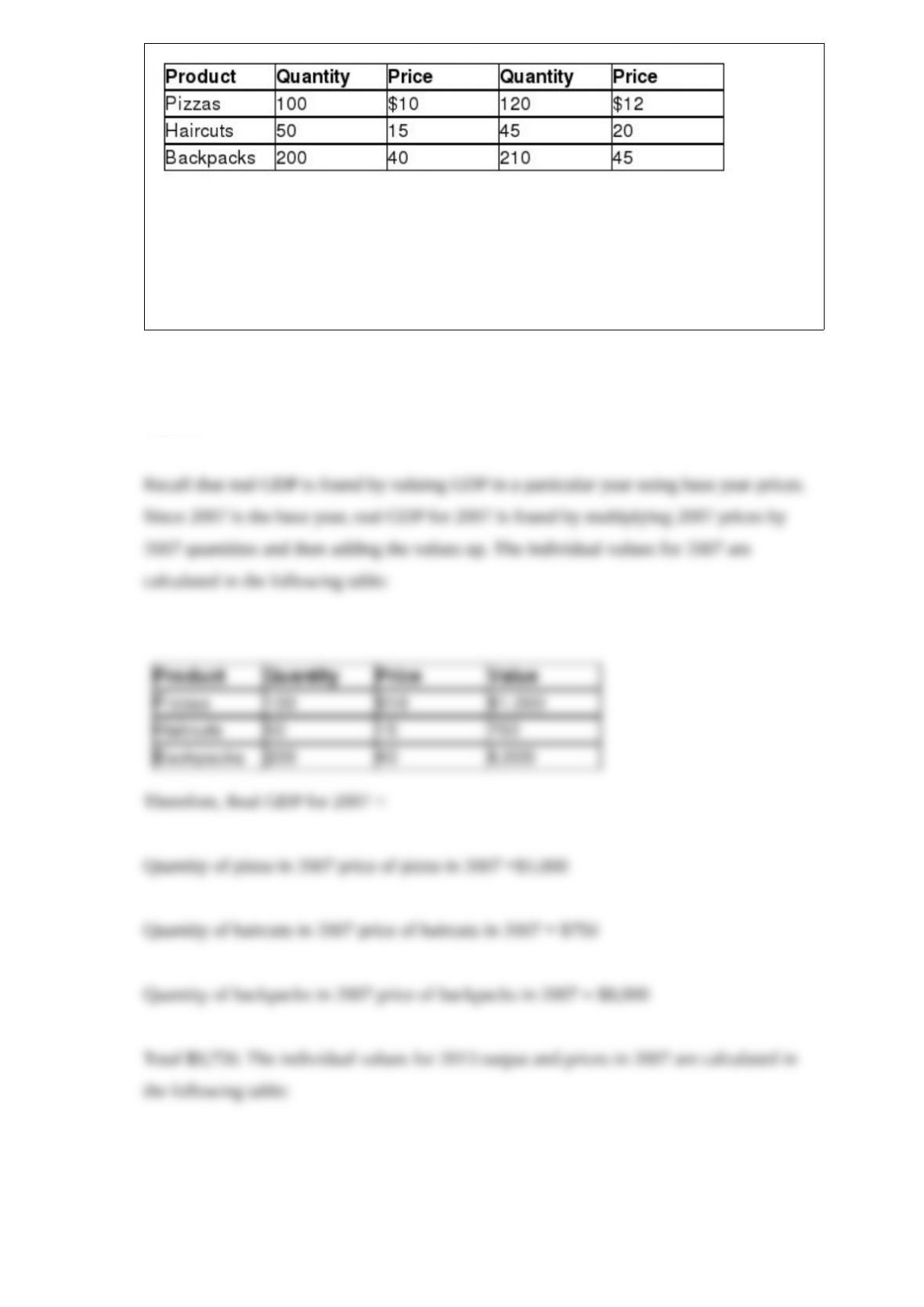
Suppose that a very simple economy produces three goods: pizzas, haircuts, and
backpacks. Suppose the quantities produced and their corresponding prices for 2007
and 2013 are shown in the table above. Use the information to compute real GDP in the
year 2007 and 2013. Assume that 2007 is the base year. Is output higher in 2013 or
2007? Why?
Answer:
Are sellers who practice arbitrage taking advantage of buyers?
Answer:
In 1984, the National Minimum Drinking Age Act was passed, raising the legal age to
consume alcoholic beverages in the United States to 21. In much of Europe, the legal
age to consume alcohol is 18. If the legal drinking age in the United States was changed
back to 18, how would this affect the market for alcoholic beverages? What would
happen to the equilibrium price and quantity of alcoholic beverages?
Answer:
What is meant by the term “government-imposed barrier to entry”? Why would a
government be willing to impose barriers to entering an industry?
Answer: