1)
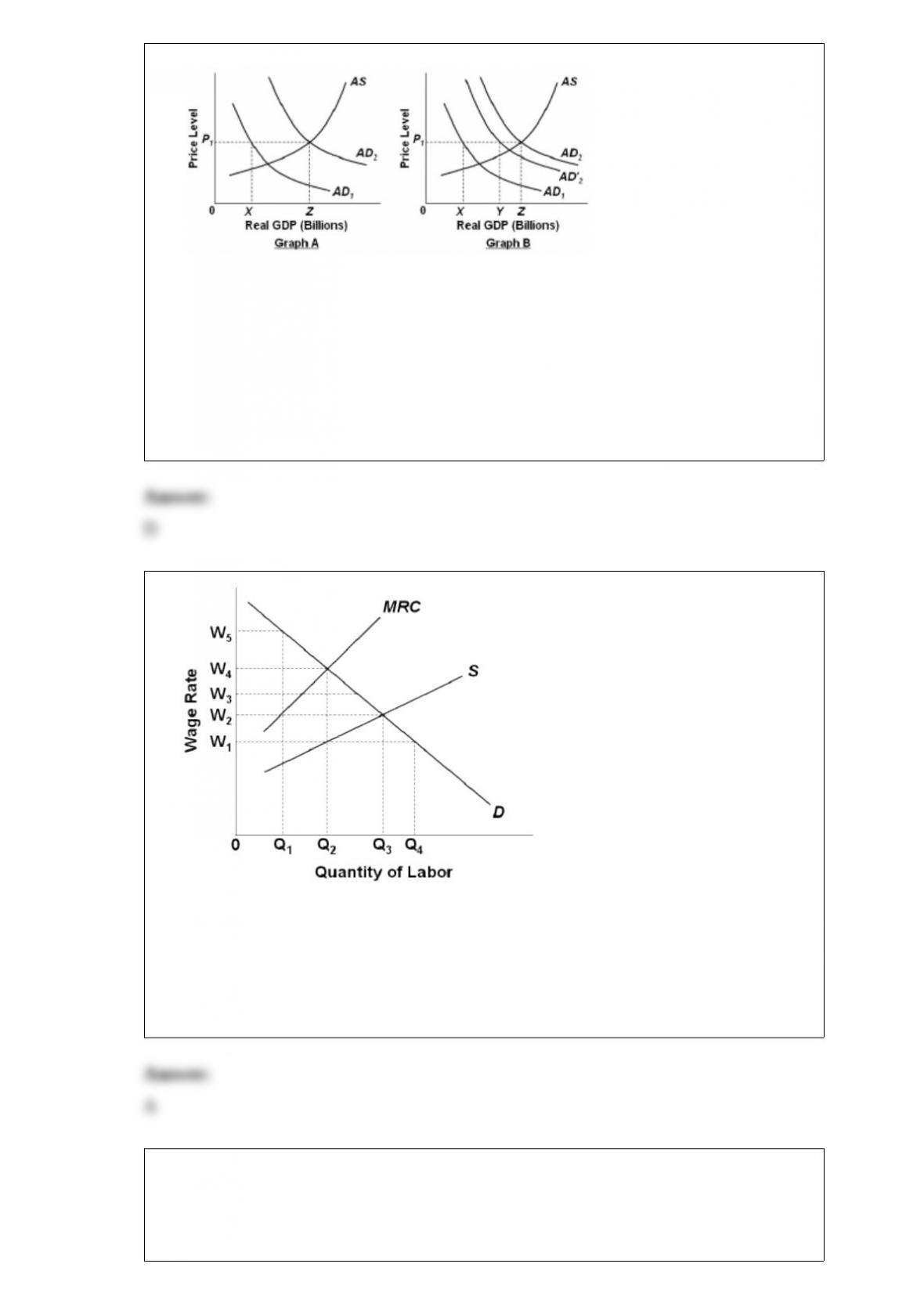
Refer to the above diagrams. Suppose that government undertakes fiscal policy
designed to increase aggregate demand from AD1 to AD2 and thereby to increase GDP
from X to Z. In terms of graph B, which of the following might explain why GDP
increases to Y rather than to Z?
A.depreciation of the dollar.
B.reduction in tariffs imposed by our trading partners.
C.decrease in the saving schedule.
D.crowding-out effect.
2)
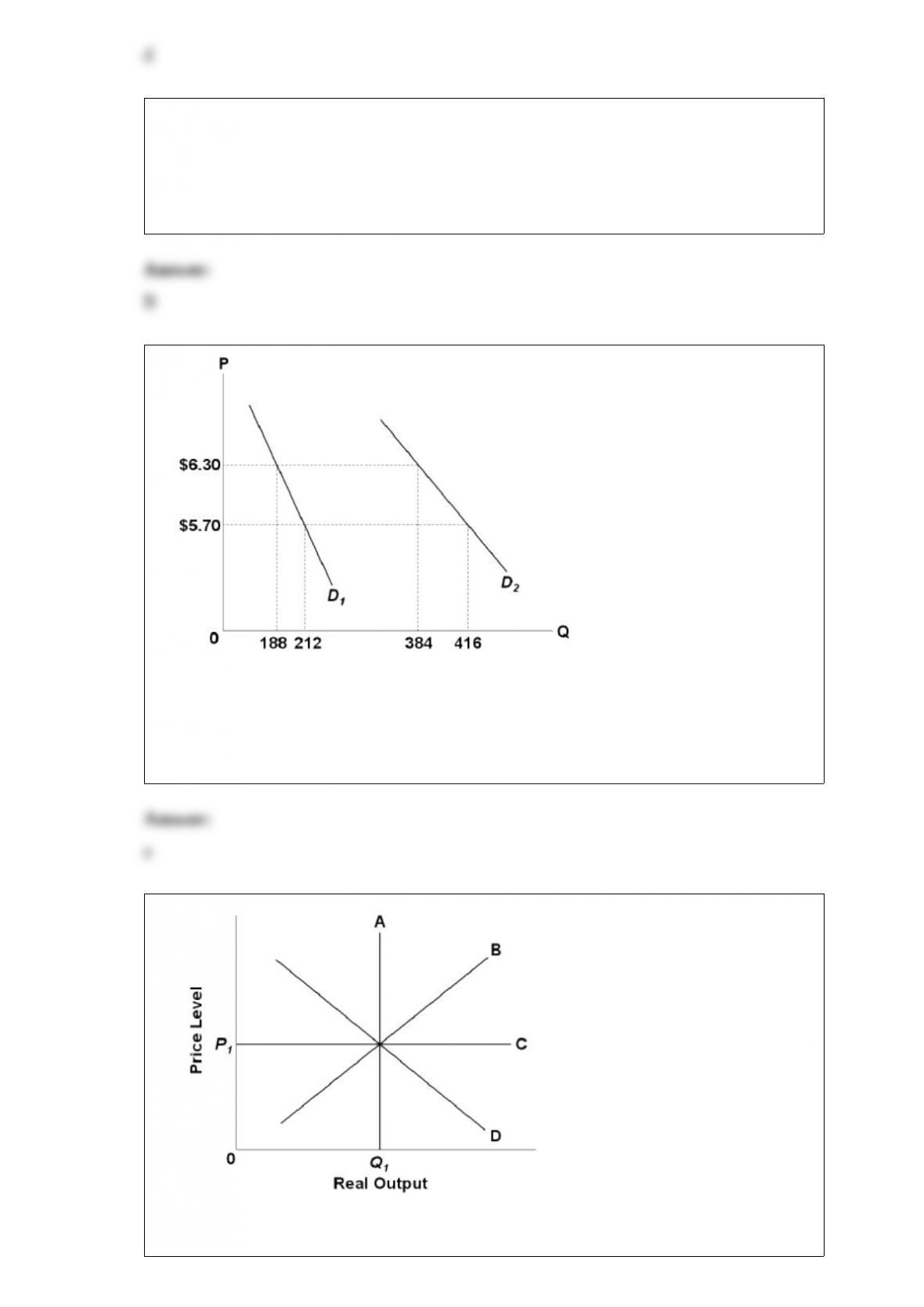
Refer to the above diagram. An industrial (inclusive) union could increase employment
in this labor market:
A.by negotiating any wage rate between W1 and W4.
B.by negotiating a wage rate greater than W4.
C.only if it accepted a wage rate below W1.
D.only if it could shift the labor demand curve rightward.
3) If the MPS in an economy is .4, government could shift the aggregate demand curve
leftward by $50 billion by:
A.reducing government expenditures by $125 billion.
B.reducing government expenditures by $20 billion.

C.increasing taxes by $50 billion.
D.increasing taxes by $250 billion.
4) In the aggregate expenditures model, a reduction in taxes may:
A.increase saving.
B.decrease real GDP.
C.increase unemployment.
D.reduce consumption.
5) most economists agree that the immediate determinant of the volume of output and
employment is the:
a.composition of consumer spending.
b.ratio of public goods to private goods production.
c.level of total spending.
d.size of the labor force.
6) The optimal extraction level in the present for a non-renewable resource is:
A.zero.
B.where the market price of the resource equals the extraction cost of the last unit.
C.where the market price of the resource equals the extraction cost of the last unit plus
the user cost of the last unit.
D.where the extraction cost of the last unit equals the user cost of the last unit.
7) the fact that most medical care purchases are financed through insurance:
a.has no effect on health care consumption because aggregate costs are the same
regardless of payment method.
b.reduces the amount of health care consumed.
c.has decreased health care costs and therefore reduced aggregate health care
expenditures.
d.increases the amount of health care consumed.
8) The velocity of money is equal to:
A.1/MPS.
B.nominal GDP/M.
C.1/reserve ratio.
D.nominal GDP/P.
9)
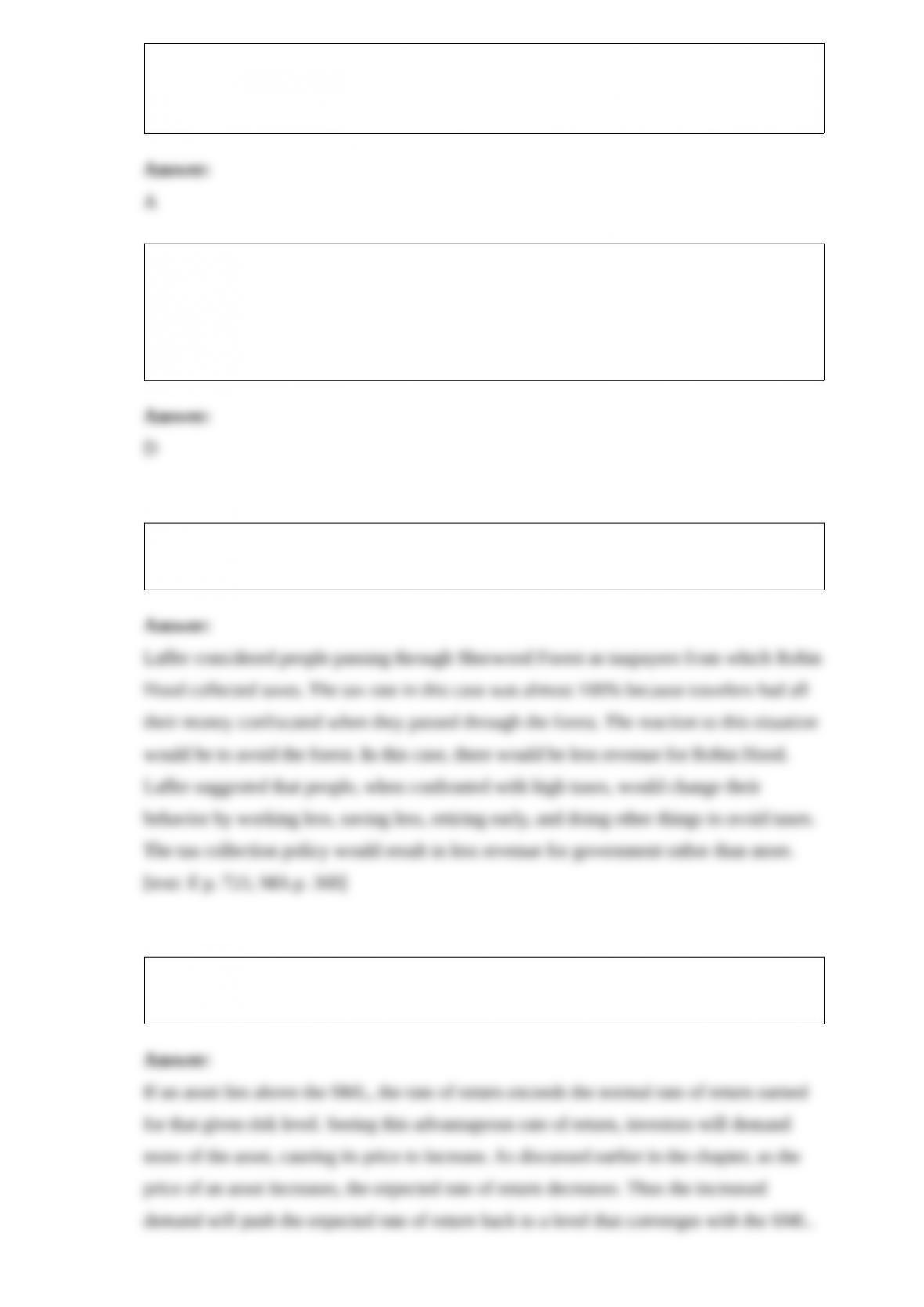
refer to the above diagram. between prices of $5.70 and $6.30:
a.d1is more elastic than d2.
b.d2is an inferior good and d1is a normal good.
c.d1andd2have identical elasticities.
d.d2is more elastic than d1.
10)
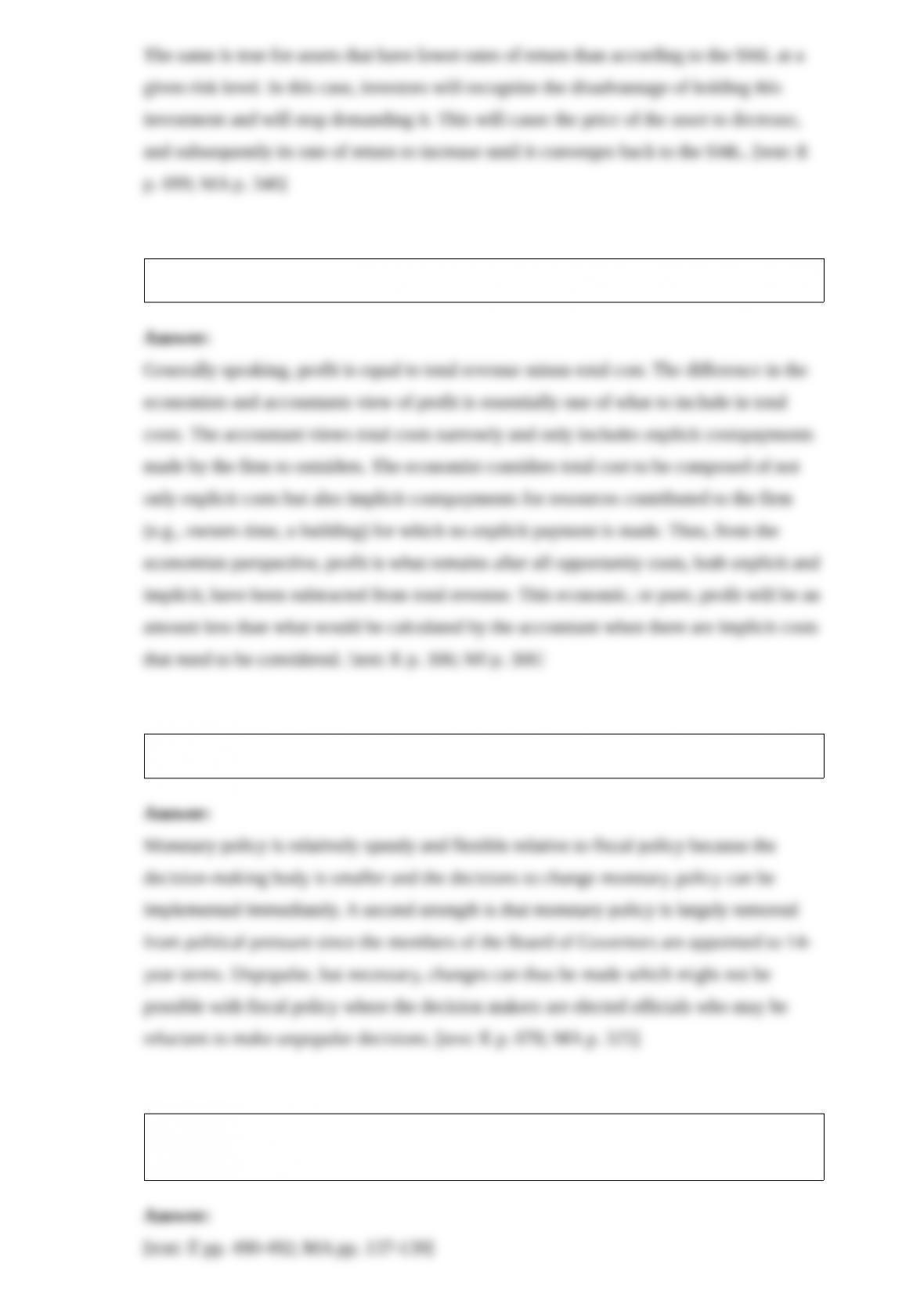
Refer to the above diagram. The long-run aggregate supply curve is:
A.A.
B.B.
C.C.
D.D.
11) Prices and wages tend to be:
A.flexible both upward and downward.
B.inflexible both upward and downward.
C.flexible downward, but inflexible upward.
D. flexible upward, but inflexible downward.
12) (Consider This) How did Arthur Laffer use Robin Hood and Sherwood Forest to
explain the advantage of supply-side economics?
13) How does arbitrage tend to move any asset divergent from the Security Market Line
back to it?
14) Explain the difference between the economists and the accountants view of profit.
15) Explain two strengths of monetary policy for achieving economic stability.
16) The following table shows the price of a specific stereo receiver for a five-year
period. Using Year 1 as the base year, calculate the price index for each year.