
Countries that have experienced sustained increases in their standard of living have
achieved them because of
A) higher rates of saving and investment.
B) higher rates of population growth.
C) sustained technological change.
D) All of the above are correct.
Which of the following determines the amount of money the banking system as a whole
can create?
A) the quantity of bank reserves
B) the quantity of vault cash held by banks
C) currency held by the Federal Reserve
D) the total amount of assets held by the banking system
Since 1962, which of the following federal expenditures, measured as a percentage of
GDP, has decreased?
A) Social Security
B) Medicare and Medicaid
C) net interest
D) defense
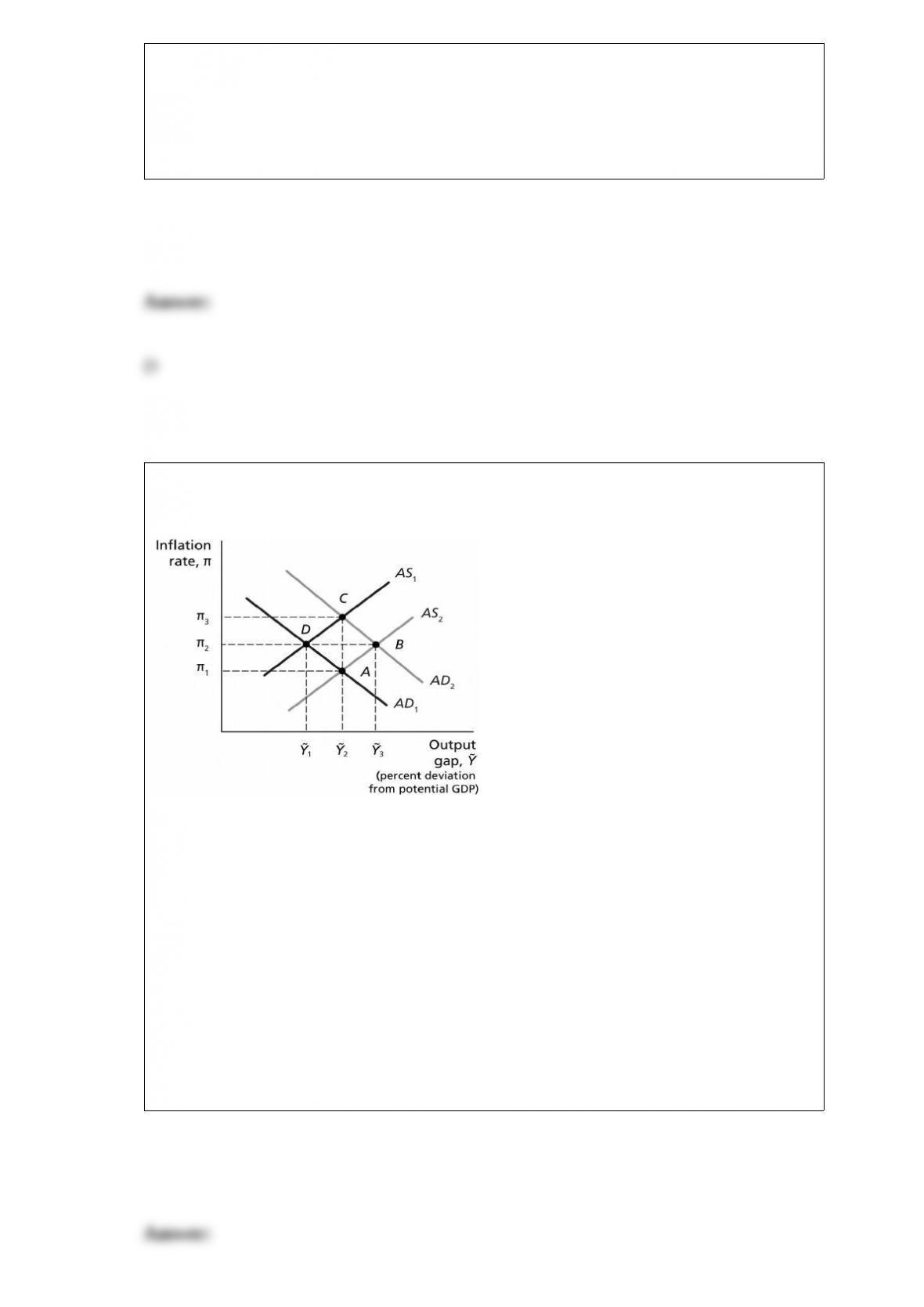
Figure 14.3
Refer to Figure 14.3. Suppose the economy is initially at long-run equilibrium and the
Fed increases the target inflation rate, and to hit this rate, it must reduce the real interest
rate. The economy then reaches a new, short-run equilibrium point. Assuming
expectations are adaptive, the next movement will result in the inflation rate
A) rising to π2, the new, long-run inflation rate.
B) falling to π2, the new, long-run inflation rate.
C) rising to π3, the new, long-run inflation rate.
D) falling back to π1, the original, long-run inflation rate.

Expansionary fiscal policy would involve ________, whereas contractionary fiscal
policy would involve ________.
A) increasing the money supply; increasing personal income taxes
B) increasing corporate income taxes; raising interest rates
C) increasing transfer payments; increasing corporate income taxes
D) increasing government purchases; increasing transfer payments
The domestic real interest rate in a small open economy is
A) determined by the intersection of the supply curve and demand curve for loanable
funds in the country.
B) equal to the world real interest rate.
C) the same as its nominal interest rate.
D) determined by the total value of net exports in the country.
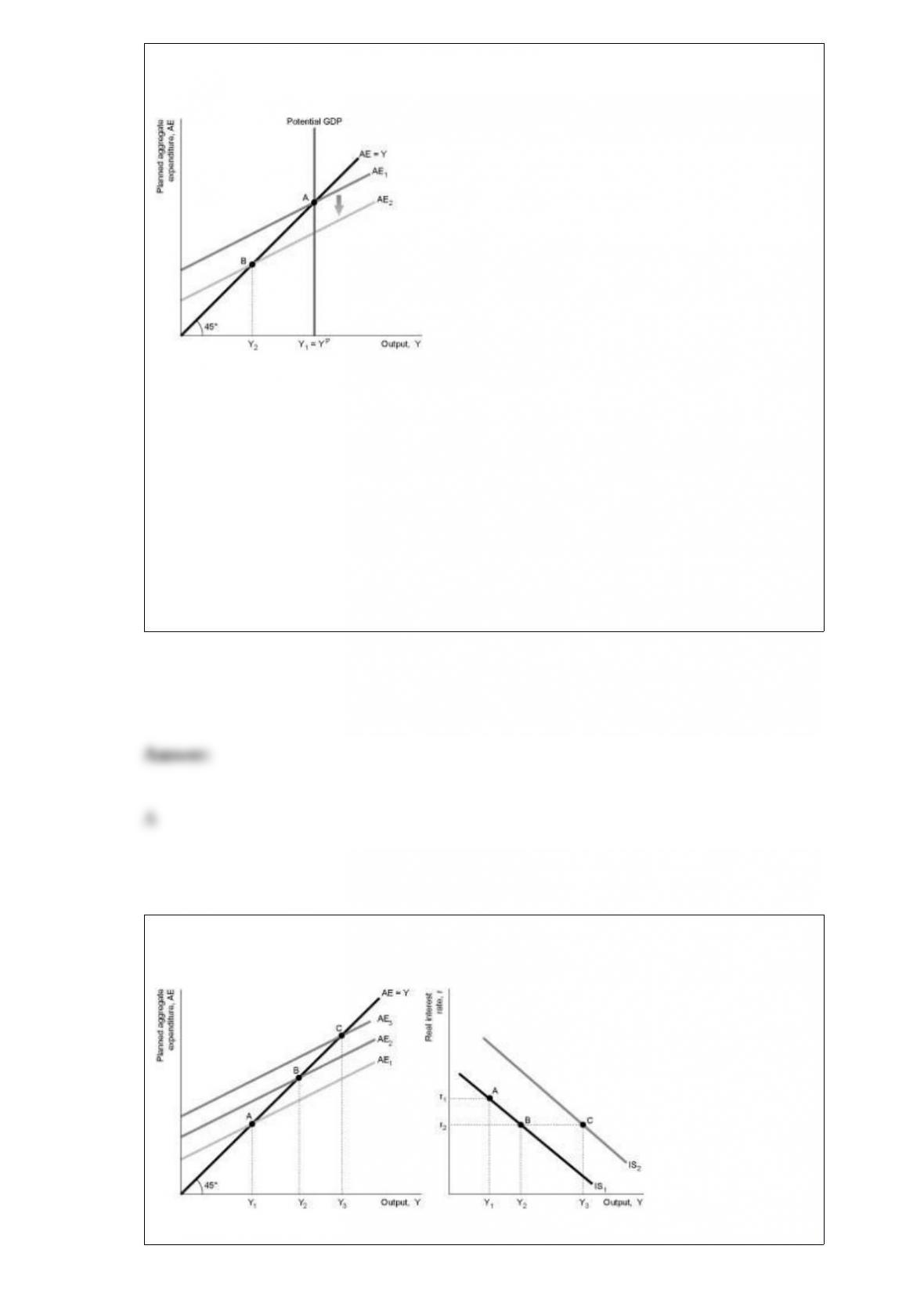
Figure 10.2
Refer to Figure 10.2. Assume the economy is initially at equilibrium at potential GDP
of $250 billion. If the MPC = 50 and the difference between AE1 and AE2 represents a
$75 billion decrease in planned investment spending, real GDP at Y2 will be equal to
A) $100 billion.
B) $125 billion.
C) $175 billion.
D) $212.5 billion.
Figure 10.3
Panel (a) Panel (b)
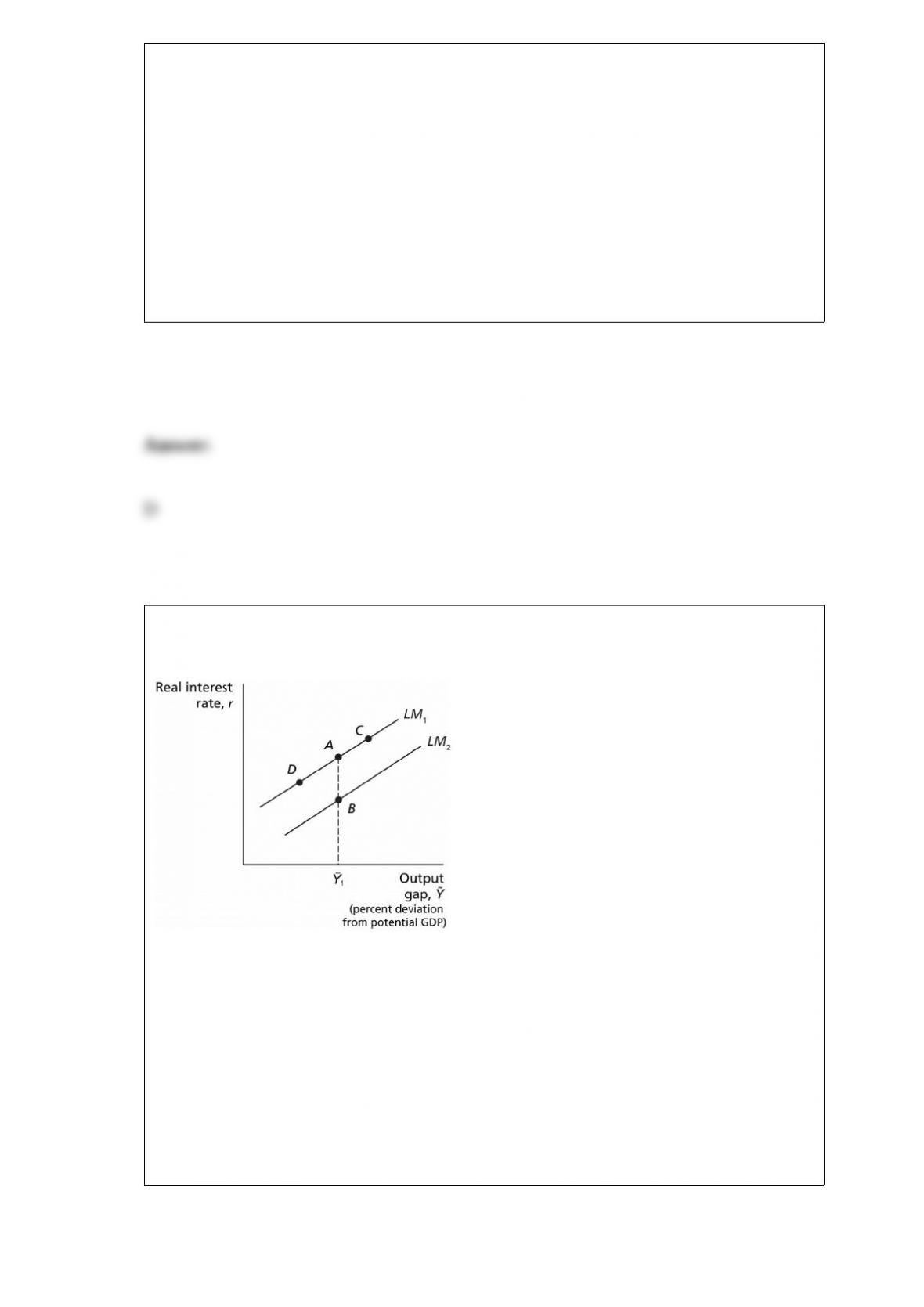
Refer to Figure 10.3. A negative demand shock accompanied by an increase in the real
interest rate is best represented by ________ in panel (a) and ________ in panel (b).
A) a shift from AE3 to AE2; a movement from point C to point B
B) a shift from AE2 to AE3; a shift from IS1 to IS2
C) a shift from AE2 to AE1; a movement from point B to point A
D) a shift from AE3 to AE1; a movement from point C to point A
Figure 10.8
Refer to Figure 10.8. Other things equal, an increase in the price level would best be
represented by
A) a movement from point A to point C.
B) a movement from point A to point D.
C) a shift from LM1 to LM2.
D) a shift from LM2 to LM1.

Hector’s wealth is zero, he expects to work for another 45 years at a constant salary of
$80,000 and live for another 60 years. Assuming taxes are zero, if Hector receives an
unexpected $20,000 increase in salary his first year of work and he completely smooths
consumption over his lifetime, his annual consumption is
A) $67,500
B) $75,000.
C) $80,000.
D) $111,111.
Suppose you purchase a bottle of vitamin water with a price of $3. The price of $3 best
reflects the function of money as a ________, and when you take $3 out of your wallet
to purchase the bottle, money is functioning as a ________.
A) medium of exchange; standard of deferred payment
B) store of value; unit of account
C) unit of account; medium of exchange
D) medium of exchange; store of value
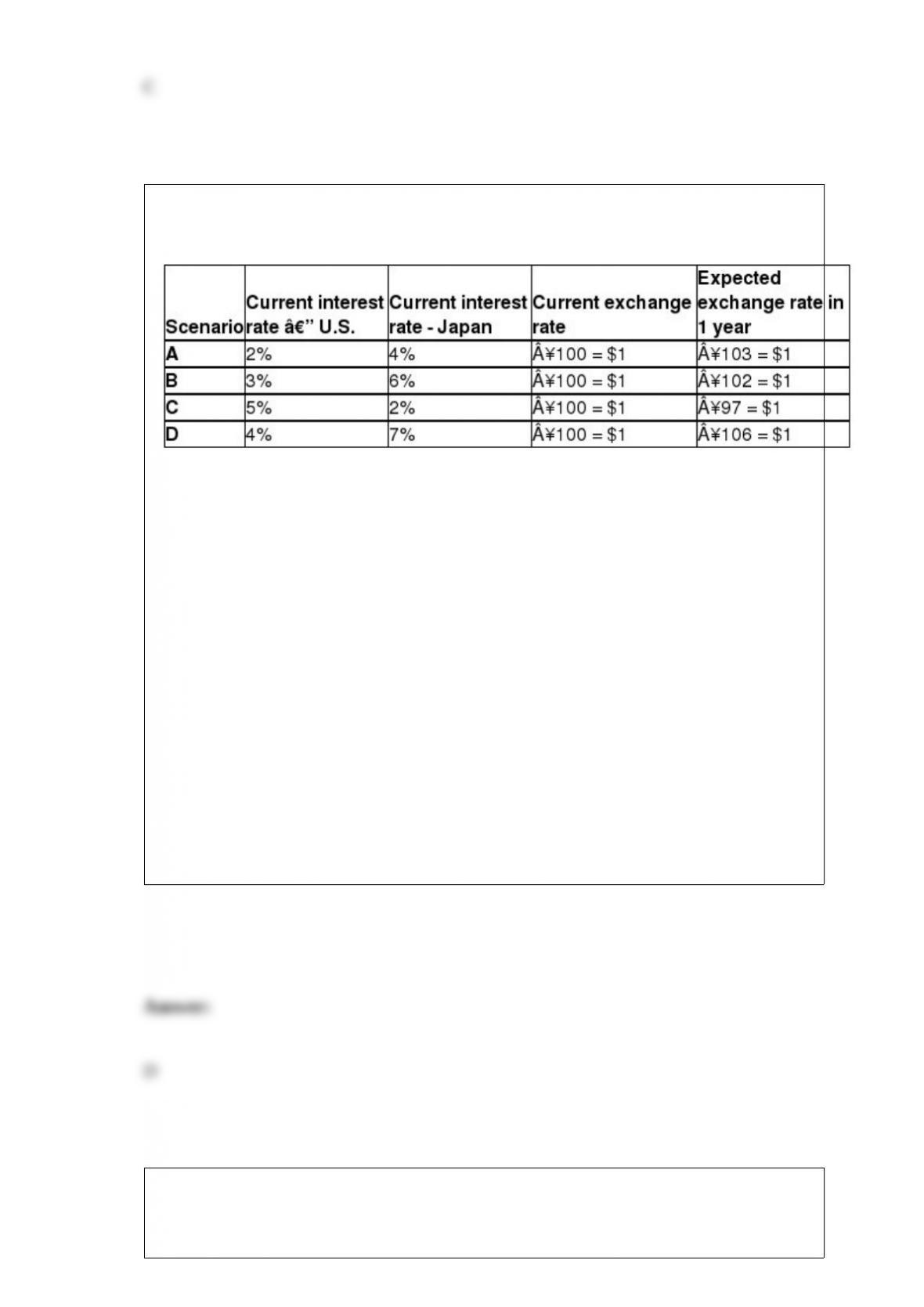
Table 4.2
Suppose that you intend to invest $10,000 in one-year government bonds. You are
looking for the highest return on your investment and do not care whether you
invest in the United States or Japan, but as U.S. resident, you want your
investment return to be in U.S. dollars. The Table lists 4 scenarios, each showing
the current interest rate for one-year government bonds in the United States and
Japan, the current exchange rate between the dollar and the yen, and the expected
exchange rate in one year. Other than the interest rates, you assume the bonds
from each country to be identical.
Refer to Table 4.2. With which scenario will you be worst off by investing in Japanese
bonds instead of U.S. bonds?
A) A
B) B
C) C
D) D
Contractionary monetary policy causes a ________ the MP curve and a ________ the
aggregate demand curve.

A) movement to the right along; shift to the right of
B) downward shift of; shift to the right of
C) movement to the left along; movement up along
D) upward shift of; shift to the left of
An increase in the real interest rate in the United States will cause the dollar to
________ relative to other currencies and ________ net exports and real GDP.
A) appreciate; increase
B) appreciate; reduce
C) depreciate; increase
D) depreciate; reduce
If Jennifer withdraws $750 from her checking account and holds it as currency, then M1
will ________ and M2 will ________.
A) decrease; not change
B) not change; increase
C) decrease; decrease

D) not change; not change
Which of the following transactions would be included in Germany’s current account?
A) A German citizen purchases a new BMW made in Germany.
B) An American citizen purchases 500 shares of BMW stock.
C) A German citizen purchases 500 shares of eBay stock.
D) An American citizen purchases a new BMW made in Germany.
Prices and wages are considered ‘sticky” if
A) their rates of increase and decrease are identical.
B) as prices increase, wages increase by the same percentage.
C) their rates of change are directly connected to the rate of change in unemployment.
D) they do not fully adjust to changes in demand and supply.

If personal income minus transfer payments is rising, real GDP is most likely
A) rising.
B) falling.
C) remaining stable.
D) getting ready to fall.
When the cost of borrowing funds which is stated on a loan is adjusted for the effects of
inflation, the resulting interest rate is called the
A) prime interest rate.
B) nominal interest rate.
C) real interest rate.
D) core PCE interest rate.
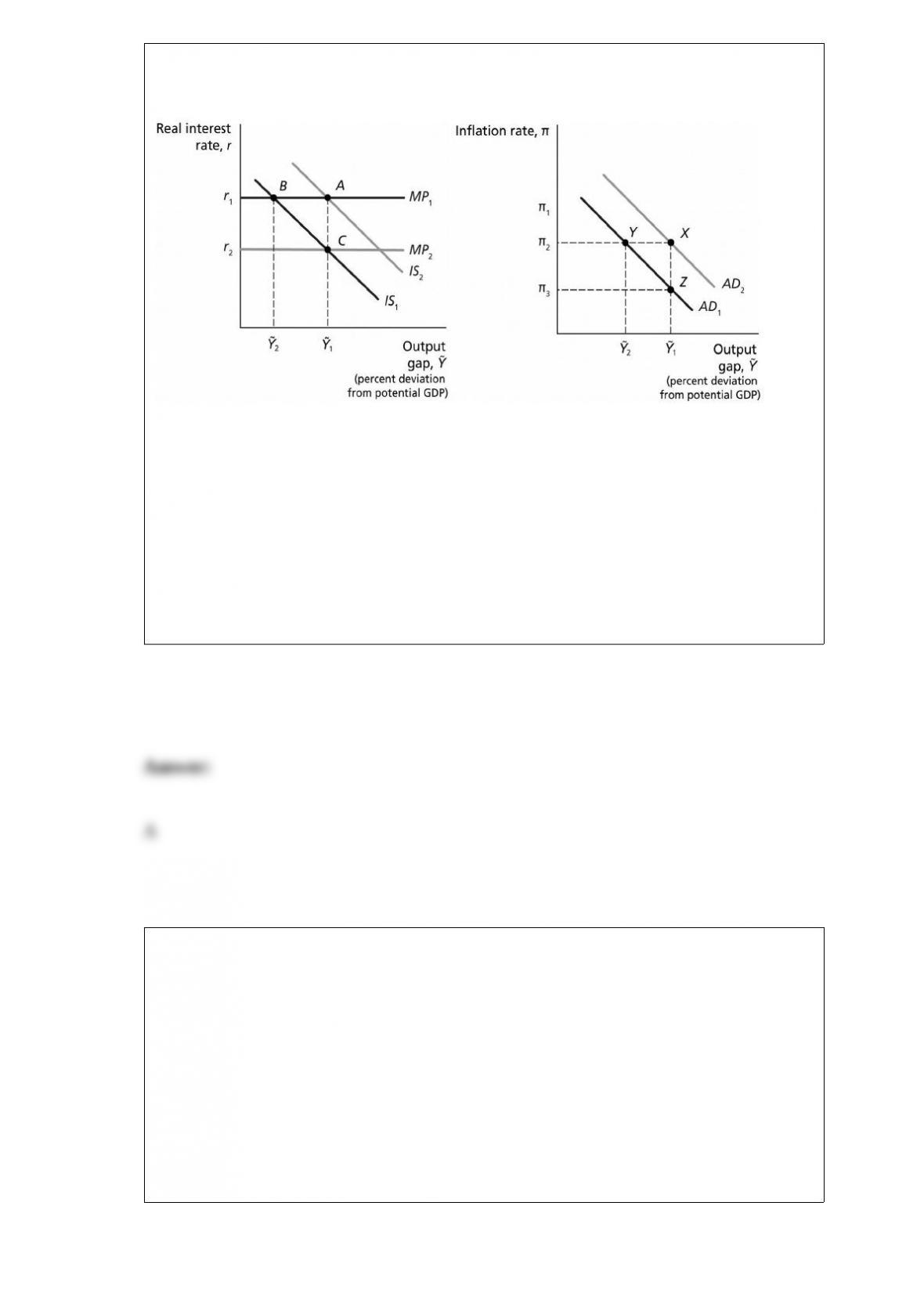
Figure 14.1
Refer to Figure 14.1. Other things equal, a decrease in the target inflation rate is best
represented as a movement from
A) point A to point B.
B) point C to point B.
C) point A to point C.
D) point B to point C.
Ricardian equivalence suggests that forward looking households ________ the future
taxes required to pay off government debt, so that reductions in lump-sum taxes have
________ effect on the economy.
A) fully anticipate; a multiplied
B) fully anticipate; no
C) are unaware of; a negative
D) are unaware of; a positive

All of the following are part of an economic model except
A) data.
B) opinions.
C) assumptions.
D) hypotheses.
If you pay $17,500 for a $20,000 face value one-year Treasury bill, what is the rate of
interest you will receive?
A) 8.75%
B) 11.43%
C) 12.5%
D) 14.29%

Under a fixed exchange rate system, if the government decides to devalue its currency,
net exports will ________ and the IS curve will shift to the ________.
A) increase; left
B) increase; right
C) decrease; left
D) decrease; right
From 1950 to 2009, the average length of expansions in the United States has been
A) less than 2 years.
B) between 2 year and 3 years.
C) between 3 years and 4 years.
D) longer than 4 years.
In response to the destructive bank panics of the Great Depression, Congress
established ________ in 1934 to reduce the likelihood of asset deflation and bank
failures.
A) the Federal Reserve system
B) banking reserve requirements
C) fractional reserve banking
D) the Federal Deposit Insurance Corporation
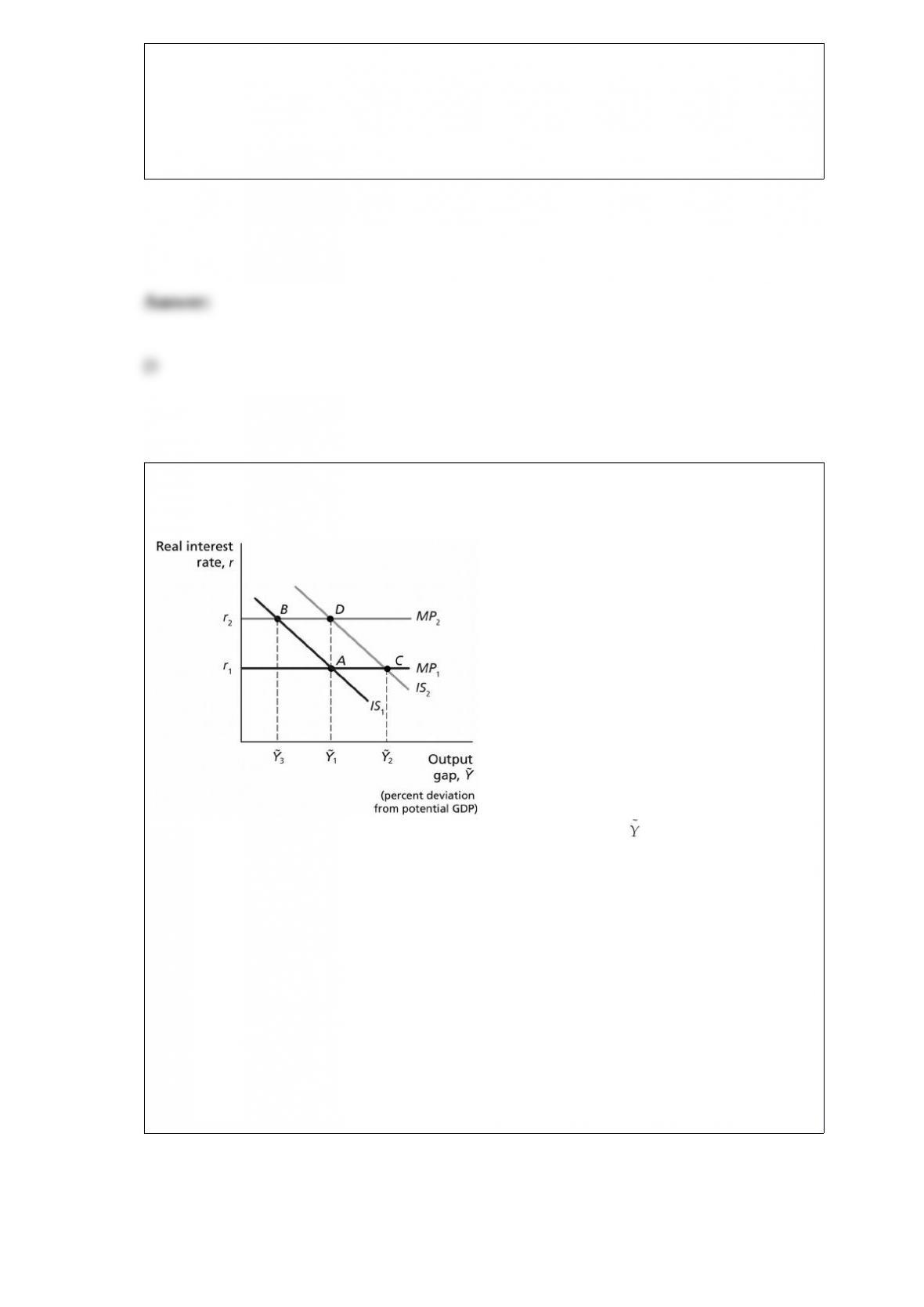
Figure 11.2
Refer to Figure 11.2. Assume the economy is in equilibrium at 1, where real GDP
equals potential GDP. The economy experiences a negative demand shock, and the Fed
responds by decreasing real interest rates to bring real GDP and inflation back to their
original levels. Other things equal, the negative demand shock is best represented by a
movement from
A) point A to point B.
B) point A to point C.
C) point D to point B.
D) point D to point C.
Suppose that the marginal propensity to consume is 0.75.
a. If the government decreases spending by $500 billion, what is the change in output?
b. If the government decreases taxes by $500 billion, what is the change in output?
c. If the government decreases transfer payments by $500 billion, what is the change in
output?
d. If the government decreases spending by $500 billion and at the same time decreases
taxes by $500 billion, what is the change in output?
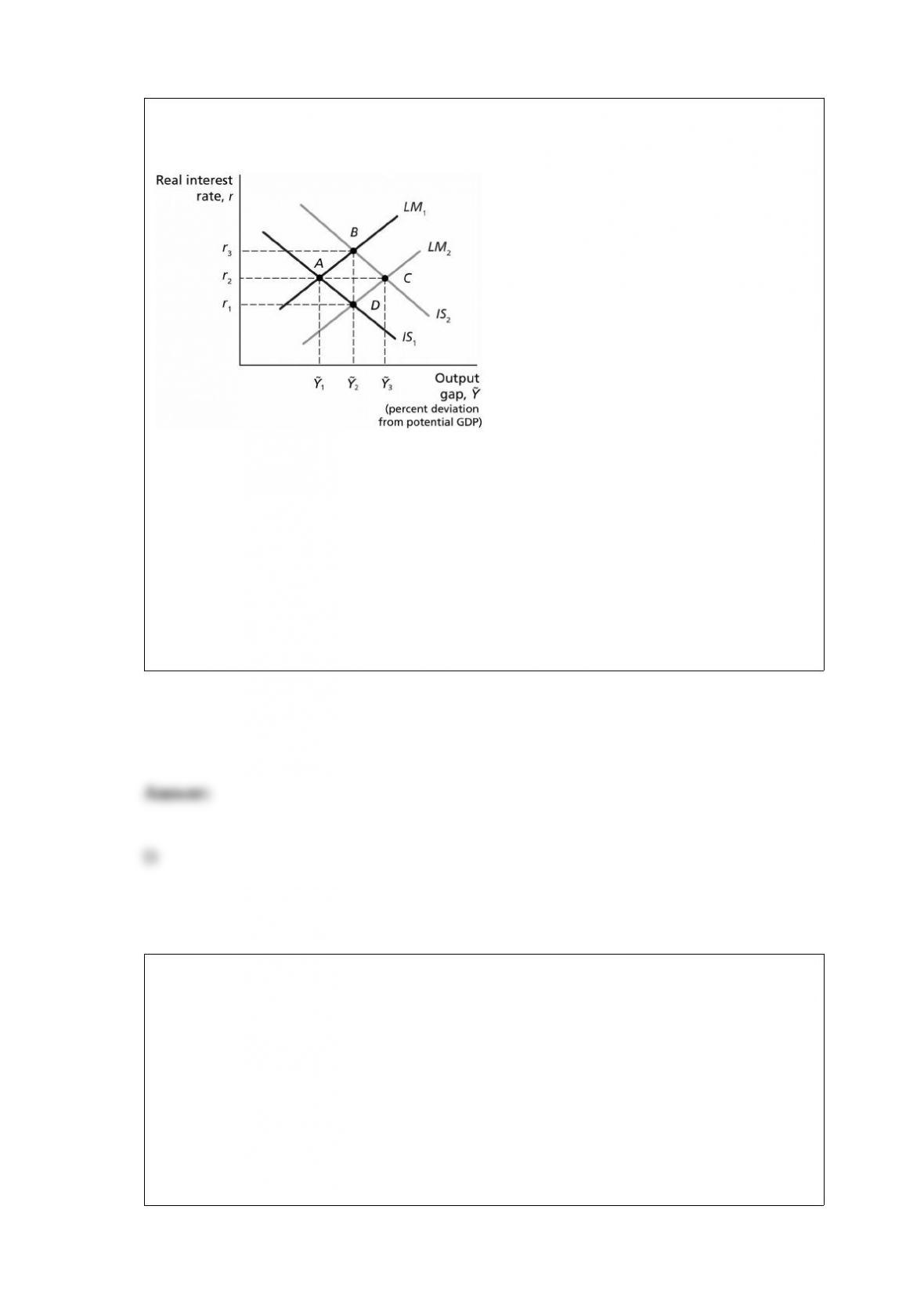
Figure 10.9
Refer to Figure 10.9. Other things equal, a negative demand shock is best represented
as a change in equilibrium from
A) point A to point B.
B) point A to point D.
C) point C to point B.
D) point C to point D.
Which of the following is one of the most important benefits of money in an economy?
A) Money allows for the accumulation of wealth.
B) Money makes exchange easier, leading to more specialization and higher
productivity.
C) Money encourages self-sufficiency and therefore increases economic stability.
D) Money allows for the exchange of goods and services.
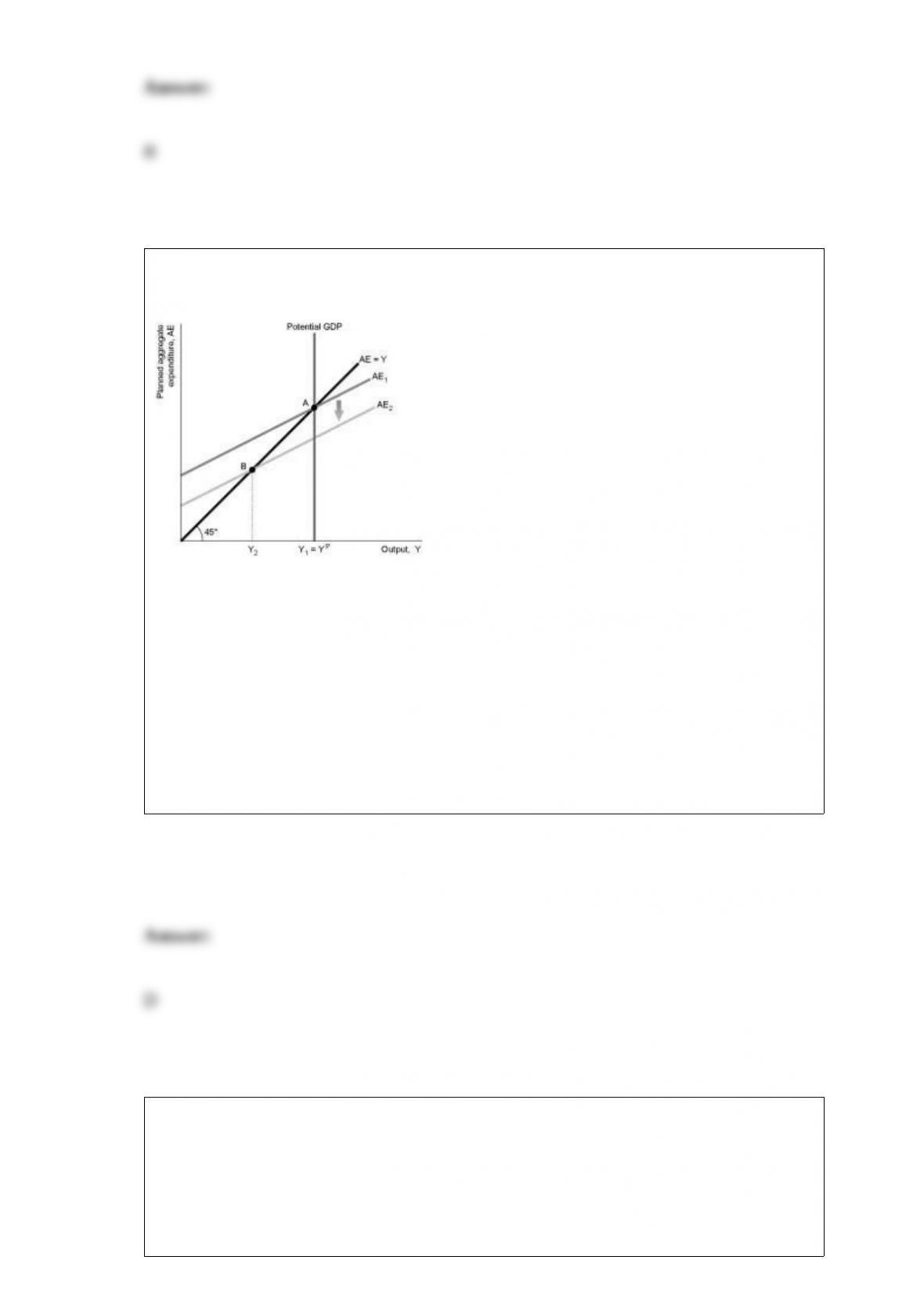
Figure 10.2
Refer to Figure 10.2. If in this economy the MPC = 0.6, Y2 = $50 billion, and AE2 is $5
billion below AE1, potential GDP is
A) $53 billion.
B) $55 billion.
C) $58.3 billion.
D) $62.5 billion.
Table 1
Checking Account Deposits $2,200

Currency 2,500
Money Market Mutual Fund Shares 1,600
Savings Deposits 7,600
Small Time Deposits 2,800
Traveler’s Checks 100
Refer to Table 7.1. In this simple economy, M1 equals
A) $2,500.
B) $2,600.
C) $4,800.
D) $12,400.
The costs associated with the user cost of capital include all of the following except
A) the real price of the capital good.
B) the expected change in the marginal cost of capital based on expectations of the
future.
C) the real interest cost of borrowing to finance the purchase of the capital good.
D) the depreciation costs associated with actually using the capital good.
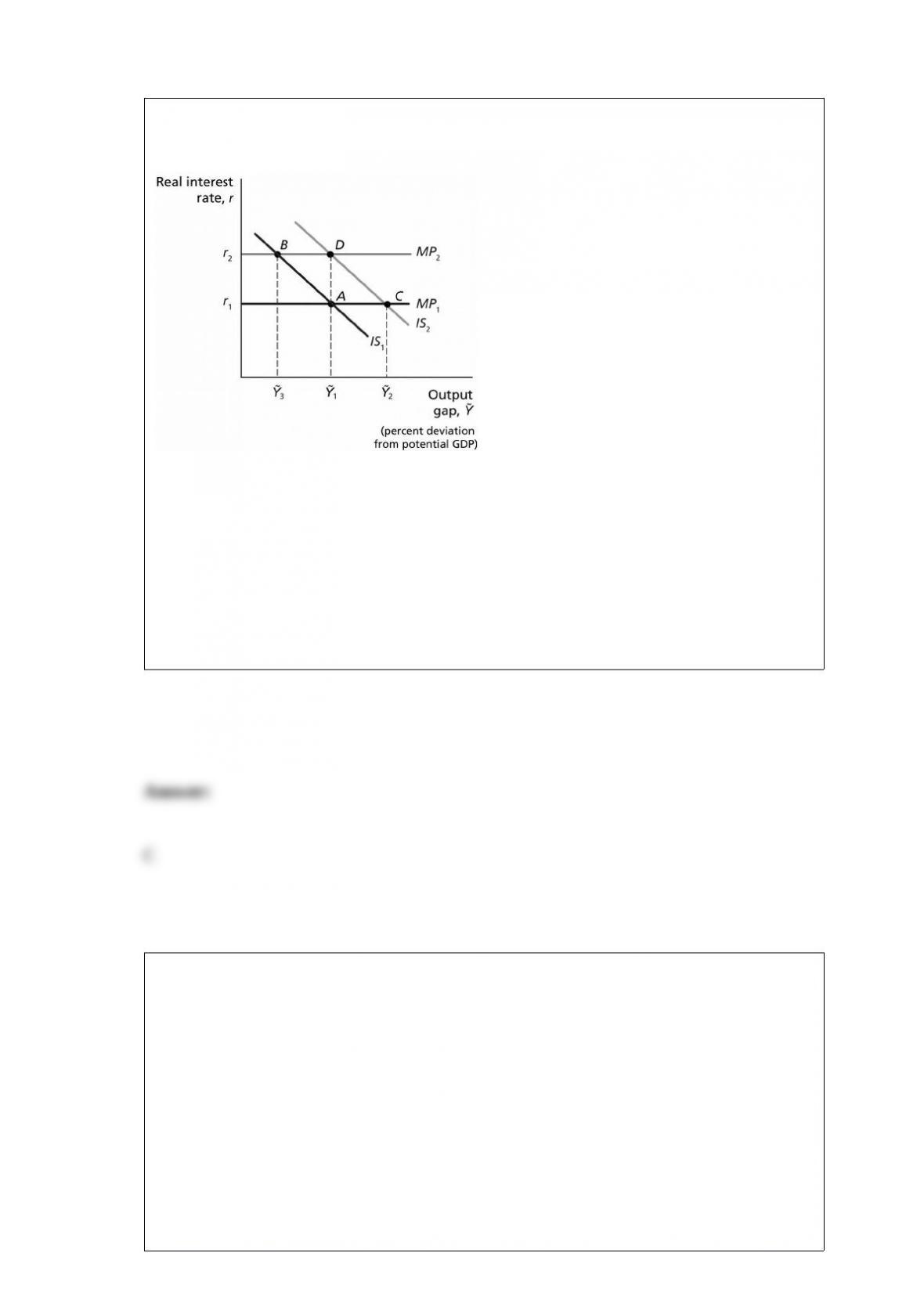
Figure 10.7
Refer to Figure 10.7. A movement from point A to point B could be caused by
A) a negative demand shock.
B) a decrease in the term premium investors expect in the future.
C) an increase in the default-risk premium.
D) an increase in the expected rate of inflation.
Table 1
Checking Account Deposits $2,200
Currency 2,500
Money Market Mutual Fund Shares 1,600
Savings Deposits 7,600
Small Time Deposits 2,800
Traveler’s Checks 100
Refer to Table 7.1. In this simple economy, M2 equals
A) $4,800.
B) $6,400.
C) $9,200.
D) $16,800.