1) graphically, producer surplus is measured as the triangle:
a.under the demand curve and below the actual price.
b.under the demand curve and above the actual price.
c.above the supply curve and above the actual price.
d.above the supply curve and below the actual price.
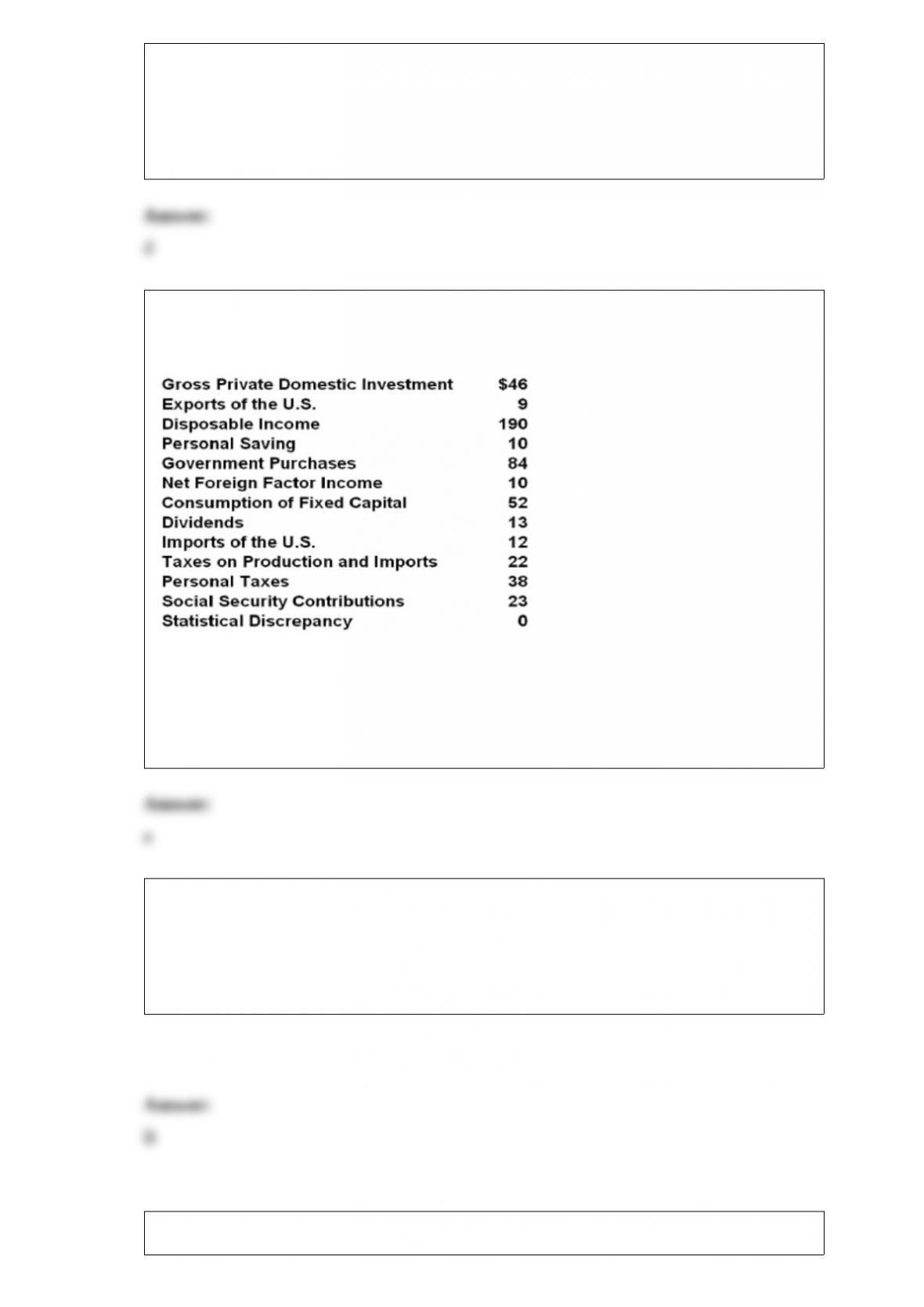
2) answer the next question(s) on the basis of the following data. all figures are in
billions of dollars.
refer to the above data. the national income is:
a.$265.
b.$223.
c.$208.
d.$346.
3)
Renewable resources:
A.can never be exhausted permanently.
B.can be exhausted if harvest rates exceed replenishment rates for an extended period.
C.can be exhausted if replenishment rates exceed harvest rates for an extended period.
D.will tend to be over-harvested when they are private property.
4) Answer the next question(s) on the basis of the following table for a particular

country in which C is consumption expenditures, Ig is gross investment expenditures, G
is government expenditures, X is exports, and M is imports. All figures are in billions of
dollars. Each question is independent of the other questions.
Refer to the above table. A decline in the international value of the dollar would:
A.increase the values in columns (5) and (6) and reduce aggregate demand.
B.decrease the values in columns (5) and (6) and increase aggregate demand.
C.decrease the values in column (5), increase the values in column (6), and reduce
aggregate demand.
D. increase the values in column (5), decrease the values in column (6), and increase
aggregate demand.
5) Social regulation differs from industrial regulation in that:
A.social regulation applies to virtually all industries, while industrial regulation applies
to a restricted number.
B.industrial regulation is involved in the details of the production process, while social
regulation is not.
C.social regulation has expanded less rapidly in recent years than has industrial
regulation.
D.industrial regulation regulates products whereas social regulation regulates prices.
6) in a full-employment economy government can reallocate resources from private to
public employment by:
a.reducing taxes and increasing government expenditures.
b.reducing taxes and reducing government expenditures.
c.increasing taxes and reducing government expenditures.
d.increasing taxes and increasing government expenditures.
7) Consumer’s income = $12
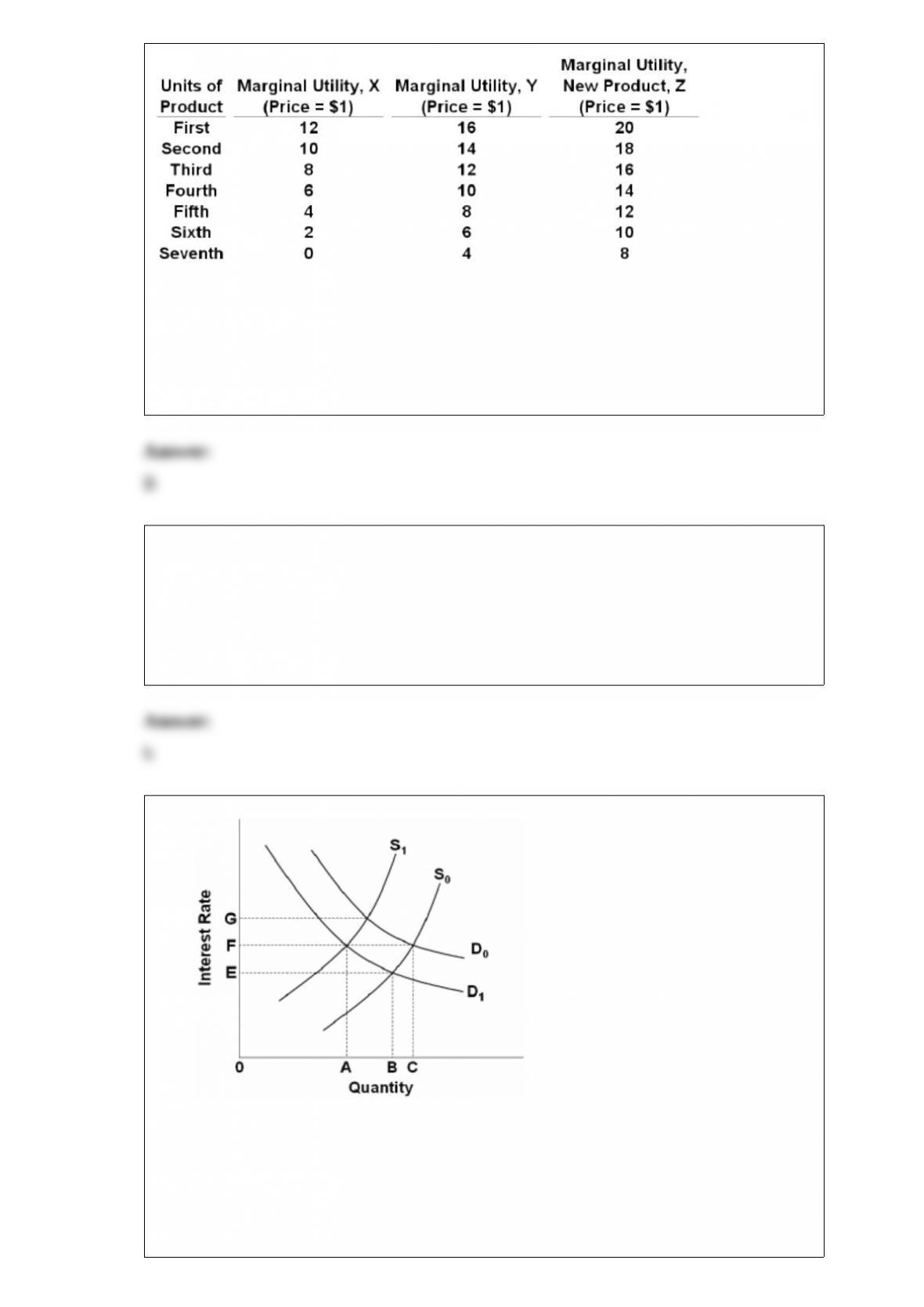
Refer to the above data. In equilibrium, the introduction of new product Z has increased
this consumer’s total utility by:
A.42 utils.
B.54 utils.
C.60 utils.
D.66 utils.
8) other things the same, if a price change causes total revenue to change in the opposite
direction, demand is:
a.perfectly inelastic.
b.relatively elastic.
c.relatively inelastic.
d.of unit elasticity.
9)
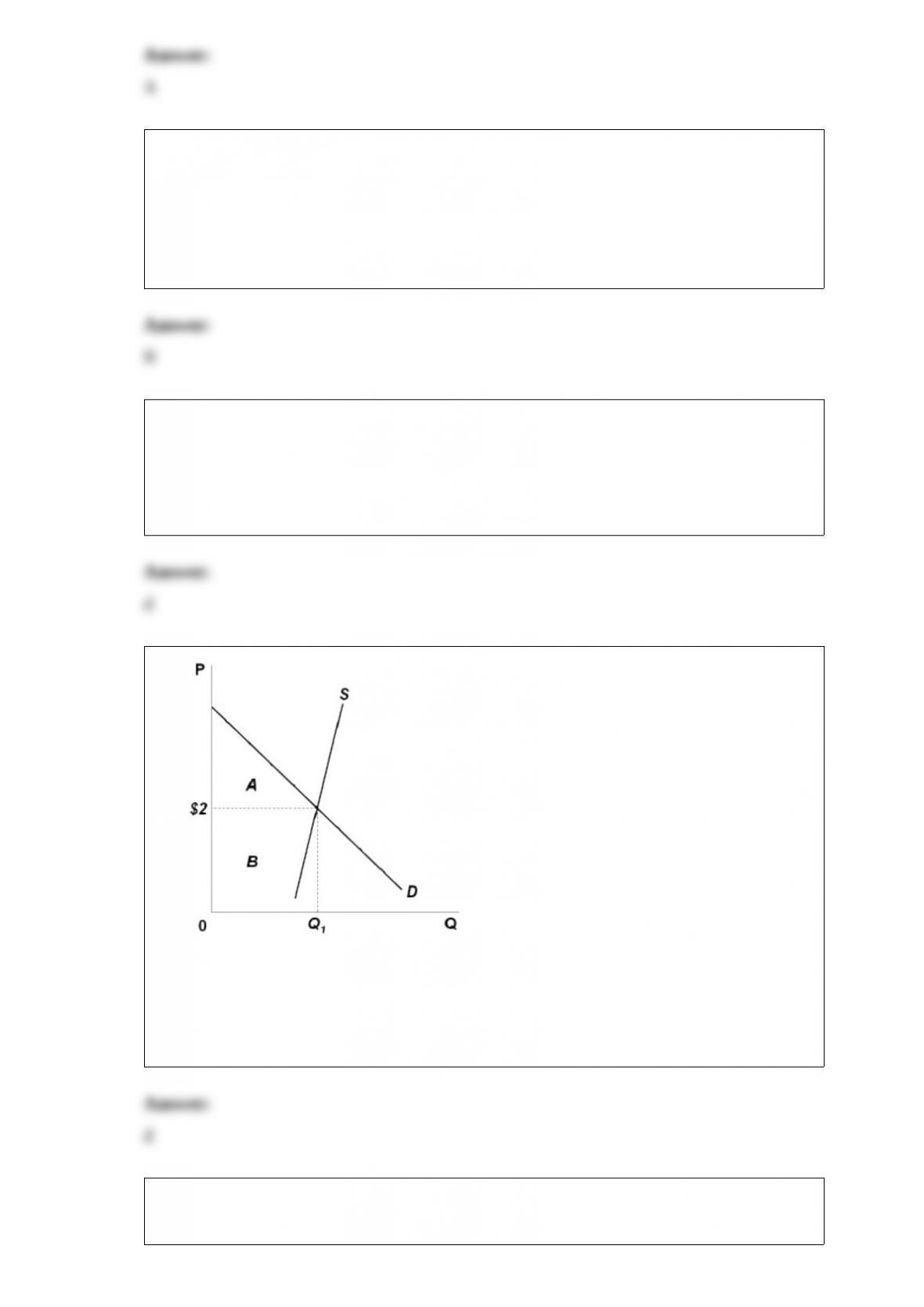
Refer to the above diagram. The demand for loanable funds curve D1 slopes downward
because:
A.business will borrow more funds at lower interest rates than at higher ones.
B.at lower interest rates households will make more funds available for lending.
C.at lower interest rates, households will consume more and save less.
D.business will borrow more funds at higher interest rates than at lower ones.
10) Public choice theorists contend public bureaucracies are inefficient primarily
because:
A.the value of public goods is more easily measured than is the value of private goods.
B.of the absence of competitive market pressures.
C.public sector workers are more security-conscious than are private sector workers.
D.relatively low pay in government attracts workers of lesser quality.
11) if the japanese yen appreciates relative to the swedish krona, then the krona:
a.will be more expensive to the japanese.
b.may either appreciate or depreciate relative to the yen.
c.will appreciate relative to the yen.
d.will depreciate relative to the yen.
12)
refer to the above graph of the market for asparagus. producer surplus in this market:
a.is $2.
b.is $2 times q1.
c.is equal to area b
d.cannot be determined with the information given.
13) which of the following generalizations is not correct?
a.the larger an item is in one’s budget, the greater the price elasticity of demand.

b.the price elasticity of demand is greater for necessities than it is for luxuries.
c.the larger the number of close substitutes available, the greater will be the price
elasticity of demand for a particular product.
d.the price elasticity of demand is greater the longer the time period under
consideration.
14) which of the following is correct?
a.the unemployment rates of men and women workers are roughly the same.
b.unemployment rates for african-american and white workers are approximately the
same.
c.teenagers experience approximately the same unemployment rates as do adults.
d.laborers are less vulnerable to unemployment than are professional workers.
15) On a diagram where the interest rate and the quantity of money demanded are
shown on the vertical and horizontal axes respectively, the total demand for money can
be found by:
A.horizontally adding the transactions and the asset demand for money.
B.vertically subtracting the transactions demand from the asset demand for money.
C.horizontally subtracting the asset demand from the transactions demand for money.
D.vertically adding the transactions and the asset demand for money.
16) The Fed’s ability to alter the level of reserves in the banking system is the main idea
of the:
A.sponge analogy.
B.squeegee analogy.
C.pushing-on-a-string analogy.
D.hose analogy.