1) an increase in import restrictions by the u.s. government tends to promote a
merchandise-trade surplus.
a.true
b.false
2) following world war ii, the u.s.:
a.became less open
b.negotiated reductions in trade barriers with other countries
c.passed a number of protective tariffs
d.concentrated on armament production
3) suppose that mexico and canada form a free-trade area and canada begins importing
steel from mexico rather than from germany. there occurs:
a.trade diversion
b.trade creation
c.trade destruction
d.trade exhaustion
4) exhibit 11.1
assume the following: (1) the interest rate on 6-month treasury bills is 8 percent per
annum in the united kingdom and 4 percent per annum in the united states; (2) today’s
spot price of the pound is $1.50 while the 6-month forward price of the pound is
$1.485.
refer to exhibit 11.1. if the price of the 6-month forward pound were to ____, u.s.
investors would no longer earn an extra return by shifting funds to the united kingdom.
a.rise to $1.52
b.rise to $1.53
c.fall to $1.48
d.fall to $1.47
5) often, countries realizing rapid economic growth rates possess long-run current
account deficits.
a.true
b.false
6) a nation experiences overall balance if it achieves:
a.balance-of-payments equilibrium, full employment, and price stability
b.balance-of-payments equilibrium, maximum productivity, and price stability
c.full employment, price stability and no change in its money supply
d.full employment, price stability, and maximum productivity
7) under the original provisions of the reciprocal trade agreements act, the president of
the united states was authorized to cut tariffs up to:
a.10 percent
b.50 percent
c.75 percent
d.100 percent
8) a larger variety of products results from international trade especially if:
a.international trade affords producers monopoly power
b.national governments levy import tariffs and quotas
c.producing goods entails increasing costs
d.economies of scale exist for producers
9) during the 1980s and 1990s, japanese auto firms established manufacturing facilities
in the united states known as “transplants.”
a.true
b.false
10) one factor that has prevented the formation of cartels for producers of commodities
is that:
a.the demand for commodities tends to be price inelastic
b.substitute products exist for many commodities
c.commodity produces have been able to dominate world markets
d.production of most commodities is capital intensive
11) partial currency pass-through implies that if the dollar’s exchange value appreciates
by 10 percent, imports would become, say, 6 percent more expensive to americans
while u.s. exports would become, say, 8 percent cheaper to foreigners.
a.true
b.false
12) the european union has achieved all of the following except:
a.adopted a common fiscal policy for member nations
b.established a common system of agricultural price supports
c.disbanded all tariffs among its member countries
d.levied common tariffs on products imported from nonmembers
13) the terms of trade is given by the prices:
a.paid for all goods imported by the home country
b.received for all goods exported by the home country
c.received for exports and paid for imports
d.of primary products as opposed to manufactured products
14) if a nation with a balance-of-payments deficit is willing and able to initiate quick
actions to increase export receipts and decrease import payments, the amount of
international reserves needed will be relatively large.
a.true
b.false

15) concerning exchange rate forecasting, ____ is a common sense approach based on a
wide array of political and economic data.
a.econometric analysis
b.technical analysis
c.judgmental analysis
d.sunspot analysis
16) at the maastricht summit of 1991, european union negotiators called for the pursuit
of a:
a.free trade area
b.customs union
c.common market
d.monetary union
17) under an adjustable-pegged system, market exchange rates are intended to be
maintained within a narrow band around a currency’s official exchange rate. in the case
of fundamental disequilibrium, the currency can be devalued or revalued to promote
current-account equilibrium.
a.true
b.false
18) the united states
a.has been a heavy user of antidumping laws to protect domestic producers
b.has rarely used antidumping laws to protect domestic producers
c.has targeted antidumping action against china, japan, canada, italy, and germany
d.both a and c
19) according to the absorption approach, currency devaluation best improves a
country’s trade balance when its economy is at maximum capacity.
a.true
b.false
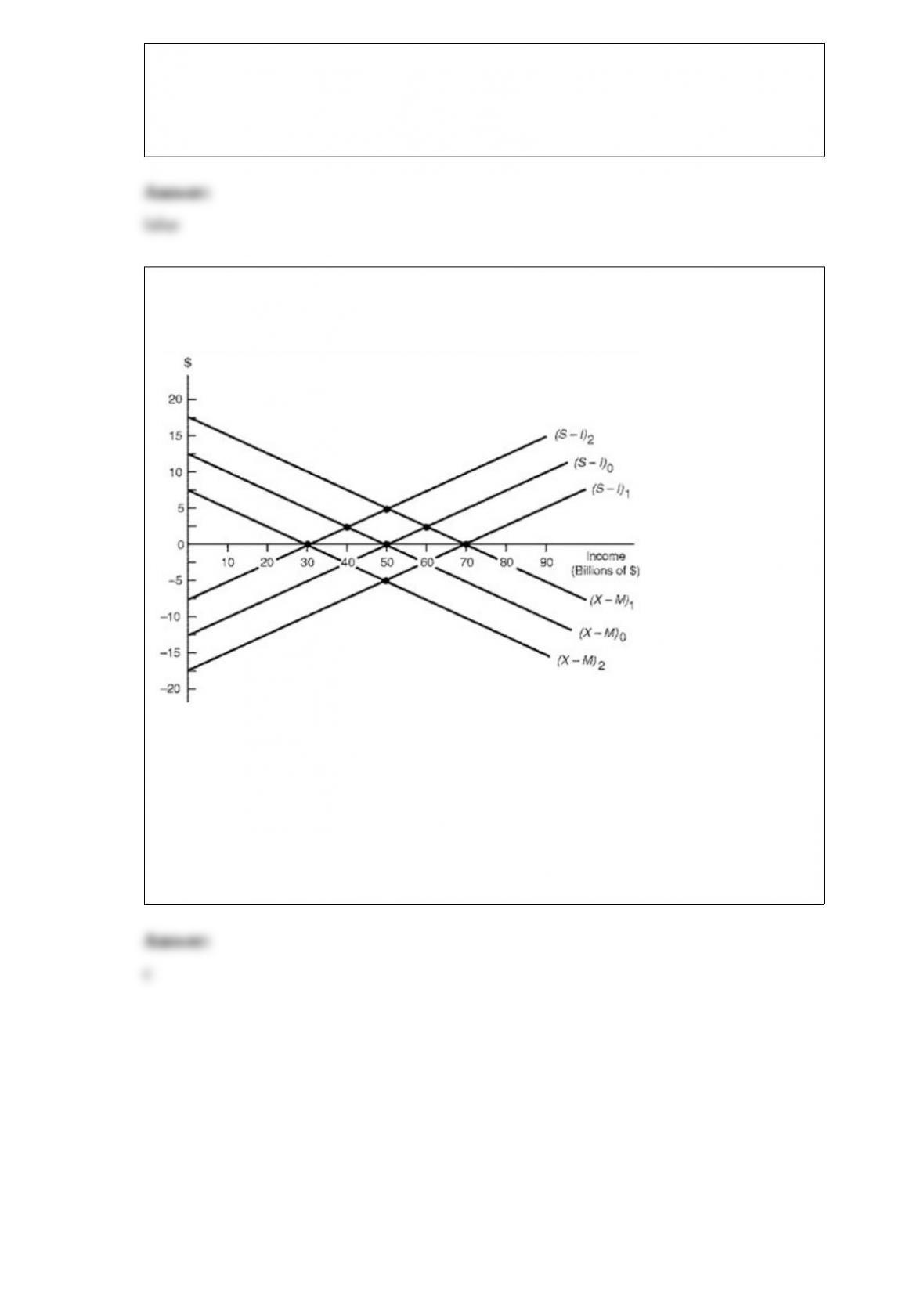
20) figure 13.2. australian economy under a fixed exchange rate system
refer to figure 13.2. starting at equilibrium income $50 billion, where (s-i)0 intersects
(x-m)0, suppose that changing preferences lead to an autonomous increase in australian
imports of $5 billion. australian income thus ____ which leads to australia’s trade
account moving to a ____.
a.rises to $60 billion, surplus of $2.5 billion
b.rises to $60 billion, surplus of $5 billion
c.falls to $40 billion, deficit of $2.5 billion
d.falls to $40 billion, deficit of $5 billion