
1)
refer to the above information. average fixed cost is:
a.
b.
c.
d.
2) according to emerson: “want is a growing giant whom the coat of have was never
large enough to cover.” according to economists, “want” exceeds “have” because:
a.people are greedy.
b.productive resources are limited.
c.human beings are inherently insecure.
d.people are irrational.
3) The most likely way the public debt burdens future generations, if at all, is by:
A.reducing the current level of investment.
B.causing future unemployment.
C.causing deflation.
D.reducing real interest rates.
4) In 1985, the exchange rate between the U.S. dollar and the Japanese yen was $1 =
262 yen; in 2003, the rate was $1 = 110 yen.
Refer to the above information. Between 1985 and 2003 the:
A.dollar appreciated in value relative to the yen.
B.yen appreciated in value relative to the dollar.
C.dollar price of yen fell.
D.yen price of dollars rose.
5) a country can achieve some combination of goods outside its production possibilities
curve by:
a.idling some of its resources.
b.specializing and engaging in international trade.
c.buying the debt (bonds and stocks) of foreign nations.
d.producing more capital goods and fewer consumer goods.
6)
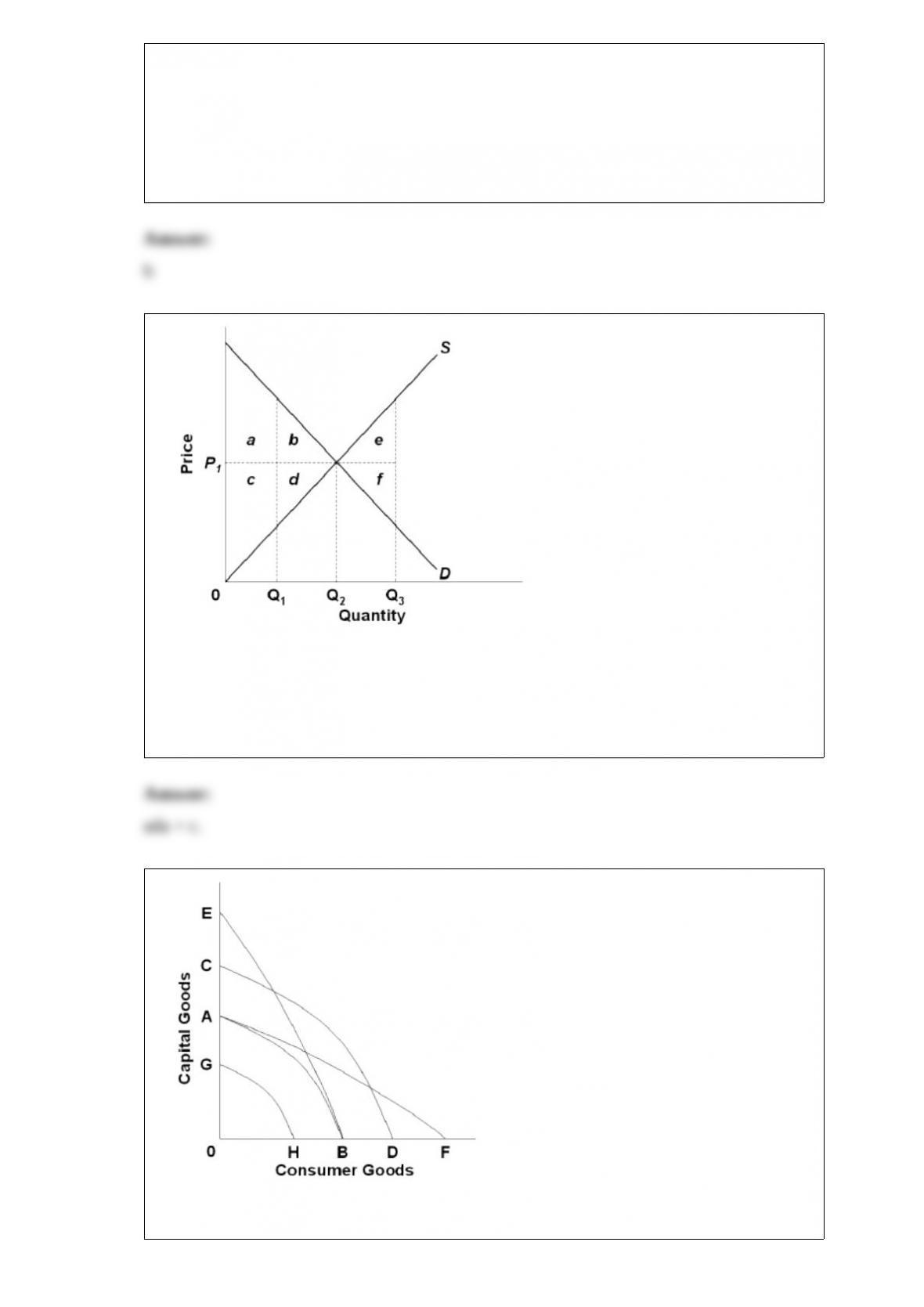
refer to the above diagram. assuming equilibrium price p1, consumer surplus is
represented by areas:
a.a + b.
b.a + b + c + d.
c.c + d.
7)
refer to the above diagram. the concave shape of each production possibilities curve
indicates that:

a.resources are perfectly substitutable.
b.wants are virtually unlimited.
c.prices are constant.
d.resources are not equally suited for alternative uses.
8) If the Fed were to increase the amount of reserves available through the term auction
facility, we would anticipate:
A.lower interest rates, an expanded GDP, and depreciation of the dollar.
B.lower interest rates, an expanded GDP, and appreciation of the dollar.
C.higher interest rates, a contracted GDP, and depreciation of the dollar.
D.lower interest rates, a contracted GDP, and appreciation of the dollar.
9) The total fertility rate:
A.measures the average number of children that a woman is expected to have during
her lifetime.
B.measures the average number of children that each couple is expected to have during
their lifetime.
C.equals the rate of population change over time.
D.rises as income rises.
10) The demand for labor is derived from:
A.the demands for other variable inputs.
B.the cost-minimization rule.
C.consumer demand for the product or service it is helping to produce.
D.the supply of related inputs.
11) the following marginal utility data for products x and y. assume that the prices of x
and y are $4 and $2 respectively and that the consumer’s income is $18.

refer to the above data. what level of total utility will the utility-maximizing consumer
realize?
a.96 utils
b.108 utils
c.72 utils
d.142 utils
12) which of the following statements is correct?
a.united states exports and imports have been decreasing as a percentage of u.s. gdp but
the u.s. share of total world trade has been increasing.
b.united states exports and imports have been decreasing as a percentage of u.s. gdp and
the u.s. share of total world trade has been declining.
c.united states exports and imports have been expanding as a percentage of u.s. gdp and
the u.s. share of total world trade has been increasing.
d.united states exports and imports have been expanding as a percentage of u.s. gdp but
the u.s. share of total world trade has been declining.
13) The idea of efficiency wages is that:
A.the wages of each type of labor must be proportionate to their marginal products.
B.the wages of each type of labor must be equal to their marginal products.
C.firms might get greater work effort by paying above-equilibrium wage rates.
D.workers are more diligent when paid below-equilibrium wages.
14) Suppose the MRP of a firm’s twelfth worker is $22 and the worker’s marginal wage
cost is $16. We can say with certainty that the firm:
A.is hiring labor in a competitive labor market at a wage rate of $16.
B.is hiring labor in a monopsonistic labor market.
C.will find it profitable to hire fewer workers.
D.will find it profitable to hire more workers.
15)
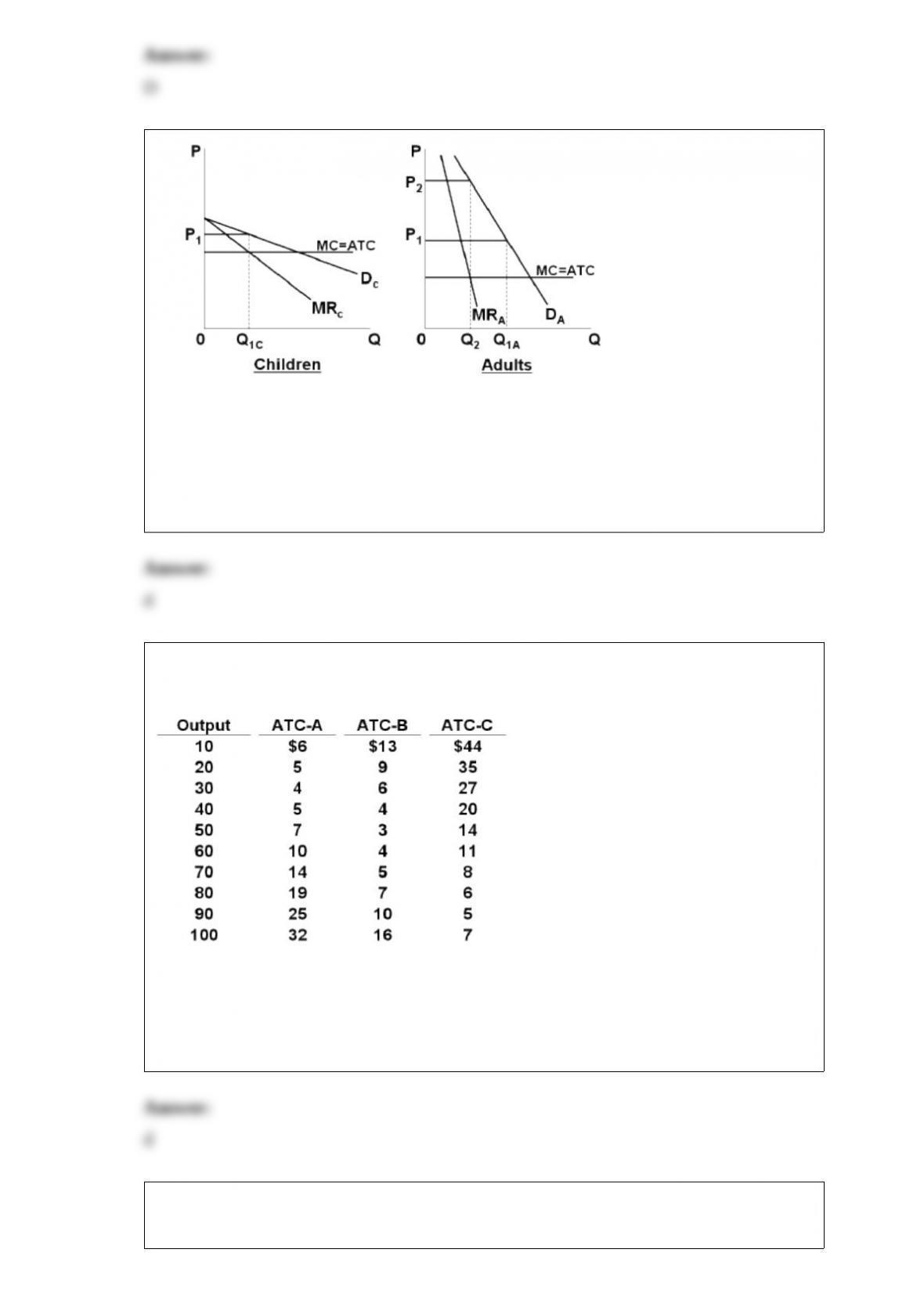
assume the above figure applies to a pure monopolist. if this firm is able to price
discriminate between children and adults, its economic profit will be:
a.(p2 – mc) (q1c + q2).
b.(p1 – mc) (q1c + q2).
c.(p2 – p1) (q1c + q2).
d.[(p1 – mc) q1c] + [(p2 – mc) q2].
16) the letters a, b, and c designate three successively larger plant sizes.
refer to the above data. in the long run the firm should use plant size “c” for:
a.all possible levels of output.
b.10 to 30 units of output.
c.40 to 70 units of output.
d.all units of output greater than 80.
17) the following cost data for a firm that is selling in a purely competitive market.
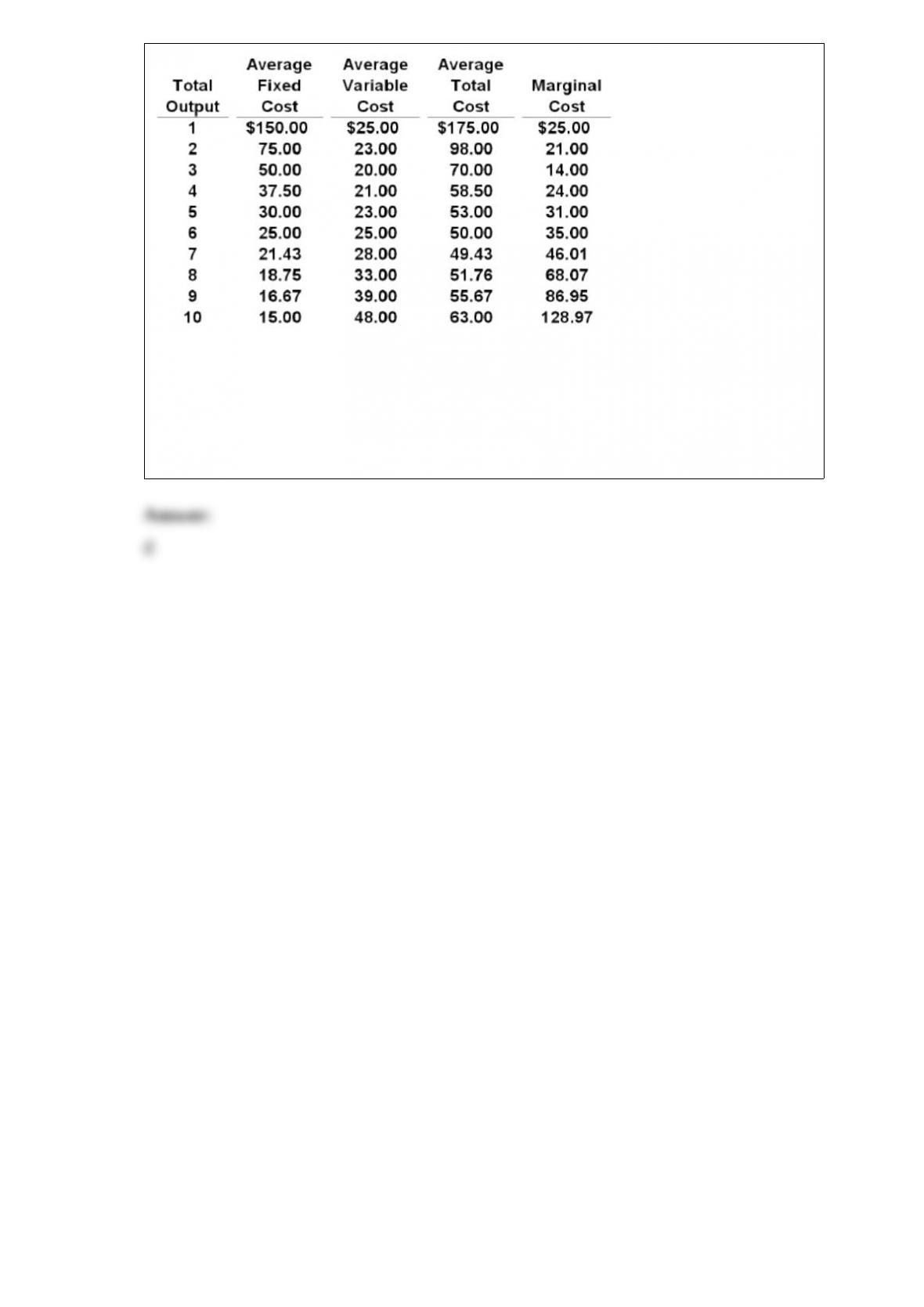
refer to the above data. at 6 units of output, total fixed cost is ____ and total cost is
____
a.$25; $50.
b.$50; $300.
c.$100; $200.
d.$150; $300.