Which of the following is true of price and marginal revenue for the first unit of output
sold by a monopolist?
a. Price is greater than marginal revenue.
b. Price is less than marginal revenue.
c. Price is equal to marginal revenue.
d. This answer could be a or b, depending on whether it is a single-price or a price
discriminating monopolist.
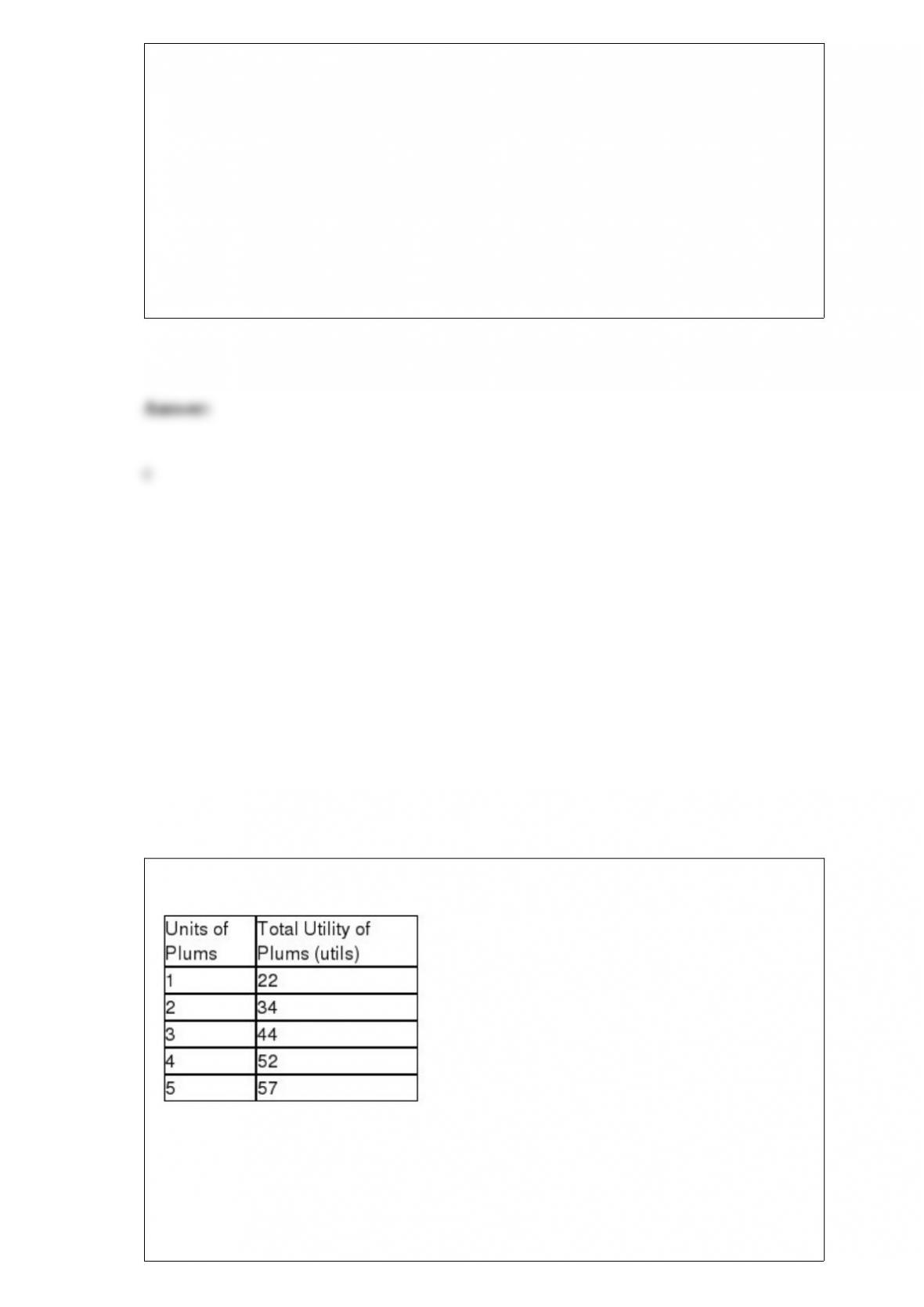
Exhibit 21-1
The marginal utility of the fourth plum is
a. 8 utils.
b. 2 utils.

c. 10 utils.
d. 13.5 utils.
e. 50 utils.
For every gift that A gives to B from the first to the tenth gift, A receives a net benefit of
$10.The additional cost to A of giving an additional gift is constant at $5.It follows that
A’s marginal benefit curve for giving gifts to B is ___________________(assuming that
we place “marginal benefits” on the vertical axis and “number of gifts” on the
horizontal axis).
a. downward-sloping over units 1 -10.
b. upward-sloping over units 1-10.
c. horizontal over units 1-10.
d. vertical over units 1-10.
e. There is not enough information provided to answer the question.
Opportunity cost is the value of
a. the best (or most highly valued) forfeited alternative.
b. the chosen alternative.
c. a free good.
d. all forfeited alternatives.
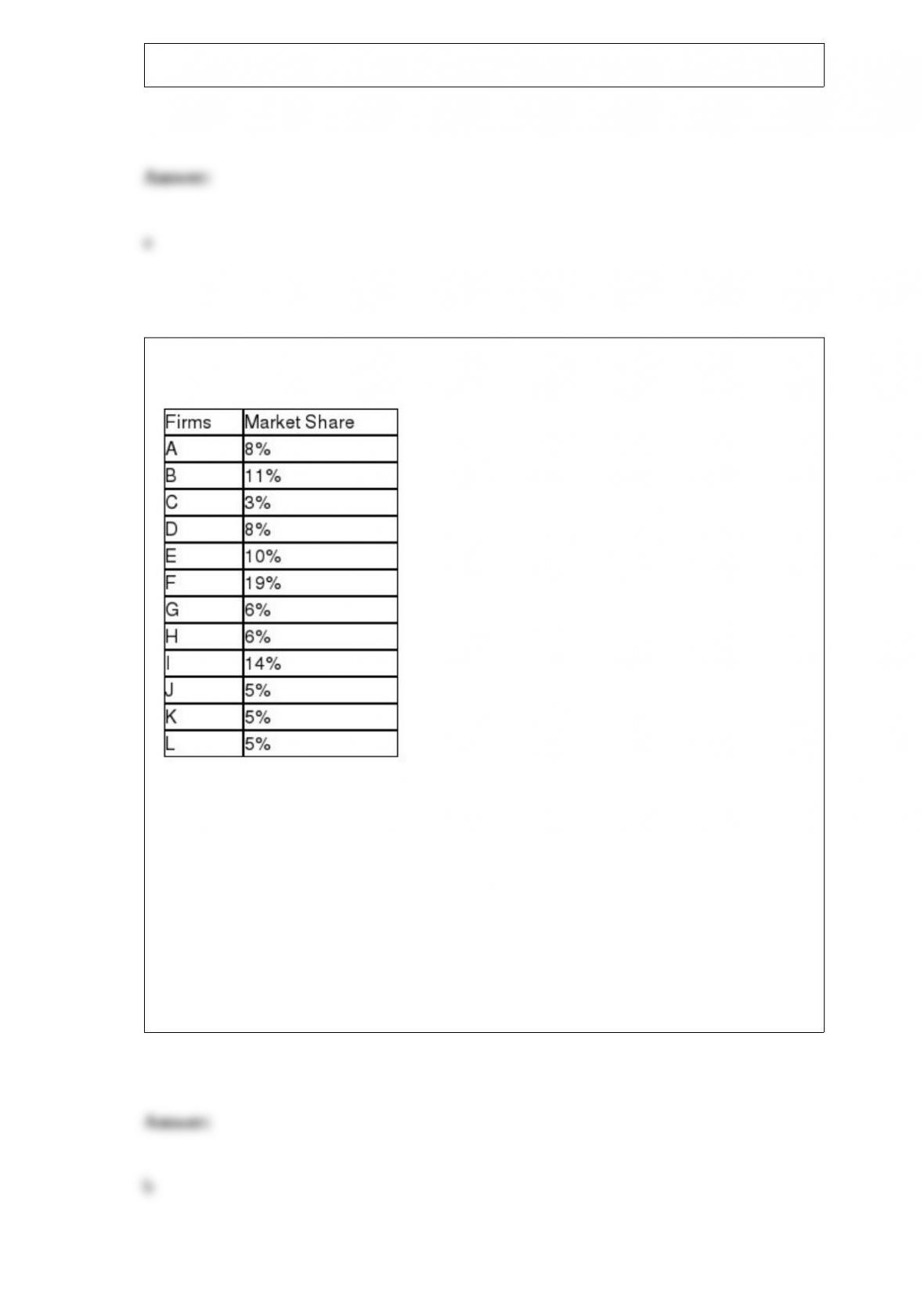
Exhibit 26-3
The Herfindahl Index for this industry is currently
a. 996.
b. 1,062.
c. 1,800.
d. 1,980.
e. 10,000.

If price is on the vertical axis and quantity demanded is on the horizontal axis, why is a
demand curve downward sloping (left to right)?
a. Because a demand curve is the graphical representation of the law of demand, which
specifies an inverse relationship between price and supply, ceteris paribus.
b. Because a demand curve is the graphical representation of the law of demand, which
specifies a direct relationship between price and quantity supplied, ceteris paribus.
c. Because a demand curve is the graphical representation of the law of demand, which
specifies an inverse relationship between price and demand, ceteris paribus.
d. Because a demand curve is the graphical representation of the law of demand, which
specifies a direct relationship between price and demand, ceteris paribus.
e. Because a demand curve is the graphical representation of the law of demand, which
specifies an inverse relationship between price and quantity demanded, ceteris paribus.
If the demand for a good rises by more than the supply of the good falls, then the
good€s equilibrium price will __________ and its equilibrium quantity will
__________.
a. rise; fall
b. rise; rise
c. fall; fall
d. fall; rise

Suppose that a consumer purchases a combination of X and Y such that MUX/PX = 15
utils per dollar and MUY /PY = 10 utils per dollar. To maximize utility, the consumer
should buy
a. less of X and more of Y.
b. more of X and less of Y.
c. more of both X and Y.
d. less of both X and Y.
e. neither X nor Y.
The monopolist’s marginal revenue curve is
a. downward sloping and lies below the firm€s demand curve.
b. upward sloping and lies above the firm€s demand curve.
c. perfectly inelastic.
d. downward sloping and lies above the firm€s demand curve.
e. the same as the industry demand curve.
If government regulators guarantee that a natural monopoly will earn normal profits,
then

a. the monopolist has little or no incentive to hold down its costs.
b. the monopolist has a sharp incentive to hold down its costs so as to increase profits.
c. the monopolist will probably try its best to maintain its costs at the current level.
d. it is impossible to determine the monopolist’s incentives regarding costs before the
firm actually incurs some changes in its costs.
Under the target price system,
a. supply is restricted.
b. consumers must pay the target price.
c. payments are made to the government when the price paid by consumers rises above
the target price.
d. farmers are paid a deficiency payment if the market price for their goods is below the
target price.
e. a and c
A monopolistic competitor has a demand curve that is ___________ elastic than a
perfectly competitive firm€s demand curve and ______________ a monopolistic firm€s
demand curve.
a. less; more elastic than
b. less; less elastic than
c. more; more elastic than
d. less: equally as elastic as
If the supply of aisle seats equals the supply of middle seats on an airplane, and the
demand for aisle seats is _____________ than the demand for middle seats, then the
equilibrium price of aisle seats will be ______________ the equilibrium price of middle
seats.
a. greater; higher than
b. less; higher than
c. greater; lower than
d. less; the same as
If the minimum wage law sets a price floor above the equilibrium wage in the market
for unskilled labor, then the
a. minimum wage will create a surplus of unskilled labor.
b. minimum wage will create a shortage of unskilled labor.
c. minimum wage will not impact the unskilled labor market.
d. unskilled labor market will change, but we cannot be certain how.
Risk
a. is the result of economic rent seeking.
b. is the same as uncertainty.
c. exists when the probability of a given event can be estimated.
d. exists when a potential occurrence is so unpredictable that a probability cannot be
estimated.
e. none of the above