
Suppose the federal budget deficit for the year was $100 billion and the economy was
in a recession. If the economy had been at potential GDP, it is estimated that tax
revenues would have been $60 billion higher and government spending on transfer
payments $50 billion lower. Using these estimates, the cyclically adjusted budget
A) deficit was $210 billion.
B) deficit was $110 billion.
C) surplus was $10 billion.
D) surplus was $110 billion.
Which is the least common type of business?
A) corporation
B) partnership
C) sole proprietorship
D) impossible to determine without further information
The ________ production points on a production possibility curve are the points along
and inside the production possibility frontier.
A) attainable
B) unattainable

C) productively efficient
D) allocatively efficient
Which of the following statements is true?
A) An increase in demand causes an increase in equilibrium price; the increase in price
causes supply to increase.
B) A decrease in supply causes equilibrium price to rise; the increase in price then
results in a decrease in quantity demanded.
C) If both demand and supply decrease, there must be a decrease in equilibrium price;
equilibrium quantity may either increase or decrease.
D) If demand increases and supply decreases one cannot determine if equilibrium price
will increase or decrease without knowing which change is greater.
An increase in investment causes the price level to ________ in the short run and
________ in the long run.
A) increase; increase further
B) increase; decrease
C) decrease; decrease further
D) decrease; increase

The terms of trade refers to
A) the rules and regulations that countries must adhere to when trading.
B) the ratio at which a country can trade its exports for imports from other countries.
C) the role of the government in overseeing international trade.
D) a legal document that specifies the trade quantities agreed to by two countries.
Tax increases on business income decrease aggregate demand by decreasing
A) business investment spending.
B) consumption spending.
C) government spending.
D) wage rates.
Which of the following would decrease the current account balance of the United
States?

A) a decrease in imports
B) a decrease in the amount of money the U.S. government sends in foreign aid to other
countries
C) a decrease in the balance of trade
D) a decrease in the amount of income U.S. companies pay out to foreigners who own
investments in the U.S.
Laura’s Pizza Place incurs $800,000 per year in explicit costs and $100,000 in implicit
costs. The restaurant earns $1.3 million in revenues and has $5 million in net worth.
Based on this information, what is economic profit for Laura’s Pizza Place?
A) $200,000
B) $400,000
C) $500,000
D) $2.8 million
Figure 2-9
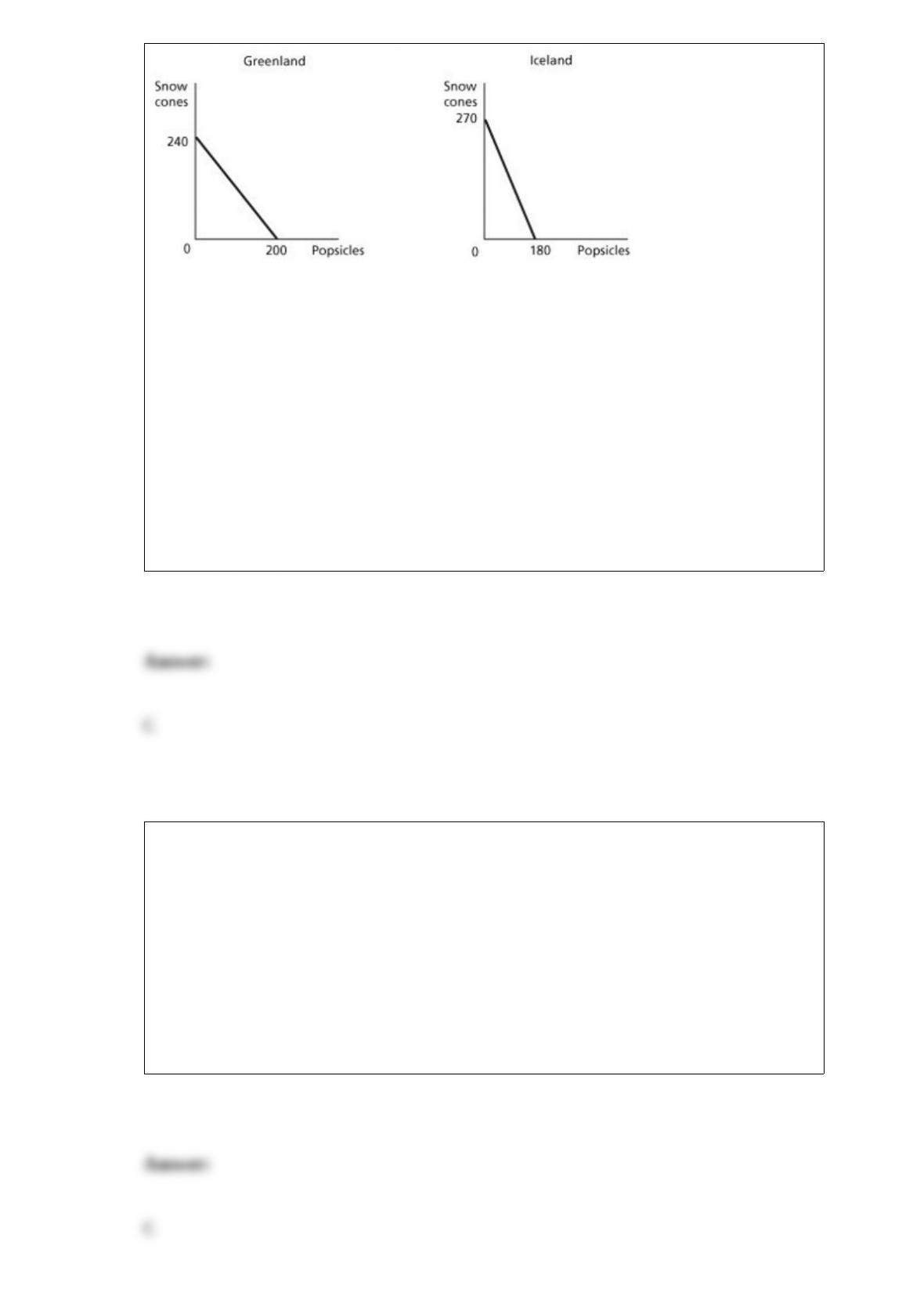
Figure 2-9 shows the production possibilities frontiers for Greenland and Iceland. Each
country produces two goods, snow cones and popsicles.
Refer to Figure 2-9. What is the opportunity cost of producing 1 popsicle in
Greenland?
A) 2/3 of a snow cone
B) 5/6 of a snow cone
C) 1 1/5 snow cones
D) 240 snow cones
Ted quits his $60,000-a-year job to be a stay-at-home dad. What is the opportunity cost
of his decision?
A) 0 since he will no longer be earning a salary
B) depends on the “going rate” for stay-at-home dads
C) at least $60,000
D) the value he attributes to the joy of parenting

One reason Zimbabwe suffered from hyperinflation is that the government had decided
to pay for all of its expenses by
A) selling Treasury bonds to foreign governments.
B) selling its government-run oil company to a private company, which then defaulted
on its payment.
C) raising interest rates to attract foreign direct investment, then nationalizing the
foreign-owned facilities.
D) printing more and more money.
________ of unemployment during ________ make it easier for workers to ________
wages.
A) High levels; a recession; negotiate higher
B) Low levels; an expansion; negotiate higher
C) Low levels; a recession; accept lower
D) High levels; an expansion; accept lower
Figure 7-3
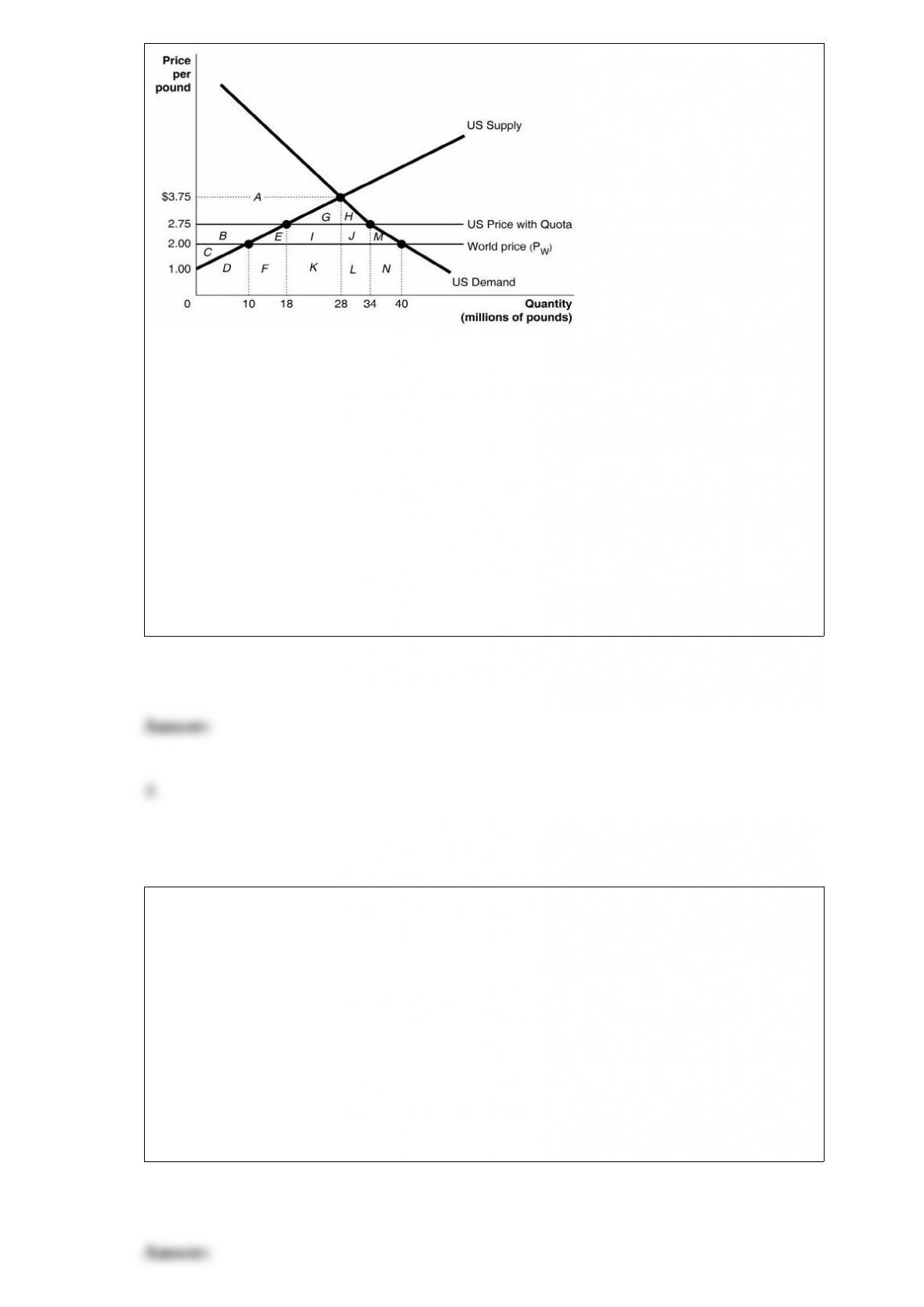
Since 1953 the United States has imposed a quota to limit the imports of peanuts.
Figure 7-3 illustrates the impact of the quota.
Refer to Figure 7-3. If there was no quota, how many pounds of peanuts would
domestic producers supply?
A) 10 million
B) 28 million
C) 30 million
D) 40 million
Employees at the hospital have negotiated a 3 percent increase in wages for the next
year, based on their inflation expectations. If inflation is actually 5 percent over the next
year, which of the following will occur?
A) Unemployment of hospital employees will rise.
B) Real wages for hospital employees will fall.
C) Inflation will be 3 percent the following year.
D) The increase in inflation is expected.

Government deficits tend to increase during
A) recessions and booms.
B) periods of war and recession.
C) periods of below- or above-average growth.
D) periods of increased financial uncertainty.
If the GDP deflator in the United States is 114, and the GDP deflator in Ukraine is 142,
which of the following exchange rates would the theory of purchasing power parity
predict in the long run? (The Ukrainian currency is the hryvnia.)
A) 0.80 hryvnias per dollar
B) 1.25 hryvnias per dollar
C) 2.80 hryvnias per dollar
D) 28 hryvnias per dollar
An explicit cost is

A) a nonmonetary opportunity cost.
B) a cost specifically related to government rules and regulations.
C) a cost that involves spending money.
D) a cost unique to corporations.