1) The bank panics of 1930-1933:
A.resulted in the passage of the Smoot-Hawley Act.
B.boosted the nation’s money supply, causing inflation.
C.directly resulted in the Federal insured deposit program.
D.caused a significant outflow of gold from the United States.
2) Since 1950, farm productivity has:
A.advanced twice as fast as in nonfarm sectors of the economy.
B.lagged behind productivity advances in the nonfarm economy.
C.almost exactly matched productivity increases in the rest of the economy.
D.doubled.
3)
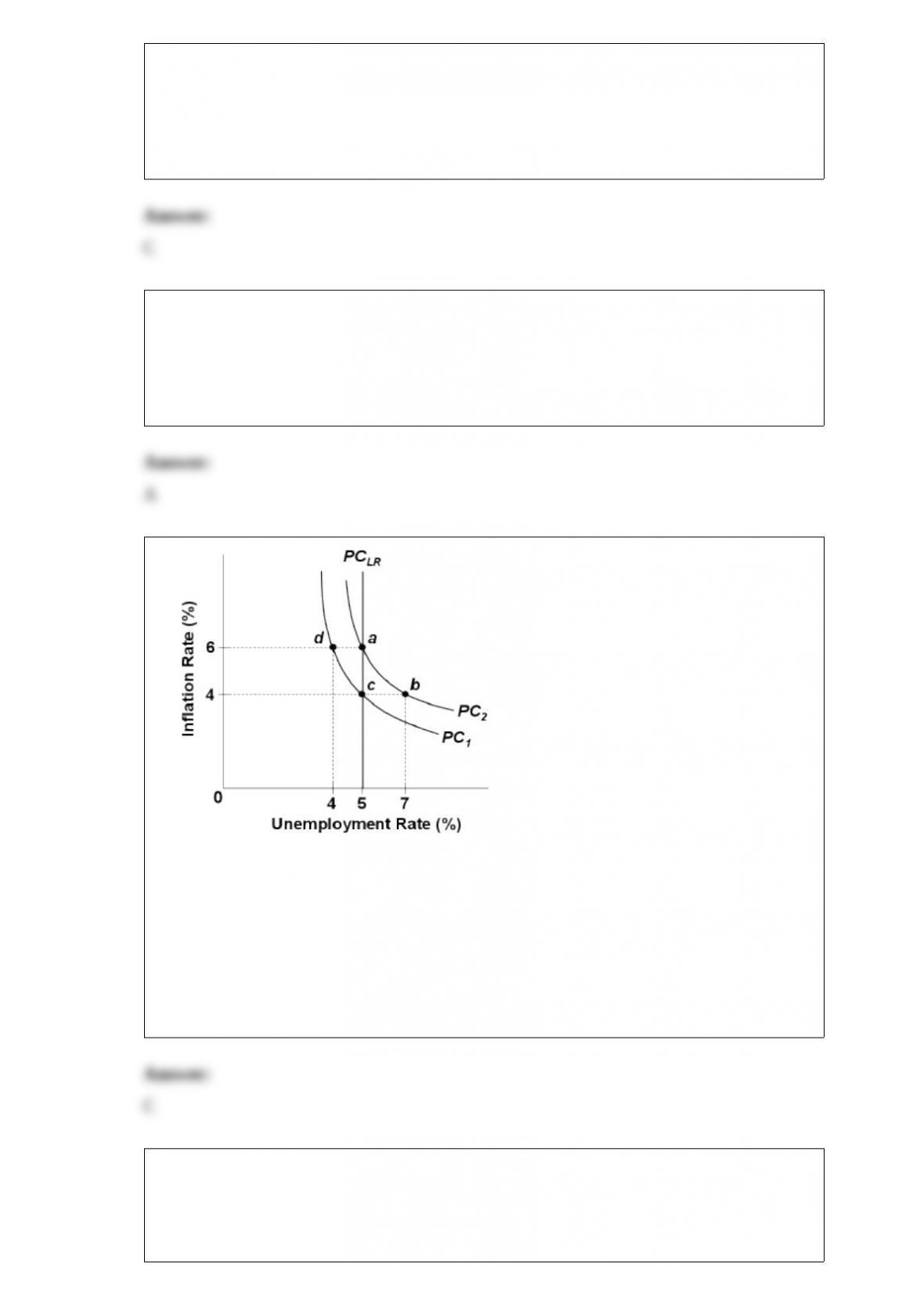
Refer to the above diagram. Assume that the natural rate of unemployment is 5 percent
and that the economy is initially operating at point a where the expected and actual rates
of inflation are each 6 percent. In the long run, the decline in the actual rate of inflation
from 6 percent to 4 percent will:
A.reduce the unemployment rate.
B.reduce corporate profits in real terms.
C.have no effect on the unemployment rate.
D.reduce real domestic output.
4) If per capita trash generation is constant over time, this implies that:
A.per capita consumption of solids has also been constant.
B.per capita consumption of goods and services has also been constant.
C.total consumption of solids has also been constant.

D.total consumption of goods and services has also been constant.
5) economists use the term imperfect competition to describe:
a.all industries which produce standardized products.
b.any industry in which there is no nonprice competition.
c.a pure monopoly only.
d.those markets which are not purely competitive.
6) In January 2008, the supply of money (M1) in the United States was about:
A.$247 billion.
B.$1600 billion.
C.$1365 billion.
D.$7499 billion.
7) the optimal point on a production possibilities curve is achieved where:
a.the smallest physical amounts of inputs are used to produce each good.
b.each good is produced at a level where marginal benefits equal marginal costs.
c.large amounts of capital goods are produced relative to consumer goods.
d.large amounts of consumer goods are produced relative to capital goods.
8) in economics, the pleasure, happiness, or satisfaction received from a product is
called:
a.marginal cost.
b.rational outcome.
c.status fulfillment.
d.utility.
9)
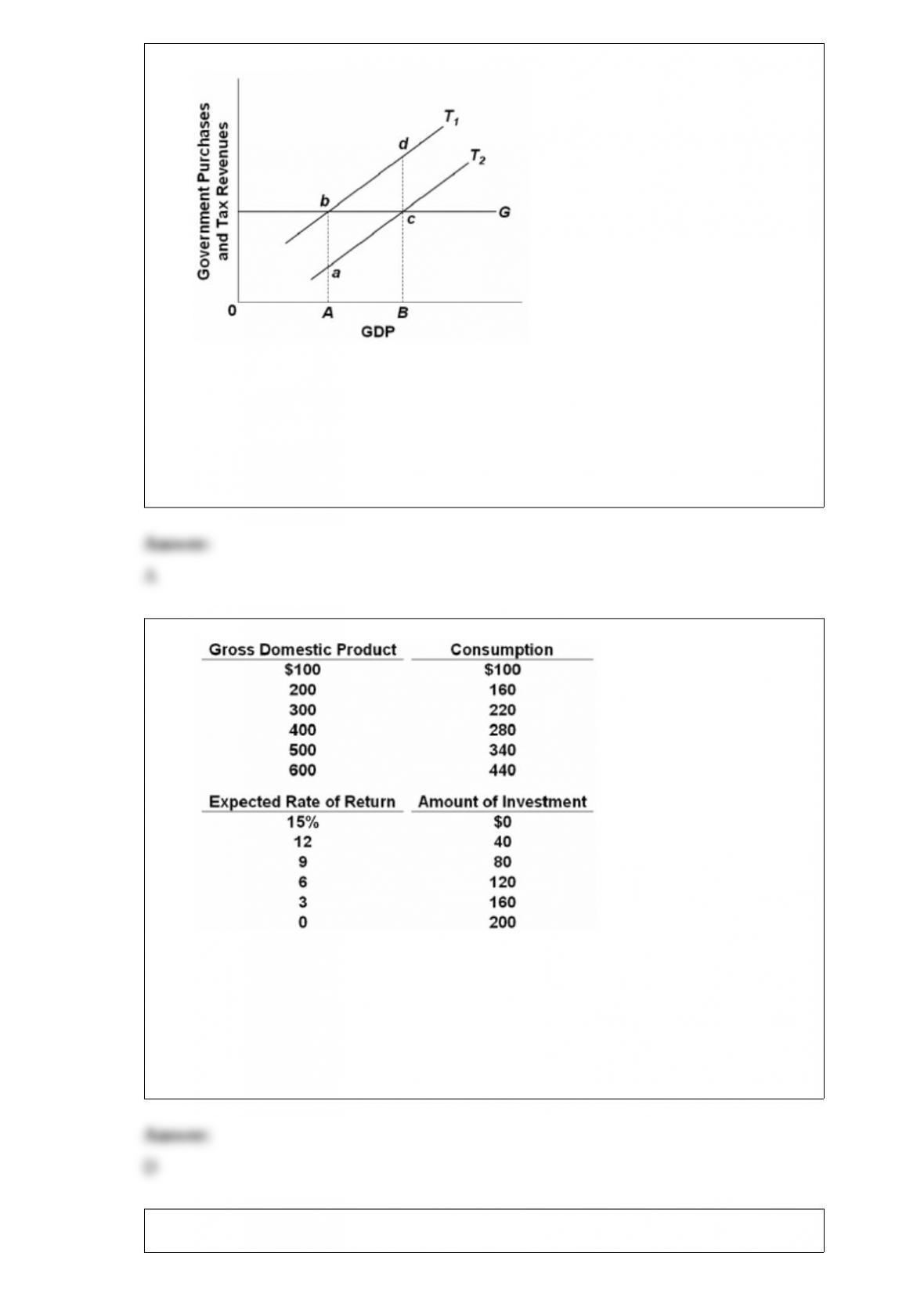
Refer to the above diagram. Assume that G and T1 are the relevant curves, the economy
is currently at A, and the full-employment GDP is B. This economy has a(n):
A.standardized budget surplus.
B.standardized budget deficit.
C.actual budget deficit.
D.actual budget surplus.
10)
Refer to the above information. If the real interest rate is 9 percent, the equilibrium
GDP will be:
A.$600.
B.$500.
C.$400.
D.$300.
11) The following table in which columns (1) and (2) indicate the transactions demand
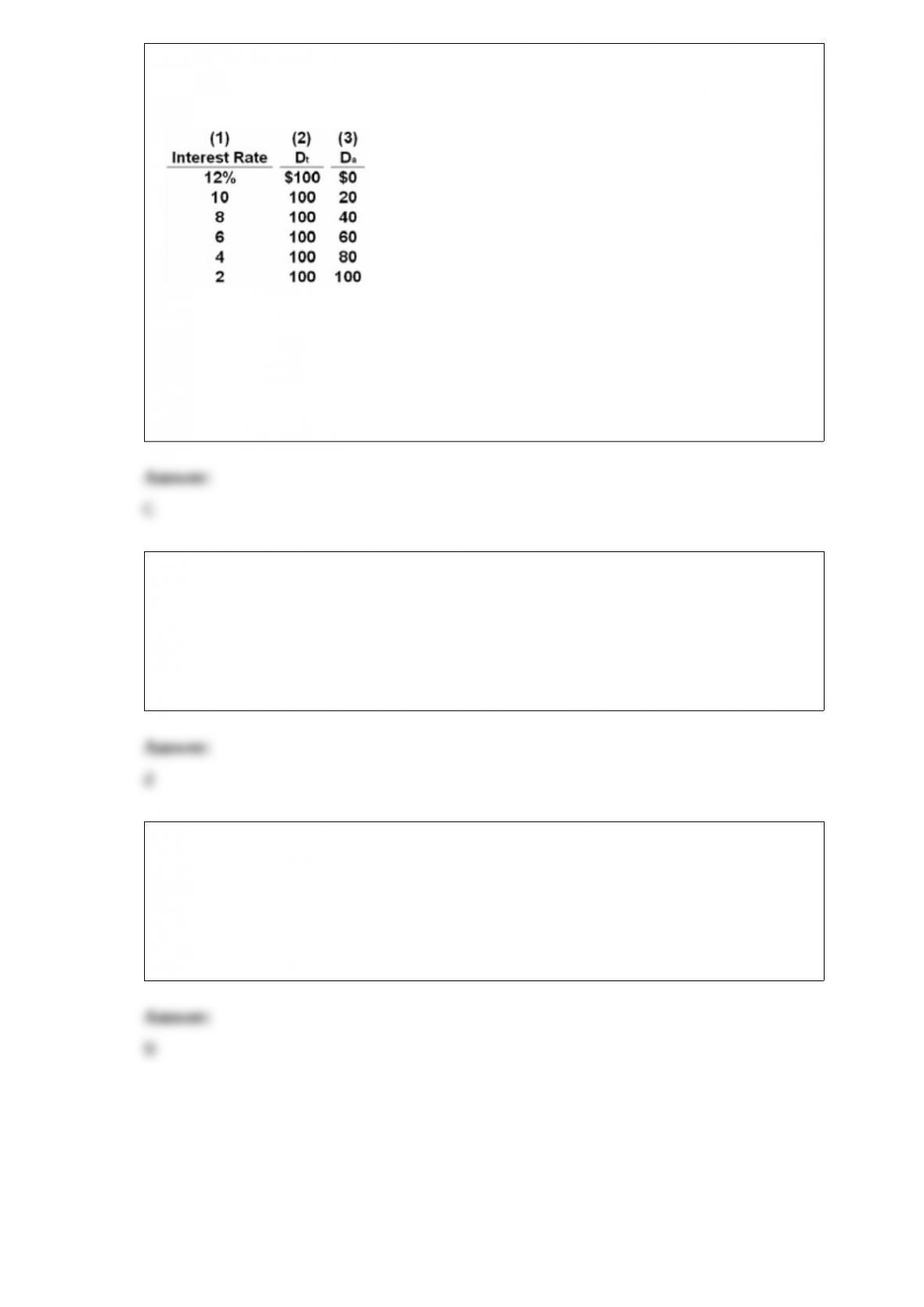
(Dt) for money and columns (1) and (3) show the asset demand (Da) for money:
Refer to the above data. If the money supply is $160, the equilibrium interest rate will
be:
A.10 percent.
B.8 percent.
C.6 percent.
D.4 percent.
12) the invisible-hand concept suggests that:
a.changes in product demands are only randomly reflected in changes in the demands
for resources.
b.profit maximization is inconsistent with an efficient allocation of resources.
c.government action is necessary to correct for market failures.
d.when firms maximize their profits, society’s output will also be maximized.
13) Assume that a restaurant is hiring labor in an amount such that the MRC of the last
worker is $16 and her MRP is $12. On the basis of this information we can say that:
A.profits will be increased by hiring additional workers.
B.profits will be increased by hiring fewer workers.
C.marginal revenue product must exceed average revenue product.
D.the restaurant is maximizing profits.
14)
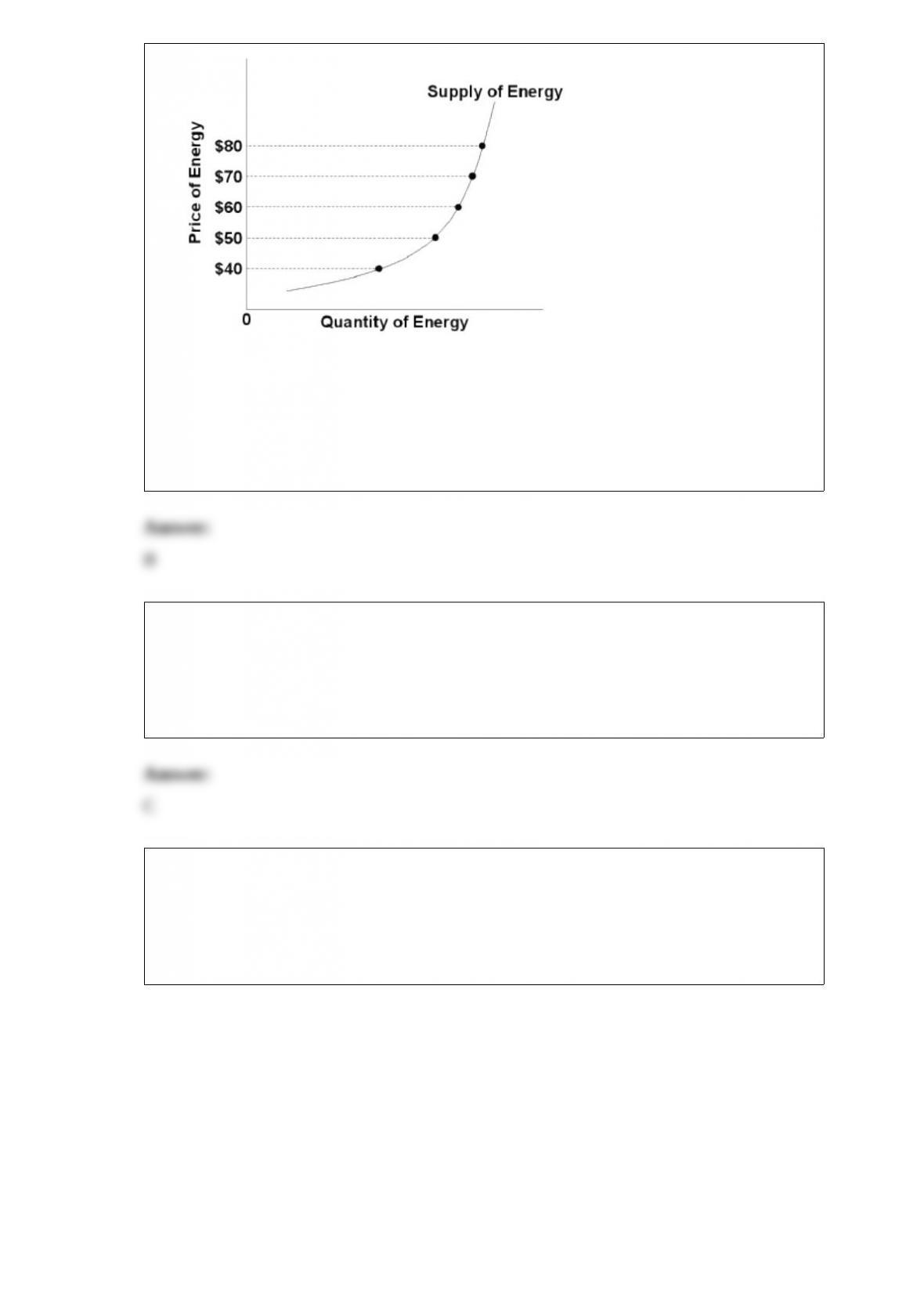
Refer to the diagram above. Assuming it represents the overall supply of energy, at what
per barrel price of oil does the extraction of shale oil become economically viable?
A.$40.
B.$50.
C.$60.
D.$70.
15) Other things equal, serious recession in the economies of U.S. trading partners will:
A.have no perceptible impact on the U.S. economy.
B.cause inflation in the U.S. economy.
C.depress real output and employment in the U.S. economy.
D.stimulate real output and employment in the U.S. economy.
16) Following are the consolidated balance sheets of the commercial banks. Assume
that the reserve ratio for banks is 10%. The figures in column 1 show the balance sheets
condition prior to each of the following five transactions. Place the new balance-sheet
figures in the appropriate columns and complete A, B, C, D, and E for each column.
Start each part (26) with the figures in column 1. All figures are in billions of dollars.
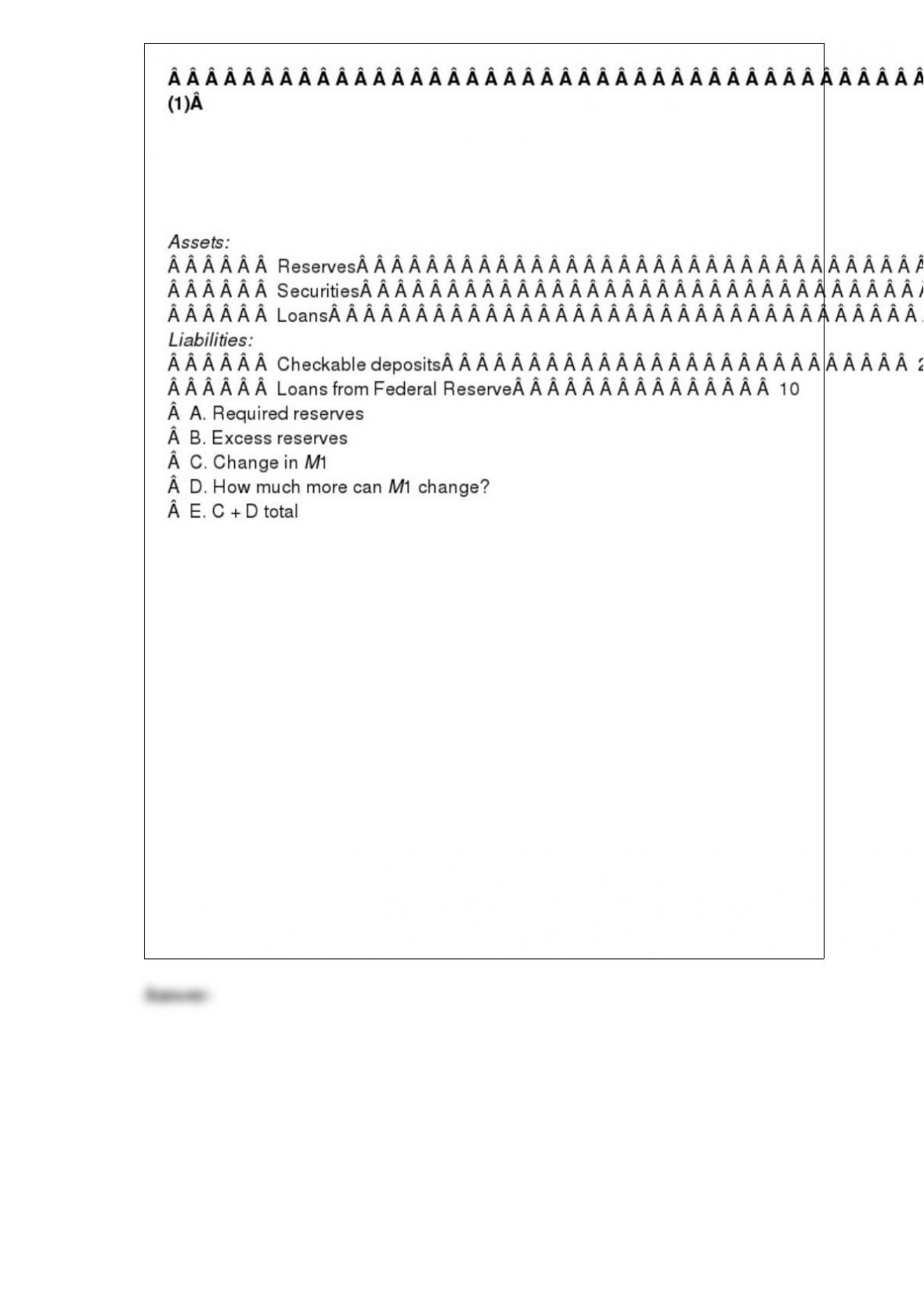
(a)Show in column 2 the initial results of the Federal Reserve selling $3 billion in
securities to the public which pays by checks.
(b)Show in column 3 the initial results of the Federal Reserve buying $4 billion in
securities from the commercial banks.
(c)Show in column 4 the initial results of the Federal Reserve raising the reserve ratio to
20%.
(d)Show in column 5 the initial results when the U.S. Government buys $5 billion
worth of goods from American businesses with checks from the U.S. Treasury account
at the Federal Reserve Banks and the businesses immediately deposit these checks in
their commercial banks.
(e)Show in column 6 the initial results when the Federal Reserve raises the discount
rate which causes commercial banks to repay $6 billion in loans owed to the Federal
Reserve.
17) the marginal revenue curve of a purely competitive firm:
a.lies below the firm’s demand curve.
b.increases at an increasing rate as output expands.
c.is horizontal at the market price.
d.is downsloping because price must be reduced to sell more output.
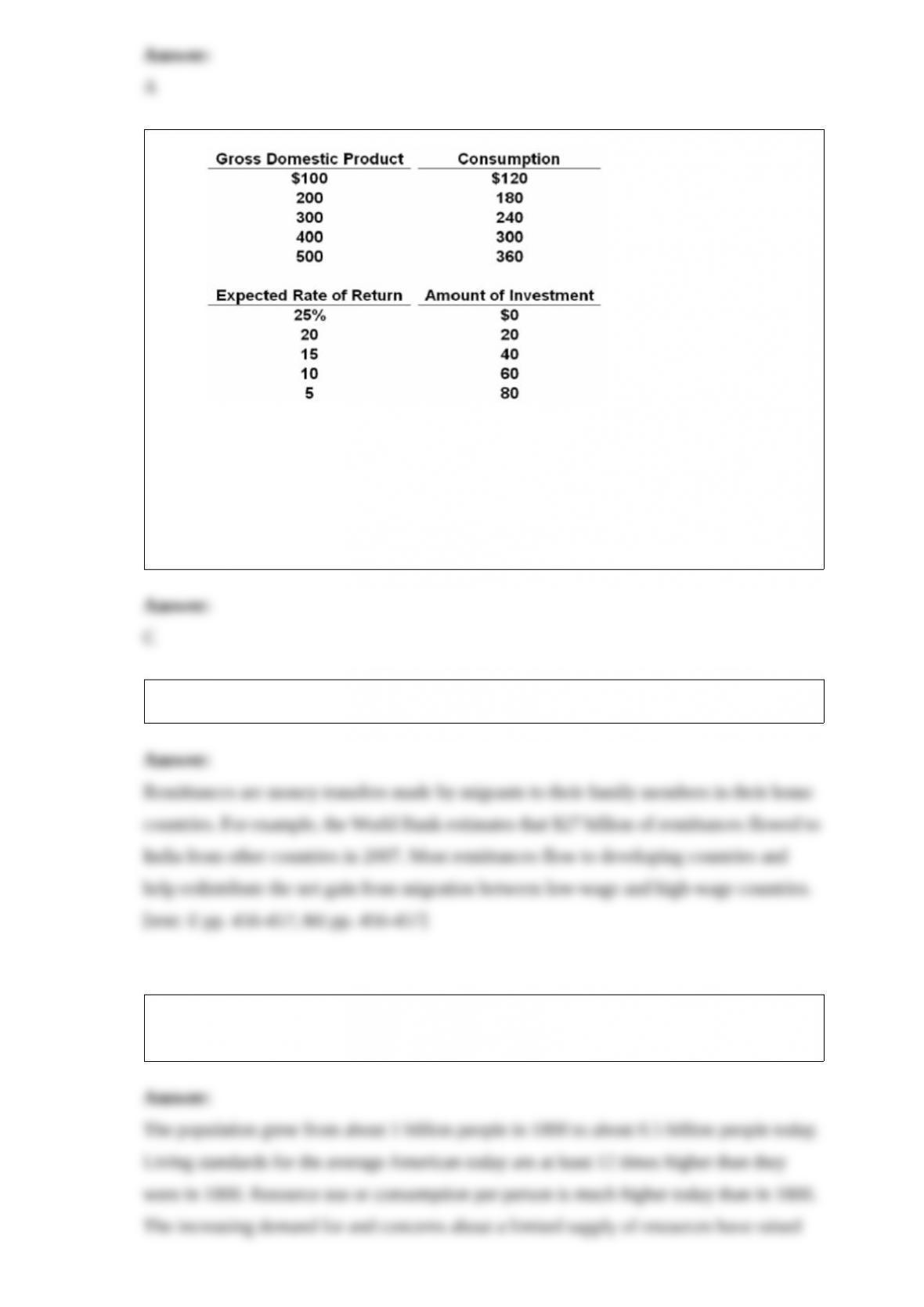
18) Answer the next question(s) on the basis of the following table for a particular
country in which C is consumption expenditures, Ig is gross investment expenditures, G
is government expenditures, X is exports, and M is imports. All figures are in billions of
dollars. Each question is independent of the other questions.
Refer to the above table. If the amounts of GDP supplied at the price levels shown (in
descending order) are $45, $43, $40, $37, and $31, the equilibrium level of real GDP
will be:
A.$37 billion.
B.$35 billion.
C.$26 billion.
D.$43 billion.
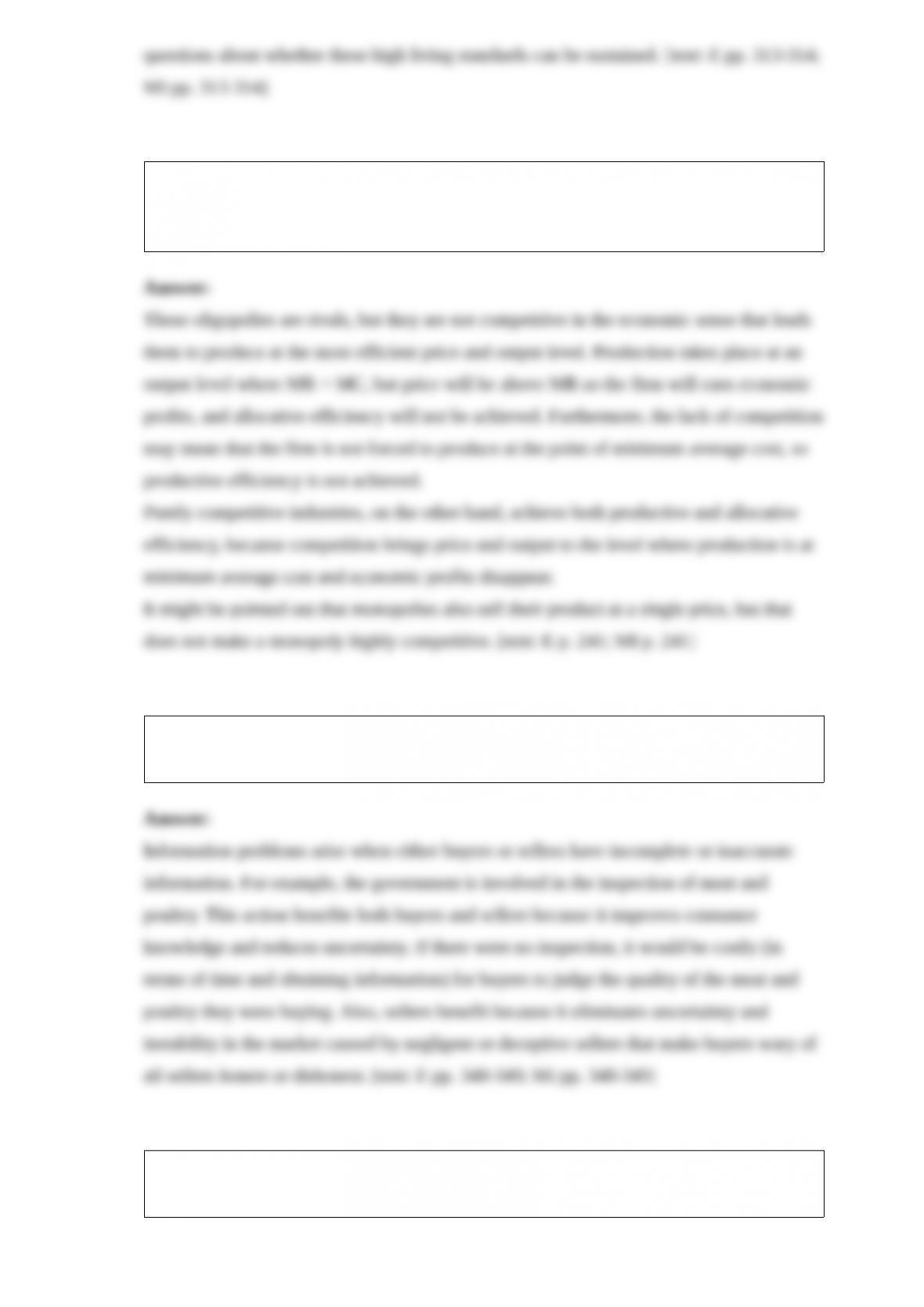
19)
Refer to the above information. If the real interest rate is 10 percent, the equilibrium
GDP will be:
A.$100.
B.$200.
C.$300.
D.$400.
20) Define remittances.
21) Describe the changes in population and living standards since 1800. What
implications do these changes raise about standards of living today?
22) Purely competitive firms sell their product at the same price. This is also true in
some oligopolistic markets with standardized products. Therefore, these oligopolies are
actually highly competitive. Evaluate critically.
23) What are information problems affecting sellers? Give an example that illustrates
how these types of problems are resolved.
24) What is the difference between income and wealth? How can wealth contribute to
income inequality?