
Suppose thatAmerican firms claim that protectionism in Canada is on the rise as the
Canadian government attempts to protect its infant industries. This protectionism will
cause the greatest harm to
A) Canadian manufacturers.
B) the Canadian government.
C) manufacturers who export to Canada.
D) Canadian consumers.
The Bretton Woods system confronted severe problems in the 1960s, problems which
included
A) some countries with overvalued currencies refused to devalue their currencies.
B) dollars held by foreign central banks exceeded gold reserves held by the United
States.
C) the increased demand for gold brought about by lifting the prohibition against U.S.
citizens owning gold.
D) all of the above
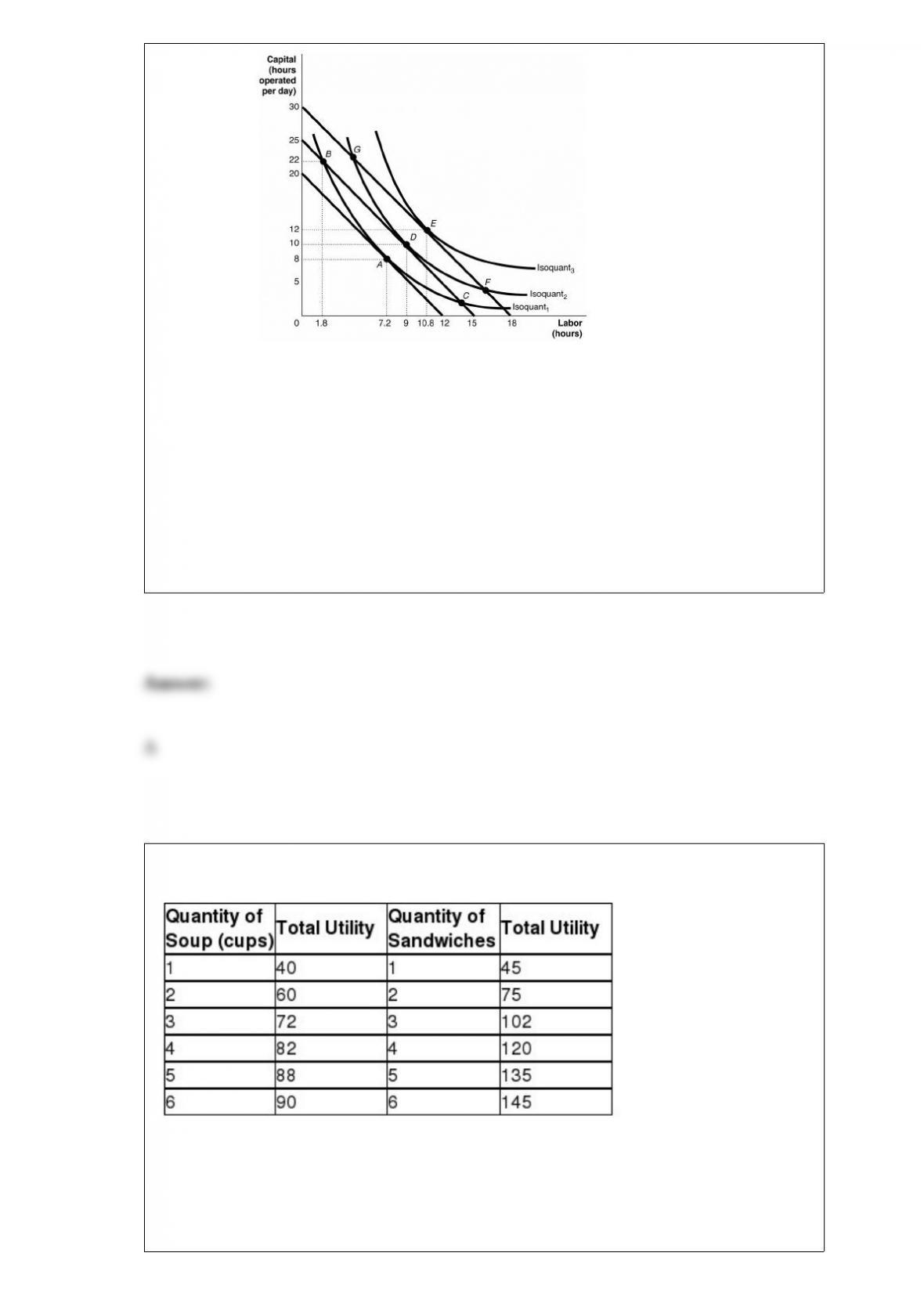
Figure 11-18
Starting from point d a movement along isoquant1 to point f
A) increases the total cost of production with no change in output.
B) increases output but not the total cost of production.
C) increases the total cost of production and decreases output.
D) increases both the total cost of production and output.
Table 10-2
Table 10-2 above shows Keira’s utility from soup and sandwiches. The price of soup is
$2 per cup and the price of a sandwich is $3. Keira has $18 to spend on these two
goods. Holding prices constant, when Keira’s income changed from $18 to $23, her
utility maximizing bundle changed. Based on your answers to her optimal choices at the
two income levels, what type of goods are soup and sandwiches?

A) Soup is an inferior good and sandwiches are a normal good.
B) Soup is a normal good and sandwiches are an inferior good.
C) Both soup and sandwiches are normal goods.
D) Both soup and sandwiches are inferior goods.
Disposable personal income equals personal income
A) minus personal tax payments.
B) plus government transfer payments.
C) minus personal tax payments plus government transfer payments.
D) minus government transfer payments plus personal tax payments.
When a recession ends,
A) interest rates decrease.
B) households decrease spending on durable goods.
C) the household sector decreases spending substantially.
D) firms increase the amount of borrowing.
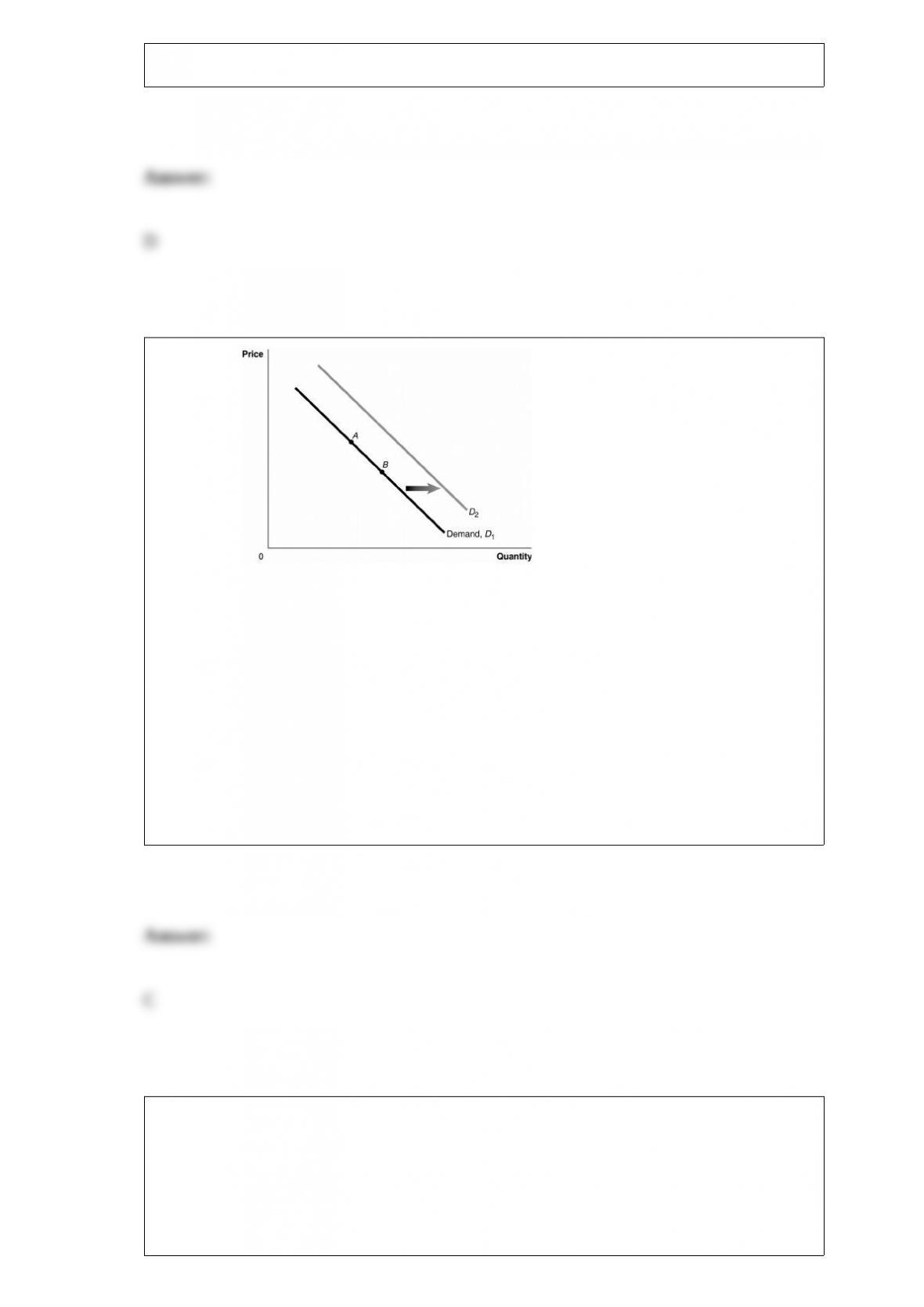
Figure 3-1
If the product represented is a normal good, an increase in income would be represented
by a movement from
A) A to B.
B) B to A.
C) D1 to D2.
D) D2 to D1.
Which of the following labor market statistics best indicates the amount of labor that is
available to the economy from a given working-age population?
A) unemployment rate
B) discouraged-worker ratio

C) labor force participation rate
D) the ratio of minimum wage to inflation
In the economic sense, almost everything is scarce. ________ of a good or service
occurs when the quantity demanded is greater than the quantity supplied at the current
market price.
A) Scarcity
B) A shortage
C) A surplus
D) An overstock
When you purchase a new pair of jeans you do so in the
A) factor market.
B) input market.
C) product market.
D) resource market.

Few firms in the United States are monopolies because
A) few firms experience economies of scale.
B) of antitrust laws.
C) when a firm earns profits, other firms will enter its market.
D) most products that firms produce have substitutes.
In Walnut Creek, California, there are three very popular supermarkets: Safeway, Whole
Foods and Lunardi’s. While Safeway remains open twenty-four hours a day, Whole
Foods and Lunardi’s close at 9 pm. Which of the following statements is true?
A) Safeway is a monopoly all day because it produces a service that has no close
substitutes.
B) Safeway has a monopoly at midnight but not during the day.
C) Safeway can ignore the pricing decisions of the other two supermarkets.
D) Safeway probably has a higher markup to compensate for its higher cost of
production.

The period between a business cycle peak and a business cycle trough is called
A) expansion.
B) recession.
C) diffusion.
D) recalculation.
All else being equal, if the rate of growth in productivity in Spain is greater than the
rate of growth in productivity in the United States, the euro
A) will decrease in value relative the U.S. dollar.
B) will increase in value relative to the U.S. dollar.
C) will nominally appreciate against the dollar, but its real value relative to the dollar
will remain unchanged.
D) will nominally depreciate against the dollar, but its real value relative to the dollar
will remain unchanged.
To decrease the money supply, the Federal Reserve could
A) lower the discount rate.
B) raise income taxes.
C) lower the required reserve ratio.
D) conduct an open market sale of Treasury securities.
E) raise transfer payments.
The U.S. government’s focus on supply reduction efforts in its “war on drugs” has been
relatively unsuccessful at addressing illegal drug use. Some economists believe that a
successful anti-drug program must concentrate on reducing demand; for example,
through drug education and voluntary treatment programs for addicts.
a. Suppose the price elasticity of demand for cocaine is -0.5. What will happen to the
equilibrium price, quantity and total revenue from cocaine sales if the government
succeeds in its efforts to reduce demand? What is likely to happen to the incentive to
sell cocaine?
b. Suppose the government continues to concentrate its efforts on supply reduction and
is able to reduce the supply of cocaine. As a result of the reduction in supply the price
of cocaine increases by 25 percent. If the price elasticity of demand is -0.5, what is
likely to happen to the incentive to sell cocaine?
c. Based on your answers, explain why one approach might be preferred over the other.

If the per-worker production function shifts down,
A) it now takes more capital per hour worked to get the same amount of real GDP per
hour worked.
B) an economy can increase its real GDP per hour worked without changing the level of
capital per hour worked.
C) the per-worker production function becomes steeper.
D) positive technological change has occurred in the economy.
In long-run equilibrium, compared to a perfectly competitive market, a
monopolistically competitive industry produces a ________ level of output and charges
a ________ price.
A) higher; lower
B) lower; lower
C) lower; higher
D) higher; higher
The automatic budget surpluses and budget deficits that occur in the federal budget over
the business cycle
A) destabilize the economy.
B) stabilize the economy.

C) decrease potential GDP.
D) increase potential GDP.