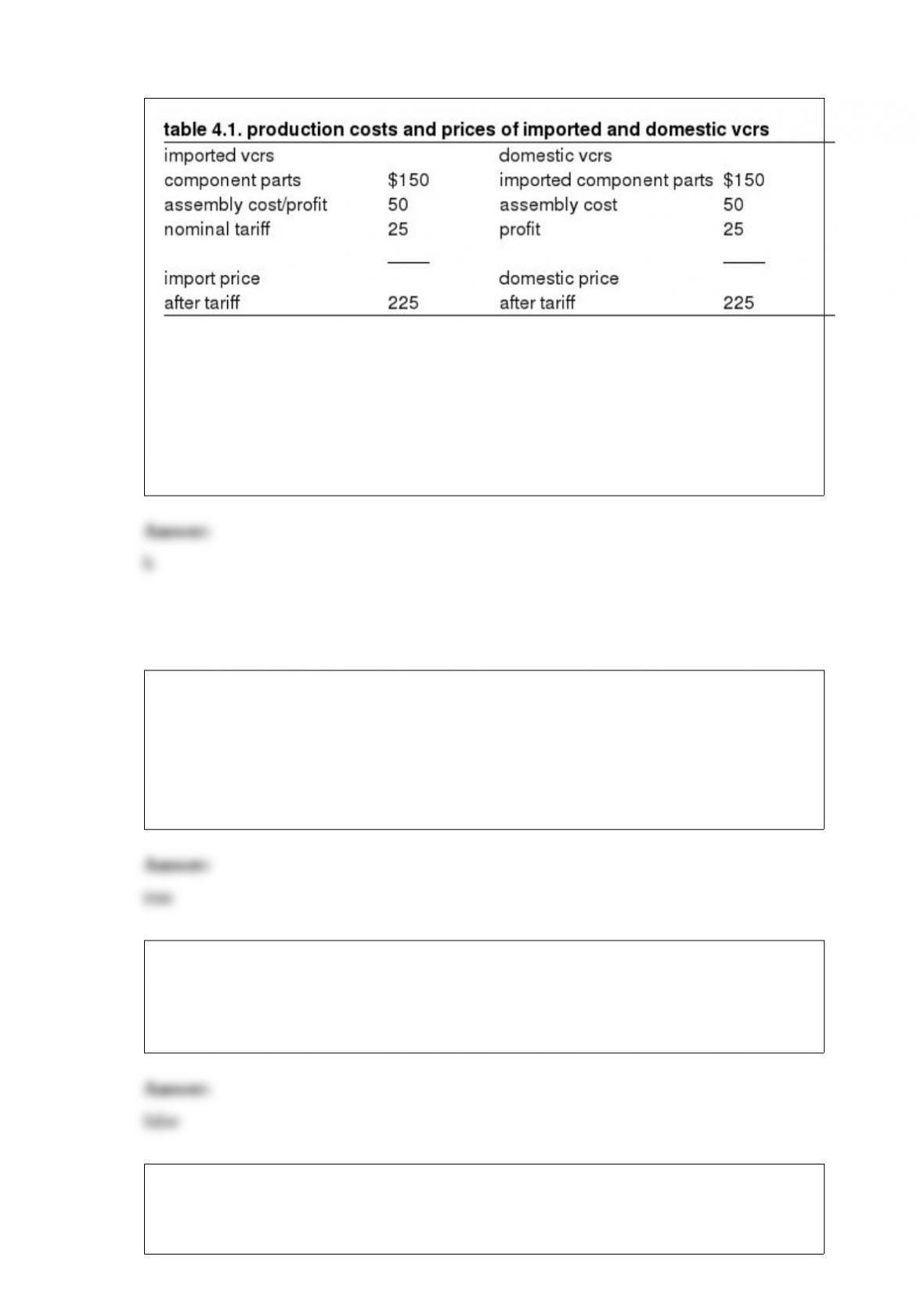
1) consider table 4.1. prior to the tariff, the total price of domestically-produced vcrs is:
a.$150
b.$200
c.$225
d.$250
2) trade creation tends to more than offset trade diversion for a home country forming a
customs union with partner countries when: (1) the tariff rate in the home country is
high prior to the formation of the customs union; (2) there are a large number of
countries forming the customs union.
a.true
b.false
3) if canada has a higher wage level and higher labor productivity than mexico, canada
will necessarily produce a good at a higher labor cost than mexico.
a.true
b.false
4) the purpose of international reserves is to finance:
a.short-term surpluses in the balance of payments
b.long-term surpluses in the balance of payments

c.short-term deficits in the balance of payments
d.long-term deficits in the balance of payments
5) proponents of the smoot-hawley act of 1930 viewed it as a means of combating
domestic unemployment.
a.true
b.false
6) boeing inc. has criticized the airbus company’s competitiveness on the grounds that
airbus benefits from:
a.import tariffs protecting airbus in the european market
b.import quotas protecting airbus in the european market
c.lenient environmental standards of european governments
d.production subsidies supplied by european governments
7) assume that the united states imports vcrs from south korea at a price of $200 per
unit and that these vcrs are subject to an import tariff of 20 percent. also assume that
u.s. components are used in the vcrs assembled by south korea and that these
components have a value of $100. under the offshore assembly provision of u.s. tariff
policy, the price of an imported vcr to the u.s. consumer after the tariff has been levied
is $220.
a.true
b.false
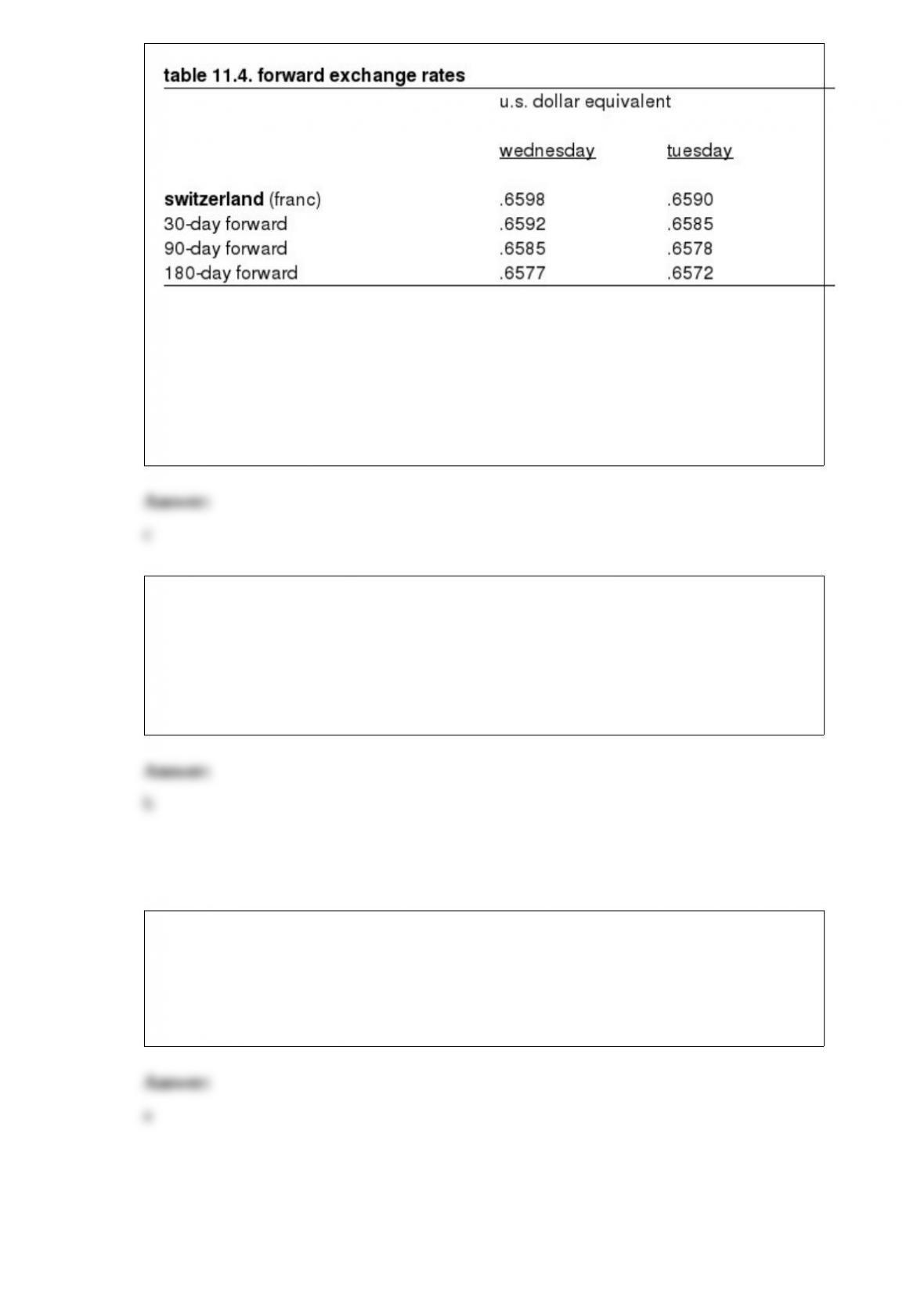
8) refer to table 11.4. on wednesday, the 90-day forward franc was selling at a:
a.0.8 percent premium per annum against the dollar
b.1.6 percent premium per annum against the dollar
c.0.8 percent discount per annum against the dollar
d.1.6 percent discount per annum against the dollar
9) a widely used indicator to differentiate developed countries from developing
countries is:
a.international trade per capita
b.real income per capita
c.unemployment per capita
d.calories per capita
10) adjustment assistance is sometimes used to assist:
a.in retraining workers displaced by imports
b.in retraining workers displaced by exports
c.foreign firms injured by our quotas
d.foreign firms injured by our tariffs