
If crowding out occurs, the Main Burden of the debt is
a. smaller government assets passed along to the next generation.
b. smaller capital stock passed along to the next generation.
c. fewer government services during this generation.
d. higher debt payments passed along to the next generation.
At levels of GDP above full employment, the federal budget would usually be in a
deficit position.
a. True
b. False
The supply curve of a natural resource like oil has a positive slope because
a. the supply becomes closer to exhaustion as demand rises.
b. it becomes more costly to find and develop supplies as demand rises.
c. rents rise as output increases.
d. indirect taxes rise with output.

Many economists think that, in the long run, the economy tends to move toward
a. the natural or full-employment rate of unemployment.
b. the natural or full-employment rate of inflation.
c. a severe slump with high unemployment.
d. an accelerating rate of inflation.
When a resource is being depleted and becomes scarce, the market’s way of
encouraging conservation is for the price of the resource to rise, without any
government intervention.
a. True
b. False

The monetary policies carried out by the Fed
a. must be ratified by Congress.
b. must be consistent with fiscal policies passed by Congress.
c. are sometimes inconsistent with fiscal policy.
d. must be approved by the president.
When interest rates decrease, banks will normally
a. increase lending, but decrease deposits and the money supply.
b. increase lending, deposits, and the money supply.
c. decrease lending, but increase deposits and the money supply.
d. decrease lending, deposits, and the money supply.
Price discrimination only occurs under monopoly.
a. True
b. False

A bond’s price is sensitive to changes in
a. the interest rate.
b. the accepted rate of return on investment.
c. investor confidence in the stability and credit worthiness of the firm.
d. All of the above are correct.
Rising prices for a natural resource stimulate
a. the development of complements for the resource.
b. the development of substitutes for the resource.
c. the development of externalities from the resource.
d. All of the above are correct.

In early 1996, the upper Midwest suffered record cold, with wind chills of fifty degrees
below zero or worse. Yet, grocery stores stocked fresh citrus fruit (obviously not grown
locally). Why did grocers stock the fruit?
a. the desire for profit
b. concern for their neighbors
c. the need to dispose of excess production
d. government orders to distribute fruit
e. All of the above are correct.
Using the saving-investment approach, which of the following describes an equilibrium
condition of GDP?
a. I = X − IM
b. S = X − IM
c. I = S + (X − IM)
d. S = I + (X − IM)
The Fed’s loan that effectively nationalized AIG was approved by Congress.

a. True
b. False
Which of the following items are included in GDP? For those items not included,
explain why they are not included in GDP.
a. Jane buys newly issued shares of stock in Macro.com, Inc.
b. Ross buys a new pair of jeans at a local department store.
c. Joey has his mustache trimmed at his hair salon.
d. Rachel buys an antique chest at a resale shop.
e. Monica makes her own pasta sauce in her apartment.
f. Phoebe grows her own herbs on her apartment balcony.
g. Michael travels to Austria and buys wine and cheese.
Providing medical services for smaller fees to the poor than to the rich is
a. misplaced charity.
b. benevolent pricing.
c. price discrimination.
d. social pricing.
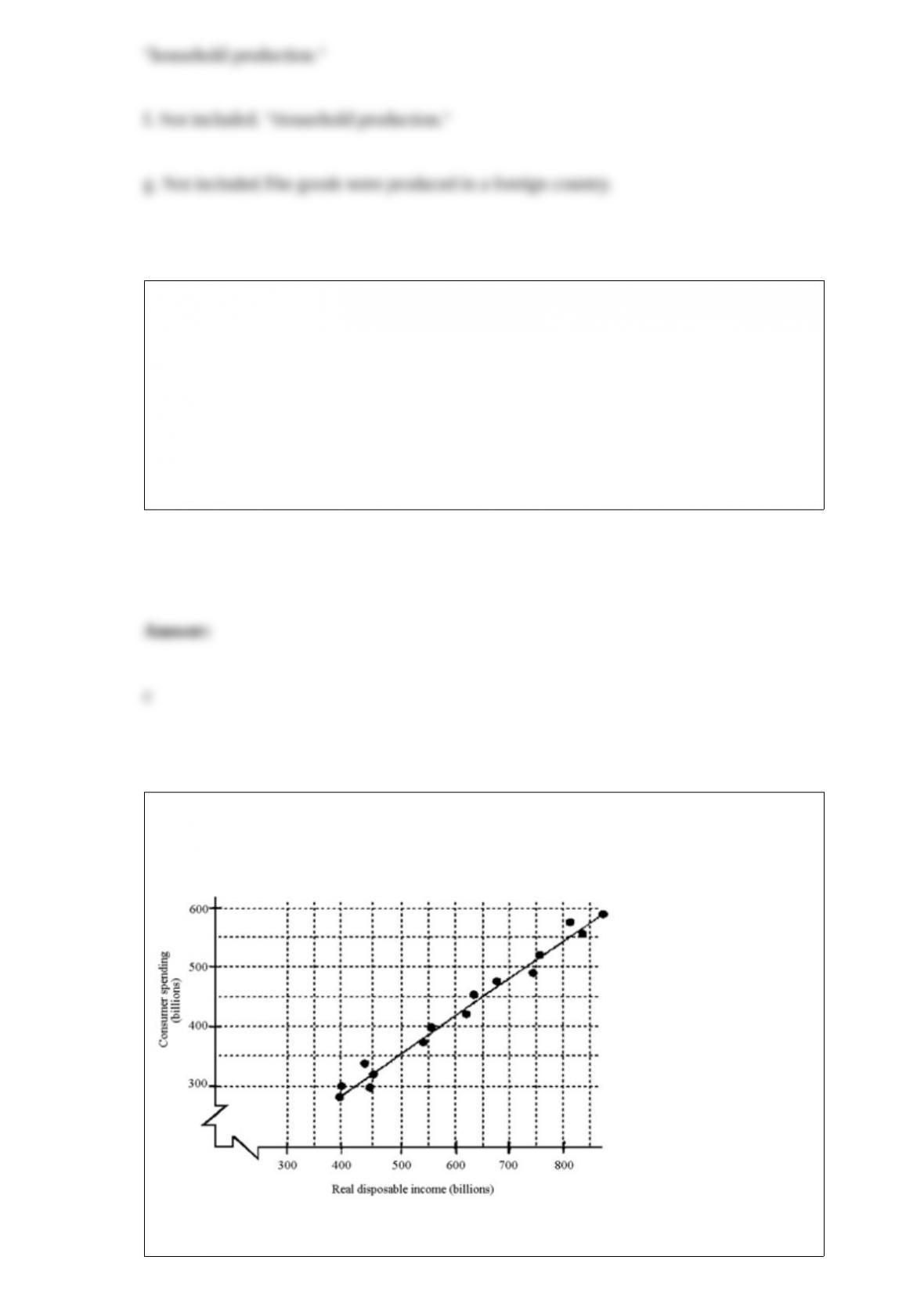
Figure 8-1
Given the scatter diagram in Figure 8-1, what is the MPC (your best estimate)?

a. 1/2
b. 1/3
c. 2/3
d. 1
Government gives subsidies to encourage production of products with beneficial
externalities.
a. True
b. False
One of the possible consequences of the expenditure schedule lying below the level of
full employment GDP is
a. unemployment.
b. rising prices.
c. increasing production.
d. decreasing inventories.
Average cost equals total cost multiplied by the number of units of output.
a. True
b. False
Americans will benefit if China has enough purchasing power to enable its people to
buy American products.
a. True
b. False
The kinked demand curve is an explanation of sticky prices.
a. True

b. False
Paying into a pension fund while you are earning wages and salaries is equivalent to
a. borrowing money.
b. lending money.
c. withdrawing from a savings account.
d. paying off debt.
If net exports decrease, the expenditure schedule will
a. get steeper.
b. get flatter.
c. shift upward.
d. shift downward.

The aggregate demand curve shows the quantity of domestic product
a. produced at each possible price level.
b. demanded and produced at each possible price level.
c. that is exported at each possible price level.
d. demanded at each possible price level.
The concept of “an invisible hand” led Adam Smith to believe that
a. if each person looks out for himself or herself, then chaos will inevitably ensue.
b. pursuit of self-interest promotes economic well-being for society as a whole.
c. governmental rule actually results in greater good than is apparent at the time.
d. traditional religion is an appropriate guide for human behavior.
e. All of the above are correct.

A higher price level would mean ____ for a person who has a bank deposit of $2
million.
a. an increase in real income
b. a decrease in real wealth
c. a decrease in nominal income
d. an increase in nominal income
The steepness of a curve is partially determined by the units of measurement.
a. True
b. False
The Fed conducts an open market sale of Treasury bills of $5 million. If the required
reserve ratio is 0.20, what change in the money supply can be expected using the
oversimplified money multiplier?
a. $25 million
b. $5 million
c. 0

d. −$5 million
e. −$25 million
The reason that velocity increases when interest rates rise is
a. the Fed encourages banks to turn money in faster for recycling, which causes money
to move faster.
b. the opportunity cost of saving increases, so people hold smaller cash balances.
c. home mortgage payments increase, so people write larger checks that reduces their
checking account balances.
d. the opportunity cost of holding money increases, so average money balances
decrease.
To the corporation, bonds are more risky than stocks because
a. interest rates fluctuate.
b. bond interest is a fixed cost.
c. investors prefer stocks to bonds.
d. speculators manipulate bonds more than stocks.

A monopolist can sell 10 wangdoodles if he charges $10 per wangdoodle and 11
wangdoodles if he charges $9. The MR from selling the 11th wangdoodle is
a. −$1.
b. $1.
c. $9.
d. $99.