
If two firms that form a cartel agreement are in a prisoner’s dilemma game, then
a. both firms will have an incentive to break the agreement.
b. only one firm will have an incentive to break the agreement.
c. both firms will be better off if they hold to the agreement than if they break it.
d. a and c
e. b and c
If the government establishes a target price for particular agricultural products, then
a. the government sets a limit on the quantity of a product that a farmer is allowed to
bring to market.
b. farmers are paid to take part of their land out of cultivation, the intent being to reduce
supply and raise price to the target level.
c. farmers are given limits as to the number of acres that can be used to produce a
particular product, the intent being to reduce supply and raise price to the target level.
d. farmers are paid the difference between the market price of their product and a
government-determined price.
e. the government establishes a minimum price that farmers will be paid for their
product, which causes the farmers to cut back on the number of acres planted in certain
products, which, in turn, causes the price to rise to the target level.
The horizontal demand curve faced by the perfectly competitive firm implies that the
firm can sell an infinite amount of the product at the equilibrium price.
a. True
b. False
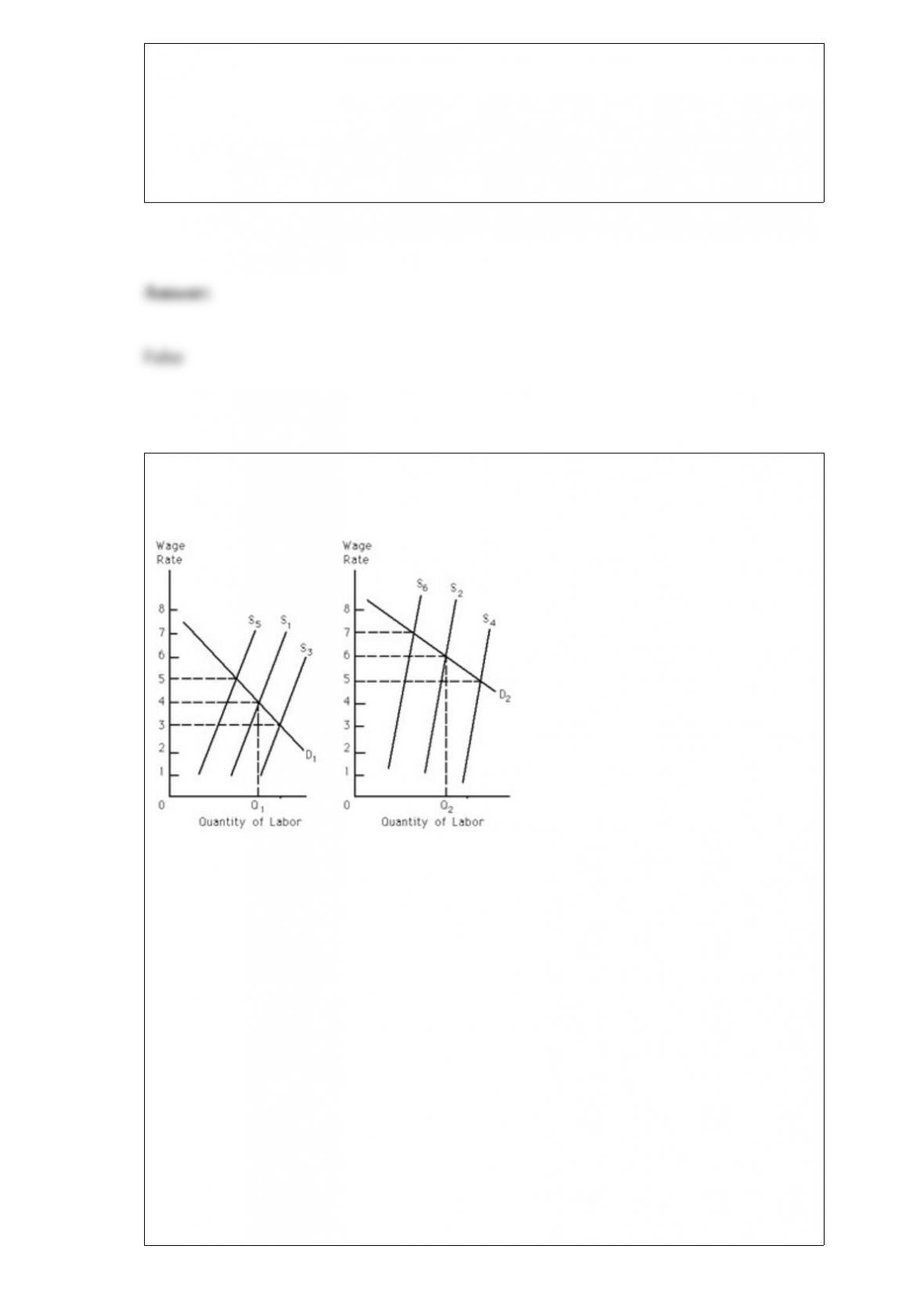
Exhibit 27-7
Market AMarket B
The exhibit shows two markets in which labor of identical skills is employed. Assume
that both markets are in equilibrium with Q1 and Q2 quantities of labor employed at the
respective prices of $4 and $6 per unit. If labor is costlessly mobile between the
markets, which of the following pairs of shifts of the respective labor supply curves is
to be expected?
a. S1 to S5 and S2 to S6
b. S1 to S5 and S2 to S4
c. S1 to S3 and S2 to S6
d. S1 to S3 and S2 to S4

Which of the following statements is false?
a. Competing for artificial rents is socially unproductive; competing for real rents is not.
b. If the production of good X generates real rents, then in the process of competing for
these real rents, it would not be unusual for the supply of good X to rise.
c. Individuals and firms will compete for real rents, but not for artificial rents.
d. An artificial rent is an economic rent that would not exist without government.
If the MPP of the last unit of labor hired equals 6 and the MPP of the last unit of capital
hired equals 8, and the price of labor is $4 per unit and the price of capital is $4 per
unit, then the firm
a. is minimizing its costs with this combination of factors.
b. is maximizing its profits with this combination of factors.
c. should hire more labor and less capital in order to minimize its costs.
d. should hire more capital and less labor in order to minimize its costs.
e. a and b

The market shares (in percentage terms) for the 12 firms that comprise an industry are
15, 12, 11, 10, 8, 7, 7, 6, 6, 6, 6, and 6. The Herfindahl index is __________ and the
four-firm concentration ratio is __________.
a. 932; 48 percent
b. 1,032; 27 percent
c. 1,000; 48 percent
d. 950; 24 percent
e. none of the above
Consumer equilibrium occurs at the point where the slope of the budget constraint is
equal to the slope of the indifference curve.
a. True
b. False
The _________________ the opportunity cost of bad behavior, the
_________________ likely one is to exhibit bad behavior.
a. higher; less

b. lower; more
c. higher; more
d. lower; less
e. a and b
A theory is a perfect description of reality.
a. True
b. False
If the government legalizes the purchase and sale of marijuana, the equilibrium quantity
would _________ and the price would ________ if the supply of marijuana increased
by _______ than the demand for marijuana increased as a result of the legalization.
a. rise; rise; more
b. fall; rise; more
c. rise; fall; more
d. rise; rise; less
e. none of the above
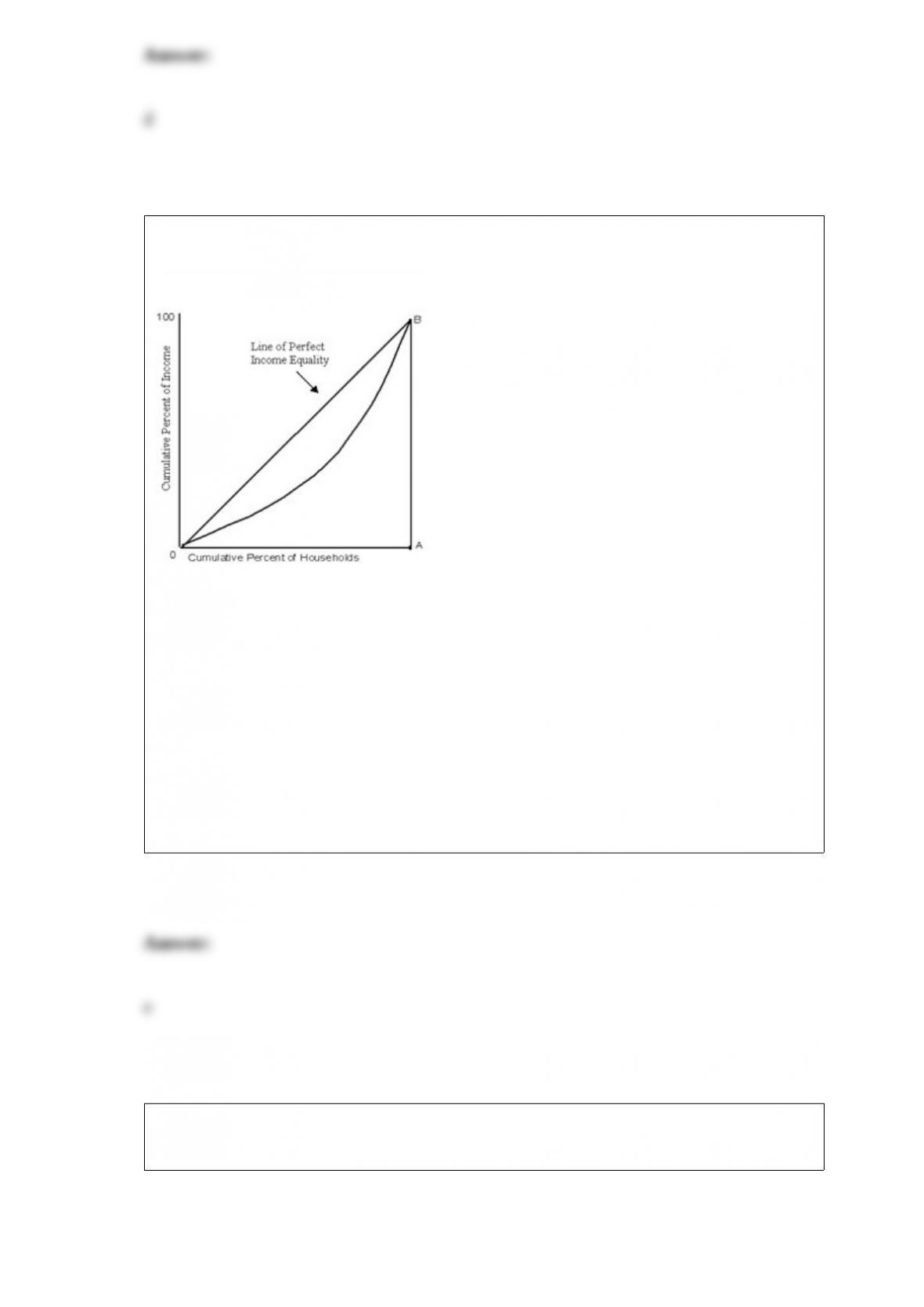
Exhibit 29-1
If the Gini coefficient equals 1, then the Lorenz curve is
a. point B.
b. line OB.
c. the horizontal axis from 0 to A.
d. line AB.
e. the horizontal axis from 0 to A and the line AB.

For Maria, the opportunity cost of producing one unit of good Y is ___________ unit(s)
of good X.
a. 2.00
b. 1.00
c. 10.00
d. 0.50
A union shop is an organization that
a. requires individuals to join a union within a certain period of time after becoming
employed.
b. requires individuals to be members of the union before they can be hired.
c. is legal in all fifty states.
d. is set up by labor unions to train new entrants and inform members of jobs in
different states.
e. a and c

If consumers’ surplus is $30 and the price paid for the good is $50, then the maximum
price a buyer is willing and able to pay for the good is
a. $80.
b. $30.
c. $50.
d. $20.
e. There is not enough information to answer the question.
If, at a particular wage rate in a competitive market, the quantity supplied of labor
exceeds the quantity demanded of labor, then
a. the supply curve will shift to the left, the demand curve will shift to the right, and the
surplus of labor will be eliminated.
b. since wages are so high, the quantity supplied of workers will increase further, and
the quantity demanded will decrease further.
c. some workers will begin to accept lower wages and, as a result, employers will begin
to hire more workers.
d. the supply curve will shift to the right, the demand curve will shift to the left, and the
shortage of labor will be eliminated.

The natural monopolist might have an incentive to let costs increase under
a. price regulation.
b. profit regulation.
c. output regulation.
d. a and b
Society as a whole is made worse off by rent seeking behavior by producers.
a. True
b. False
Which scenario below most accurately describes the process by which a technological
change can affect employment patterns across industries?
a. A technological advance makes it possible to produce more of good X with less labor.
As a result, labor is released from producing good X. Some of this labor ends up
producing goods Y and Z.
b. A technological advance makes it possible to produce less of good X with less labor.
As a result, labor is released from producing good X. Some of this labor ends up
producing good Y.
c. A technological advance makes it possible to produce more of good X with more
labor. As a result, more labor is needed to produce good X. There is less labor available
to produce goods Y and Z.

d. A technological advance makes it possible to produce more of good X with less labor.
As a result, labor becomes more important to the production of good X. More labor
ends up producing good X.
e. none of the above
Which of the following is usually considered a natural monopoly?
a. a major car manufacturer
b. a car stereo installer
c. overnight mail services
d. state universities
e. none of the above