What is the term that explains why voters often lack knowledge of pending legislation,
and lack knowledge of the views of candidates for office on a range of issues that affect
their own (the voters’) welfare?
A) the voting paradox
B) logrolling
C) rational ignorance
D) regulatory capture
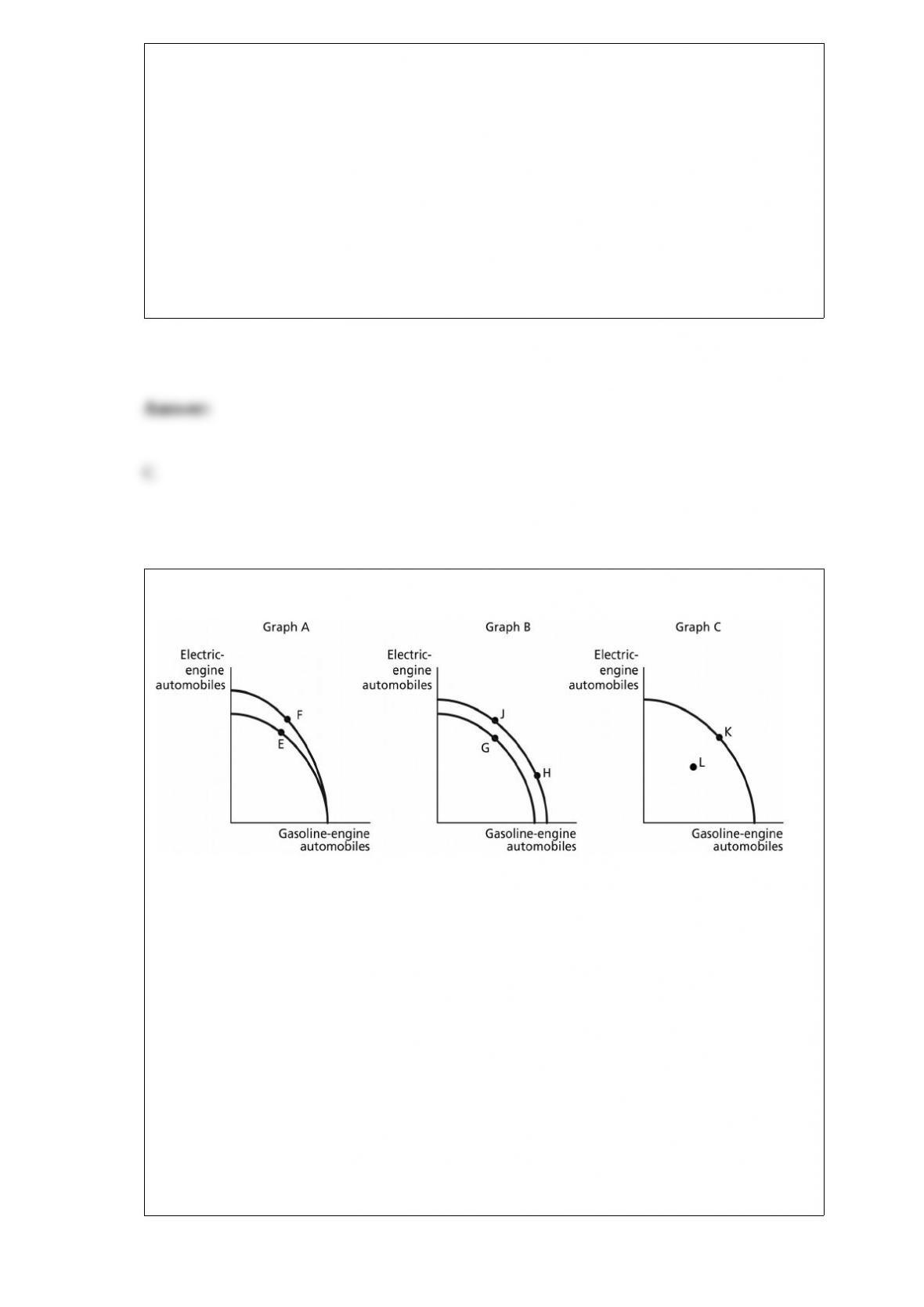
Figure 2-7
Mercedes Benz recently decided to introduce its B-class automobile in the U.S. market,
an electric car that is has designed and developed in a partnership with Tesla Motors.
Assume Mercedes Benz chooses to produce both electric-engine vehicles and
gasoline-engine vehicles. Figure 2-7 shows changes to its production possibilities
frontier in response to new developments and different strategic production decisions.
Assume a technological advancement greatly reduces the cost to produce
electric-engine vehicles. This is best represented by the
A) movement from E to F in Graph A.
B) movement from G to H in Graph B.
C) movement from K to L in Graph C.
D) movement from H to J in Graph B.

An agreement negotiated by two countries that places a numerical limit on the quantity
of a good that can be imported by one country from another country is called
A) a non-tariff trade barrier.
B) an export quota.
C) an import quota.
D) a voluntary export restraint.
How might a budget deficit affect the balance of trade?
A) A budget deficit raises interest rates, which raises exchange rates and increases the
balance of trade.
B) A budget deficit raises interest rates, which raises exchange rates and reduces the
balance of trade.
C) A budget deficit reduces interest rates, which raises exchange rates and reduces the
balance of trade.
D) A budget deficit reduces interest rates, which reduces exchange rates and reduces the
balance of trade.

Article Summary. In an attempt to discourage smoking, New York City Mayor
Michael Bloomberg proposed a bill which would set a $10.50 minimum price for a
pack of cigarettes. The bill would also prohibit retailers from offering any
discounts such as 2-for-1 offers or accepting discount coupons. New York City
already has the highest cigarette tax in the country, at $5.85 per pack, and the state
of New York is one of many which already require cigarettes be marked up by a
specified percentage. This bill is a companion to one which would require stores to
keep tobacco products hidden from sight. Although the bills are expected to be
challenged in court, a precedent has been set in Rhode Island, where a court
upheld a ruling allowing the city of Providence to forbid retailers from accepting
coupons and offering discounts on cigarettes.
Source: Vivian Yee, “Bloomberg Seeks End to Cheap Cigarettes,” New York Times,
March 26, 2013.
The minimum price of $10.50 per pack of cigarettes being proposed by Mayor
Bloomberg is an example of
A) a price ceiling.
B) a price floor.
C) an economically efficient price.
D) a black market price.
If an airport decides to expand by building an additional passenger terminal, and in
doing so it lowers its average cost per airplane landing, it was previously operating at
A) minimum efficient scale.
B) more than minimum efficient scale.
C) less than minimum efficient scale.
D) minimum capacity.

If you spend more of your income on consumption goods, which of the following will
occur?
A) The production of investment goods will fall.
B) Economic growth will be stimulated.
C) Investments in education will rise.
D) For every dollar you spend on consumption, real GDP will fall by a dollar.
A successful market economy requires
A) a government-controlled banking system and government price controls.
B) well-defined property rights and an independent court system to adjudicate disputes
based on the law.
C) generous unemployment benefits and paid medical leave for everyone in the labor
force.
D) an equitable distribution of income and limits on immigration.
Congress has divided the authority to police mergers between the Antitrust Division of
the U.S. Department of Justice (AD) and the Federal Trade Commission (FTC). How is

this authority divided?
A) The AD decides whether proposed horizontal mergers will be challenged; the FTC
decides whether proposed vertical mergers will be challenged.
B) Both the AD and the FTC are responsible for merger policy.
C) The AD always renders its opinion on any proposed merger first. If the AD approves
the merger, the case then goes to the FTC for final approval. If the AD disallows the
merger, the decision stands and the FTC does not become involved.
D) The AD establishes the guidelines that are used to evaluate proposed mergers; the
FTC uses these guidelines to decide whether a proposed merger will be allowed to take
place.
If the nominal interest rate is 6% and the inflation rate is 9%, then the real interest rate
is
A) -3%.
B) 3%.
C) 6.67%.
D) 15%.
When Ford increases the production of cars in Australia, which of the following occurs?
A) GDP in the United States rises.

B) GNP in the United States rises.
C) GNP in Australia rises.
D) Both A and C occur.