
1) central planning in the soviet union and pre-reform china emphasized the expansion
of the production of consumer goods to raise the domestic standard of living.
2) The idea that the economy will ‘self-correct” when confronted with changes in
aggregate demand is associated with new classical economics.
3) Per capita water use in the United States has steadily increased since 1973.
4) The supply of loanable funds is perfectly elastic.
5) In the private closed economy, equilibrium GDP occurs where C + Ig = GDP.
6) asymmetric information in the health care market has increased the supply of health
care.
7) The demand for a resource depends on its productivity and the market value of the
product it is producing.
8) If the reserve requirement is 20 percent, the monetary multiplier will be 4.
9) DVCs tend to have permanent shortages of farm labor.
10) successful price discrimination requires that buyers charged the different prices be
physically separated.
11) When C + Ig = GDP in a private closed economy, S = I and there are no unplanned
changes in inventories.
12) during a period of hyperinflation:
a.creditors gain because their loans are repaid with dollars of higher value.
b.people tend to hold goods rather than money.
c.income is redistributed away from borrowers.
d.the real value of the national currency rises.
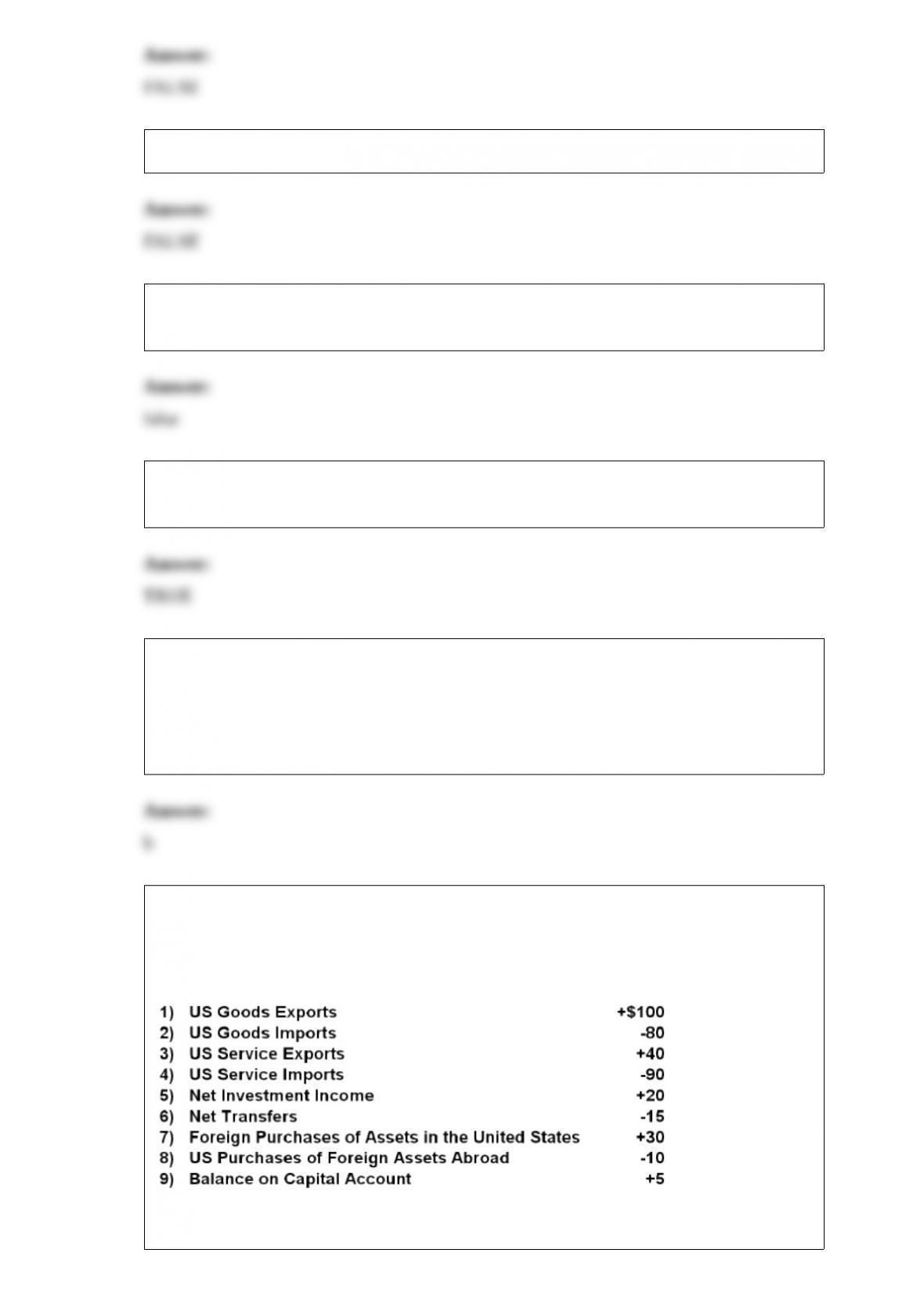
13) The following table contains hypothetical data for the 2010 U.S. balance of
payments. Answer the next question(s) on the basis of this information. All figures are
in billions of dollars.
Refer to the above data. The U.S. balance on goods and services is a:
A.$10 billion deficit.

B.$20 billion deficit.
C.$30 billion surplus.
D.$30 billion deficit.
14) if a pure monopolist can engage in price discrimination:
a.the marginal revenue curve and the total revenue curve will now coincide.
b.the marginal revenue curve will now shift to a position above the demand curve.
c.the firm will face multiple marginal revenue curves.
d.marginal revenue will become less at each level of output than it would be without
price discrimination.
15) Economists believe that use of the term auction facility:
A.has intensified business cycle fluctuations.
B.has replaced open-market operations as the most important tool of monetary policy.
C.will be limited to times of economic crisis when a quick injection of reserves will be
helpful.
D.will give the Fed the ability to prevent recessions.
16) Private-sector strikes and lockouts typically end because:
A.the Federal government intervenes with a “back-to-work” order.
B.the parties eventually tire of bickering.
C.they are costly in terms of lost profits and lost wage income.
D.the parties rely heavily on outside arbitration.
17) The following production possibilities data for two countries, Alpha and Beta,
which have populations of equal size.
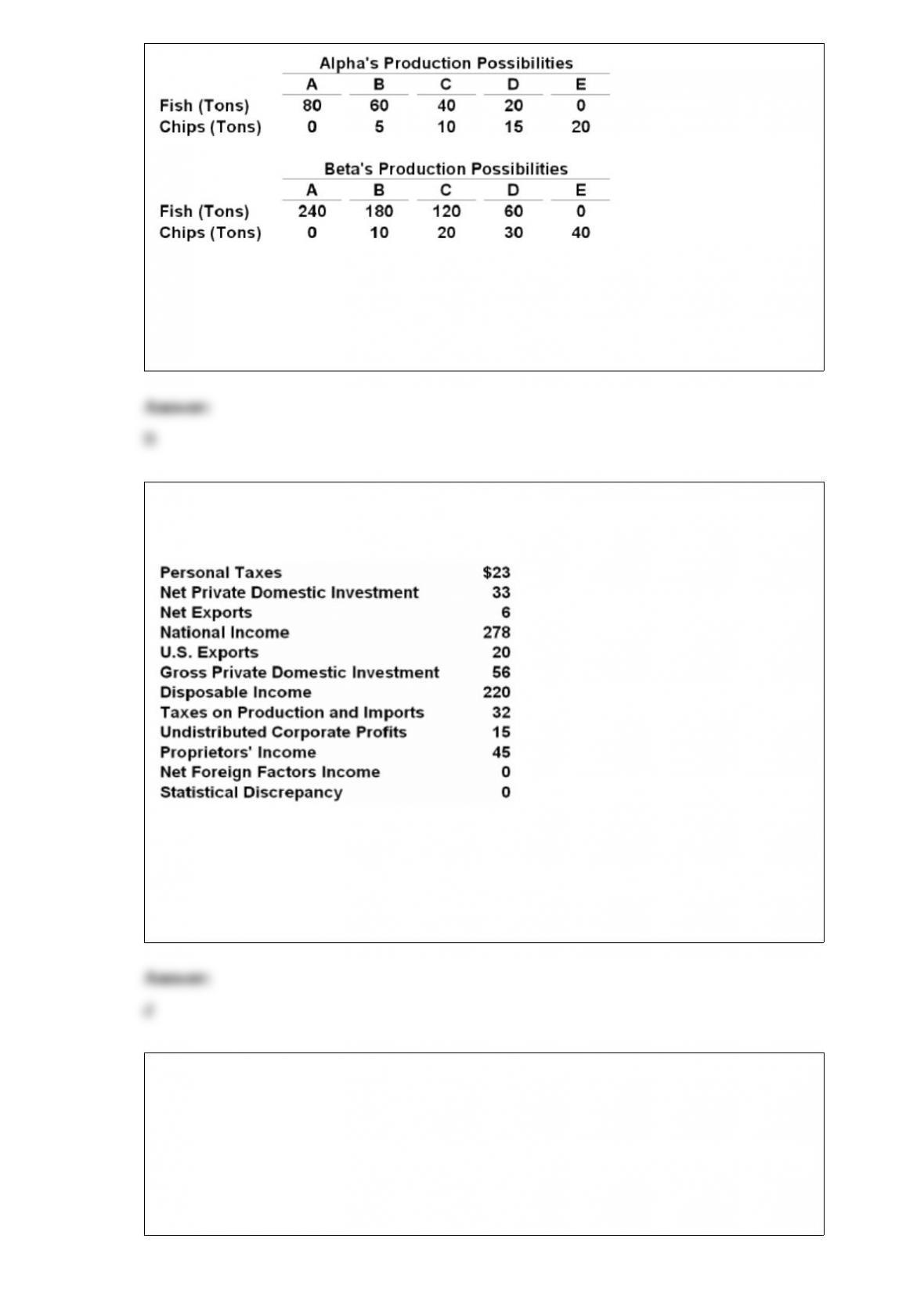
Refer to the above data. The domestic opportunity cost of:
A.producing a ton of chips in Alpha is 1/5 of a ton of fish.
B.producing a ton of chips in Beta is 6 tons of fish.
C.catching a ton of fish in Alpha is 5 tons of chips.
D.catching a ton of fish in Beta is 6 tons of chips.
18) answer the next question(s) on the basis of the following national income data. all
figures are in billions of dollars.
refer to the above data. personal income is:
a.$229.
b.$253.
c.$274.
d.$243.
19) Firm X develops a new product and gets a head start in its production. Other firms
try to produce a similar product but discover they have higher average total costs than
the existing firm. This situation illustrates:
A.diseconomies of scale.
B.diminishing marginal returns.
C.learning-by-doing.
D.spillover costs.
20) assume a purely competitive increasing-cost industry is initially in long-run
equilibrium and that an increase in consumer demand occurs. after all economic
adjustments have been completed product price will be:
a.lower, but total output will be larger than originally.
b.higher and total output will be larger than originally.
c.lower and total output will be smaller than originally.
d.higher, but total output will be smaller than originally.
21) “Pork-barrel” legislation that contains funding for hundreds of earmarks throughout
numerous states often reflects:
A.the paradox of voting.
B.logrolling.
C.the benefits-received principle.
D.the Coase theorem.
22) Assume that M is $200 billion and V is If V increases by 15%, what will be the
change in nominal GDP?
23) What domestic macroeconomic adjustments would be necessary to maintain fixed
exchange rates when there are persistent balance-of-payments deficits? What are the
problems with these adjustments?
24) Explain how the dollar price of an imported good may change even though the
foreign production cost of that product remains unchanged.
25) Describe the cost of discrimination to society. How is the cost of discrimination
illustrated in a production possibilities curve?
26) Explain the difference between final and intermediate goods, and give an example
of each.
27) Identify at least four transactions and other variables which are not included in the
Gross Domestic Product.
28) In what ways do entrepreneurs differ from other innovators? In what types of
businesses do entrepreneurs and innovators tend to work? How do past successes affect
these types of individuals?
29) Who gains and who loses from a protective tariff? Explain.
30) What is energy economics and what does it have to say about energy demand and
efficiency?
31) What is X-inefficiency? Why is it likely to occur in monopoly?