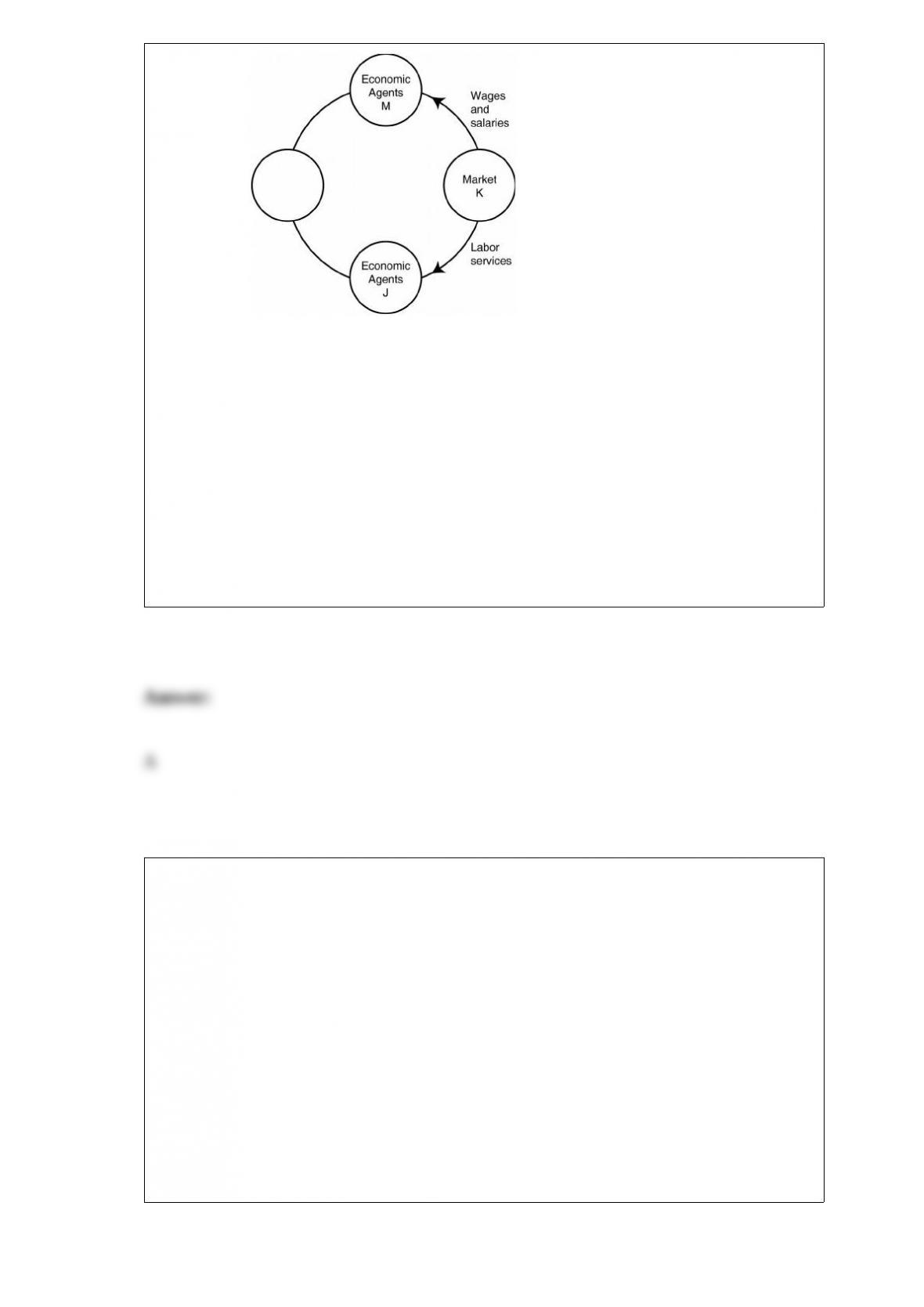
Figure 2-16
One segment of the circular flow diagram in the figure shows the flow of wages and
salaries from market K to economic agents M. What is market K and who are economic
agents M?
A) K = factor markets; M = households
B) K = product markets; M = households
C) K = factor markets; M = firms
D) K = product markets; M = firms
The principal-agent problem is a problem
A) caused by a person (principal) who hires an agent to act on his behalf but is
unwilling to delegate authority to the agent to carry out the task in the best possible
way.
B) caused by agents pursuing their own interests rather than the interests of the
principals who hired them.
C) of the power system of boss and subordinate where the boss (principal) exerts
influence over his subordinates (agents) using punishment or threat.
D) that exists when a person (principal) has more information about the task than the
agent he hires to perform the task.

Which of the following is not held constant along a firm’s demand curve for labor?
A) the quantity of other inputs used by the firm
B) the wage rate
C) changes in technology
D) the price of the product produced by the firm
To make the calculation of real GDP more accurate, in 1996 the BEA switched to using
A) base-year prices.
B) current prices.
C) chain-weighted prices.
D) market prices.

If the dollar depreciates against the Indian rupee,
A) Indian imports to the U.S. become less expensive.
B) U.S. exports to India become less expensive.
C) U.S. exports to India become more expensive.
D) The value of Indian imports to the United States does not change.
Ben’s Peanut Shoppe suffers a short-run loss. Ben will not choose to shut down if
A) his Shoppe’s total revenue exceeds his fixed cost.
B) his Shoppe’s total revenue exceeds his variable cost.
C) his Shoppe’s total revenue exceeds his implicit costs.
D) his Shoppe’s total revenue exceeds his capital costs.
Policies to promote growth by increasing saving and investment work through
A) decreasing the supply of loanable funds, lowering the interest rate, raising the level
of investment in physical capital.
B) increasing the supply of loanable funds, increasing the interest rate, raising the level
of investment in physical capital.
C) increasing the supply of loanable funds, lowering the interest rate, lowering the level
of investment in physical capital.
D) increasing the supply of loanable funds, lowering the interest rate, raising the level
of investment in physical capital.
You earn $500 a month, currently have $200 in currency, $100 in your checking
account, $2,000 in your savings accounts, $3,000 worth of illiquid assets and $1,000 of
debt. You have
A) money = $2,300, annual income = $6,000, and wealth = $5,000.
B) money = $300, annual income = $6,000, and wealth = $4,300.
C) money = $200, annual income = $500, and wealth = $4,300.
D) money = $300, annual income = $6,000, and wealth = $5,000.
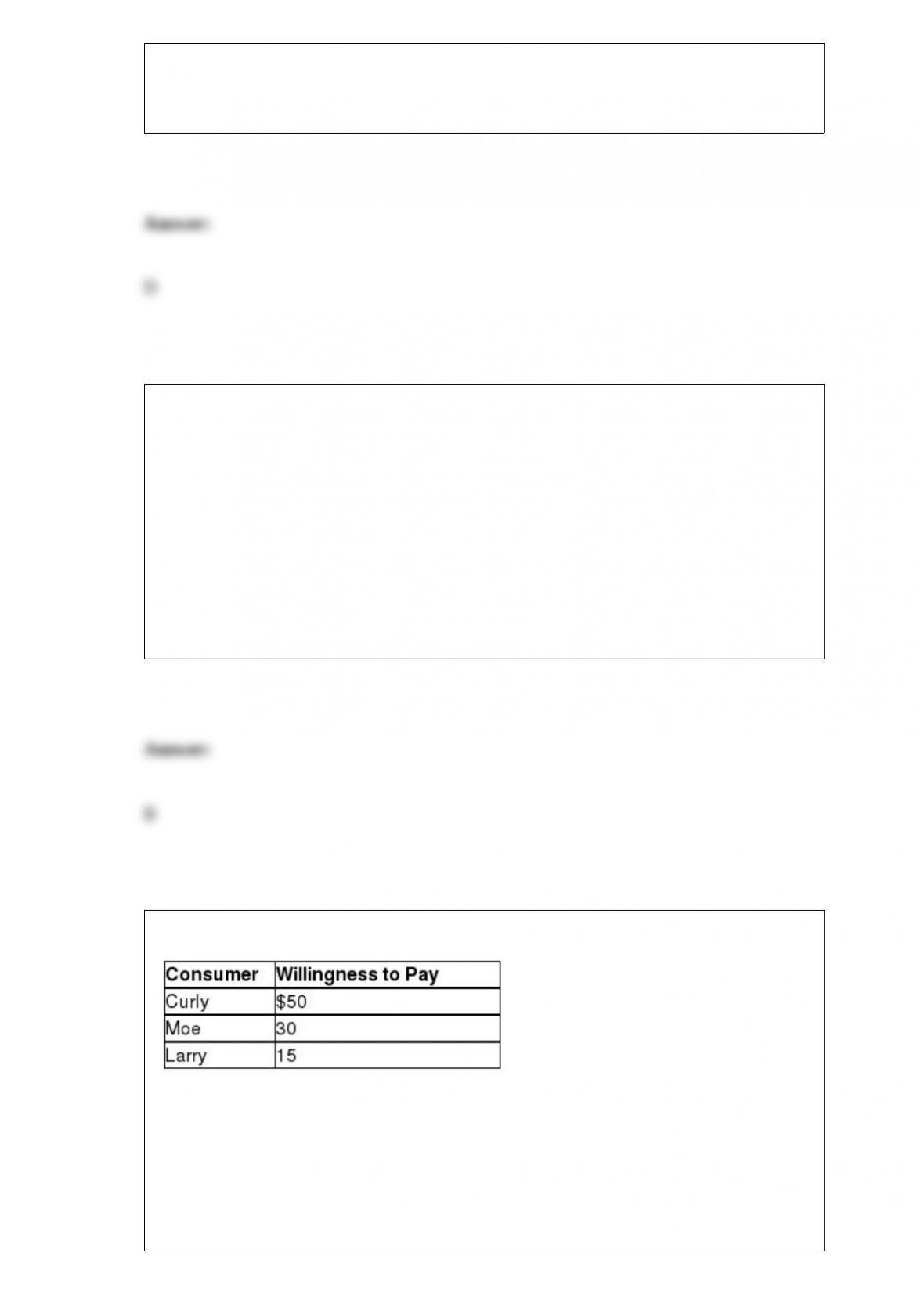
Table 4-1
The table above lists the highest prices three consumers, Curly, Moe, and Larry, are
willing to pay for a bottle of champagne. If the price of one of the bottles is $24 dollars
A) Curly will buy two bottles, Moe will buy one bottle and Larry will buy no bottles.
B) Curly will receive $26 of consumer surplus from buying one bottle.

C) Curly and Moe receive a total of $80 of consumer surplus from buying one bottle
each. Larry will buy no bottles.
D) Larry will receive $15 of consumer surplus since he will buy no bottles.
The most important of the factors that make a firm successful and that can be controlled
by the firm’s owners and managers are
A) the establishment of trademarks for its products and the aggressive defense of those
trademarks.
B) lobbying government to erect or enforce entry barriers in its markets and the
marketing of its products as widely as possible.
C) the differentiation of its products and the production of products at a lower average
cost than competing firms.
D) the selection of the prices of its products and the selection of the most productive
and loyal employees.