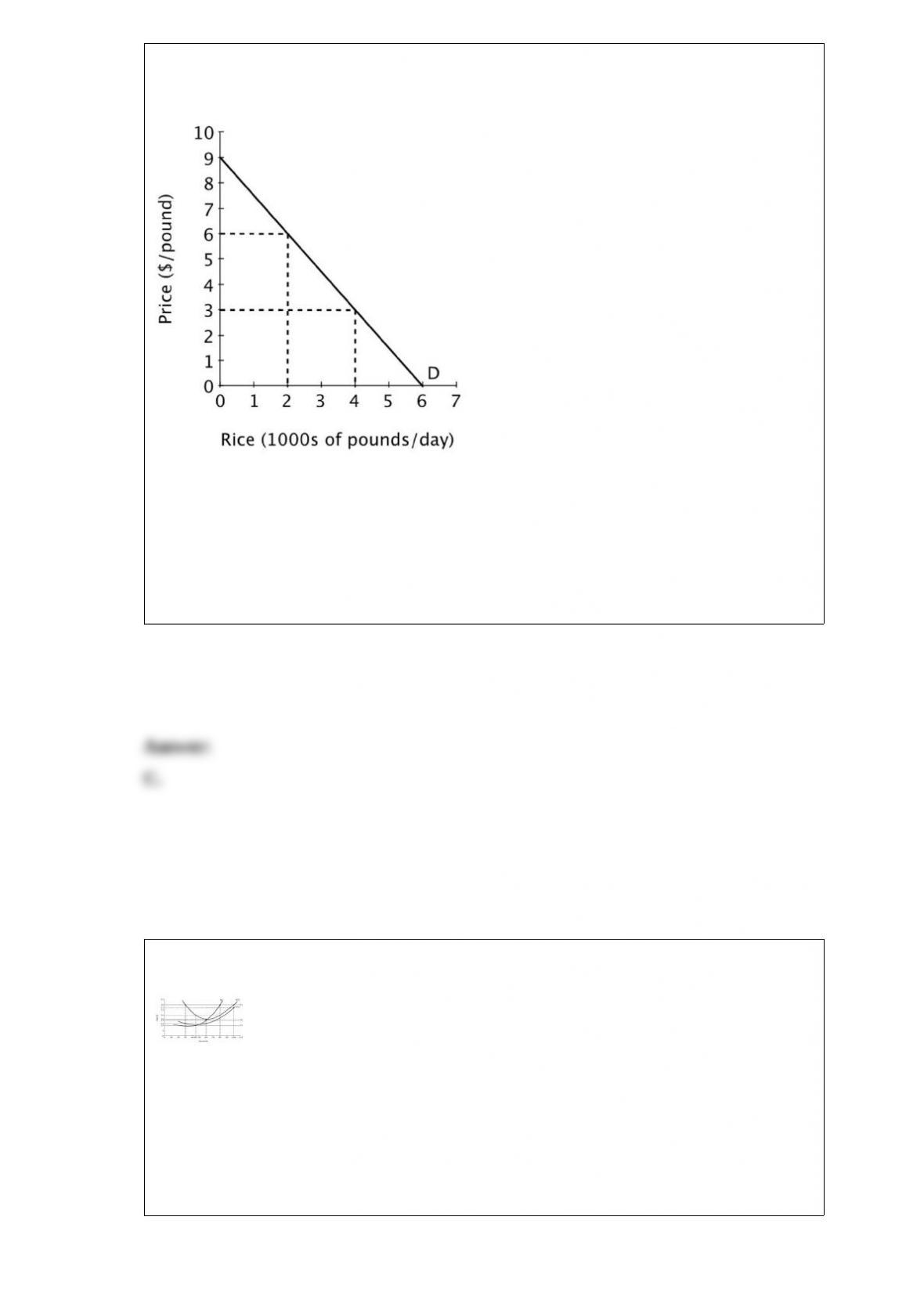
Refer to the figure below. What is the price elasticity of demand when the price of rice
is $6 per pound?
A. 0.5
B. 0.67
C. 2
D. 3
Refer to the figure below. If this firm is a price taker and the price of each unit of output
is $15, then this firm should:
A. produce 60 units of output.
B. shut down in the short run.
C. raise its price to increase its revenue.
D. lower its output to decrease its marginal cost.
When the price of a good rises, marginal utility per dollar spent on that good ______,
leading consumers to purchase ______ of that good.
A. rises; more
B. falls; more
C. rises; less
D. falls; less
To compare the change in physical production (GDP) between 2010 and 2016, we
should compare ______ GDP in 2010 with ______ GDP in 2016.
A. real; real
B. real; nominal
C. nominal; nominal
D. current dollar; current dollar

A trade surplus occurs when:
A. exports exceed imports.
B. imports exceed exports.
C. tariffs exceed quotas.
D. quotas exceed tariffs.
The purchasing power parity theory is a reasonably good explanation for nominal
exchange rate determination:
A. in the short run.
B. in the long run.
C. when there are significant volumes of non-traded goods and services.
D. when there are fixed exchange rates.

In the Keynesian cross diagram, the ______ line shows the relationship between
planned aggregate expenditure and output, and the ______ line represents the condition
that planned aggregate expenditure and output are equal.
A. consumption function; 45-degree
B. 45-degree; consumption function
C. expenditure; 45-degree
D. 45 degree; expenditure
Starting from full employment at the initial target inflation rate, if there is an adverse
inflation shock, then the Federal Reserve must _____ in order to keep inflation from
becoming permanently higher.
A. increase the target inflation rate.
B. decrease the target inflation rate.
C. maintain the initial target inflation rate.
D. shift the short-run aggregate supply curve up.
The biggest problem thwarting economic growth in the poorest countries, compared to
the richest countries, is:
A. insufficient human capital.
B. outdated physical capital.
C. no access to technology.
D. a legal and/or political environment unfavorable to economic growth.
The marginal benefit of an activity is the:
A. same as the total benefit of an activity.
B. total benefit of an activity divided by the level of the activity.
C. extra benefit associated with an extra unit of the activity.
D. total benefit associated with an extra unit of the activity.
The following graph depicts demand.
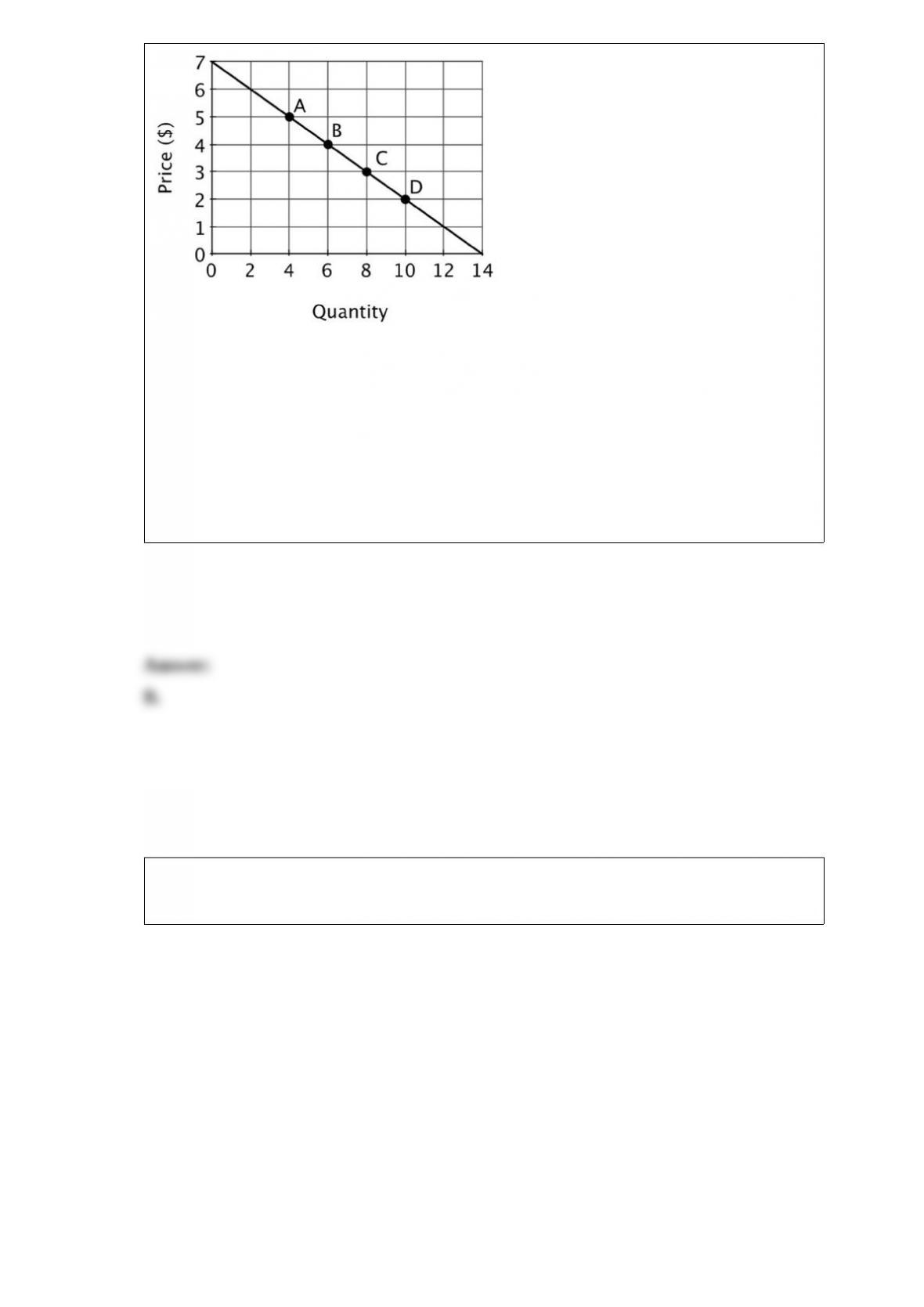
The price elasticity of demand at point B is:
A. 3/4.
B. 4/3.
C. 3.
D. 1/3.
Moe divides his time between studying Physics and studying Economics. His
production possibilities curve for his final grade in each class is shown below.
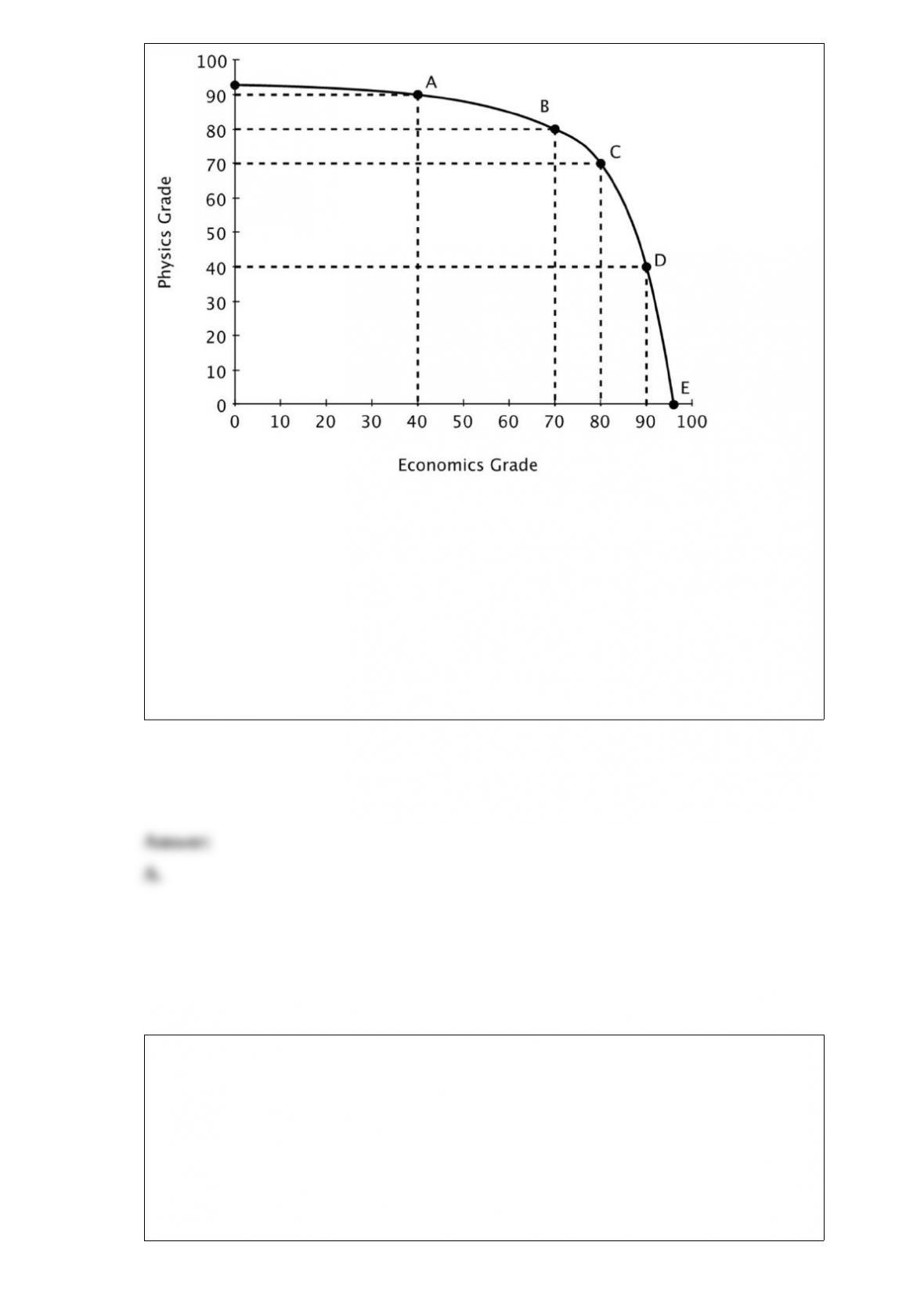
Moe needs to earn at least an 80 in both economics and physics to keep his scholarship.
Given his current PPC, an 80 in both classes is ______.
A. unattainable
B. attainable
C. efficient
D. inefficient
Larry was accepted at three different graduate schools, and must choose one. Elite U
costs $50,000 per year and did not offer Larry any financial aid. Larry values attending
Elite U at $60,000 per year. State College costs $30,000 per year, and offered Larry an
annual $10,000 scholarship. Larry values attending State College at $40,000 per year.
NoName U costs $20,000 per year, and offered Larry a full $20,000 annual scholarship.
Larry values attending NoName at $15,000 per year. Larry’s opportunity cost of
attending State College is:
A. $35,000

B. $30,000
C. $20,000
D. $15,000
The price of gold is 300 U.S. dollars per ounce in New York and 435 Canadian dollars
per ounce in Toronto, Canada. If the law of one price holds for gold, the nominal
exchange rate is ______ Canadian dollars per U.S. dollar.
A. 0.333
B. 0.690
C. 1
D. 1.45
Two firms, Acme and FirmCo, have access to five production processes, each of which
has a different cost and gives off a different amount of pollution. The daily costs of the
processes and the corresponding number of tons of smoke emitted are shown in the
table below.
Process

(smoke/day) A
(10 tons/day) B
(8 tons/day) C
(6 tons/day) D
(4 tons/day) E
(2 tons/day)
Cost to Acme ($/day) $750 $800 $1,000 $1,400 $2,000
Cost to FirmCo ($/day) $500 $750 $1,200 $2,200 $4,000
Suppose the firms are both currently using process A. If the government imposes a tax of
$110 per ton of smoke emitted, then Acme will use process ______, and FirmCo will use
process ______.
A. B; A
B. C; A
C. C; C
D. D; C
One thousand adults live in Milltown. Every day, they all leave work at 4:30 p.m.,
arrive home at exactly 5:00 p.m., and go to bed at 9:00 p.m. Three fundraisers, Alpha,
Beta, and Charlie, have targeted Milltown’s population. To get a donation, they must
call Milltown’s residents after they get home from work but before they go to bed.
Because the charities raising the funds are identical, the first to call a willing donor will
get the donation. Beta’s manager has decided that the best time to call is 7:00 p.m.
because it is exactly halfway between 5:00 p.m. and bedtime. Which of the following is
true?
A. Beta is certain to generate the most donations.
B. Alpha and Charlie will also make calls at 7:00 p.m.
C. Alpha and Charlie will divide up the rest of the market, with one choosing to call at
6:00 p.m. and the other at 8:00 p.m.
D. Beta’s manager did not choose wisely.
The principle that if the amount of labor and other inputs is held constant, then the
greater the amount of capital in use, the less an additional unit of capital adds to
production is called the principle of:
A. increasing average capital productivity.
B. diminishing returns to capital.
C. increasing returns to capital.
D. decreasing output per unit of capital.
When Acme Dynamite produces 250 units of output, its variable cost is $2,000, and its
fixed cost is $500. It sells each unit of output for $25. When Acme Dynamite produces
250 units of output, its average variable cost is ______ and its average total cost is
______.
A. $8; $2
B. $10; $10
C. $10; $2
D. $8; $10
If a person takes an action if, and only if, the extra benefits from taking that action
exceed the extra costs, then that person is:
A. not following the Cost-Benefit Principle.
B. following the Scarcity Principle.
C. following the Cost-Benefit Principle.
D. not rational.
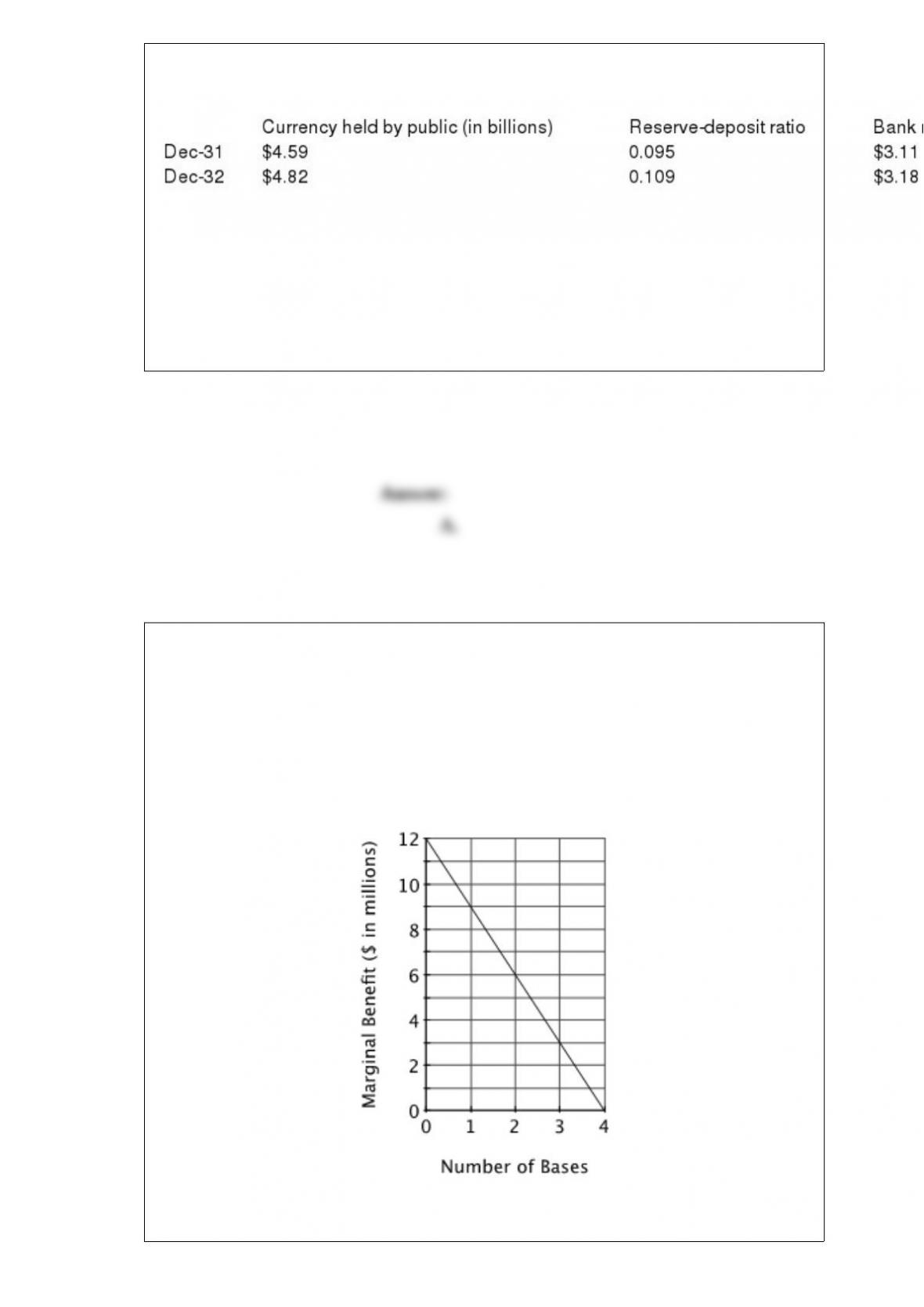
Based on the information in the table, what quantity of reserves did the Federal Reserve
inject into the economy in 1932?
A. $0.30 billion
B. $0.23 billion
C. $0.16 billion
D. $0.07 billion
There are ten states in the democratic nation of Fatlandia, and each state has ten
thousand residents. Although incomes vary, each Fatlandian pays a tax equal to the total
cost of all government projects divided by the number of residents in the country.
Currently, two states each have one army base. An army base adds $2 million to a
state’s local economy each year. In addition, in terms of increased security, the annual
marginal benefit to Fatlandia of having an additional army base is shown below. The
total cost of an army base is $8 million per year.
If Fatlandia builds a third army base, the country will have:
A. the efficient number of bases.
B. more than the efficient number of bases.
C. fewer than the efficient number of bases.
D. more bases than they can afford.
To close a recessionary gap, the Federal Reserve must ______ real interest rates by
______ the money supply.
A. increase; increasing
B. increase; decreasing
C. decrease; decreasing
D. decrease; increasing
The two most important factors contributing to increased productivity in industrialized
countries in the twentieth century were:
A. higher relative prices and a larger labor supply.
B. higher relative prices and technological progress.

C. technological progress and increases in the capital stock.
D. technological progress and increases in the labor supply.
In a small town of 100 people, there are 10 children under 16, 10 retired people, 60
people with full-time jobs, 3 people with part-time jobs, 3 full-time students over 16,
and 4 full-time homemakers. The remaining people did not have jobs, but wanted
them.What is the participation rate in this town?
A. 63.0%
B. 72.0%
C. 81.1%
D. 87.5%
John is trying to decide how to divide his time between his job as a stocker in the local
grocery store, which pays $7 per hour for as many hours as he chooses to work, and
cleaning windows for the businesses downtown. He makes $2 for every window he
cleans. John is indifferent between the two tasks, and the number of windows he can
clean depends on how many hours he spends cleaning in a day, as shown in the table
below:
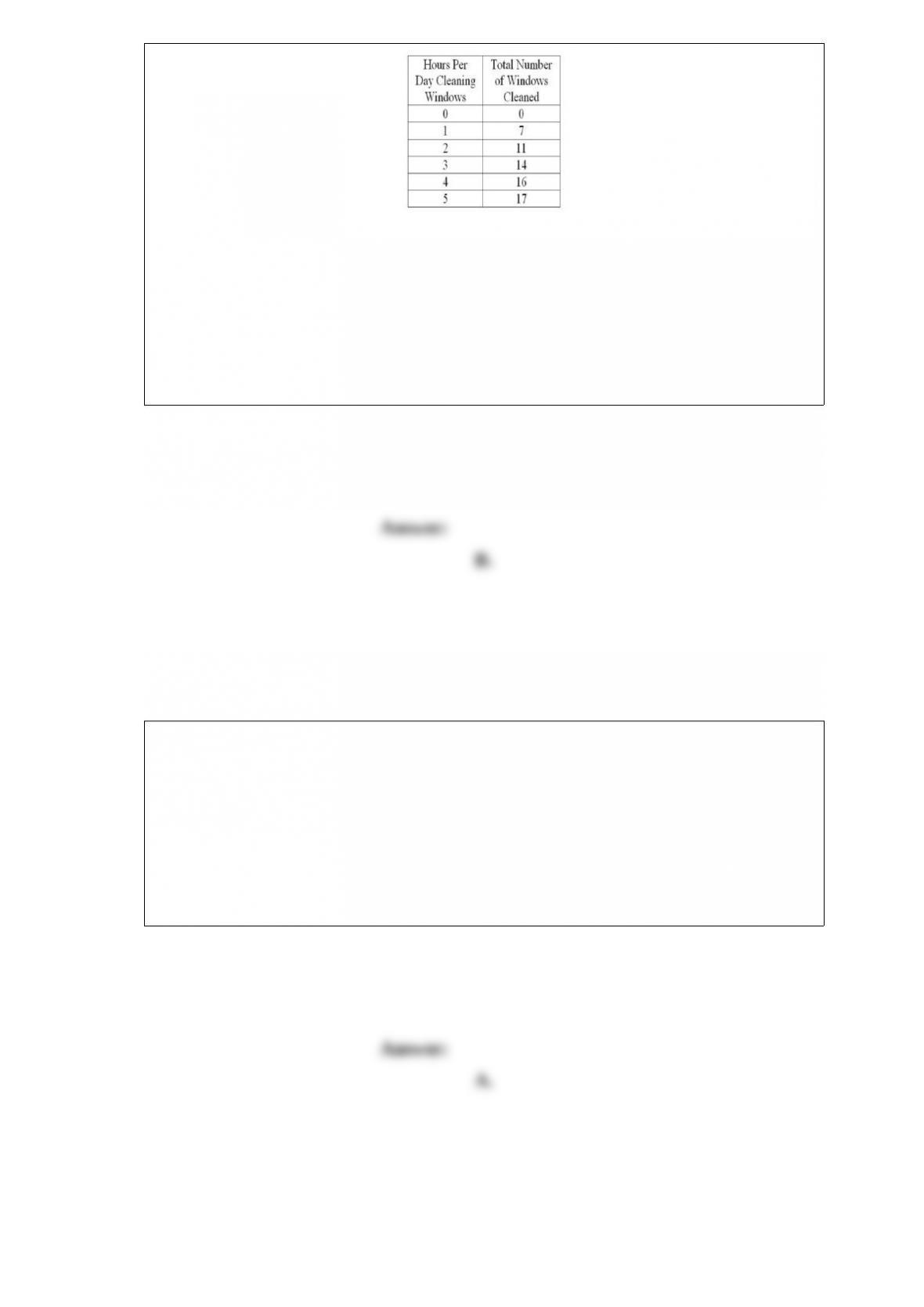
How many hours a day should John spend cleaning windows?
A. 1
B. 2
C. 3
D. 4
Which of the following would be included in the GDP of the United States?
A. Boeing builds a plane in Seattle that is sold to Air Canada.
B. Chrysler produces a car in Germany that is sold in Michigan.
C. Nestle produces a candy bar in Switzerland that is sold in San Francisco.
D. Planet Hollywood serves customers in a restaurant in Hong Kong.

Over the period from 1950 to 2010, which country experienced the fastest average
annual growth rate of real GDP per person?
A. United States
B. Japan
C. China
D. Canada
Inflation makes it difficult to distinguish relative price changes from changes in the
general level of prices. Consequently, inflation ______ the efficiency of the market
system.
A. increases
B. decreases
C. does not change
D. may either increase or decrease
Purchasing power parity is the theory that nominal exchange rates are determined:
A. by the forces of supply and demand.

B. by real exchange rates.
C. as necessary to achieve the fundamental value of the exchange rate.
D. as necessary for the law of one price to hold.
If the production of a good generates a positive externality, then:
A. production of the good is harmful.
B. there will be deadweight loss at the market equilibrium quantity.
C. total economic surplus will be maximized at the market equilibrium quantity.
D. the government should tax producers of the good.