1) the short-run profit maximizing position of an unregulated pure monopolist is
characterized by:
a.p = minimum atc.
b.p = mc.
c.mr = mc.
d.mc = atc.
2) a firm reaches a break-even point (normal profit position) where:
a.marginal revenue cuts the horizontal axis.
b.marginal cost intersects the average variable cost curve.
c.total revenue equals total variable cost.
d.total revenue and total cost are equal.
3) one can say with certainty that equilibrium price will decline when supply:
a.and demand both decrease.
b.increases and demand decreases.
c.decreases and demand increases.
d.and demand both increase.
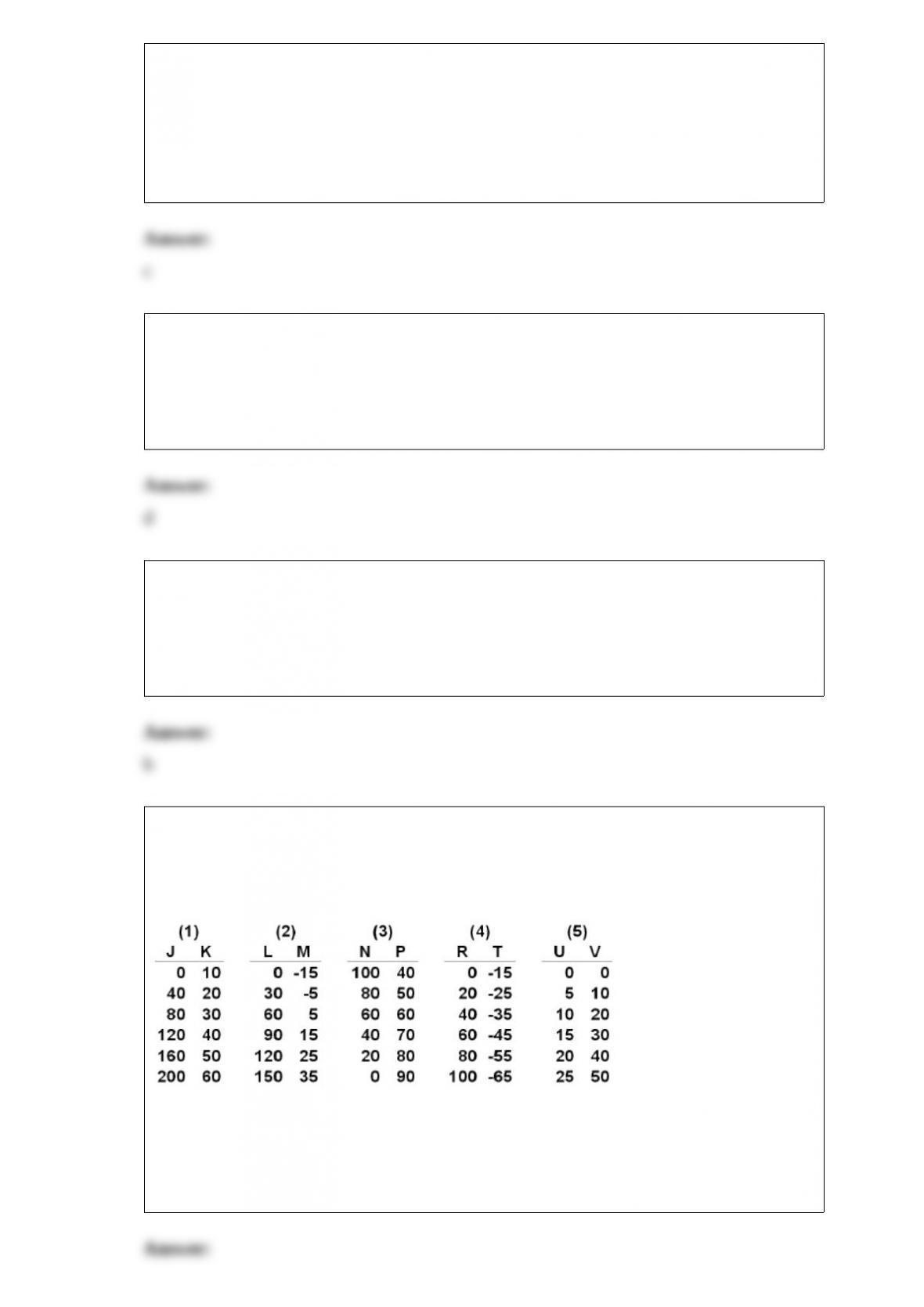
4) answer the next question(s) on the basis of the following five data sets wherein it is
assumed that the variable shown on the left is the independent variable and the one on
the right is the dependent variable. assume in graphing these data that the independent
variable is shown on the horizontal axis and the dependent variable on the vertical axis.
refer to the above data sets. the equation for data set 3 is:
a.p = 90 – .5n.
b.p = 90 + .5n.
c.p = .5n.
d.p = 40 + .5n.
5) alex sees that his neighbors’ lawns all need mowing. he offers to provide the service
in exchange for a wage of $20 per hour. some neighbors accept alex’s offer and others
refuse. economists would describe alex’s behavior as:
a.rational self-interest, because he attempting to increase his own income by identifying
and satisfying someone else’s wants.
b.greedy, because he is asking for a high wage.
c.selfish, because he is asking for a wage that is higher than others might charge.
d.irrational, because some neighbors refused his offer.
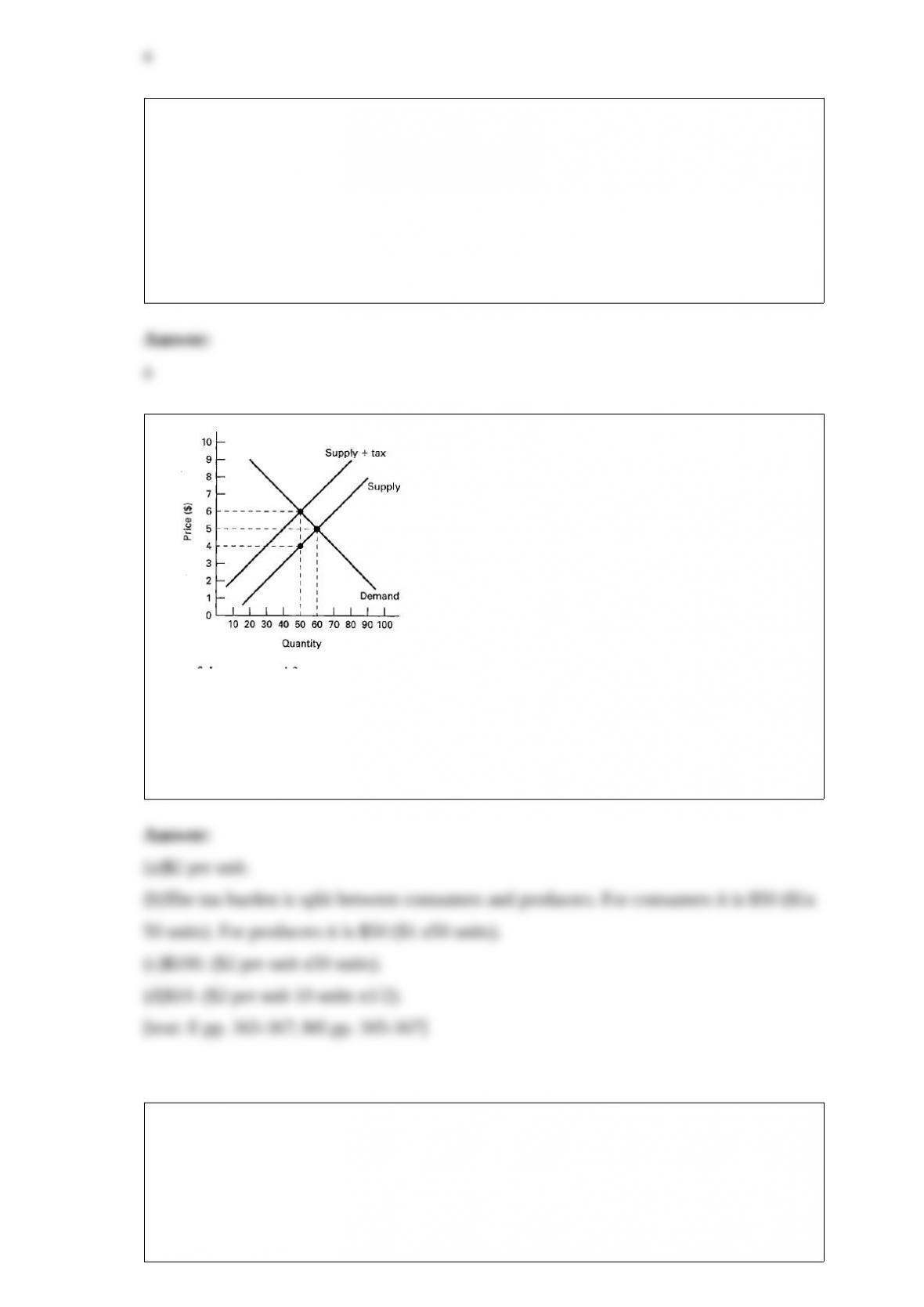
6) The next four questions refer to the below supply
and demand graph for a product on which the government imposes an excise tax.
(a)What is the amount of the tax per unit?
(b)What is the total amount of the excise tax paid by the consumer? By the producer?
(c)What is the total tax revenue for government?
(d)What is the efficiency loss of the tax?
7) In a television advertisement for AFLAC supplemental health insurance, an ice
skater says to his skating partner, “Do you want to try a triple jump?” She responds,
“Why not, I have AFLAC.” This response illustrates the:
A.principal-agent problem.
B.Coase theorem.
C.moral hazard problem.
D.free-rider problem.
8)
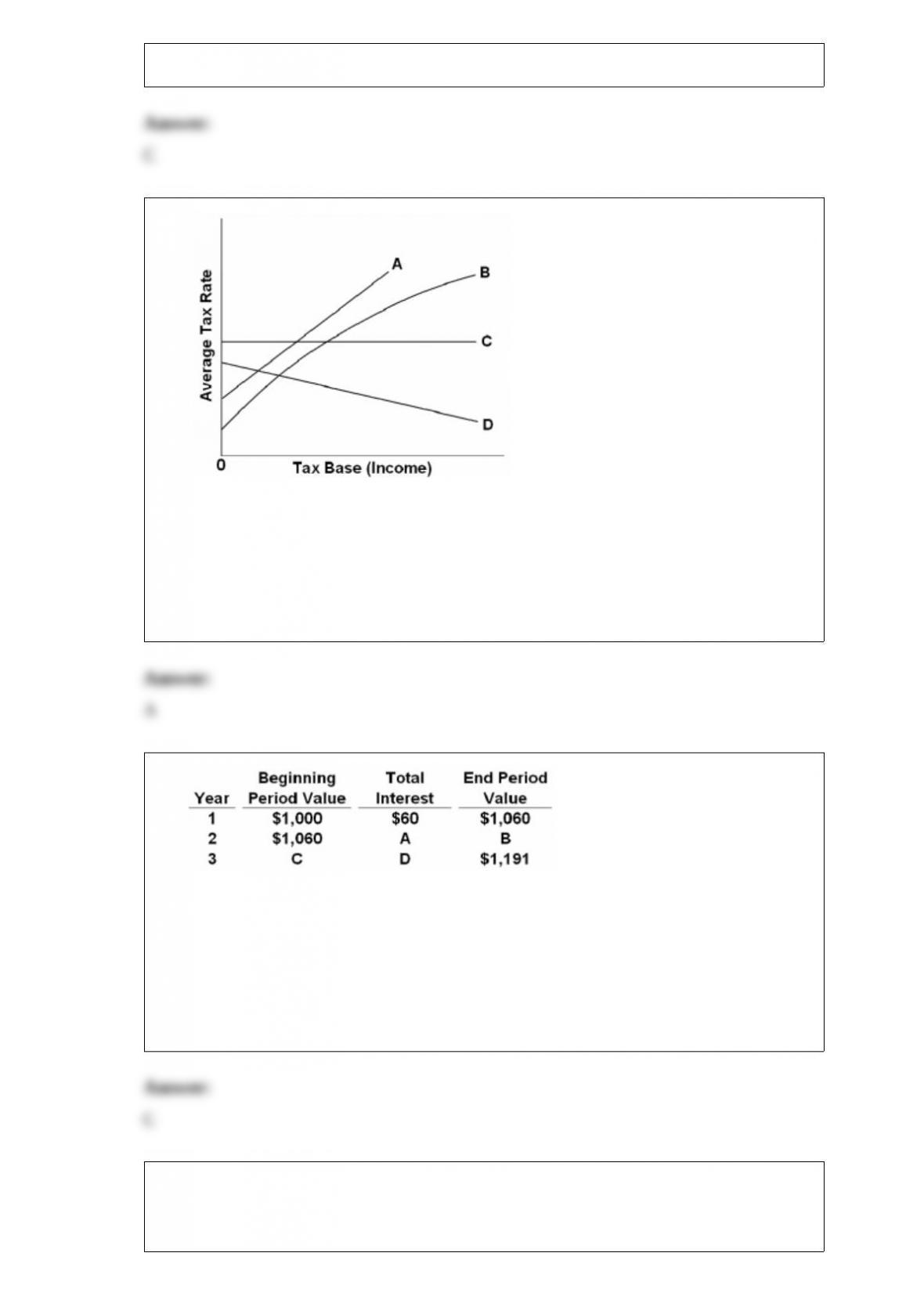
Refer to the above graph. Which of the lines in the above diagram represent(s) a
progressive tax?
A.both A and B.
B.D only.
C.C only.
D.B only.
9)
Refer to the above table representing Darcy’s bank account. Assuming that $1000 was
deposited into her account at the beginning of year 1, and no further deposits or
withdrawals were made, the $1191 value at the end of year 3 represents the:
A.discounted value of the $1000 deposit made at the beginning of year 1.
B.present value of the $1000 deposit made at the beginning of year 1.
C.future value of the $1000 deposit made at the beginning of year 1.
D.present value of the interest earned over the three-year period.
10) which form of business enterprise accounts for the largest number of firms in the
united states?
a.corporations

b.proprietorships
c.partnerships
d.cooperatives
11) What was the largest U.S. fishery, in dollar terms, in 2006?
A.Pacific Halibut.
B.Lobster.
C.Walleye Pollock.
D.Blue Crab.
12) when the production or consumption of a good involves an externality:
a.resources are necessarily overallocated to the product.
b.resources are necessarily underallocated to the product.
c.someone not involved in buying or selling the good is affected.
d.the market will efficiently allocate resources to its production.
13) According to the standard government definitions, the percentage of the U.S.
population now considered to be living in poverty is about:
A.24.1 percent.
B.20.5 percent.
C.5.8 percent.
D.12.3 percent.
14) suppose that gdp was $200 billion in year 1 and that all other components of
expenditures remained the same in year 2 except that business inventories increased by
$10 billion. gdp in year 2 is:
a.$180 billion.
b.$190 billion.
c.$200 billion.
d.$210 billion.
15) economists who believe that the recent productivity acceleration may be permanent
claim that the above-normal economic growth in the united states between 1995 and
2007 was caused by:
a.increases in the rate of personal saving.
b.increased entrepreneurial activity, application of information technology, and global
competition.
c.rising federal budget surpluses that reduced real interest rates.
d.expansionary monetary policy.
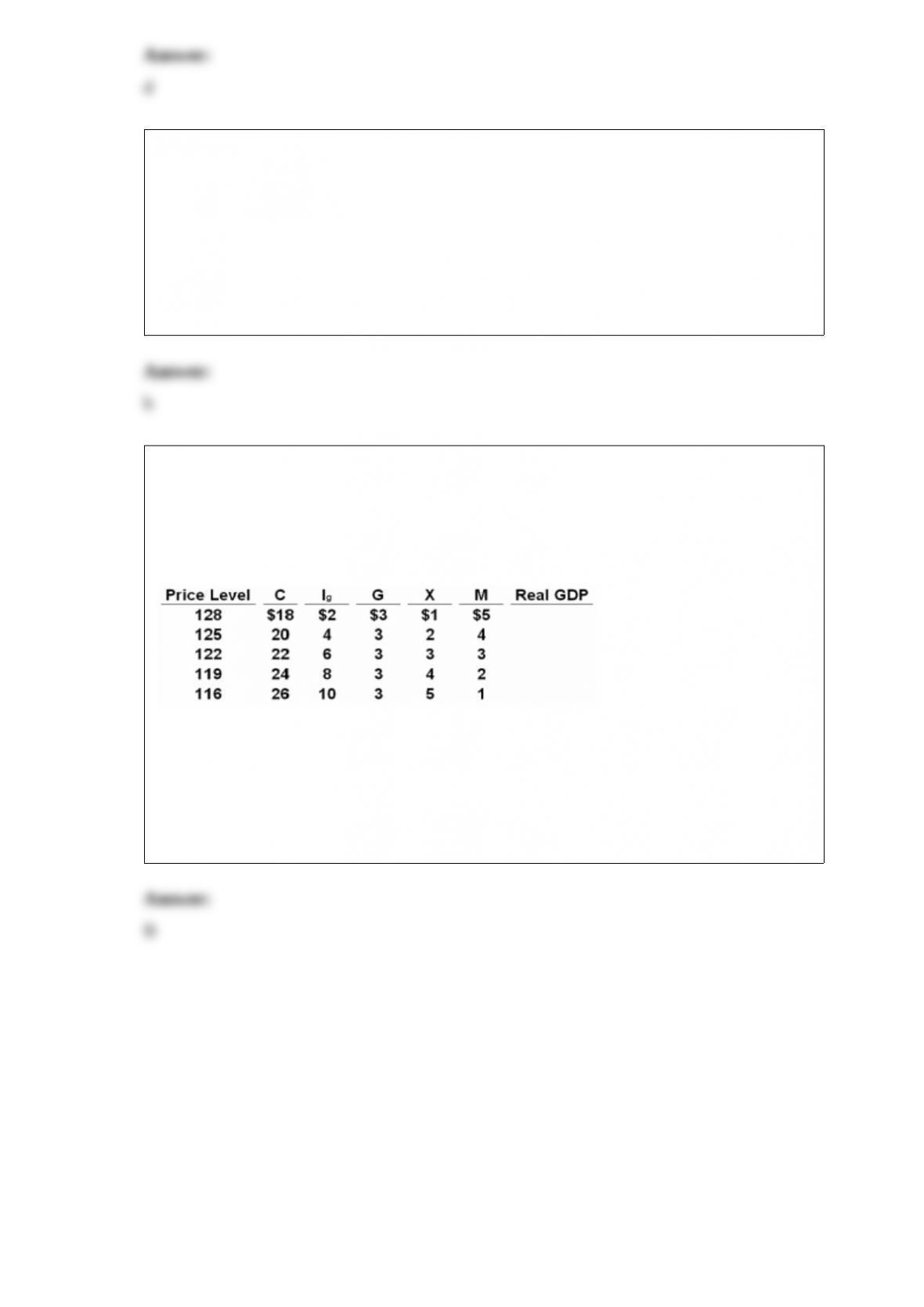
16) Answer the next question(s) on the basis of the following table for a particular
country in which C is consumption expenditures, Ig is gross investment expenditures, G
is government expenditures, X is exports, and M is imports. All figures are in billions of
dollars. Each question is independent of the other questions.
Refer to the above table. If this nation’s equilibrium price level is 125, its net exports
will be:
A.minus $4 billion.
B.minus $2 billion.
C.zero.
D.$2 billion.