
If the favorable supply shocks of the 1990s were reversed in the future, we should
expect a(n)
a. increase in inflation and unemployment.
b. decrease in inflation and unemployment.
c. increase in inflation and a decrease in unemployment.
d. decrease in inflation and an increase in unemployment.
The proposition that the Fed should concentrate on price stability rather than reducing
unemployment is
a. generally accepted by politicians, although few economists accept this proposal.
b. largely accepted by most economists, although politicians do not agree.
c. highly debatable, because many do not agree that price stability should be the most
important goal.
d. simply incorrect, and no one accepts this idea anymore.
The economic justification for public subsidies to university research is based on
a. the value of this research to the university.

b. the higher salaries graduate students earn as a result of working with professors
involved in research.
c. the external benefits of research and development to, in particular, high rates of
economic growth.
d. higher incomes earned by those who provide services to university researchers
(equipment, supplies, etc.).
An individual’s demand curve for a good is ____ her marginal utility curve for the
good.
a. based on
b. the mirror image around the vertical axis of
c. twice as steep as
d. half as steep as
Laissez-faire refers to a situation in which there is ____ with the workings of the market
system.
a. zero consumer involvement
b. zero government interference

c. minimal government interference
d. complete government interference
If the reserve requirement is 20 percent and a new deposit of $10,000 in cash is made
by a customer to their checking account, by how much are excess reserves increased?
a. $10,000
b. $8,000
c. $4,000
d. $2,000
Which of the following is an example of a price floor?
a. rent controls
b. maximum prices for gasoline
c. usury laws that set maximum interest rates
d. the minimum wage
Which of the following is an example of tacit collusion?
a. OPEC
b. copper cartel
c. price leadership
d. government franchise granted to a utility
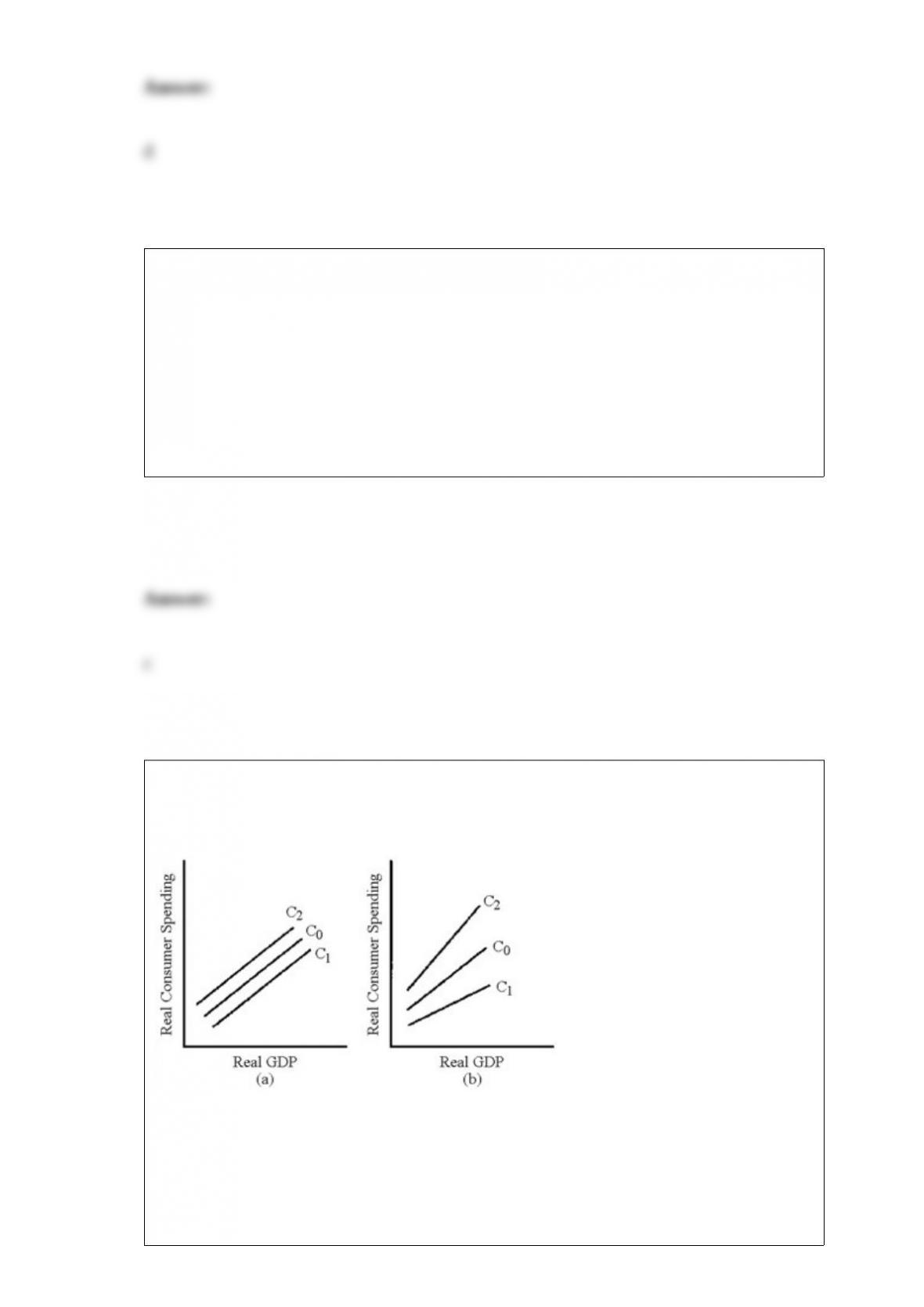
Figure 11-3
In Figure 11-3, which line represents the change in the consumption schedule caused by
an increase in the personal income tax?
a. C1 in graph (a)

b. C2 in graph (a)
c. C1 in graph (b)
d. C2 in graph (b)
The Ponderosa Bank receives a new deposit of $2,500. The reserves requirement is 20
percent. How much can this bank loan out as a result of this deposit?
a. $25,000
b. $12,500
c. $3,125
d. $2,000
e. $500
In 2013, new stock sales accounted for ____ in corporate financing because
corporations bought back some of their stock.
a. $2 billion
b. -$384 billion
c. $1 trillion
d. −$65 billion
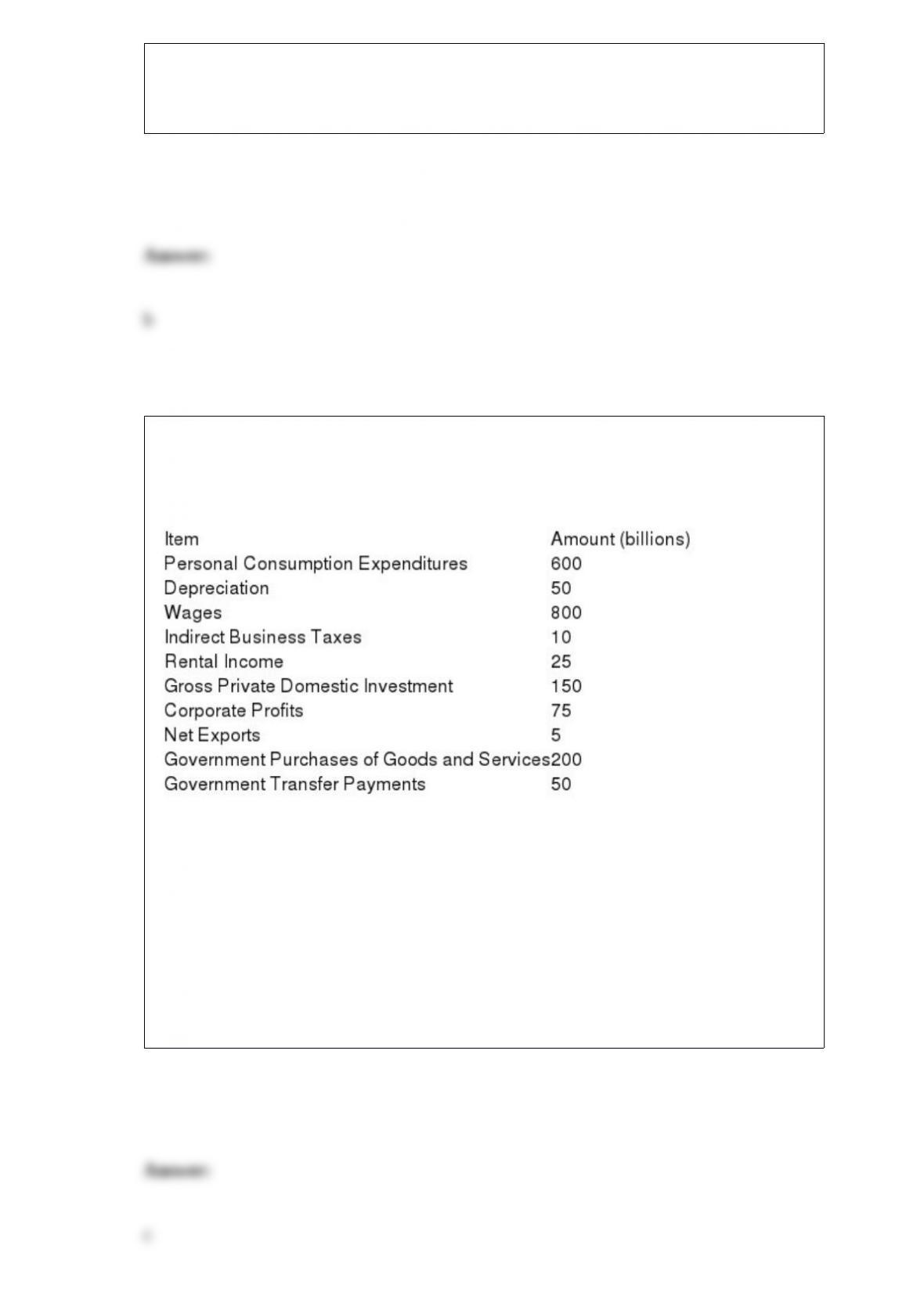
Table 8-1
According to the data in Table 8-1, the value of GDP is
a. 800.
b. 805.
c. 955.
d. 1055.

Who would receive payments from the government under a negative income tax
system?
a. everyone
b. only people with no earnings
c. only people with incomes below a certain level
d. only people with incomes above a certain level
A monopolist in the radio industry has two radio-making plants. The marginal cost of
radio production by Plant A is $4Q (where Q is the number of radios produced) and the
marginal cost of radio production by Plant B is always $16. If the demand curve for
radios is downward sloping, the monopolist will
a. never produce radios at Plant A.
b. always produce four times as many radios at Plant B as at A.
c. never produce more than four radios at Plant A.
d. produce radios at Plant A only as a last resort.
The supply-side shocks of the 1970s shifted the aggregate supply curve inward.

a. True
b. False
Very recently, the debt-to-GDP ratio has been:
a. higher than usual.
b. lower than usual.
c. stabilized.
d. volatile.
If the supply curve remains constant, an outward shift in the demand curve for a
commodity causes the price of factors used in its production to decline.
a. True
b. False

If the Fed raises the discount rate, what happens to reserves and the money supply?
a. Reserves increase and the money supply decreases.
b. Both increase.
c. Reserves decrease and the money supply increases.
d. Both decrease.
Studies of data support the view that higher levels of education are associated with
higher levels of real
a. interest rates.
b. per capita GDP.
c. price inflation.
d. income decline.

What makes the macroeconomic performance of the 1993 to 1998 period so unusual is
the
a. simultaneous occurrence of unemployment and inflation increases.
b. simultaneous occurrence of real GDP decreases and inflation rate increases.
c. occurrence of real GDP decreases while the unemployment rate increases.
d. simultaneous occurrence of reduced unemployment rates and falling inflation rates.
Even if all individual demand curves are downwardly sloped, the market demand curve
may slope upward.
a. True
b. False
From 2005 to 2006 the U.S. economy experienced significant inflation because the
aggregate demand curve shifted outward more than the aggregate supply curve shifted
outward.
a. True
b. False

Gross Domestic Product is a dollar measure of
a. total gross investment in an economy.
b. total industrial sales in a particular time period.
c. the total physical product of the economy.
d. the value of all final goods and services produced in one time period.
Americans needing foreign currencies get those currencies from a bank. The ultimate
source of these currencies is
a. U.S. investments abroad.
b. U.S. exports to foreign countries.
c. U.S. imports of foreign goods and services.
d. the International Monetary Fund.

In their 1994 book, The Bell Curve, Murray and Herrnstein presented evidence that IQ
is an important determinant of economic success.
a. True
b. False
Externalities are benefits or damages conferred upon people who are directly involved
in an exchange of a good or service.
a. True
b. False
In the United States, the incidence of poverty has declined since the 1970s.
a. True
b. False
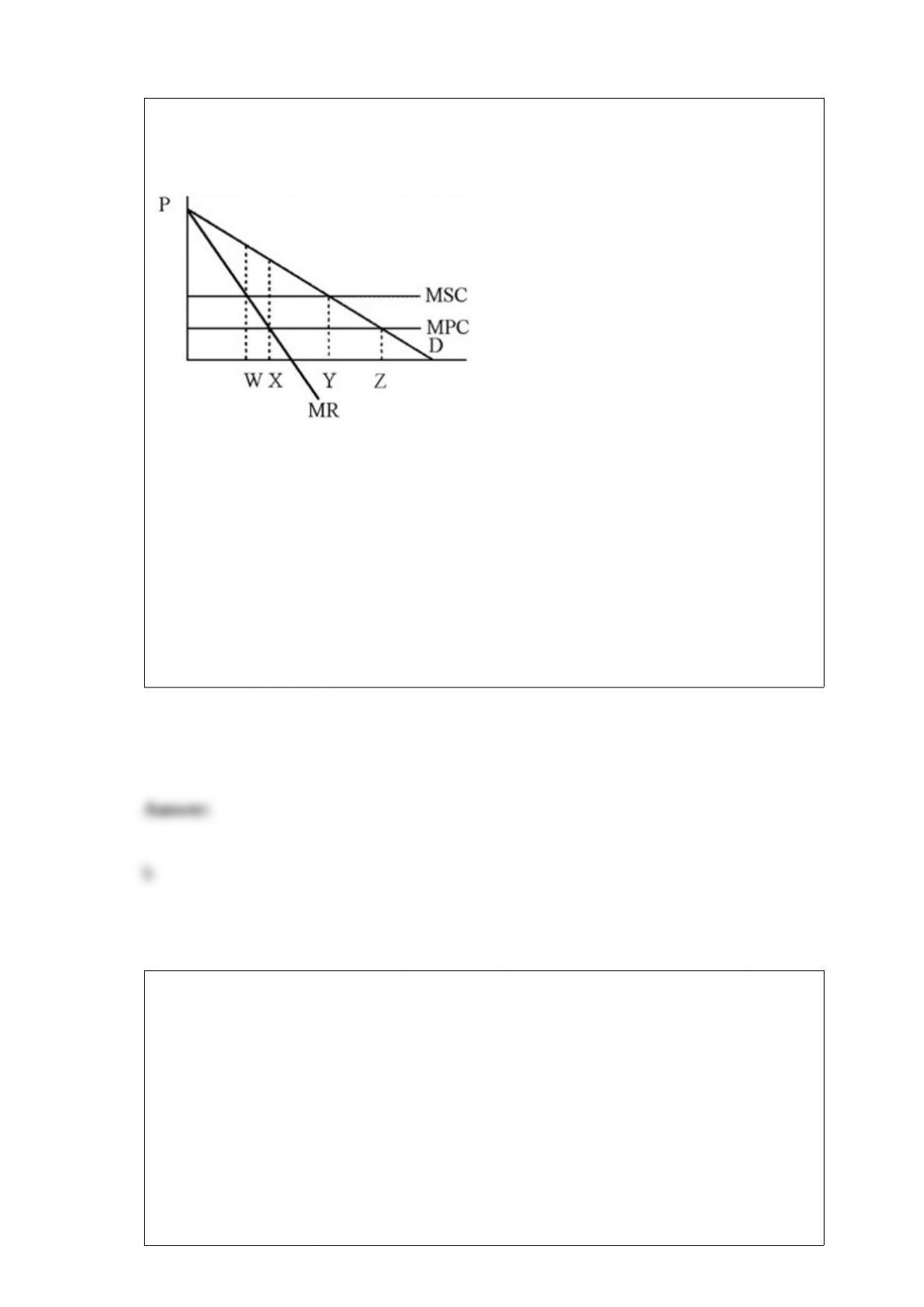
Figure 15-1
Figure 15-1 describes conditions in the monopolized weezil industry. In the absence of
government intervention, the monopolist will produce an output equal to
a. W.
b. X.
c. Y.
d. Z.
A market system (market economy) depends on the market to
a. find the most efficient way of using resources.
b. determine how large the budget deficit should be.
c. decide how much government regulation there should be.
d. provide minimum incomes for everyone.
e. All of the above are correct.

More than 80% of American firms are incorporated.
a. True
b. False
The first economist to point out the importance of specialization of labor was
a. Leonardo da Vinci.
b. Adam Smith.
c. David Ricardo.
d. John Maynard Keynes.
e. Enrico Caruso.

A quota reduces quantity sold by operating through the demand side of the market.
a. True
b. False
When an airline reduces its fares, other airlines typically match the action. But when an
airline increases its fare, other airlines do not follow suit. Which oligopoly model cartel,
price leadership, or kinked demand best fits the airline industry as described? Justify
your choice and explain why the other models are less appropriate.
Draw the demand, marginal revenue and marginal cost curve for a monopolist. Show
the equilibrium price and quantity supplied and total profit. Show the equilibrium price
and quantity supplied and total profit.
What are the two basic principles of aggregation?
When inflation comes from the supply side, inflation and unemployment are positively
correlated. Does this mean that monetary and fiscal policy makers can escape the
trade-off between inflation and unemployment?

Which factors will cause the consumption function to shift? Which factors do not cause
the function to shift?
Give an example of a price ceiling. Draw a corresponding diagram and explain why
there is a continuing shortage.
What are the reasons for unequal distribution of income? List at least six reasons.
What are the major goals that unions may pursue in labor negotiations? Are these ever
in conflict with one another?

List five major economic activities of government, and give an example of each.
Explain how a large number of firms in the industry and product heterogeneity affect
the likelihood of cartel success.
If you leave your money in the bank at a fixed interest rate and allow for compounding
of interest, show what will happen to your savings over time. Indicate with a graph
whether there is a negative or positive slope between savings and time and what
happens to the slope over time.
Is a benevolent command economy likely to achieve greater efficiency than a purely
competitive market system? Explain.
Discuss the advantages of the Herfindahl-Hirschman Index compared with the four-firm
concentration ratio.
Are there key differences between an increase in the capital stock and an improvement
in the level of technology?
One of the conclusions of the model of monopoly is that the firm earns economic
profits above the required opportunity cost of the factors of production. Are these
profits lost to society? Do they take spending power from the economy, and act as a
brake on economic growth?
Who bears the burden of an excise tax if demand is perfectly inelastic; if supply is
perfectly inelastic? Use graphs in your explanation.
Define and distinguish between real and nominal GDP. Explain why the distinction is
important to economists.
Compare the advantages and disadvantages of marginal and average cost pricing for
natural monopolies.