
Members of the Board of Governors of the Federal Reserve System are
a. elected by member banks to serve four-year terms.
b. appointed by Congress for 14-year terms.
c. appointed by the president for 14-year terms.
d. appointed by the Supreme Court for lifetime terms.
Historical data on prices and quantities sold do not provide the basis for drawing an
accurate demand curve because
a. reporters who gather these data are often wrong.
b. factors other than price may change over time.
c. they do not include measures of price close to the quantity axis.
d. they sometimes tend to be clustered around one point.
If economic fluctuations originate on the supply side,
a. there will be no relationship between unemployment and inflation.
b. real wage increases will be necessary to eliminate unemployment.

c. inflation and unemployment will be negatively related.
d. inflation and unemployment will be positively related.
Slope is measured as rise/run.
a. True
b. False
A market which firms can enter if they choose and exit without losing money invested
is
a. pure monopoly.
b. duopoly.
c. contestable.
d. a market where there are kinked demand curves.

A concentration ratio provides a better assessment of market power than the
Herfindahl-Hirschman index does.
a. True
b. False
In North Carolina, a car must pass an emissions test before it can be registered. The
emissions test costs $20 per car. This system is an example of
a. direct controls on pollution.
b. a per-unit emissions tax.
c. a “license to pollute.”
d. subsidies for nonpollution.
As the U.S. labor force grows and the nation’s capital stock is augmented by
investment, the
a. price level will rise.

b. aggregate supply curve shifts inward.
c. aggregate supply curve shifts outward.
d. aggregate supply curve becomes steeper.
In 1981, the Reagan administration employed a policy that included tax ____ while at
the same time the Federal Reserve’s strategy was to combat ____.
a. cuts; unemployment
b. cuts; inflation
c. hikes; unemployment
d. hikes; inflation
The existence of a natural monopoly stems from the size of the firm relative to the total
market demand for the product of that firm.
a. True
b. False

Profits
a. are what remains from the selling price after factors have been paid.
b. accrue to entrepreneurs.
c. are lower than most people think.
d. All of the above are correct.
Marginal revenue product equals the marginal physical product multiplied by the
quantity demanded.
a. True
b. False
College tuition expenses have risen from 1982 to 2012 by

a. an amount equal to prices in general.
b. an amount greater than average prices.
c. an amount less than average prices.
d. the amount of the percentage increase in the overall CPI.
Which of the following would not lead to more conservation?
a. higher prices for a resource
b. increased interest rates on bonds
c. public awareness of increasing scarcity
d. higher taxes on goods produced using the resource
Figure 4-18
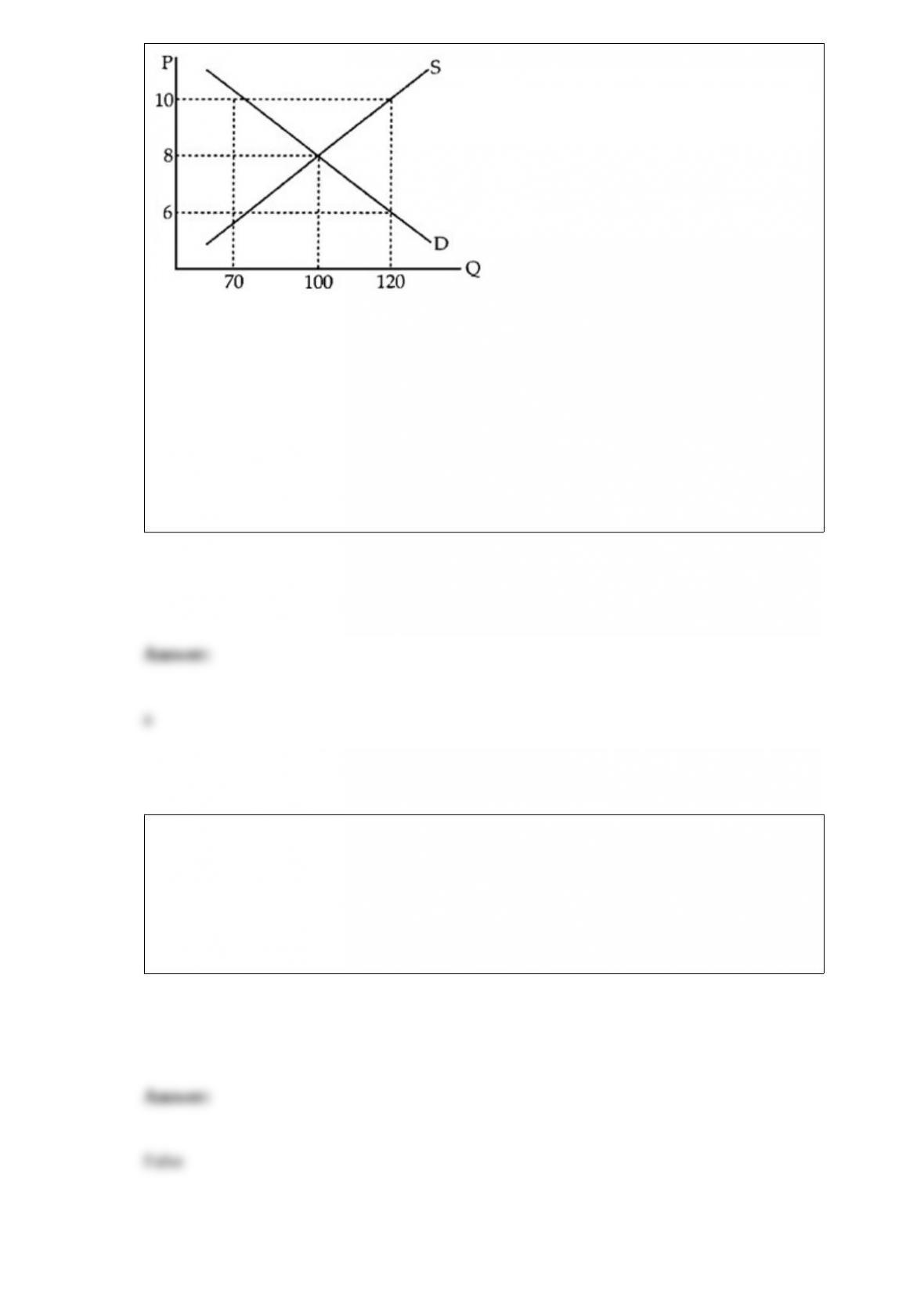
In Figure 4-18, there would be a surplus of T-shirts if the price were
a. $10.
b. $8.
c. below $8.
d. between $8 and $6.
Financial investments, such as mutual fund purchases, are included in the national
income component.
a. True
b. False

Each firm’s capital stock is fixed in the short run. Therefore, if the price of capital
increases, then in the short run the market demand curve for labor in a perfectly
competitive market will
a. shift inward.
b. be unaffected.
c. shift outward.
d. change slope.
The fallacy in the strict crowding-out argument comes from supposing that
a. the Federal Reserve always accommodates the U.S. Treasury in its financing of the
deficit.
b. corporations always outbid small businesses for government contracts.
c. the economy’s flow of saving is fixed.
d. investors will spend more when G increases.
The impact of an increase in oil prices stemming from the growth of demand is
probably going to ____ the wages of petroleum engineers.
a. decrease

b. increase
c. leave unaffected
d. be impossible to predict
The United States is the largest national economy in the world.
a. True
b. False
Taxation can promote good social policy while minimizing economic inefficiency.
a. True
b. False

GDP is a measure of the total output of an economy.
a. True
b. False
The “invisible hand” refers to the control that government must exercise over a market
economy.
a. True
b. False
Under a balanced budget policy, a sharp rise in GDP will cause
a. no serious budget changes.
b. a tax cut or an increase in expenditures.
c. a tax increase or expenditure cut.
d. tax receipts to exceed government expenditures.

Why does quantity supplied increase when price increases?
a. Producers find it more profitable to make the item.
b. People “drop out” of the market, so buyers find it more abundant.
c. As demand decreases with a high price, surpluses appear.
d. All of the above.
Derivatives:
a. can be used to reduce risk
b. can be a source of risk
c. made the financial crisis of 2007-2009 not as bad as it would otherwise have been
d. a and b only
e. all of these

Money’s principal function is to serve as a
a. standard for making loans.
b. standard for credit reporting.
c. medium of exchange.
d. method for storing wealth.
An upward spiral of protectionism is a possible outcome of strategic trade policy.
a. True
b. False
Total expenditures can be written as C + I + G + (X − IM).
a. True
b. False
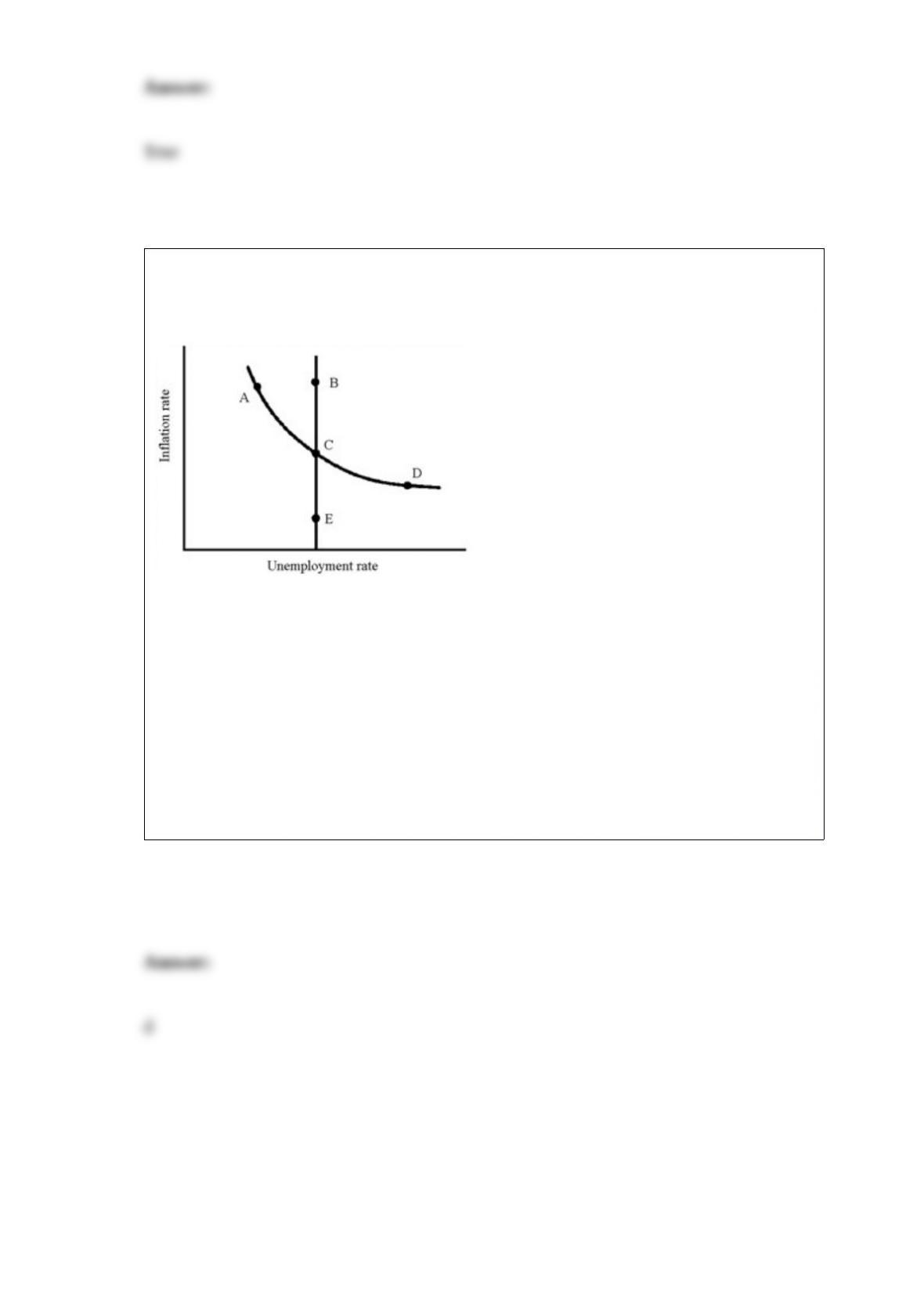
Figure 17-8
In Figure 17-8, which of the following points illustrate the expansionary monetary
policies of the mid-1990s and the accompanying favorable supply shocks?
a. A to B to C
b. B to C to E
c. C to B to A
d. D to C to E