1)
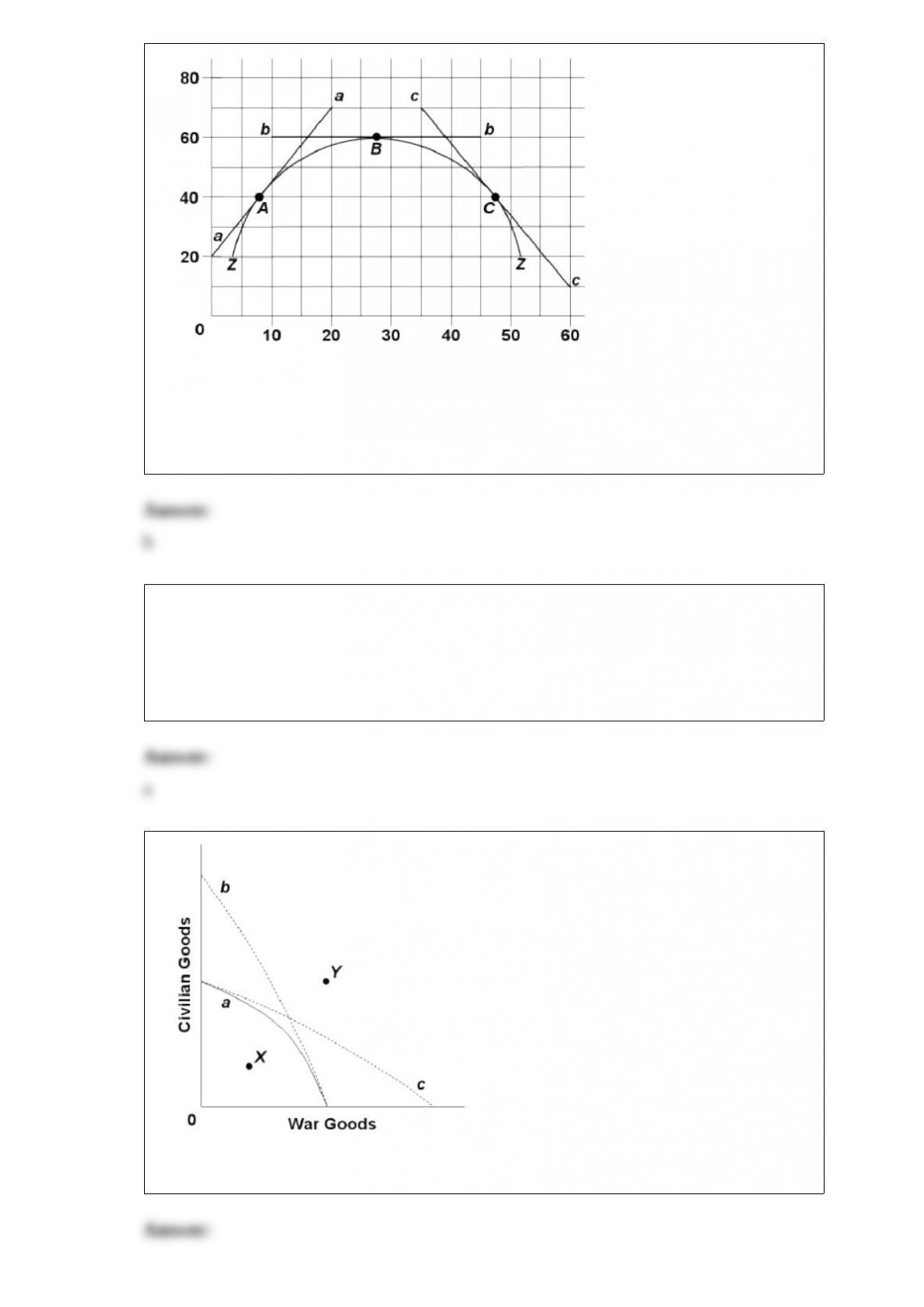
refer to the above diagram. the slope of curve zz at point b is:
a.infinity.
b.zero.
c.+1
d.-1
2) slopes of lines are especially important in economics because:
a.they measure marginal changes.
b.they always tell us something about profits.
c.positive slopes are always preferred to negative slopes.
d.they always relate to resource and output scarcity.
3)
refer to the above diagram. given production possibilities curve (a), point y indicates
that society is failing to use available resources efficiently.
4)
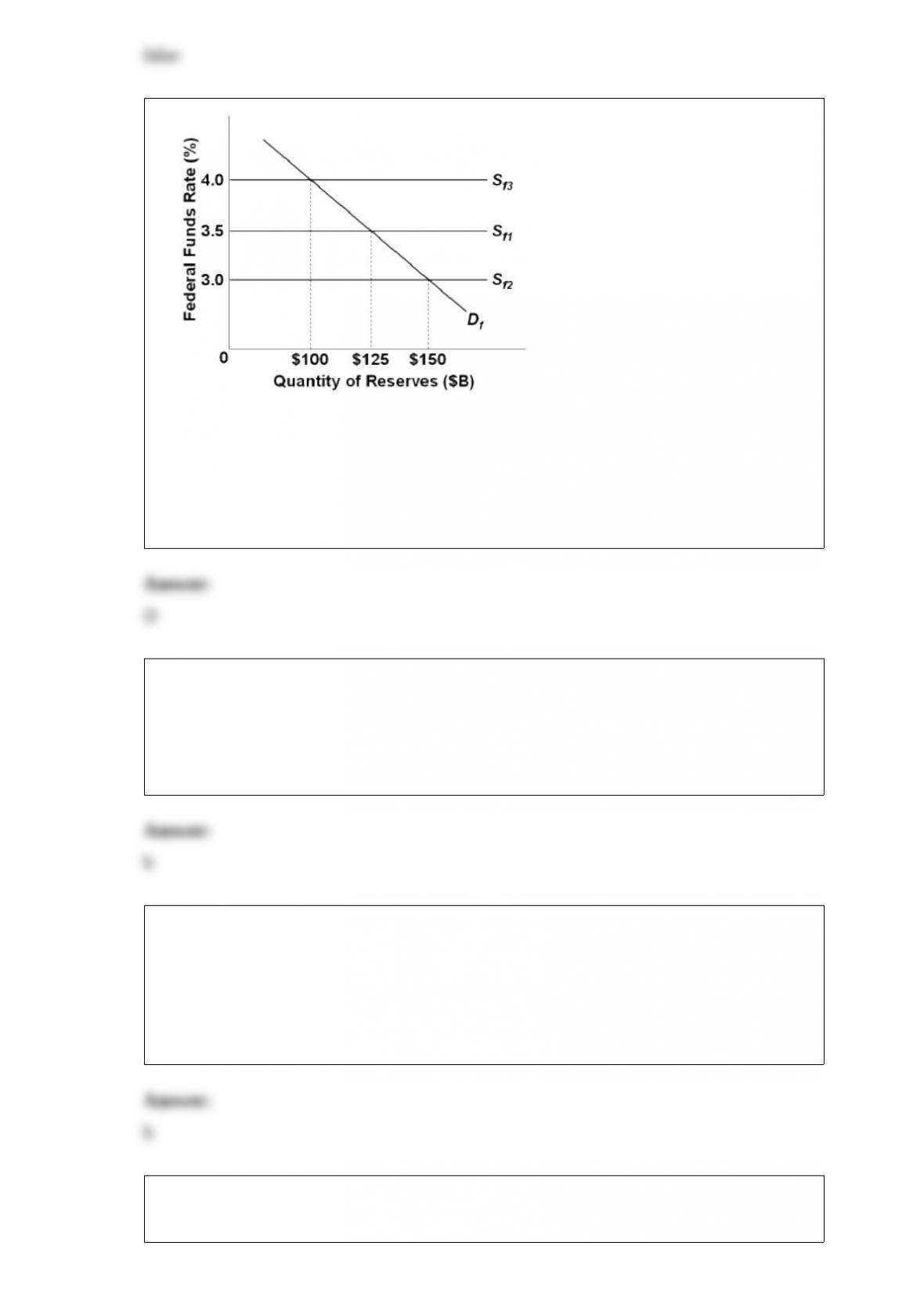
Refer to the above diagram for the Federal funds market. A $25 billion increase in
reserves will change the interest rate to:
A.3.0 percent.
B.3.5 percent.
C.4.0 percent.
D.an indeterminate level.
5) the price elasticity of demand for health care is:
a.perfectly inelastic.
b.relatively inelastic.
c.relatively elastic.
d.perfectly elastic.
6) the demand curve in a purely competitive industry is ______, while the demand
curve to a single firm in that industry is ______.
a.perfectly inelastic, perfectly elastic
b.downsloping, perfectly elastic
c.downsloping, perfectly inelastic
d.perfectly elastic, downsloping
7) In the context of labor markets, shirking refers to:
A.the nonmonetary disadvantages of certain jobs.

B.the neglecting or evading of work.
C.the elimination of monitoring costs.
D.any scheme where pay is directly related to worker output.
8) A recessionary expenditure gap exists if:
A.planned investment exceeds saving at the full-employment GDP.
B.the aggregate expenditures schedule lies below the 45-degree line at the
full-employment GDP.
C.the aggregate expenditures schedule intersects the 45-degree line at any level of GDP.
D.the aggregate expenditures schedule lies above the 45-degree line at the
full-employment GDP.
9) all of the following are sources of increasing returns and economies of scale except:
a.network effects.
b.the multiplier effect.
c.learning-by-doing.
d.simultaneous consumption.
10) which of the following nations is not a member of the european union?
a.switzerland
b.france
c.germany
d.italy
11) purely competitive industry x has constant costs and its product is an inferior good.
the industry is currently in long-run equilibrium. the economy now goes into a
recession and average incomes decline. the result will be:
a.an increase in output and in the price of the product.
b.an increase in output, but not in the price, of the product.
c.a decrease in the output, but not in the price, of the product.
d.a decrease in output and in the price of the product.
12) Currency held in the vault of First National Bank is:
A.counted as part of M1.
B.counted as part of M2, but not M1.
C.only counted as part of M1 if it was deposited into a checking account.
D.not counted as part of the money supply.
13) (Advanced analysis) In a private closed economy (a) the marginal propensity to
save is 0.25, (b) consumption equals income at $120 billion, and (c) the level of
investment is $40 billion. What is the equilibrium level of income?
A.$280 billion
B.$320 billion
C.$262 billion
D.$198 billion
14) Which of the following has contributed to large U.S. trade deficits in recent years?
A.China fixing its exchange rate.
B.Rapid increases in the price of oil.
C.A declining U.S. saving rate.
D.All of these have contributed.
15) Assume that the short-run cost and demand data given in the table below confronts
a monopolistic competitor selling a given product and engaged in a given amount of
product promotion. Compare the marginal cost and marginal revenue of each unit of
output and enter these figures in the table.
(a)At what output level and at what price will the firm produce in the short run? What
will be the total profit?
(b)What will happen to demand, price, and profit in the long run? How will the market
adjust to achieve this?
16) Which of the following is not characteristic of U.S. agriculture?
A.Productivity has been increasing more slowly in agriculture than in the rest of the
economy.
B.The demand for agricultural commodities increases less than proportionate to
increases in income.
C.Resources in agriculture are relatively immobile.
D.Demand is inelastic with respect to price.
17) the health care market is characterized by:
a.important ethical-equity considerations.
b.asymmetric information between providers and consumers.
c.third-party payment of health care costs.
d.all of these.
18) if the price elasticity of demand for a product is 2.5, then a price cut from $2.00 to
$1.80 will:
a.increase the quantity demanded by about 2.5 percent.
b.decrease the quantity demanded by about 2.5 percent.
c.increase the quantity demanded by about 25 percent.
d.increase the quantity demanded by about 250 percent.