
On an aggregate level, free trade produces a net __________ and restricted trade
produces a net __________.
a. loss; loss also
b. benefit; benefit also
c. benefit; loss
d. loss; benefit
Opportunity cost is the __________ alternative forfeited when a choice is made.
a. least-valued
b. most highly-valued
c. most convenient
d. most recently considered
Efficiency is consistent with
a. maximizing net benefits.
b. equating marginal benefits and marginal costs.
c. maximizing total benefits.
d. minimizing total costs.

e. a and b
Microeconomics is the branch of economics that deals with
a. highly aggregated markets or the entire economy.
b. the production side of the economy, exclusively.
c. the buying side of the economy, exclusively.
d. human behavior and choices as they relate to relatively small units – an individual, a
firm, an industry.
The coordinates of point A are 30 units of X and 70 units of Y. The coordinates of point
B are 28 units of X and 76 units of Y. With X on the horizontal axis and Y on the
vertical axis, the slope of the line between points A and B is
a. + 3.00
b. + 0.67
c. + 0.33
d. – 3.00
e. – 0.33

If for a given individual, between a wage rate of $20 and $25 the
____________________ effect outweighs the ________________ effect, the
individual’s supply curve of labor curve between those two wages will be
_________________.
a. substitution; income; vertical
b. substitution; income; upward sloping
c. substitution; income; downward sloping
d. income; substitution; vertical
e. income; substitution; upward sloping
A theory is an abstract representation of reality. This means a theory
a. is descriptive of the way the world is.
b. is an unrealistic representation of reality.
c. omits certain factors when trying to explain something.
d. is usually expressed in professional jargon.
e. none of the above

In a political election, a candidate whose positions are on the left will tend to be labeled
__________ by his or her opponent.
a. too far to the left
b. too far to the right
c. too much of a middle-of-the-roader
d. an unknown quantity
The monopolist’s marginal revenue curve is
a. downward sloping and lies below the firm’s demand curve.
b. upward sloping and lies above the firm’s demand curve.
c. perfectly inelastic.
d. downward sloping and lies above the firm’s demand curve.
e. the same as the industry demand curve.
One of the main criticisms of the theory of contestable markets is that the assumption of

extremely free entry into (and costless exit from) the industry is unlikely to hold in the
real world.
a. True
b. False
Economist A believes that the case for government is a strong one, but she doesn’t
always say, when it comes to negative externalities, that government can turn an
inefficient market outcome into an efficient outcome.Which statement is economist A
most likely to make?
a. If the tax placed on the activity that generates the negative externality is too large, we
are not likely too move from inefficiency to efficiency.
b. If the subsidy placed on the activity that generates the negative externality is too
small, we are not likely to move from inefficiency to efficiency.
c. If there is a free rider problem, then government cannot solve the problem of negative
externalities.
d. a and b
e. none of the above
Which of the following statements is true?
a. If the Gini coefficient is large, then the space between the Lorenz curve and the line

of perfect income equality will be small.
b. If the Gini coefficient is 1.00, then the Lorenz curve and the line of perfect income
equality coincide.
c. If the government succeeds in decreasing income inequality, then the Gini coefficient
will decrease.
d. If the Gini coefficient is 0.50, then one-half of the households earn one-half of the
income, and the other half of the households earn the other half.
The supply of seats for an economics class at 10 a.m. is the same as the supply of seats
for the same class at noon.Every student who wants to attend this class at noon can, but
not every student who wants to attend the 10 a.m. class can. Tuition does not vary by
time. It follows that the demand for the 10 a.m. class is __________ the demand for the
noon class.
a. lower than
b. the same as
c. greater than
d. either a or b
e. none of the above
A bond is
a. a claim on the assets of the corporation that gives the purchaser an ownership right in
the corporation.
b. the share of profits distributed to bondholders.
c. a promise to pay for the use of someone else’s money.
d. a promise of ownership of the government.
e. c and d
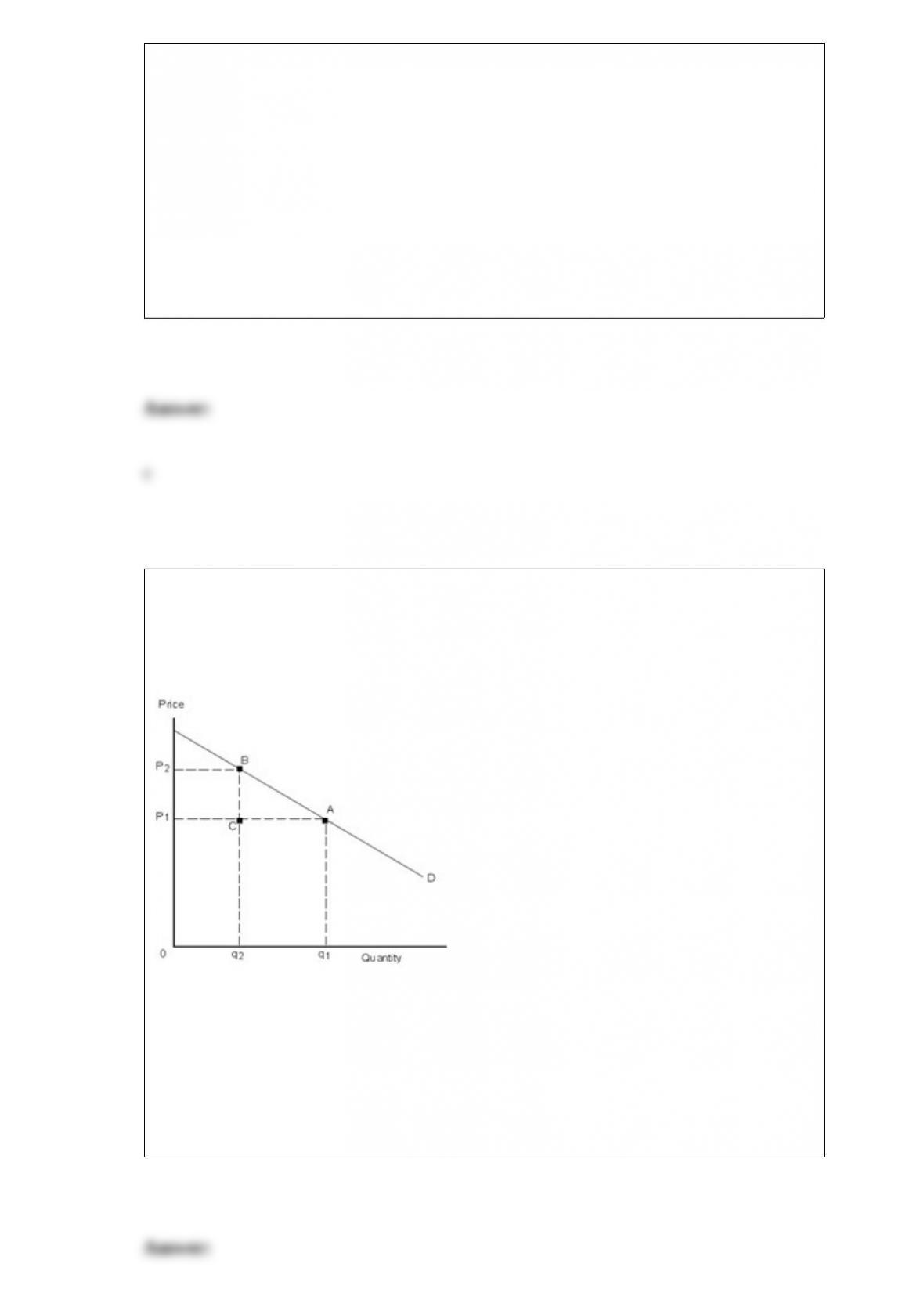
Refer to Exhibit 24-5. Suppose a single-price monopolist sells its product at the price
P2. Profits are equal to
Exhibit 24-5
a. P2 times q2.
b. (P2 – P1) times q2.
c. (P2 – P1) times (q1 – q2).
d. This cannot be determined without the average total cost curve.

In an interview an economist states, “This problem should be of greater concern to the
federal government.” We can explicitly put this statement in the category of
a. microeconomics.
b. macroeconomics.
c. positive economics.
d. normative economics.
If a theory can predict those things that you should observe if it is right and can also
predict those things that you should observe if it is wrong, it is said to have the virtue of
falsifiability.
a. True
b. False
The productivity of the agriculture sector (of the economy) increases dramatically. A
likely consequence is:

a. increased resources flowing into the agriculture sector.
b. an increase in the supply of foodstuffs and lower prices for foodstuffs.
c. an increase in the total revenue (farmers’ receive) from selling foodstuffs, assuming
the demand for their products is elastic.
d. a decrease in the total revenue (farmers’ receive) from selling foodstuffs, assuming
the demand for their products is inelastic.
e. none of the above
The term “arbitrage” refers to
a. buying a good in a market where its price is high and selling the good in another
market where its price is lower.
b. buying a good in a market where its price is low and selling the good in another
market where its price is higher.
c. selling a good in a market where its price is high.
d. selling a good in a market where its price is low.
Refer to Exhibit 2-5. The opportunity cost of moving from point A to point B is
approximately
Exhibit 2-5
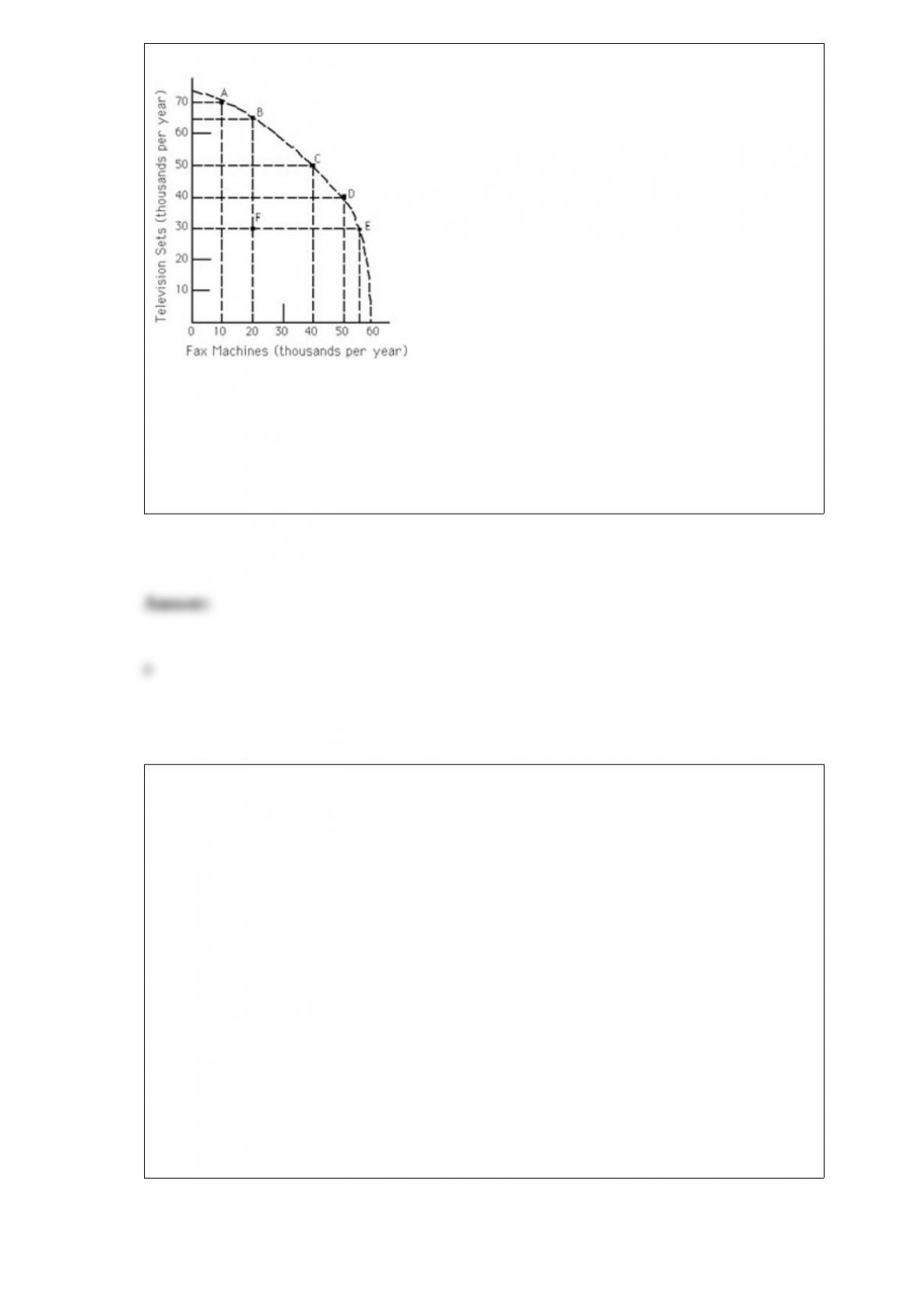
a. 5,000 televisions.
b. 5,000 fax machines.
c. 10,000 televisions.
d. 10,000 fax machines.
Countries tend to specialize in the production of goods in which they have a
comparative advantage because
a. government officials calculate opportunity costs and suggest to people what they
ought to produce.
b. people want to make a profit.
c. the Economic Development Office of the United Nations hires economic experts to
calculate the opportunity costs of different goods in different countries and then
suggests to countries what they ought to produce.
d. the United Nations hires economic experts to calculate the opportunity costs of
different goods in different countries and then suggests to countries what they ought to
produce.
e. none of the above
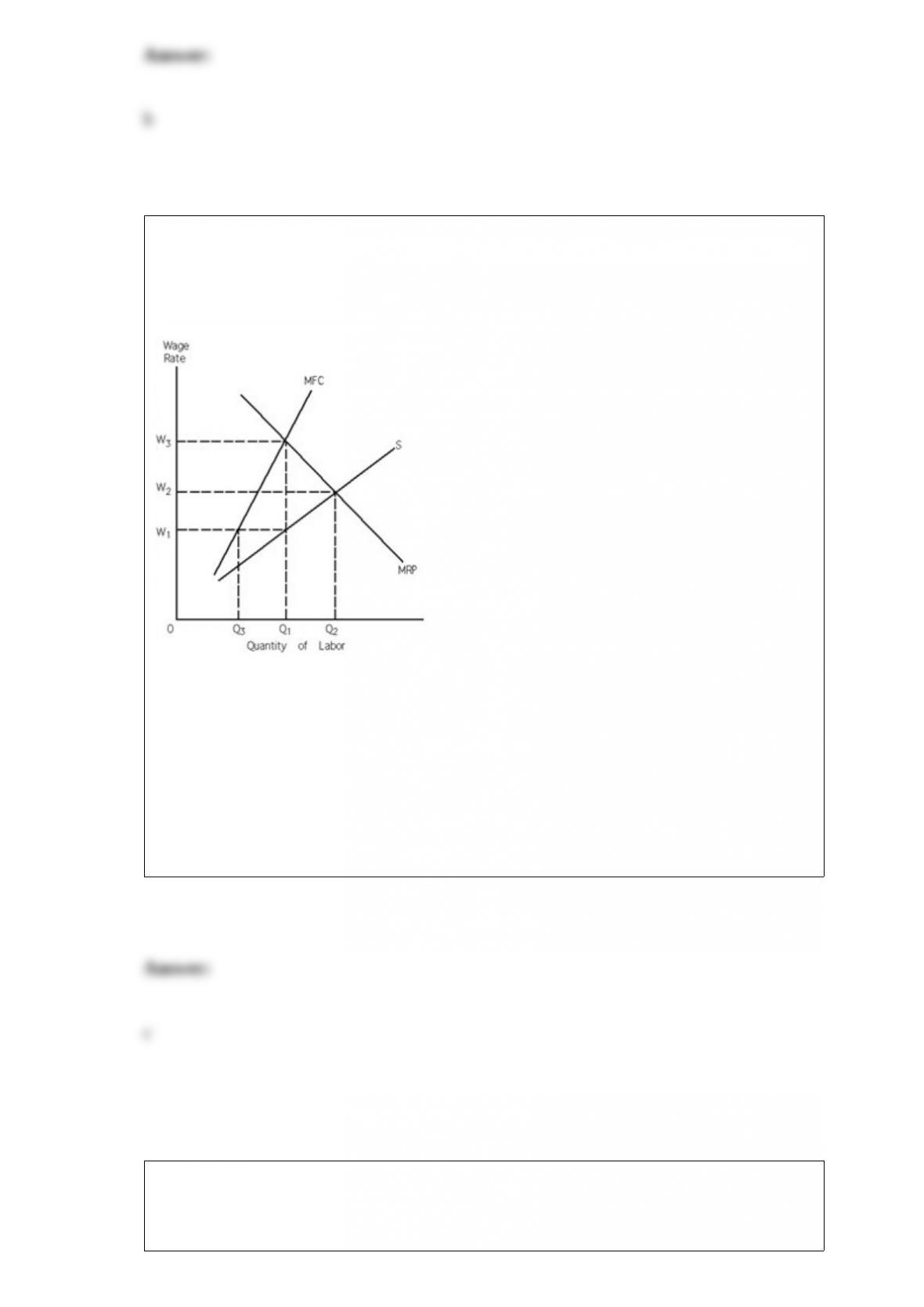
Refer to Exhibit 28-3. In the absence of collective bargaining, if the profit-maximizing
monopsonist were to pay workers what their services were worth to it, it would pay
Exhibit 28-3
a. W1.
b. W2.
c. W3.
d. some wage rate between W2 and W3.
The traditional (or orthodox) view of labor unions is that they
a. positively impact productivity and efficiency.

b. negatively impact productivity and efficiency.
c. drive an artificial wedge between the wages of comparable labor in the union and
nonunion sectors of the labor market.
d. a and c
e. b and c
Raquel, who earns $900 a week, bought a television set and gained $70 consumers’
surplus. What price did she pay for the good?
a. $40
b. $830
c. $160
d. $5
e. There is not enough information to answer the question.
If the government establishes a price floor for agricultural products, then
a. consumers will pay a lower price for the products.
b. consumers will increase the quantity that they are willing to consume.

c. farmers will want to decrease their production.
d. the government will need to purchase the resulting surplus.
e. all of the above