1) The terms of trade reflect the:
A.rate at which gold exchanges internationally for any domestic currency.
B.ratio at which nations will exchange two goods.
C.fact that the gains from trade will be equally divided.
D.cost conditions embodied in a single country’s production possibilities curve.
2) the labor force includes:
a.employed workers and persons who are officially unemployed.
b.employed workers, but excludes persons who are officially unemployed.
c.full-time workers, but excludes part-time workers.
d.permanent employees, but excludes temporary employees.
3) The Federal Reserve System:
A.has the same status as the Supreme Court.
B.is basically an independent agency.
C.has the status of a Congressional committee.
D.is an agency of the executive branch of the Federal government.
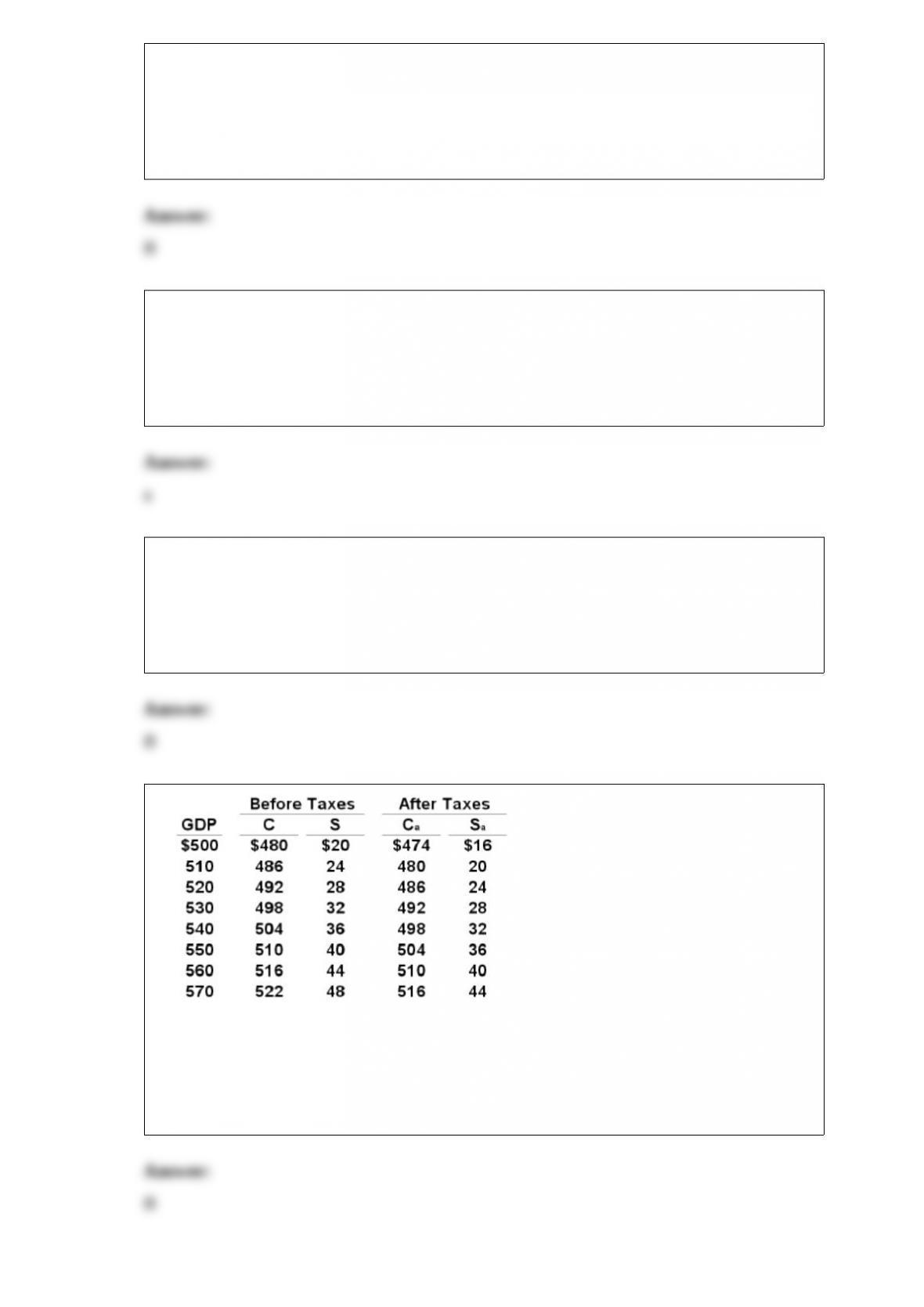
4)
The MPC and MPS in the above economy:
A.are .4 and .6 respectively.
B.are .6 and .4 respectively.
C.are .8 and .2 respectively.
D.cannot be determined from the information given.
5) Other things the same, we would expect the labor demand curve of a purely
competitive seller to be:
A.of unitary elasticity.
B.more elastic than that of an imperfectly competitive seller.
C.less elastic than that of an imperfectly competitive seller.
D.perfectly elastic.
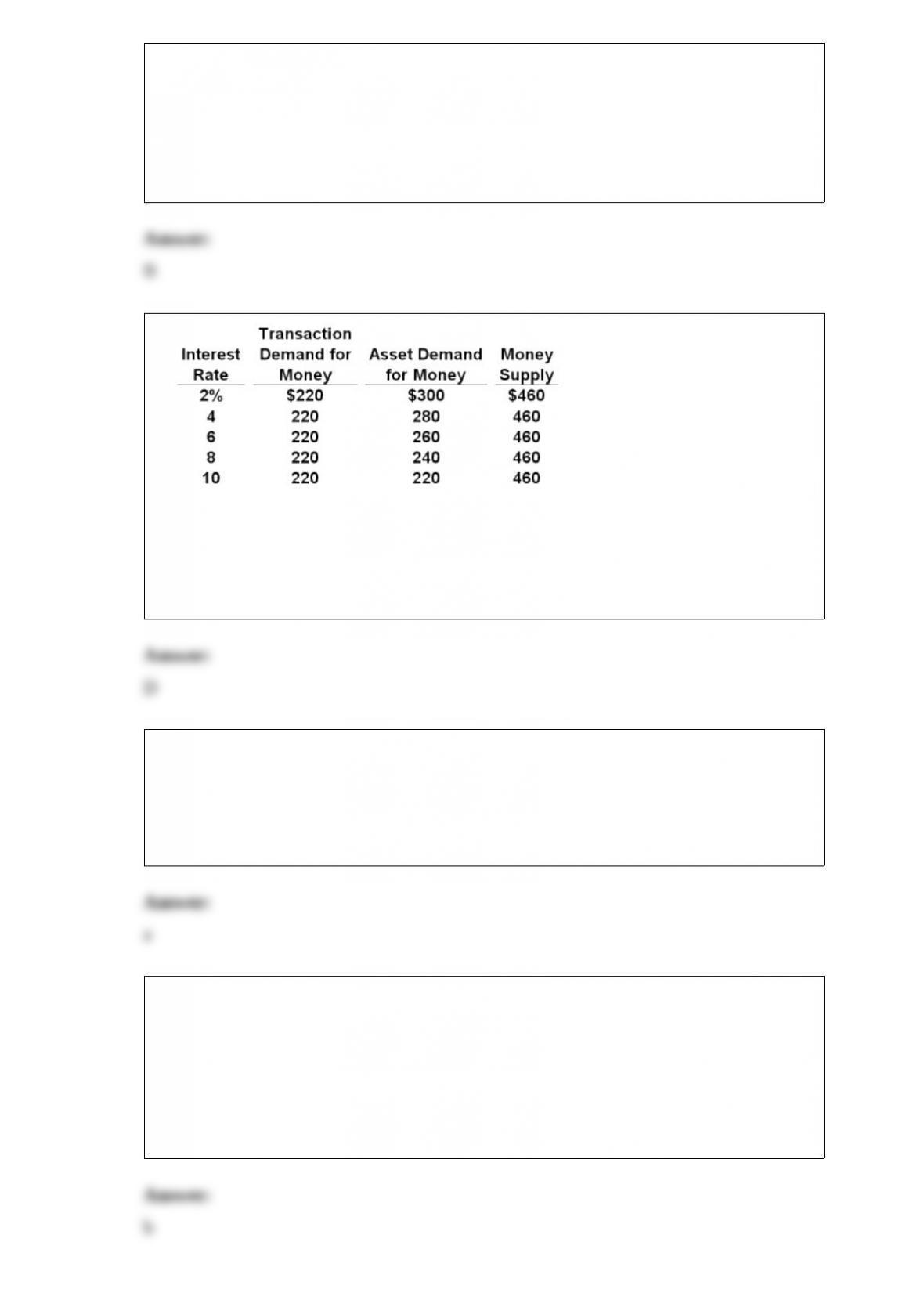
6)
Refer to the above table. The equilibrium interest rate is:
A.2 percent.
B.4 percent.
C.6 percent.
D.8 percent.
7) government purchases include government spending on:
a.government consumption goods and public capital goods.
b.government consumption goods only.
c.public capital goods only.
d.government consumption goods, public capital goods, and transfer payments.
8) assume the natural rate of unemployment in the u.s. economy is 5 percent and the
actual rate of unemployment is 9 percent. according to okun’s law, the negative gdp gap
as a percent of potential gdp is:
a.4 percent.
b.8 percent.
c.10 percent.
d.2 percent.
9) We say that the demand for labor is a derived demand because:
A.labor is a necessary input in the production of every good or service.
B.we demand the product that labor helps produce rather than labor service per se.
C.the forces of supply and demand do not apply directly to labor markets.
D.labor is hired using the MRP = MRC rule.
10) a change in the dollar price of yen from $1 = 100 yen to $1 = 50 yen will:
a.make u.s. goods more expensive to the japanese.
b.make japanese goods less expensive to americans.
c.increase u.s. exports and depress japanese exports.
d.increase japanese exports and depress u.s. exports.
11) Why has the natural rate of unemployment (NRU) declined since the 1980s?
12) What is the difference between economic profit and normal profit?
13) What was the major problem with an international gold standard?
14) Price discrimination is often used by businesses. Explain the conditions under
which price discrimination is practiced.
15) (Consider This) Explain how a reservoir can serve as an analogy for thinking about
a nations capital stock, investment, and depreciation.

16) Explain how the GDP and the interest rate are related to the transactions and asset
demands for money.