
1) utility:
a.is synonymous with usefulness.
b.is want-satisfying power.
c.is easy to quantify.
d.rarely varies from person to person.
2) All of the following are regulatory commissions dealing with social regulation (as
distinct from industrial regulation) except the:
A.Food and Drug Administration.
B.Federal Energy Regulatory Commission.
C.Equal Employment Opportunities Commission.
D.Consumer Products Safety Commission.
3) According to the Taylor rule:
A.if real GDP rises by 1 percent above potential GDP, the Fed should raise the Federal
funds rate by one-half a percentage point.
B.when real GDP is equal to potential GDP and inflation is equal to its target of 2
percent, the Federal funds rate should be kept at 4 percent.
C.if inflation falls by 1 percentage point below its target of 2 percent, then the Fed
should lower the real Federal funds rate by one-half a percentage point.
D.all of these are appropriate Fed actions.
4) the market system’s answer to the fundamental question “how will the goods and
services be produced?” is essentially:
a.”with as much machinery as possible.”
b.”using the latest technology.”
c.”by exploiting labor.”
d.”using the least-cost production techniques.”
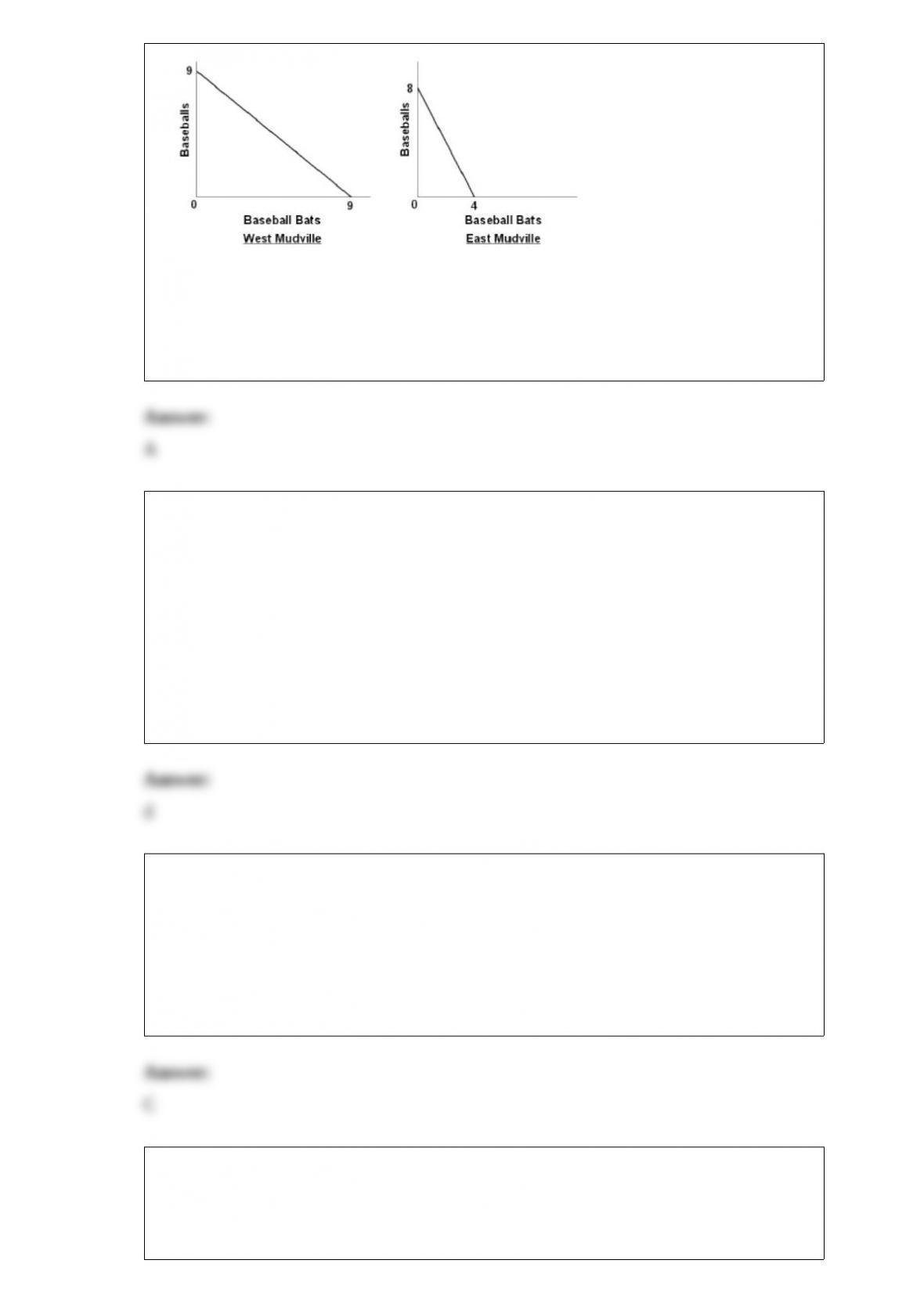
5)
The production possibilities curves above suggest that:
A.West Mudville should specialize in, and export, baseball bats.
B.West Mudville should specialize in, and export, both baseballs and baseball bats.
C.East Mudville should specialize in, and export, baseball bats.
D.workers will try to immigrate from West Mudville to East Mudville.
6) most demand curves are relatively elastic in the upper-left portion because the
original price:
a.and quantity from which the percentage changes in price and quantity are calculated
are both large.
b.and quantity from which the percentage changes in price and quantity are calculated
are both small.
c.from which the percentage price change is calculated is small and the original
quantity from which the percentage change in quantity is calculated is large.
d.from which the percentage price change is calculated is large and the original quantity
from which the percentage change in quantity is calculated is small.
7) (Last Word) In 1981, IBM introduced its version of the personal computer to
compete with existing personal computers offered by Apple and others. IBM’s action
best exemplifies:
A.invention.
B.scientific determinism.
C.diffusion.
D.technological lag.
8) economic growth is best defined as an increase in:
a.either real gdp or real gdp per capita.
b.nominal gdp.
c.total consumption expenditures.

d.wealth in the economy.
9) the marginal cost-marginal benefit approach to migration suggests that:
a.the optimal amount of immigration to the united states is probably zero.
b.everyone who wishes to come to the united states should be allowed to do so.
c.a particular level of immigration may be too low or too high.
d.efforts to reduce the inflow of illegal immigrants should be abandoned.
10) Capital flight refers to:
A.the tendency of large corporations of IACs to build new plants in the DVCs because
labor is cheaper.
B.DVC citizens accumulating or investing their savings in the IACs.
C.the high international mobility of speculative funds caused by variations in exchange
rates.
D.the tendency of DVCs to overinvest in commercial aircraft.
11) The incentive function of prices:
A.indicates that price increases bring forth more of a resource.
B.is the idea that competitive markets will always clear.
C.applies to all resources.
D.only applies to land.