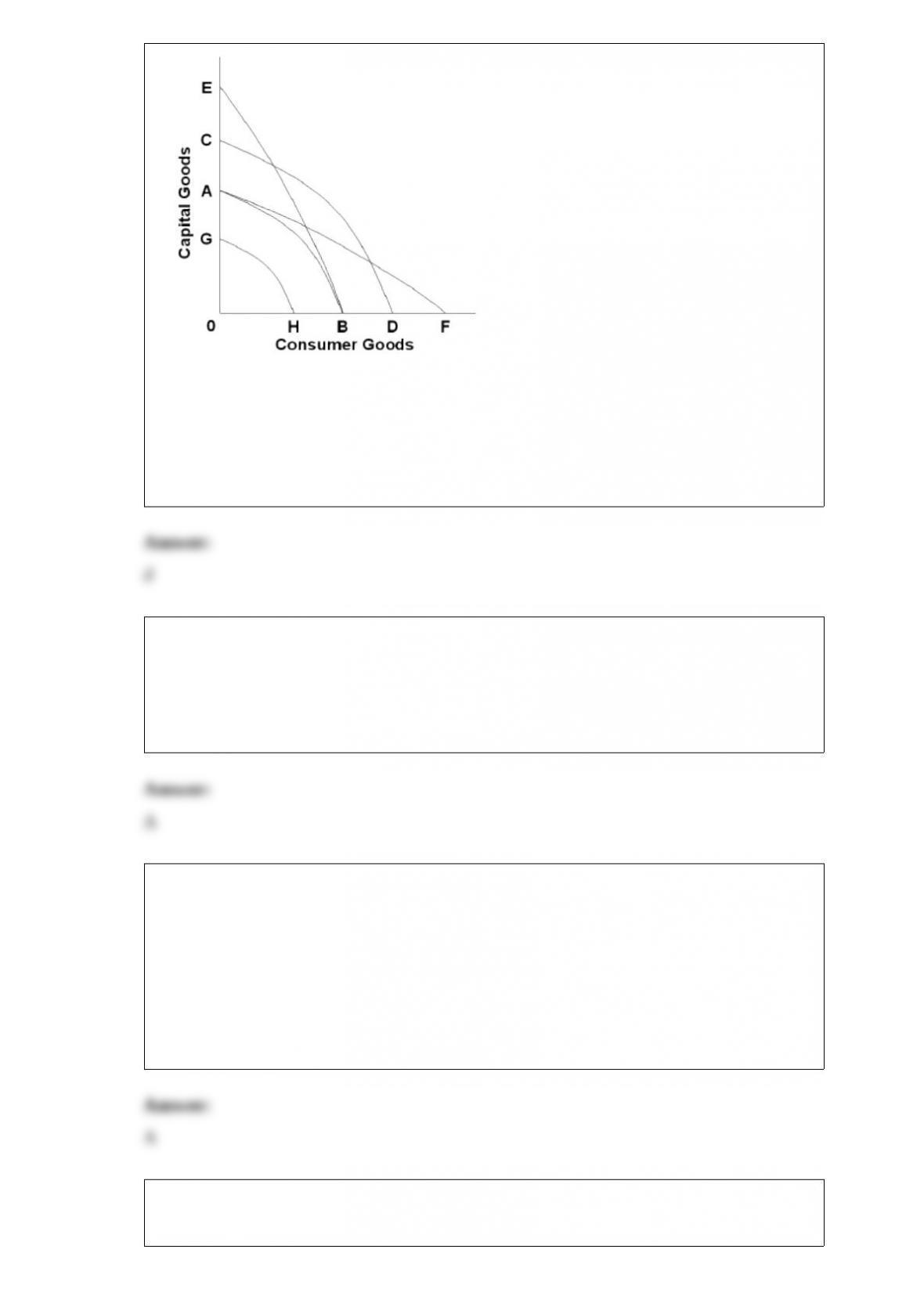
1)
refer to the above diagram. the concave shape of each production possibilities curve
indicates that:
a.resources are perfectly substitutable.
b.wants are virtually unlimited.
c.prices are constant.
d.resources are not equally suited for alternative uses.
2) Currency speculators aid international trade by:
A.absorbing exchange rate risk that others do not want to bear.
B.increasing the volatility of exchange rates.
C.making the demand for imports less elastic.
D.promoting barter.
3) Efficiency wages are:
A.above-market-wages that bring forth so much added work effort that per-unit
production costs are lower than at market wages.
B.wage payments necessary to compensate workers for unpleasant or risky work
conditions.
C.usually less than market wages.
D.relevant to macro economics because they explain rightward shifts in aggregate
demand.
4) The entrepreneur:
A.makes routine day-to-day business decisions.

B.is a colorful figure from the past who is rarely relevant in today’s complex economy.
C.introduces innovations in the form of new products or new production processes.
D.receives income mainly as wages.
5) suppose smith pays $100 to jones.
a.we can say with certainty that the gdp has increased by $100.
b.we can say with certainty that the gdp has increased, but we cannot determine the
amount.
c.we can say with certainty that the nominal gdp has increased, but we can’t say whether
real gdp has increased or decreased.
d. we need more information to determine whether gdp has changed.
6) If two resources are highly substitutable for one another:
A.a decrease in the price of one will increase unit costs of production.
B.an increase in the price of one will increase the demand for the other.
C.an increase in the price of one will reduce the demand for the other.
D.a decline in the price of one will increase the demand for the other.
7) Checkable deposits are also called:
A.checking accounts.
B.high-powered money.
C.savings balances.
D.Federal Reserve Notes.
8) the first pepsi yields craig 18 units of utility and the second yields him an additional
12 units of utility. his total utility from three pepsis is 38 units of utility. the marginal
utility of the third pepsi is:
a.26 units of utility.
b.6 units of utility.
c.8 units of utility.
d.38 units of utility.

9) The Sherman Act:
A.was declared unconstitutional in 1895.
B.provided for government regulation of the railroads.
C.declared monopoly and restraints of trade to be illegal.
D.exempted the railroad and communications industries from the antitrust laws.
10) To increase the Federal funds rate, the Fed would:
A.sell government securities.
B.buy government securities.
C.reduce the discount rate.
D.decrease the reserve requirement.
11) Antitrust authorities are least likely to take action against:
A.conglomerate mergers.
B.horizontal mergers.
C.interlocking directorates.
D.price fixing.
12) according to the concept of the “invisible hand,” if susie opens and operates a
profitable childcare center, then:
a.government should regulate the business to ensure quality.
b.the profit susie earns indicates that she is overcharging for her services.
c.she has served society’s interests by providing a desired good or service.
d.this demonstrates that consumer sovereignty is not present in this market.
13) other things equal, if the price of a key resource used to produce product x falls, the:
a.product supply curve of x will shift to the right.
b.product demand curve of x will shift to the right.
c.product supply curve of x will shift to the left.

d.product demand curve of x will shift to the left.