
1) the voluntary relocation of employable migrants from low-paying nations to
high-paying nations reduces:
a.wage rate disparities among nations.
b.business or capitalist income in the world.
c.labor productivity in the world.
d. total wage income in the world.
2) the price elasticity of demand is generally:
a.negative, but the minus sign is ignored.
b.positive, but the plus sign is ignored.
c.positive for normal goods and negative for inferior goods.
d.positive because price and quantity demanded are inversely related.
3) How often does the Fed offer reserves through the term auction facility?
A.Every two months.
B.Twice a year.
C.Once a week.
D.Twice a month.
4) amanda buys a ruby for $330 for which she was willing to pay $340. the minimum
acceptable price to the seller, tony, was $140. amanda experiences:
a.a consumer surplus of $10 and tony experiences a producer surplus of $190.
b.a producer surplus of $200 and tony experiences a consumer surplus of $10.
c.a consumer surplus of $770 and tony experiences a producer surplus of $480.
d.a producer surplus of $10 and tony experiences a consumer surplus of $190.
5) In an aggregate demand-aggregate supply diagram, equal decreases in government
spending and taxes will:
A.shift the AD curve to the right.
B.increase the equilibrium GDP.
C.not affect the AD curve.
D.shift the AD curve to the left.
6)
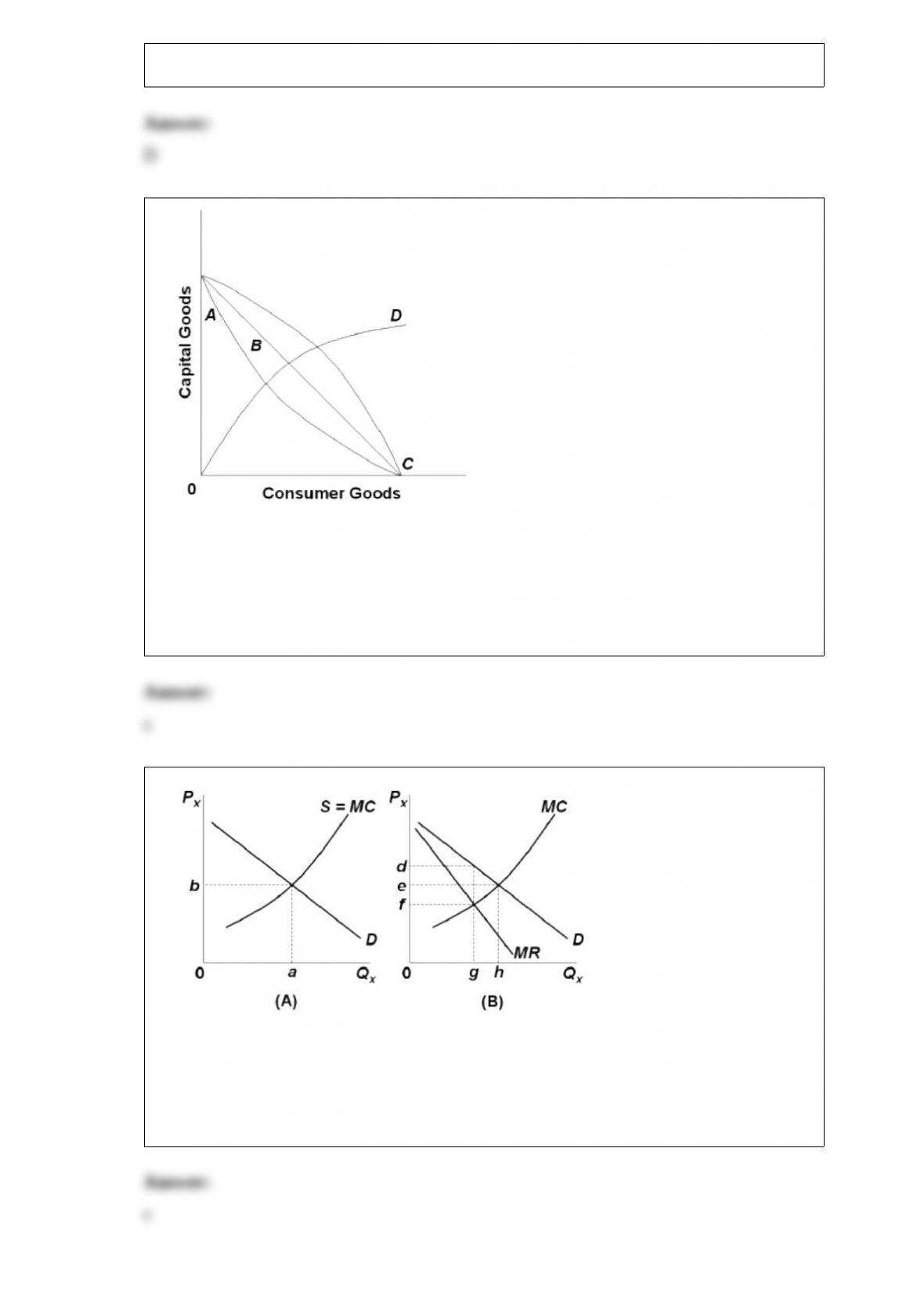
refer to the above diagram. as it relates to production possibilities analysis, the law of
increasing opportunity cost is reflected in curve:
a.a
b.b
c.c
d.d
7)
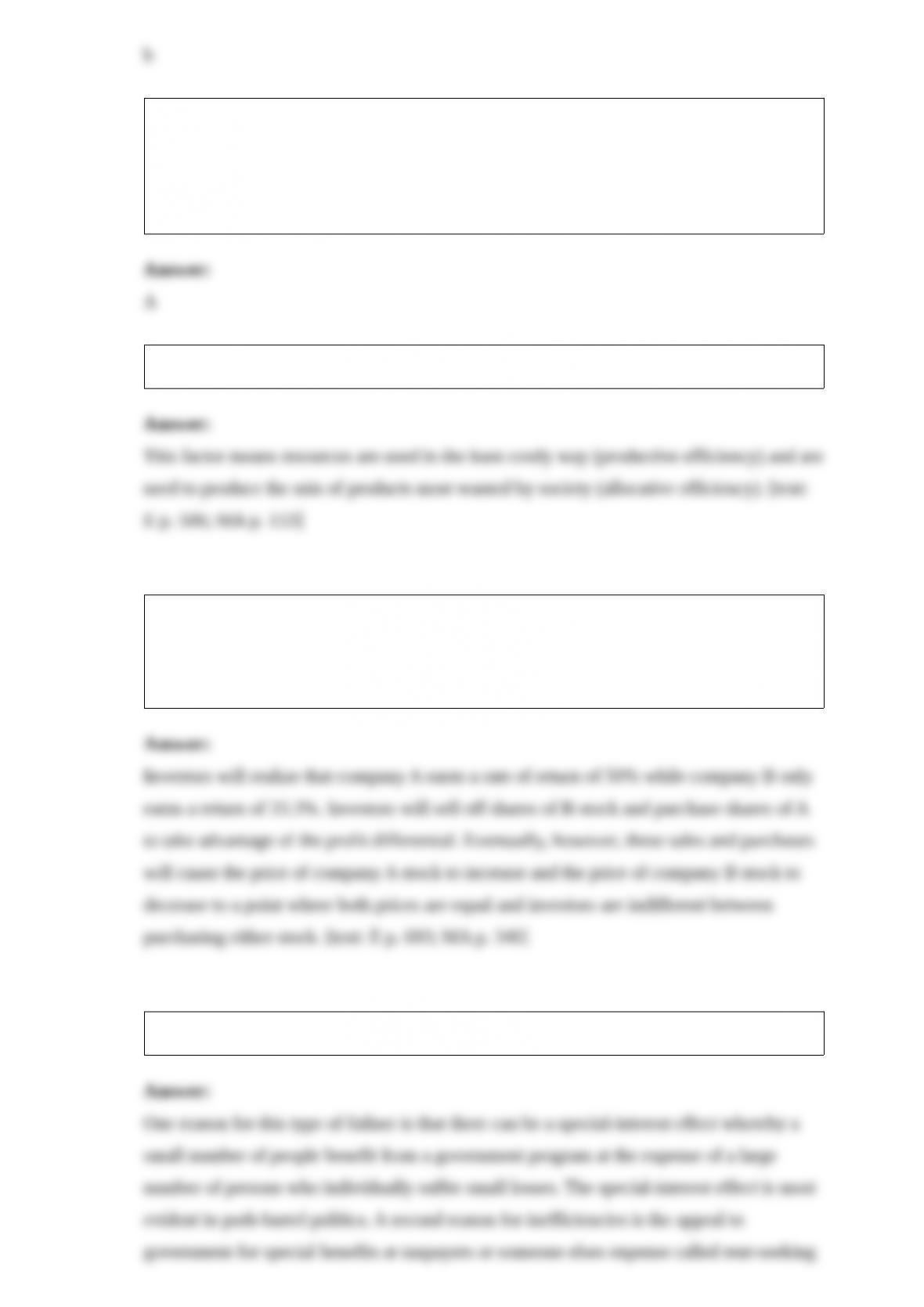
refer to the above diagrams. with the industry structure represented by diagram:
a.(b) there will be allocative efficiency.
b.(a) economic profit can persist in the long run.
c.(b) output will be less than in diagram (a).
d.(b) output will be the same as in diagram (a).

8) in the short run, which of the following statements is correct?
a.the marginal cost curve intersects the average variable and average fixed cost curves
at their minimum points.
b.average variable cost declines continuously as total output is expanded.
c.total cost will exceed variable cost.
d.if the inputs of all resources are increased by equal amounts, total output will expand
by diminishing amounts.
9) in 2007 the price of oil increased, which in turn caused the price of natural gas to
rise. this can best be explained by saying that oil and natural gas are:
a.complementary goods and the higher price for oil increased the demand for natural
gas.
b.substitute goods and the higher price for oil increased the demand for natural gas.
c.complementary goods and the higher price for oil decreased the supply of natural gas.
d.substitute goods and the higher price for oil decreased the supply of natural gas.
10) Minimum-wage legislation is less likely to have adverse effects on employment
when the:
A.affected labor market is monopsonistic.
B.economy has high unemployment.
C.derived demand for labor is shifting to the left.
D.affected labor market is perfectly competitive.
11) which of the following statements is true?
a.microeconomics focuses on specific decision-making units of the economy;
macroeconomics examines the economy as a whole.
b.macroeconomics focuses on specific decision-making units of the economy;
microeconomics examines the economy as a whole.
c.every topic in economics is either a microeconomic or a macroeconomic issue; a topic
cannot be both.
d.topics in microeconomics have public policy implications; topics in macroeconomics
do not.

12) at its profit-maximizing output, a pure nondiscriminating monopolist achieves:
a.neither productive efficiency nor allocative efficiency.
b.both productive efficiency and allocative efficiency.
c.productive efficiency but not allocative efficiency.
d.allocative efficiency but not productive efficiency.
13) The marginal benefit to society of reducing pollution declines with increases in
pollution abatement because of the law of:
A.increasing costs.
B.diminishing returns.
C.diminishing marginal utility.
D.conservation of matter and energy.
14) The U.S. tax-transfer system (as distinct from the tax system alone) is:
A.progressive.
B.proportional.
C.bimodal.
D.regressive.
15) Technological advance is a three-step process involving:
A.invention, duplication, and diffusion.
B.duplication, innovation, and diversity.
C.invention, innovation, and diffusion.
D.necessity, invention, and solution.
16) taxes on commodities or on purchases are known as:
a.corporate income taxes
b.sales and excise taxes
c.personal income taxes
d.payroll taxes
17) Firms are not likely to provide sufficient workplace safety if:
A.workers are unaware of workplace hazards.
B.they have some degree of monopoly power.
C.they are pure competitors and therefore price takers.
D.they are profit-maximizers.
18) What is the efficiency factor?
19) Suppose the stocks for two relatively identical auto makers, A and B, are selling for
$100 and $150 respectively. Both are predicted to sell for $200 in the coming year.
What action do you expect investors engaging in arbitrage to take? What will be the
ultimate effect of this action?
20) What are five sources of government failure?
21) Why does aggregate demand shift outward by a greater amount than the initial
change in spending?
22) How was the original DeBeers diamond company an example of classic monopoly
behavior? How did it manipulate demand and supply?
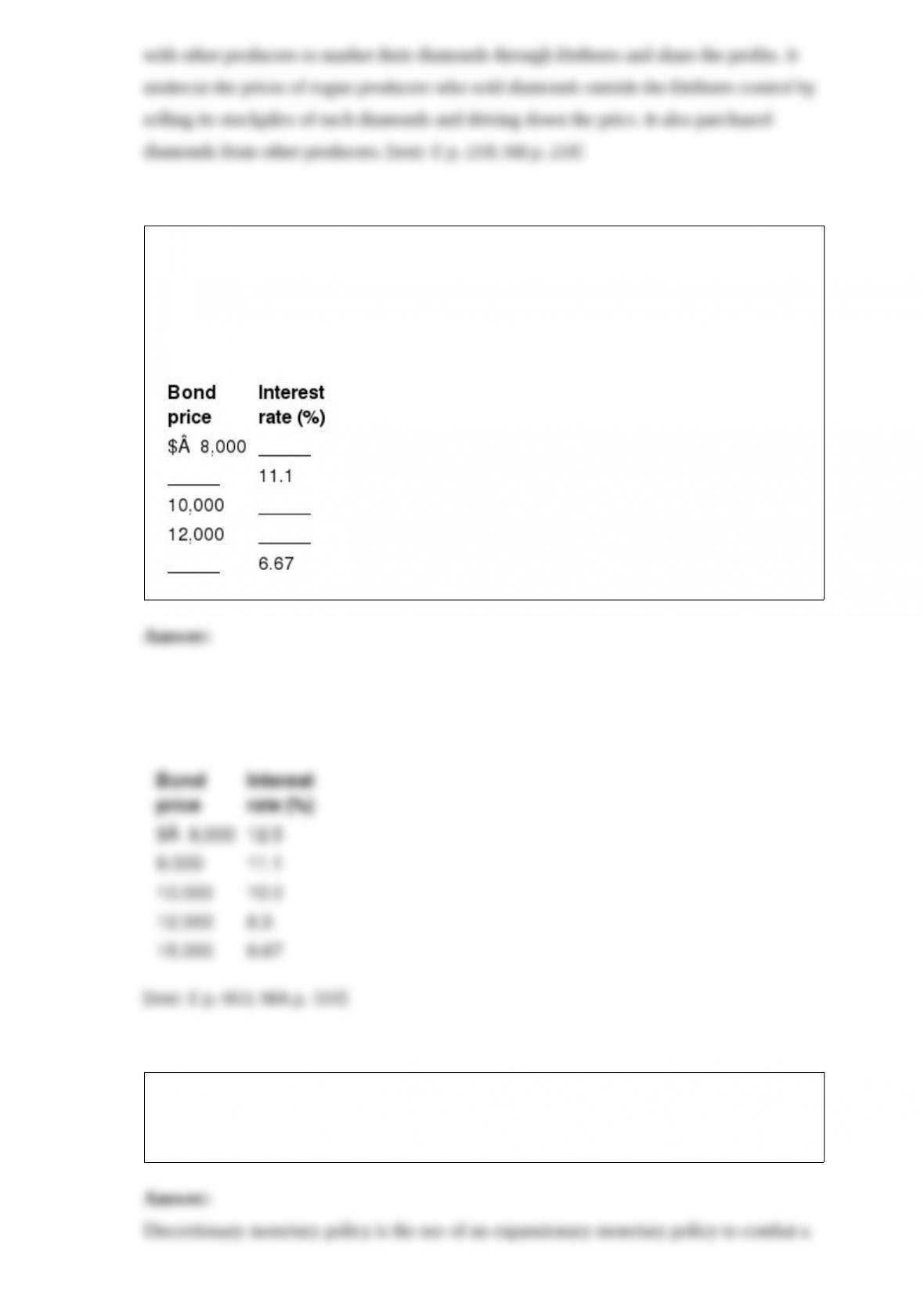
23) Suppose that a bond having no expiration date has a face value of $10,000 and pays
a fixed amount of interest of $1000 annually. Compute and enter in the spaces provided
either the effective interest rate which a bond buyer could receive at the new price or
the bond price (rounded to the nearest $1000) required to receive the interest rate
shown.
24) Distinguish between discretionary monetary policy and monetary rules. How do the
mainstream economists and monetarists differ on their recommendations for the use of
rules or discretionary policy?
25) How does pure competition differ from other basic market models?