
In the debate between the monetarists and the Keynesians over how best to achieve
economic stability, Keynesians have tended to emphasize the role of
a. aggregate supply shifts.
b. economic dualism.
c. random events.
d. the federal budget.
e. the money supply.
Over the last four decades, the value of the NAIRU has tended to change because of
a. the stability of the Phillips curve.
b. disagreements over the definition of full employment.
c. revisions in the consumer price index.
d. changes in productivity growth.
e. the Employment Act of 1946.
Since 1962, real GDP in the United States has
a. grown steadily.
b. fluctuated.
c. not changed in per capita terms.
d. been consistently above potential GDP.
e. been subject to increasingly severe depressions.
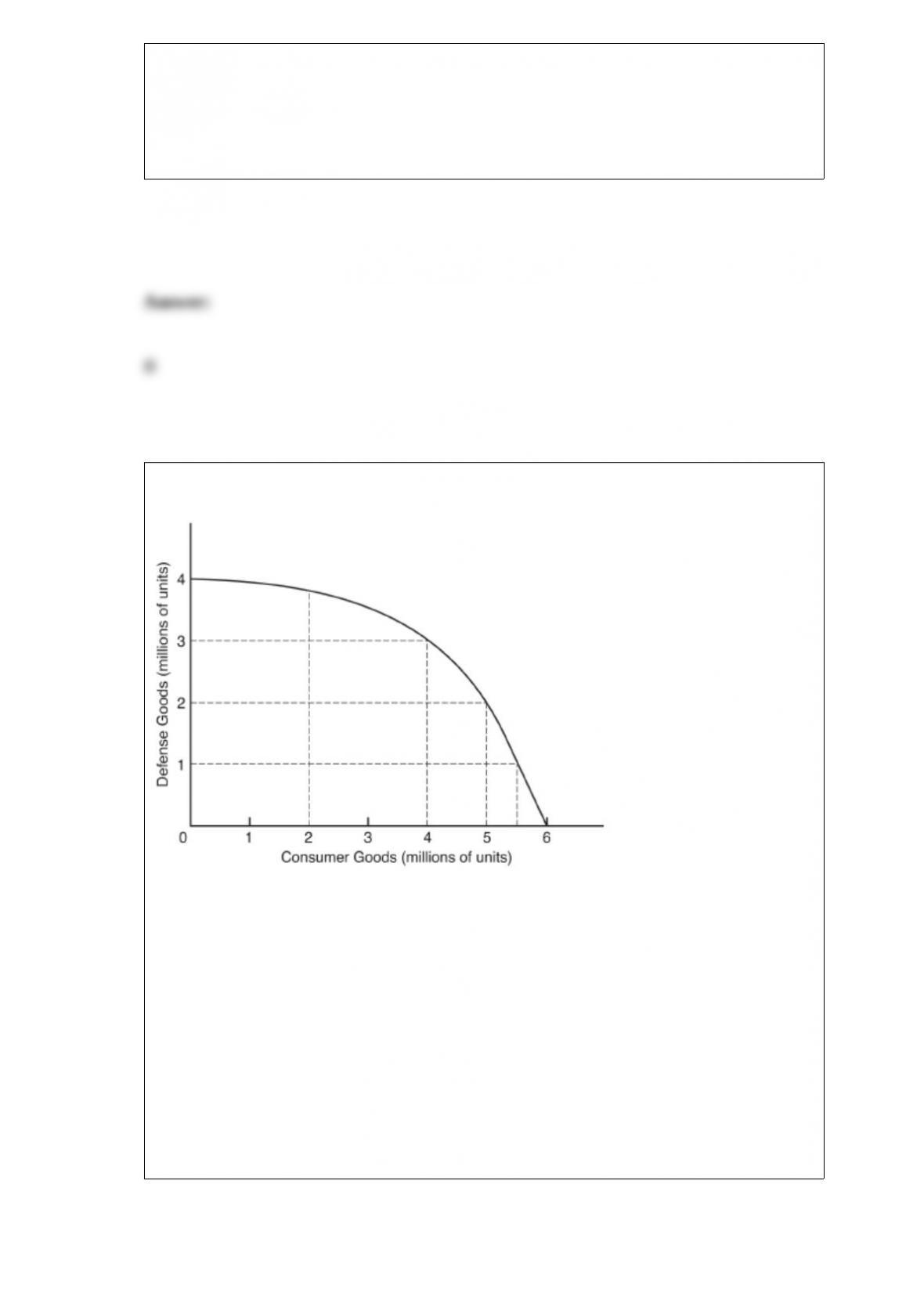
The following questions are based on the following diagram:
If at full employment, defense goods production increases from 2 million units to 3
million units, the cost would be ________ units of consumer goods.
a. zero
b. 0.5 million
c. 1 million
d. 2 million
e. 5 million

The single tax movement of Henry George would have
a. lumped together the piecemeal taxes of government into one tax on income.
b. placed taxes on economic profits but not on accounting profits.
c. taxed away economic rents.
d. taxed only consumption so as not to discourage investment and innovative activity.
e. placed a heavy tax on all consumption above the minimum requirements for food,
clothing, and shelter.
Multiyear labor contracts slow the rate of adjustment of wages because
a. people get used to the size of their paychecks and are reluctant to change them up or
down.
b. they are negotiated in real, not nominal, terms.
c. firms set their prices in terms of wages and are not able to change them when labor
costs vary frequently.
d. such contracts are not all negotiated, and thus up for renewal on the same cycle,
causing the economic impact of older contracts to linger.
e. new labor contracts normally specify wage rates equal to the current national average
wage rate.

If a perfectly competitive, constant-cost industry is monopolized, the
a. number of firms in the industry will rise.
b. industry price and output will remain unchanged.
c. industry price and output will rise.
d. price will fall and industry output will rise.
e. price will rise and industry output will fall.
When countries ignore external diseconomies, their products
a. require too much labor to be profitable.
b. are of lower quality.
c. take longer to produce.
d. become perfectly inelastic in supply.
e. have artificially low prices.

One reason for the volatility of investment is that
a. investment decisions can be postponed because of the durability of capital goods.
b. motives for saving and investment are the same for businesses and households.
c. firms maintain a constant rate of capacity utilization from year to year.
d. wages and prices are flexible.
e. consumer spending is erratic and unpredictable.
Which of the following would be excluded from a list of factors that shift the aggregate
supply curve?
a. increases and decreases in the money supply
b. changes in the prices and availabilities of raw materials
c. technological advances
d. new products and processes
e. good or bad weather conditions

One important element of our well-being that does NOT show up in GDP is our
consumption of
a. new automobiles.
b. imported consumer goods.
c. nondurable goods.
d. medical services.
e. leisure time.
A corporation is a
a. business with at least $100,000 in assets.
b. form of business organization in which 10 or more people agree to conduct a
business.
c. business organization with a charter from the federal government.
d. firm owned by a single person.
e. fictitious legal person separate and distinct from its owners.
In the long run, increases or decreases in the money supply

a. cause real potential output to rise and fall.
b. must ultimately be approved by Congress.
c. may increase or decrease aggregate supply but not aggregate demand.
d. are tied to increases and decreases in the U.S. government holdings of gold.
e. raise and lower the price level but have no effect on real GDP.
The total amount of goods and services that could be produced if the economy were at
full employment is called the
a. business cycle.
b. price level.
c. potential GDP.
d. GDP deflator.
e. aggregate demand curve.
As the price level rises
a. the average price of all goods and services falls.
b. total output demanded rises proportionately.
c. interest rates rise if the money supply is held constant.
d. the aggregate supply curve shifts back and forth.
e. the demand for money falls.

Some argue that according to implicit contract theory, unemployment is really voluntary
since
a. workers enter freely into these agreements, recognizing that they are accepting the
risk of unemployment.
b. firms agree not to lay off anyone if the economy should turn down.
c. under such contracts wages are tied to a firm’s profits, minimizing involuntary
unemployment.
d. the importance of seniority in hiring practices is minimized.
e. under such contracts wage rates are tied directly to the market demand and supply
conditions.
Which of the following events shifts the short-run aggregate supply curve to the right?
a. technological improvements
b. increases in input prices
c. reductions in the amounts of available labor and capital
d. increases in consumer and government spending
e. significant shortages of important raw materials
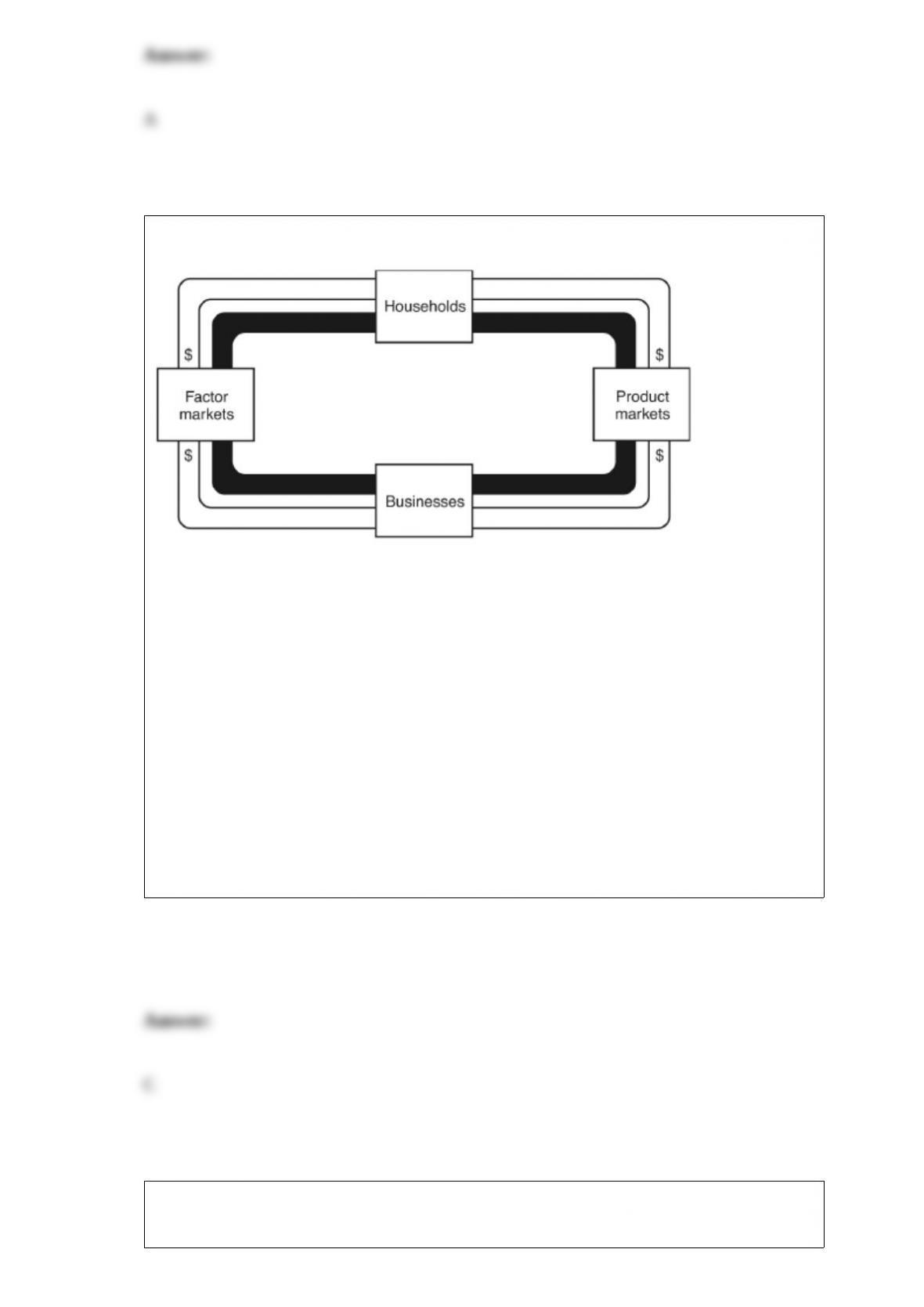
The following questions are based on the following circular flow diagram:
In the model of the circular flow
a. the dollar flows on the left side represent expenditures for final goods and services.
b. the dollar flows on the right side represent incomes being paid by businesses to
consumers.
c. resources flow to businesses on the left side, and final goods and services flow to
households on the right side.
d. households are buyers of factors of production on the left side and sellers of goods
and services on the right side.
e. the dollar value on the left side is unrelated to the dollar value on the right side.
As a result of the famous 1962 confrontation between President Kennedy and the steel
industry, U.S. Steel ultimately

a. won the right to set prices without government interference.
b. lost a major share of its market to other industry rivals.
c. became the new industry price leader by setting voluntary limits on annual price
increases.
d. had to rescind price increases when other steel producers failed to follow its lead.
e. was divided into three independent steel companies.
If the structural deficit shows a surplus
a. government officials should begin to slow down the economy to prevent the
impending danger of inflation.
b. actual revenues exceed actual expenditures.
c. the actual unemployment rate must be less than 4 percent.
d. fiscal policy is not overly expansionary, since at full employment, the federal
government would be running a surplus.
e. the economy is on a proper course, since the national debt is being retired without
undue deflationary pressure.

Between 1980 and 2000, empirical estimates of the “education premium” rose from
________ percent.
a. 3 to 5
b. 10 to 40
c. 20 to 40
d. 40 to 80
e. 80 to 100
The three generally recognized types of unemployment are
a. voluntary, potential, and residual.
b. cyclical, frictional, and structural.
c. involuntary, temporary, and disciplinary.
d. teenage, female, and nonwhite.
e. classical, Keynesian, and post-Keynesian.
Shown in this diagram are demand and supply conditions for a competitive industry.
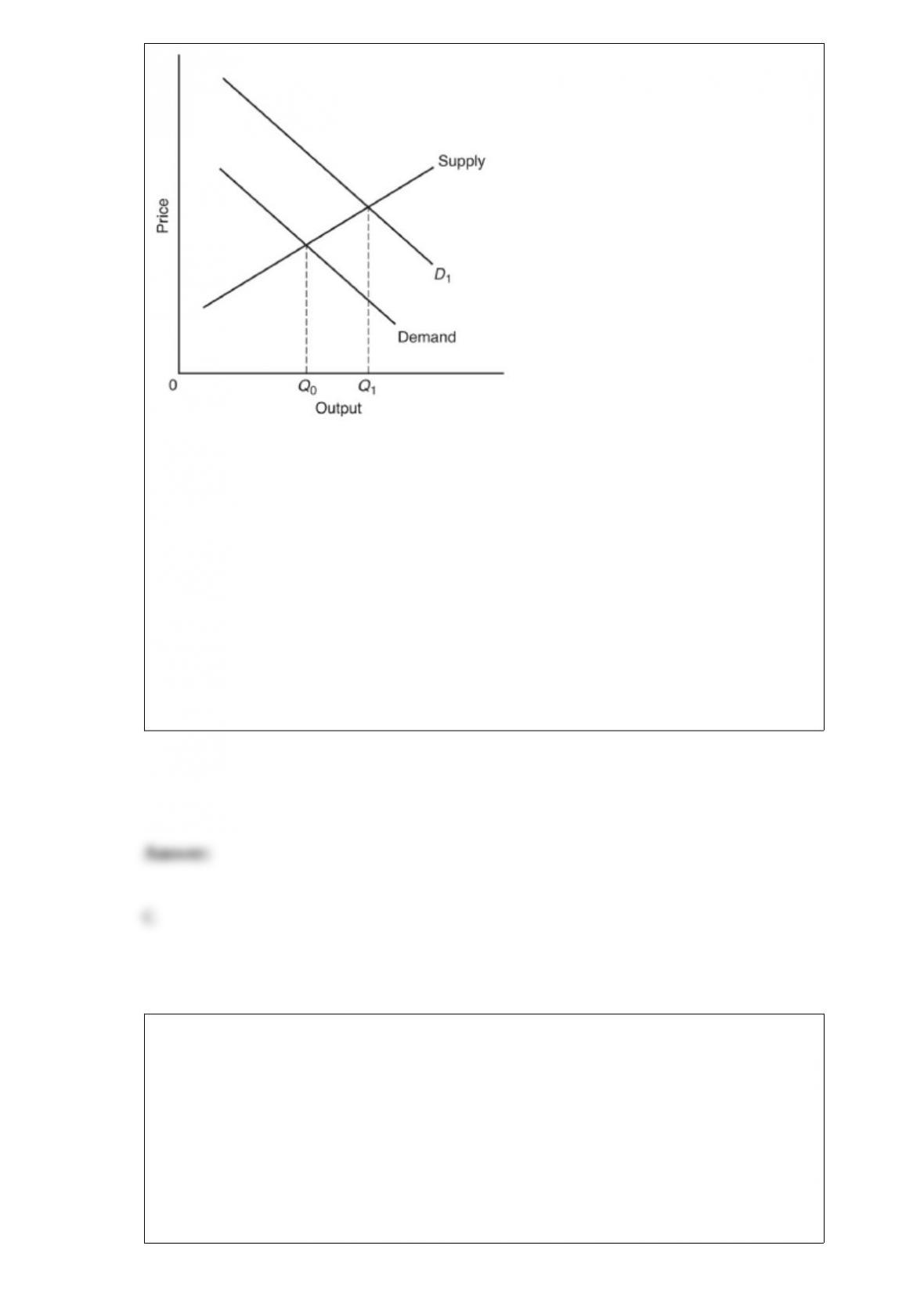
If external economies exist in the production of a good, the government could intervene
to
a. shift the industry supply curve to the left.
b. tax the industry to reduce production.
c. shift the industry demand curve to the right.
d. tax the user of the industry’s product.
e. prohibit production until the external economies are eliminated.
Workers and firms prefer to enter into long-term contracts because
a. workers assume the rate of inflation is going to increase whereas employers believe it
is likely to fall.
b. wage negotiations are costly to each side in terms of both time and money.
c. such contracts allow enough time for all labor markets to clear.

d. seniority is more easily acquired by both employers and employees under such
agreements.
e. wages, profits, and employment are less affected by changes in aggregate demand
under these conditions.
Marginal revenue steadily declines as a monopolist tries to increase the number of units
sold because
a. total revenue declines as additional units are sold.
b. the demand curve shifts to the left.
c. production costs fall as output rises.
d. the greater the sales, the smaller the profit.
e. to sell additional units, the firm must reduce the price of all the units it sells.
Accounting profits differ from the economist’s concept of profits because accounting
profits
a. fall less rapidly during recessions.
b. are excluded from calculations of the national income.
c. are corrected for differences in the quality of management provided by owners.

d. are measured in a way that does not fully reflect the opportunity costs of firms’
resources.
e. vary among industries, whereas economic profits are the same among all industries.
Which of the following markets best exemplifies pure oligopoly?
a. automobiles
b. petroleum
c. machinery
d. air transportation
e. retail trade
The following questions are based on the following graph, showing short-run supply
and demand curves for a perfectly competitive market. The initial supply curve is
labeled “Supply” and the initial demand curve is labeled “Demand.” Price 0A and
output rate 0X represent the initial equilibrium price and output.
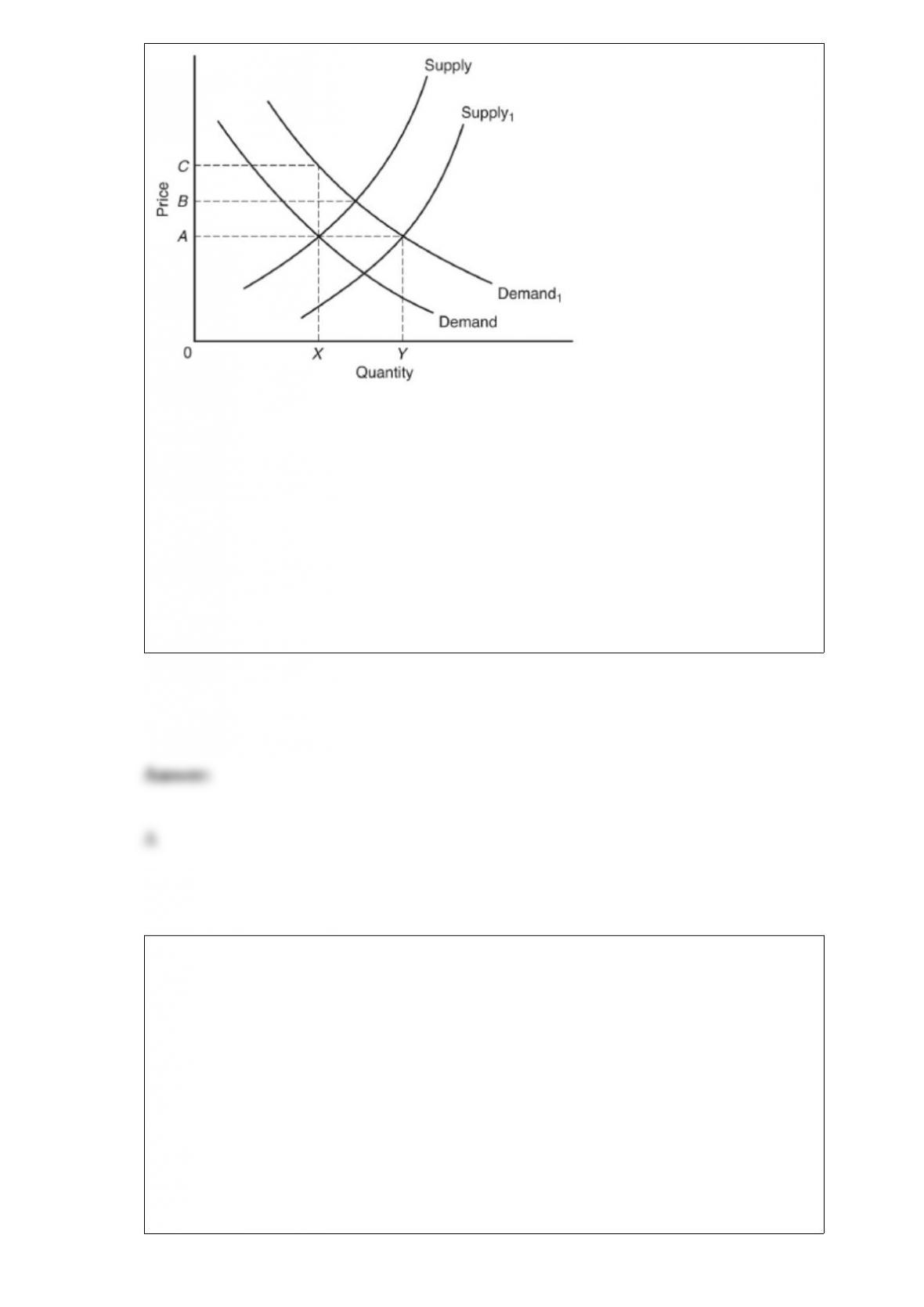
For a typical producer in this
market
a. marginal cost equals 0A.
b. average total cost is less than 0A.
c. average total cost is greater than 0A.
d. long-run average cost equals the supply curve.
e. average total cost equals the supply curve.
Goods that may be collectively consumed so that one person’s enjoyment of them does
NOT deprive others of the same enjoyment are ________ goods.
a. public
b. complementary
c. intermediate
d. primary
e. complex
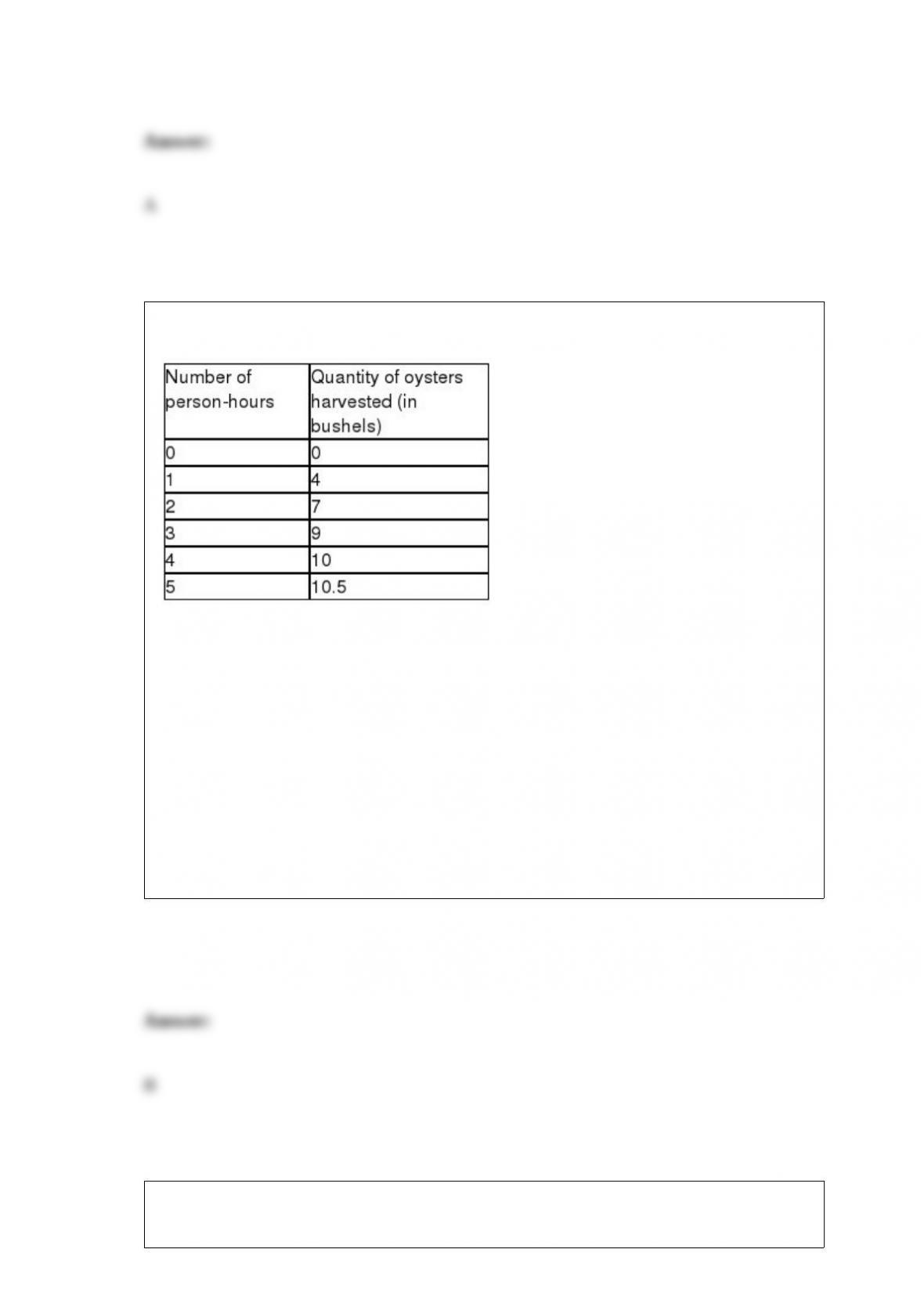
The following questions are based on the following production function:
Person-hours of labor would be considered a(n) ________ input.
a. fixed
b. variable
c. average
d. break-even
e. diminishing
Any production function embodies a

a. predetermined rate of return.
b. statement of the firm’s goals and objectives.
c. rate of depreciation.
d. given state of technology.
e. financial commitment to common stockholders.
The Federal Open Market Committee is made up of
a. five of the seven Federal Reserve Board governors.
b. the Board of Governors plus five of the presidents of the 12 Federal Reserve banks.
c. 12 members of the Federal Advisory Council plus the chairperson of the Federal
Reserve Board.
d. the president of the United States, the secretary of the Treasury, and the members of
the Federal Reserve Board.
e. 12 commercial bank presidents chosen by the president of the United States.
Union membership, as a percentage of the total U.S. labor force
a. has declined fairly steadily for about 30 years now.

b. has stayed about the same since the turn of the century.
c. has grown slightly since the 1930s.
d. has grown rapidly since the 1930s.
e. declined from the early 1950s to the 1970s but is now growing slowly.