
A check is dishonored if:
a. it is presented for payment directly to the payor/drawee bank for immediate payment,
which is refused.
b. a payor bank makes timely return of the check.
c. the payor bank becomes accountable for the amount of the check but has not yet
made payment.
d. All of the above.
An indorsement stating “Pay Paula Hobson only”:
a. is designed to restrict the rights of the indorser.
b. is given the same effect as an unrestrictive indorsement.
c. will, under the Code, be effective to prohibit further transfer beyond Paula Hobson.
d. is labeled a “qualified indorsement,” and it destroys negotiability.
Which of the following is not true of leases of real property?
a. They must always be in writing.
b. They vary in manner of termination.

c. They are both contracts and conveyances of an estate in land.
d. They involve an exclusive right to use and possession of the land for a definite or
ascertainable time and are nonfreehold estates.
Assume an offeree mails a rejection to the offeror on November 1. This rejection arrives
at the offeror’s place of business on November 5. In the meantime, on November 4, the
offeree sends the offeror an acceptance that arrives November 6. Which of the
following statements correctly describes the situation?
a. There was no contract because when an acceptance follows a prior rejection, the first
communication to be received by the offeror is the effective one.
b. There was a contract since the acceptance was mailed prior to the time the rejection
was received.
c. There was no contract because the rejection was mailed first.
d. There was no contract because the acceptance was mailed more than three days
subsequent to the rejection.
Unless one of the parties contractually assumes the risk, the ____ discharges a contract
if supervening circumstances make fulfillment of the purpose which both parties had in
mind impossible.
a. bankruptcy law

b. frustration of purpose doctrine
c. perfect tender rule
d. subjective impossibility doctrine
A wrongful discharge from non-contract employment based on public policy includes
dismissal for:
a. refusing to violate a statute.
b. exercising a statutory right.
c. performing a statutory obligation.
d. reporting an alleged violation of a statute that is of public interest.
e. All of the above.
Which of the following is correct with respect to Article 2A of the UCC?
a. It is an analogue of Article 2 that adopts many of the same rules.
b. No states have as yet adopted 2A.
c. Article 2A specifically excludes security interests from its scope.

d. Both (a) and (c) are correct.
The doctrine of res ipsa loquitur would permit the court to infer negligence in which of
the following situations?
a. A can of peas fell off the shelf onto your foot.
b. A sign over a storefront fell on your head.
c. Neither (a) nor (b).
d. Both (a) and (b).
A purchaser’s agreement to buy from a particular seller all the materials of a particular
kind he needs is a(n) ____ contract.
a. illusory
b. requirements
c. output
d. exclusive dealing

The Ajax Corporation issues bonds that pay a minimum of 6% interest but that can pay
more if corporate earnings reach certain specified levels. In lieu of payment under this
bond, a holder may exchange it for stock of the corporation. This bond would be a:
a. callable income bond.
b. convertible participating bond.
c. convertible unsecured bond.
d. convertible secured bond.
Which of the following is an objective of the North American Free Trade Agreement?
a. Create trade barriers to the movement of goods and services across the borders.
b. Promote conditions of fair competition in the free trade area.
c. Decrease investment opportunities in the area.
d. Immediately eliminate all tariffs between the three countries covered by the
agreement.

Under the RMBCA, the articles of incorporation must include all EXCEPT which one
of the following?
a. The number of authorized shares
b. The name of the registered agent
c. The names of the initial shareholders
d. The address of each incorporator
The Foreign Corrupt Practices Act of 1977 (FCPA):
a. makes it unlawful for an American company to pay money gifts to a foreign official
for the purpose of influencing the official’s acts or decisions.
b. requires that American companies in foreign countries adhere to the same health and
safety standards in that country as they do in the U.S.
c. outlaws American business from engaging in business in countries, which, as
determined by the Department, have governments “repugnant to American law and
social values.”
d. None of the above.
Nell gives Al $50 in return for Al’s promise to defame Sara. Nell hopes to ruin Sara’s
chances at a promotion. Nell finds out that Al did not hold up his end of the agreement.
Which of the following statements is true?
a. Nell can get the money back from Al through litigation.
b. Nell can get the money back and force Al to do as he promised.
c. Legally, Nell can neither get the money back nor force Al to do as he promised.
d. Nell can force Al to act through an appeal to the courts, but Al gets to keep the $50.

The degrees of mental fault in criminal law include which of the following?
a. Subjective fault, which involves negligence or carelessness
b. Objective fault, which involves purposeful, knowing, or reckless conduct
c. Liability without fault, where no requisite mental state or even knowledge of the act
is required in some instances
d. None of the above.
e. All of the above
Which of the following is not generally required in order to have a valid contract?
a. Mutual assent
b. A lawful purpose
c. Fairness of the bargain
d. Parties who have contractual capacity
Remedies for the Equal Pay Act would include:

a. recovery of future wages.
b. an award of punitive damages.
c. enjoining the employer from further unlawful conduct.
d. employer fines.
Most lemon laws define a lemon as a car that:
a. was sold by a dealer who refuses to make reasonable attempts to correct the problem.
b. continues to have a defect that substantially impairs its use, value, or safety, even
after the manufacturer has made reasonable attempts to correct the problem.
c. has been unpopular and so is sold at a discounted price.
d. a manufacturer must destroy so that it cannot be sold to other unsuspecting
consumers.
Extinction of a gift by a testator’s failure to change his will after changed circumstances
have made the performance of a provision in the will impossible is termed:
a. renunciation.
b. ademption.
c. abatement.
d. escheat.

Arthur is a shareholder of Sigma Corp. He has evidence to suggest that its
president/CEO has allowed the corporation to engage in acts that are ultra vires. Based
upon this evidence, Arthur contacts an attorney and sues the corporation on behalf of
the corporation. The lawsuit Arthur has filed is known as a(n):
a. direct suit.
b. derivative suit.
c. class action suit.
d. unauthorized suit.
A transaction in which the owner gives possession of his personal property to another to
secure a debt is:
a. an extraordinary bailment.
b. a pledge.
c. a consignment.
d. commercial bailment.
Matt tells Ron that the snow boots he is selling offer protection for temperatures of 20°
below zero. Ron orders a pair for his trip to Greenland. Upon delivery, Ron sees that the
box states “will protect your feet in temperatures down to 30° below zero.” The first

night’s temperature goes down to 27 below. Ron suffers frostbite on all of his toes. Ron
then sues for breach of warranty. What is the result?
a. Breach, because the later express warranty is valid.
b. No breach, because Matt’s statement was merely opinion.
c. No breach, because Matt said 20° below zero.
d. No breach, because Matt is allowed to be wrong.
An attorney receives a check from the defendant in settlement of a lawsuit brought by
his client, the plaintiff. Even if the check is made out in the name of the attorney, it will
belong to the client as a:
a. resulting trust.
b. constructive trust.
c. totten trust.
d. spendthrift trust.
Margaret has $3,200 cash after selling off her television, DVD player, and computer.
She has debts of $4,800 owing to the following creditors:
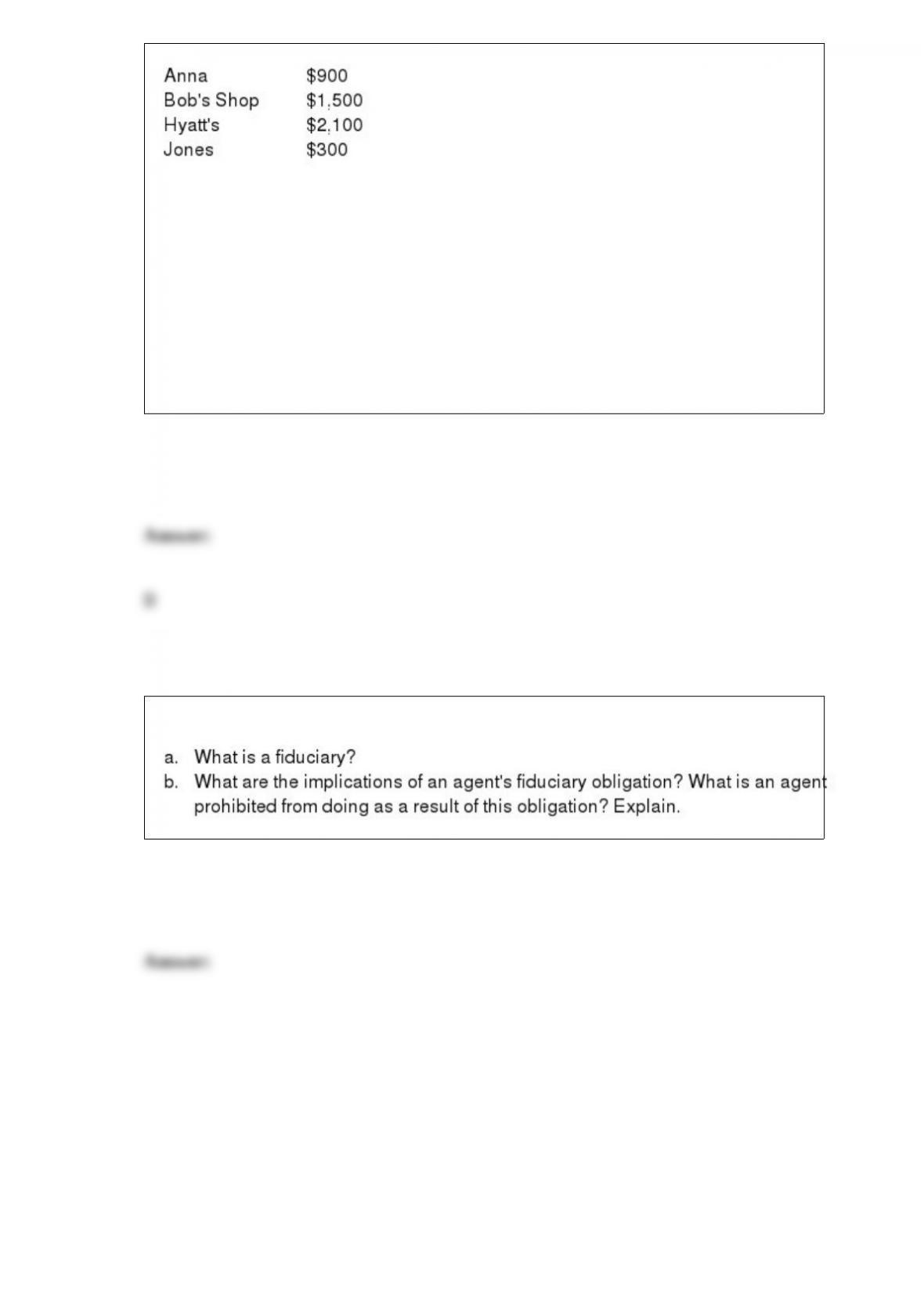
If they all agree to a composition agreement, how much will Hyatt’s be able to collect?
a. $2,100
b. $1,400
c. $700
d. $1,050
Which of the following may terminate an agency agreement by operation of law?
a. Fulfillment of purpose
b. Mutual agreement of the parties
c. Bankruptcy of the principal
d. Renunciation by the agent
Compliance with the affirmative action requirement for contractors:
a. is the same for construction and nonconstruction contractors.
b. demands nonconstruction contractors with 50 or more employees or with contracts
for more than $50,000 to have a written affirmative action plan.

c. means that federal contractors need only implement affirmative action in promoting
employees, not in recruiting.
d. affects only federal construction contractors and subcontractors.
Which of the following is true with regard to securities regulation?
a. Foreign issuers who issue securities in the United States are exempt from the
registration requirements of the 1933 Act.
b. Some foreign issuers may avoid registration under the 1934 Act by providing the
SEC with copies of all information material to investors that they have made public in
their home country.
c. Antifraud provisions of U.S. securities laws do not apply to securities sold in foreign
commerce if the courts have found either conduct or effects in the U.S. relating to a
violation of securities law.
d. U.S. securities laws have no application to foreign issuers.
The most important element in determining whether a sales contract has been made is
the:
a. language of the contract.
b. fact that the terms of the offer and acceptance are exactly alike.

c. number of open terms.
d. intention of the parties to make a contract.
Cynthia Todd is the holder of a check with the indorsement “Adam Brock.” To protect
herself, Cynthia may:
a. convert the special indorsement to a blank indorsement.
b. convert the special indorsement to a qualified indorsement.
c. write above Adam’s signature, “Pay Cynthia Todd.”
d. not convert the indorsements, but could only protect her interest in the check by
depositing it in her account as soon as possible.
If a person dies without a valid will and has no heirs or next of kin, her property goes to
the state.
According to the UCC, only a merchant can make a firm offer to a buyer.
What are the remedies available for violations of the Civil Rights Act of 1964?
For a misrepresentation to be fraud in the inducement, it need not be material.
A carrier or warehouser who receives goods from a thief and later delivers them to a
person to whom the thief ordered them to be delivered is liable to the true owner of the
goods.

Buying a negotiable instrument at a discounted price demonstrates lack of good faith.
The test under the one-year provision of the statute of frauds is whether the terms of the
contract make it possible for performance to occur within one year.
Contract remedies provided as exclusive will not preclude Code remedies if
circumstances cause the remedy to fail in its essential purpose.

Contracts binding without consideration include promises to pay debts barred by a
statute of limitations and debts discharged in bankruptcy.
A contract that is FOB Dallas where the seller is in Chicago and the buyer is in Dallas is
a destination contract.
The Revised Model Business Corporation Act has been adopted at least in part by more
than half of the states.
The Securities and Exchange Commission can seek civil injunctions and recommend
that the Justice Department bring criminal prosecution against violators of federal
securities laws.
Fraud in the execution of an instrument is a real defense which can be used against a
holder in due course.
Discuss the types of deeds that can be used to transfer title.
If an advertising statement is technically true but may tend to mislead, the FTC can still
require a company to stop using it.

All 50 states have adopted the Revised Uniform Partnership Act.
In a partnership of A, B, and C, A commits fraud which creates a $9,000 liability to the
partnership. If the three partners share profits and losses equally, A’s liability to the
partnership for his fraudulent act is $3,000.
UCC Article 9 applies to secured transactions in which the debtor provides a security
interest to secure payment of a debt, such as pledging warehoused goods to a creditor or
the creditor’s having a mechanic’s lien against the debtor’s property.

A subagent owes a fiduciary duty to only the principal.
Ratification of a contract, once effected, is final and cannot be withdrawn.