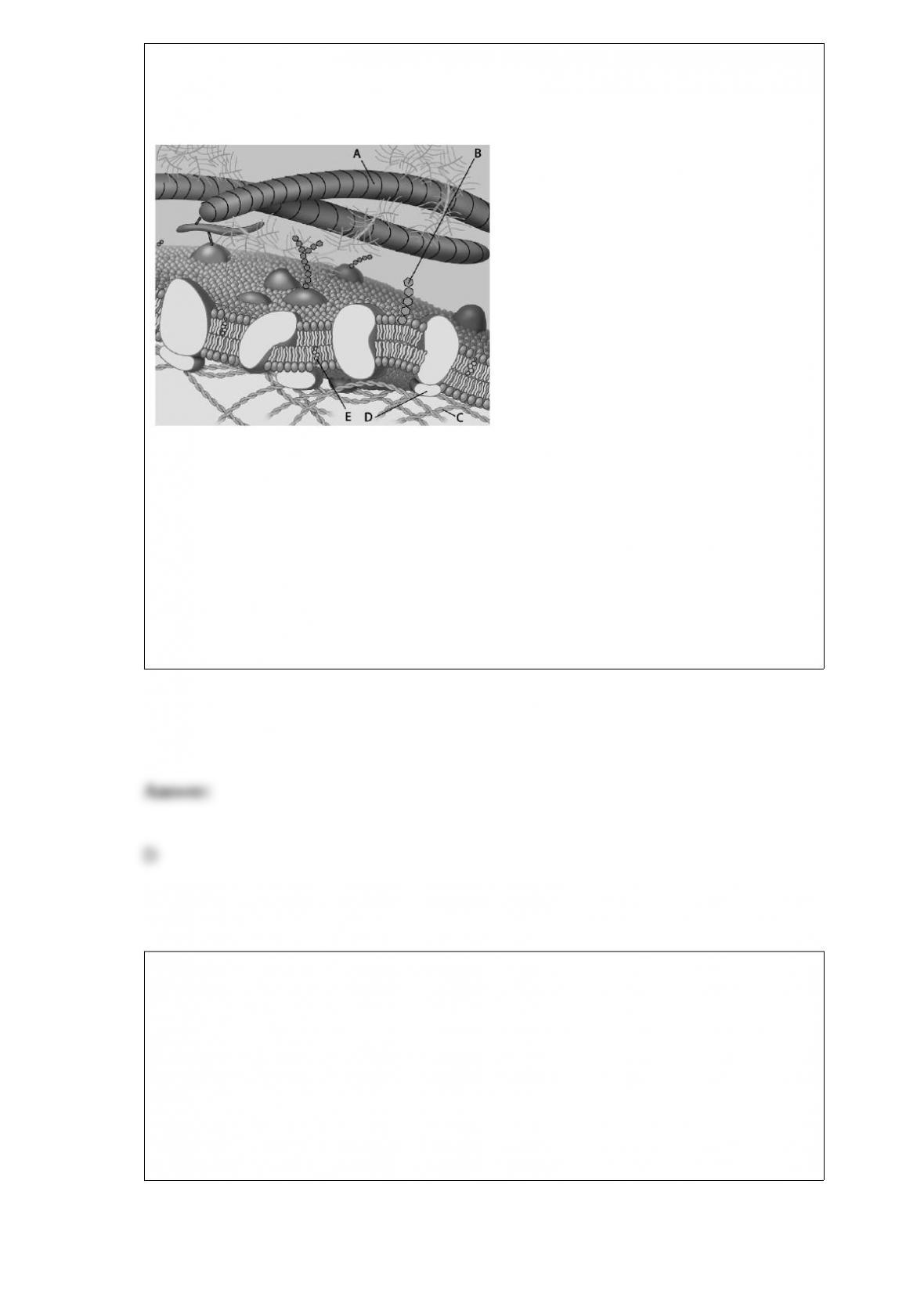
For the following questions, match the labeled component of the cell membrane in
the figure with its description.
Which component is cholesterol?
A) B
B) C
C) D
D) E
Which of the following terms includes all of the others?
A) species diversity
B) biodiversity
C) genetic diversity
D) ecosystem diversity
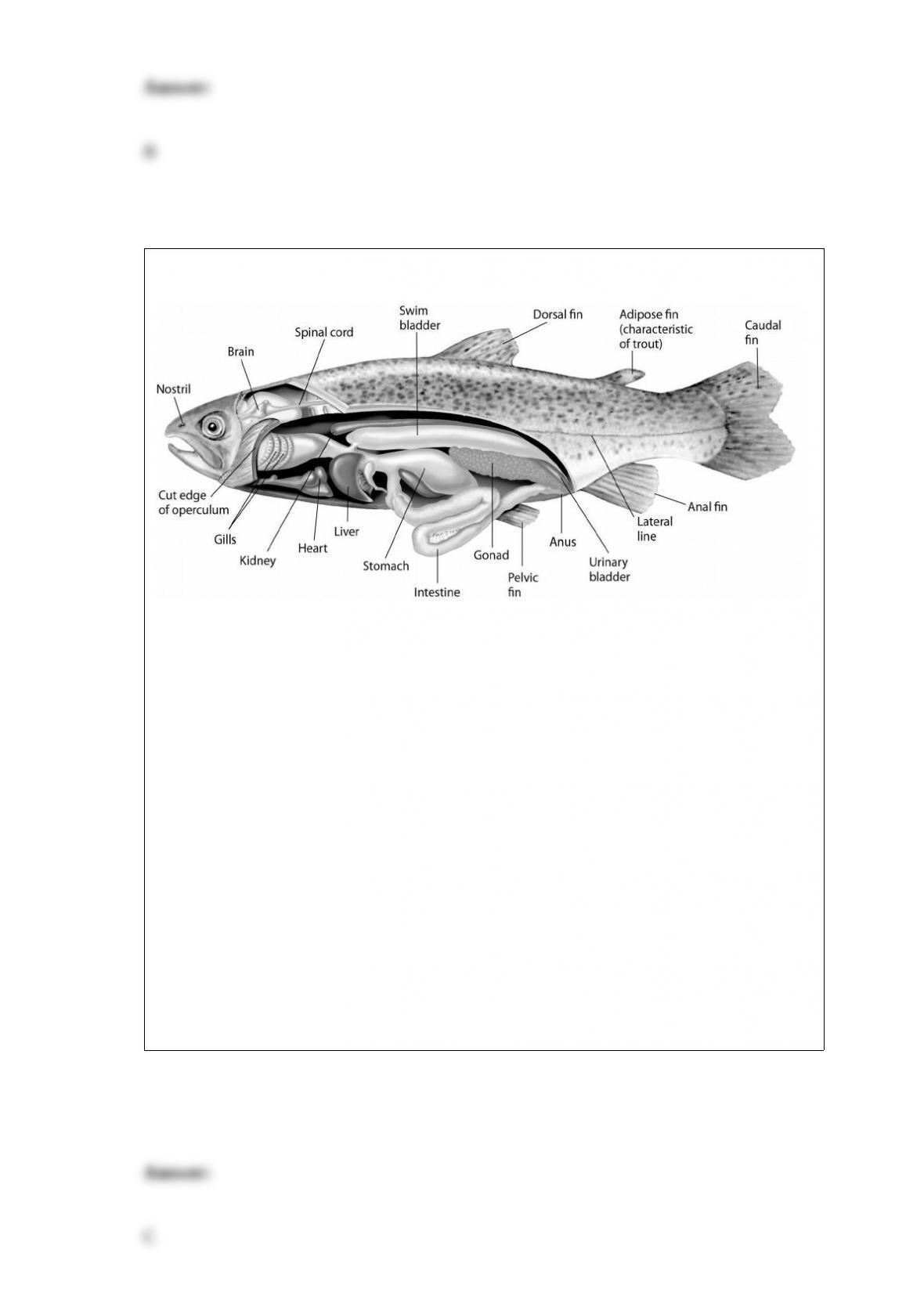
Use the following figure and information to answer the question(s) below.
Fishes that have swim bladders can regulate their density and, thus, their buoyancy.
There are two types of swim bladder: physostomous and physoclistous. The ancestral
version is the physostomous version, in which the swim bladder is connected to the
esophagus via a short tube (see the figure above). The fish fills this version by
swimming to the surface, taking gulps of air, and directing them into the swim bladder.
Air is removed from this version by “belching.” The physoclistous version is more
derived, and has lost its connection to the esophagus. Instead, gas enters and leaves the
swim bladder via special circulatory mechanisms within the wall of the swim bladder.
Which shark structure is closest in function to a swim bladder full of gas?
A) its lateral line system
B) its spiral valve
C) its liver
D) its gills

Use the following information to answer the question(s) below.
In 1983 a population of dark-eyed junco birds became established on the campus of the
University of California, San Diego (UCSD), which is located many miles from the
junco’s normal habitat in the mixed-coniferous temperate forests in the mountains.
Juncos have white outer tail feathers that the males display during aggressive
interactions and during courtship displays. Males with more white in their tail are more
likely to win aggressive interactions, and females prefer to mate with males with more
white in their tails. Females have less white in their tails than do males, and display it
less often. (Pamela J. Yeh. 2004. Rapid evolution of a sexually selected trait following
population establishment in a novel habitat. Evolution 58[1]:166-74.)
Refer to the paragraph on dark-eyed junco birds. The UCSD campus male junco
population tails were, on average, 36% white, whereas the tails of males from nearby
mountain populations averaged 40-45% white. If this observed trait difference were due
to a difference in the original colonizing population, it would most likely be due to
_____.
A) mutations in the UCSD population
B) gene flow between populations
C) a genetic bottleneck
D) a founder effect
Which of the following is the most inclusive (most general) group in which all of the
members have fully opposable thumbs?
A) apes
B) Homo
C) anthropoids
D) primates

Hyphae form a covering over roots. These hyphae create a large surface area that helps
to do which of the following?
A) aid in absorbing minerals and ions
B) maintain cell shape
C) increase cellular respiration
D) anchor a plant
Which of the following traits do archaeans and bacteria share?
A) composition of the cell wall
B) composition of the cell wall and lack of a nuclear envelope
C) lack of a nuclear envelope and presence of plasma membrane
D) presence of plasma membrane and composition of the cell wall

Parasitism is one of the most widespread life strategies ever to evolve. Which of the
following is consistent with this finding?
A) Parasites almost always predigest their hosts’ tissues and, therefore, spend less
energy and require fewer structural adaptations.
B) Parasites, unlike predators, feed on almost all the tissues of their host.
C) Parasites do not generally kill their hosts; thus they can feed on the same host
throughout the host’s normal life span and do not have competition from decomposers.
D) Parasites generally kill their host and can feed for a very long time because they are
much smaller than their host.
Use the following information to answer the questions below.
Succinate dehydrogenase catalyzes the conversion of succinate to fumarate. The
reaction is inhibited by malonic acid, which resembles succinate but cannot be acted
upon by succinate dehydrogenase. Increasing the ratio of succinate to malonic acid
reduces the inhibitory effect of malonic acid.
What is malonic acid’s role with respect to succinate dehydrogenase? Malonic acid
_____.
A) is a competitive inhibitor
B) blocks the binding of fumarate
C) is a noncompetitive inhibitor
D) is an allosteric regulator

If you were able to walk into an opening cut into the center of a large redwood tree,
when you exited from the middle of the trunk (stem) outward, you would cross, in
order, _____.
A) the annual rings, new xylem, vascular cambium, phloem, and bark
B) the secondary xylem, cork cambium, phloem, and periderm
C) the vascular cambium, oldest xylem, and newest xylem
D) the secondary xylem, secondary phloem, and vascular cambium
The host range of a virus is determined by _____.
A) the enzymes carried by the virus
B) whether its nucleic acid is DNA or RNA
C) the proteins in the host’s cytoplasm
D) the proteins on its surface and that of the host
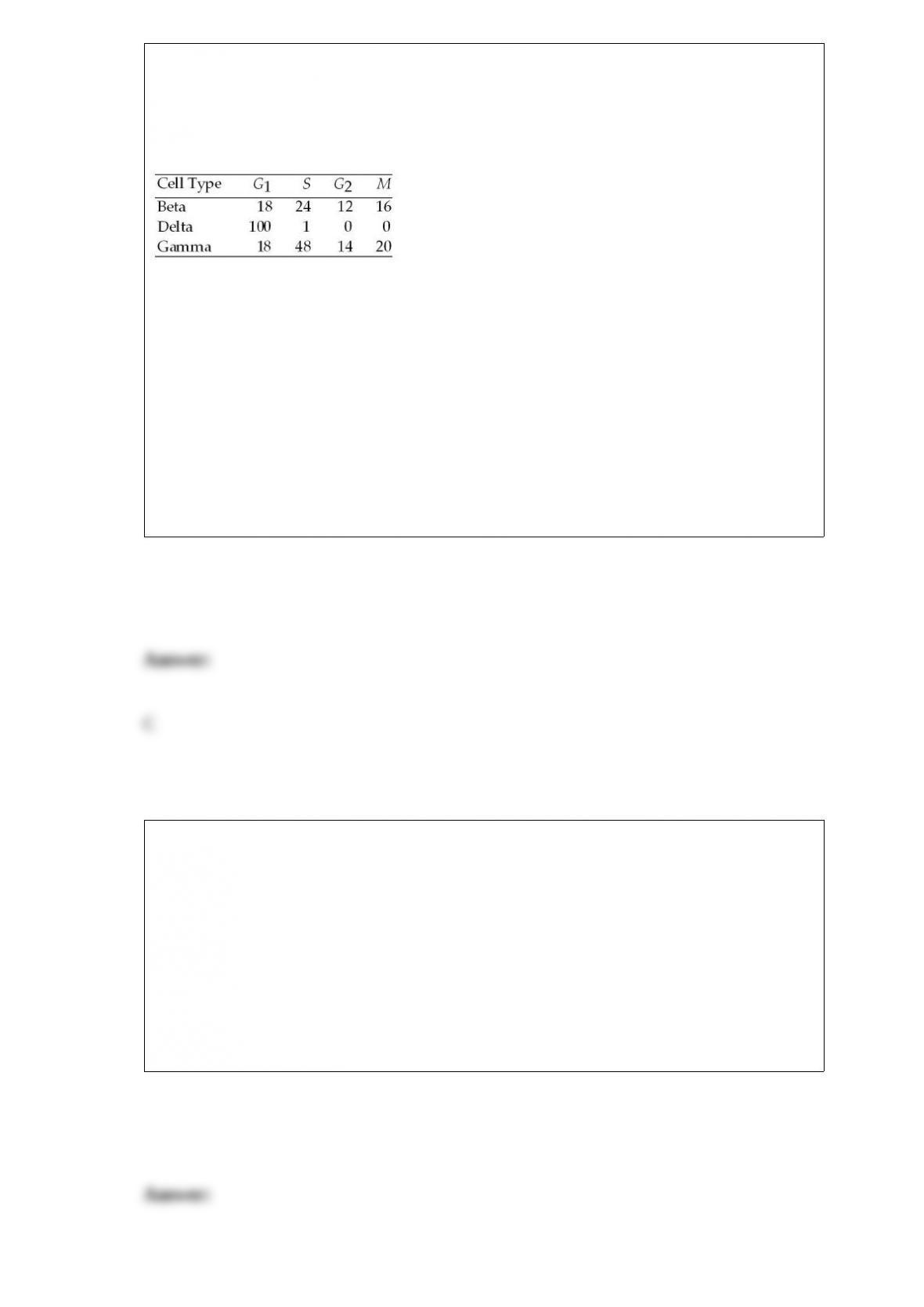
Use the data in the accompanying table to answer the following questions.
The data were obtained from a study of the length of time spent in each phase of the
cell cycle by cells of three eukaryotic organisms designated beta, delta, and gamma.
Minutes Spent in Cell Cycle Phases
The best conclusion concerning delta is that the cells _____.
A) contain no DNA.
B) contain no RNA.
C) are in the G0 phase.
D) divide in the G1 phase.
In the formula for determining a population’s genotype frequencies, the “pq” in the term
2pq is necessary because _____.
A) the population is diploid
B) heterozygotes can come about in two ways
C) the population is doubling in number
D) heterozygotes have two alleles

In photosynthetic cells, synthesis of ATP by the chemiosmotic mechanism occurs
during _____.
A) photosynthesis only
B) respiration only
C) photosynthesis and respiration
D) neither photosynthesis nor respiration
Which of the following is the most important assumption for the mark-recapture
method to estimate the size of wildlife populations?
A) More individuals emigrate from, as opposed to immigrate into, a population.
B) Over 50% of the marked individuals need to be trapped during the recapture phase.
C) There is a 50:50 ratio of males to females in the population before and after trapping
and recapture.
D) Marked individuals have the same probability of being recaptured as unmarked
individuals during the recapture phase.

Standard metabolic rate (SMR) and basal metabolic rate (BMR) are _____.
A) used differently: SMR is measured during exercise, whereas BMR is measured at
rest
B) used to compare metabolic rates during feeding and other active conditions
C) both measured across a wide range of temperatures for a given species
D) both measured in animals in a resting and fasting state
Two competing hypotheses to account for the increase in the number of Hox genes from
the last common ancestor of bilaterians to the last common ancestor of insects and
vertebrates are: (1) a single duplication of the entire four-gene cluster, followed by the
loss of one gene, and (2) three independent duplications of individual Hox genes. To
prefer the first hypothesis on the basis of parsimony requires the assumption that _____.
A) the duplication of a cluster of four Hox genes is equally likely as the duplication of a
single Hox gene
B) there is an actual process by which individual genes can be duplicated
C) genes can exist is spatial groupings called clusters
D) clusters of genes can undergo disruption, with individual genes moving to different
chromosomes during evolution

You are the lucky student of a wacky professor who develops a time machine. He asks
if you will test it with him. You get in and there is an immediate glitch”the date readout
fails so that when you land you are not sure what era you are in. As your time machine
lands, you see an unusual landscape before you. As you open the door you realize you
cannot breathe. You quickly shut the door, realizing you are in the _____.
A) Archaean eon
B) Cambrian period
C) Cenozoic era
D) Mesozoic era
Labor contractions can be increased by the medical use of a synthetic drug that mimics
the action of _____.
A) inhibin
B) luteinizing hormone
C) oxytocin
D) prolactin
Regeneration, the regrowth of lost body parts, normally follows _____.

A) all types of asexual reproduction
B) fission
C) fragmentation
D) parthenogenesis
An early step in shotgun sequencing is to _____.
A) break genomic DNA at random sites
B) map the position of cloned DNA fragments
C) randomly select DNA primers and hybridize these to random positions of
chromosomes in preparation for sequencing
Hershey and Chase used a DNA-based virus for their work. What would the results
have been if they had used an RNA virus?
A) With an RNA virus radioactive protein would have been in the final pellet.
B) With an RNA virus radioactive RNA would have been in the final pellet.
C) With an RNA virus neither sample would have had a radioactive pellet.
D) With an RNA virus the protein shell would have been radioactive in both samples.

Bioinformatics can be used to scan for short sequences that specify known mRNAs,
called _____.
A) expressed sequence tags
B) multigene families
C) proteomes
D) short tandem repeats
Which of the following scenarios would provide the most relevant data on population
density?
A) Count the number of nests of a particular species of songbird and multiply this by a
factor that extrapolates these data to actual animals.
B) Count the number of pine trees in several randomly selected 10-meter-square plots
and extrapolate this number to the fraction of the study area these plots represent.
C) Use the mark-recapture method to estimate the size of the population.
D) Calculate the difference between all of the immigrants and emigrants to see if the
population is growing or shrinking.
A nonreciprocal crossover causes which of the following products?
A) deletion only
B) duplication only
C) nondisjunction
D) deletion and duplication
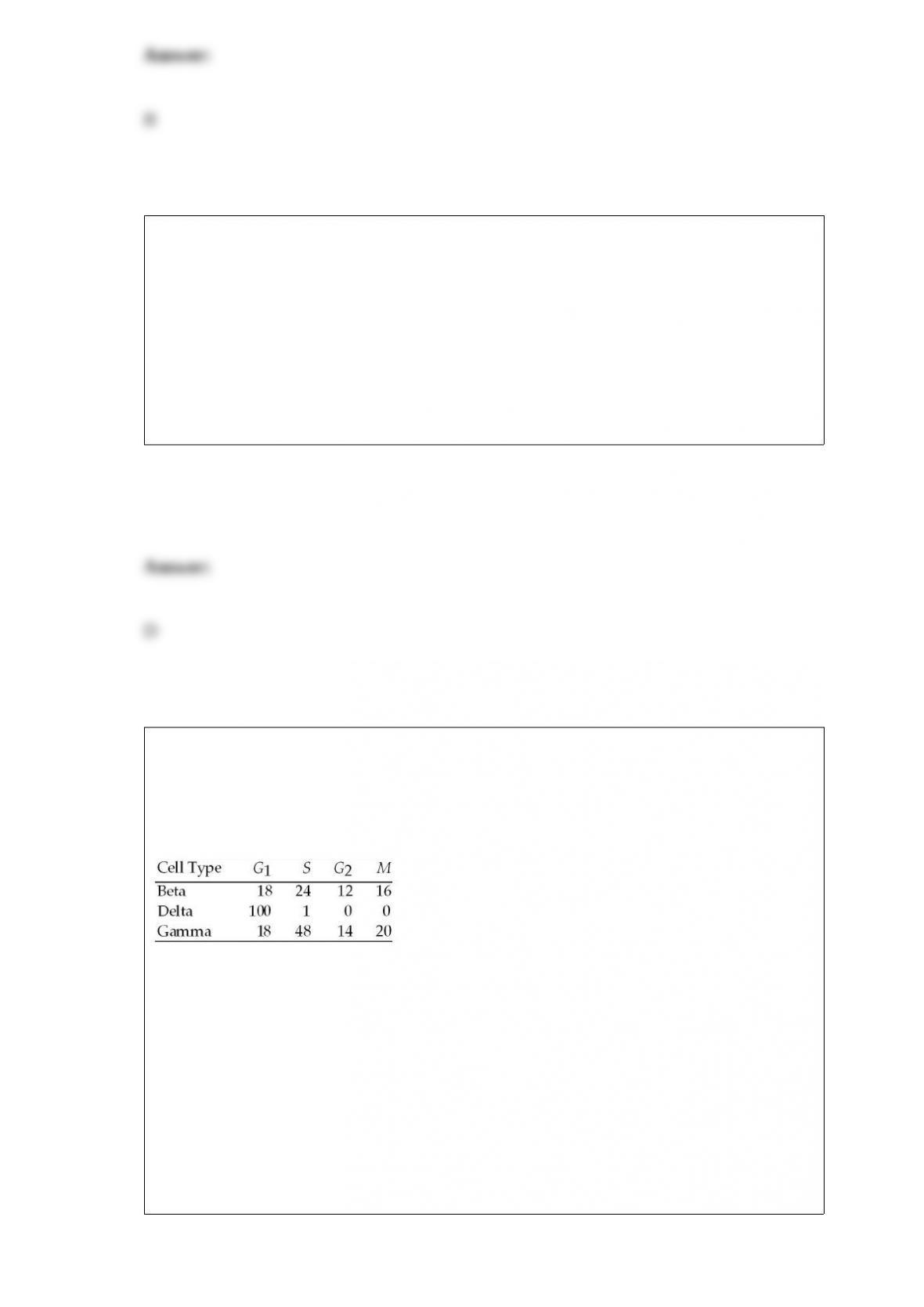
Use the data in the accompanying table to answer the following questions.
The data were obtained from a study of the length of time spent in each phase of the
cell cycle by cells of three eukaryotic organisms designated beta, delta, and gamma.
Minutes Spent in Cell Cycle Phases
Neurons and some other specialized cells divide infrequently because they _____.
A) no longer have active nuclei
B) have entered into G0
C) can no longer bind Cdk to cyclin
D) show a drop in MPF concentration

When hydrogen ions are pumped from the mitochondrial matrix across the inner
membrane and into the intermembrane space, the result is the _____.
A) formation of ATP
B) reduction of NAD+
C) creation of a proton-motive force
D) lowering of pH in the mitochondrial matrix
Suppose 64% of a remote mountain village can taste phenylthiocarbamide (PTC) and
must, therefore, have at least one copy of the dominant PTC taster allele. If this
population conforms to Hardy-Weinberg expectations for this gene, what percentage of
the population must be heterozygous for this trait?
A) 16%
B) 32%
C) 40%
D) 48%

The adaptive advantage associated with the filamentous nature of fungal mycelia is
primarily related to _____.
A) the ability to form haustoria and parasitize other organisms
B) the potential to inhabit almost all terrestrial habitats
C) the increased probability of contact between different mating types
D) an extensive surface area well suited for invasive growth and absorptive nutrition
Which two genera have members that can evade the human immune system by
frequently changing their surface proteins?
1. Plasmodium
2. Trichomonas
3. Paramecium
4. Trypanosoma
5. Entamoeba
A) 1 and 4
B) 2 and 3
C) 2 and 4
D) 4 and 5