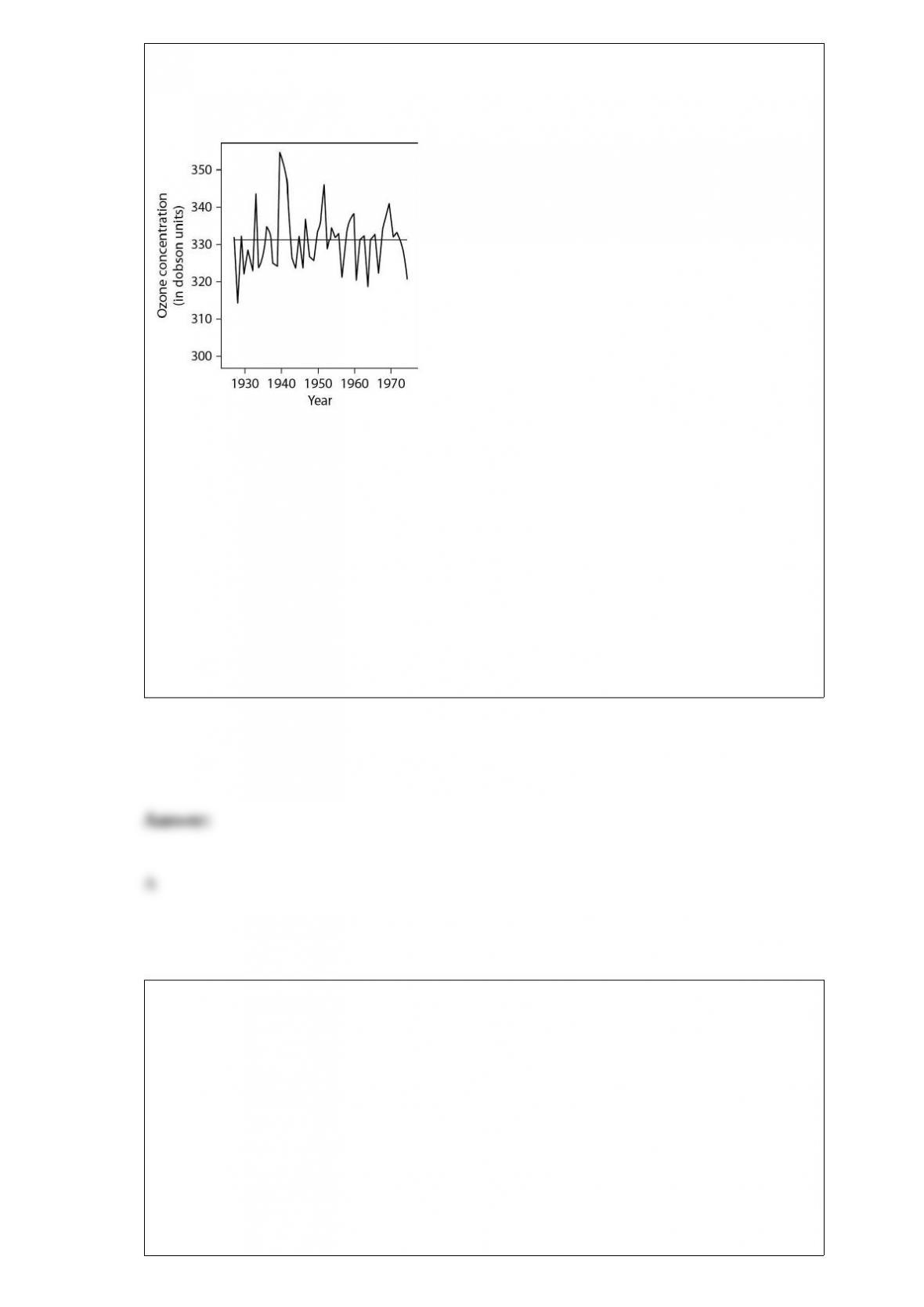
The figure below depicts natural fluctuation of ozone levels in Switzerland between
1925 and 1976. Dobson units are a way to measure the total amount of atmospheric
ozone above a point on the Earth’s surface.
What can you conclude from this figure?
A) Natural fluctuation of ozone levels varies greatly year to year, so the average for this
50-year span was approximately 330 Dobson units.
B) Switzerland can be used as a model example of how to maintain safe ozone levels.
C) All small European countries will show fluctuations in ozone concentration levels.
D) Ozone levels show a distinct pattern of increasing by 10 Dobson units every 10
years.
You find a small, elongated animal embedded in the sand with one end sticking out.
Among other things, it has segmental musculature, a coelom, a notochord, and a
complete digestive tract with an anus located partway down the body. This animal is
A) an annelid.
B) a larval echinoderm.
C) either a larval echinoderm or a chordate.
D) a chordate.
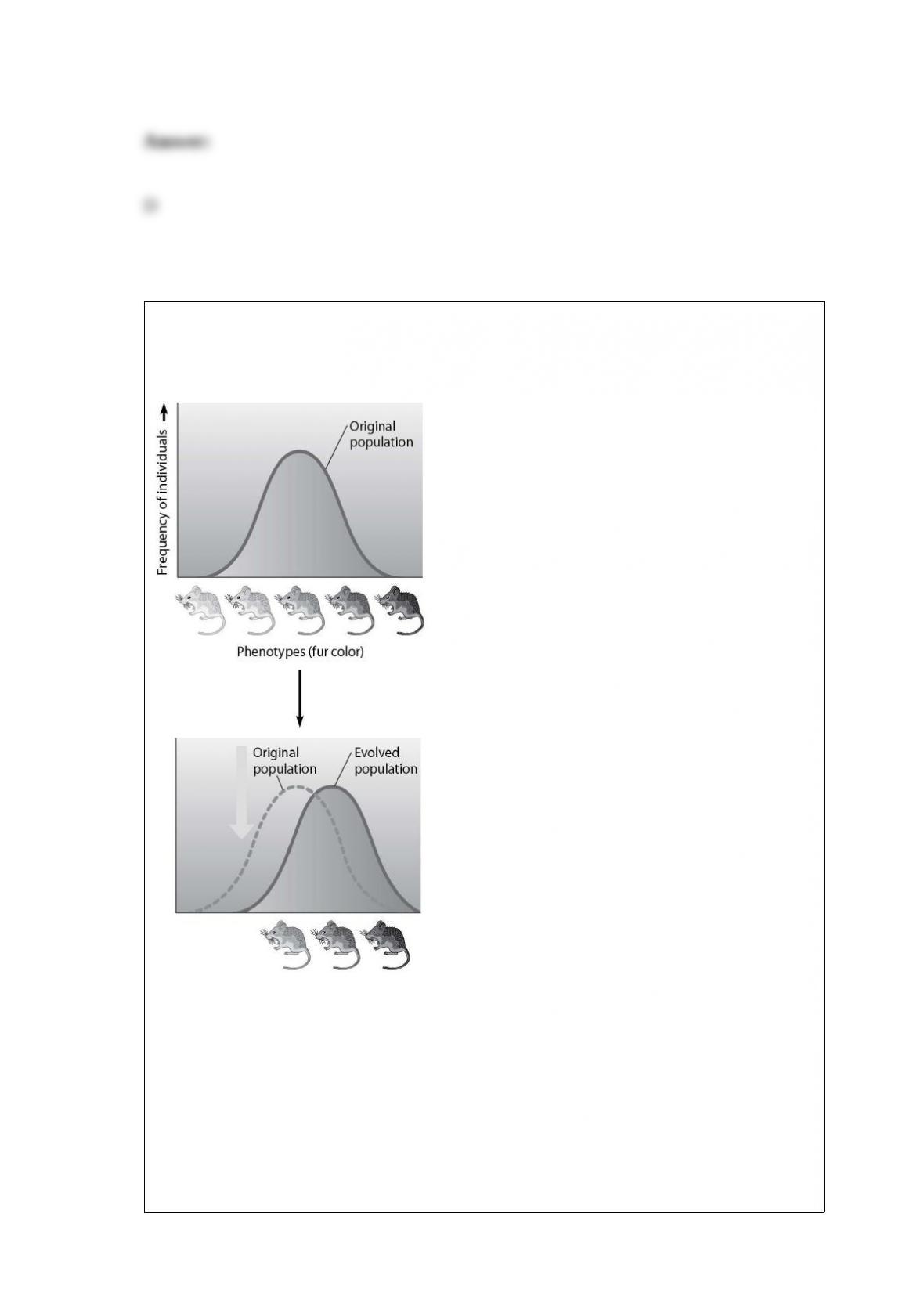
The change in curves in the graph represents
A) a decrease in genetic variation in a population of mice.
B) the appearance of a new allele for darker color in a population of mice.
C) a shift in the range of genetic variation in a population of mice.
D) a lack of genetic variation for light fur color in the original population of mice.

Integration of sensory stimuli occurs
A) in highly specialized receptors such as the organ of Corti.
B) in all receptors.
C) in the brain.
D) in the central and peripheral nervous systems.
Which of the following features likely accounts for the difference between plant and
animal cell cytokinesis?
A) Animal cells lack the microfilaments required for forming a cleavage furrow.
B) Animal cells lack chloroplasts.
C) Plant cells have cell walls.
D) Plant cells have two sets of chromosomes; animal cells have one set of
chromosomes.

Which of the following best describes the protective action of blinking?
A) An interneuron detects motion and sends this message to the peripheral nervous
system (PNS), and the PNS sends a message back to blink.
B) A sensory receptor detects motion, a sensory neuron sends this information to the
spinal cord, and the information in the central nervous system (CNS) sends a message
back to blink.
C) A cell body detects motion, a sensory neuron sends this message to the peripheral
nervous system (PNS), and the PNS sends a message back to blink.
D) A cell body detects motion, a sensory neuron sends this message to the spinal cord,
and the information in the central nervous system (CNS) sends a message back to blink.
Recent studies suggest that flame retardants, chemicals that are used for slow burning,
can mimic estrogen hormones found in the human body. The scientists investigating
this phenomenon developed three-dimensional images to show how the chemical
structure of certain flame retardants allows the retardants to bind to and inhibit an
enzyme (estrogen sulfotransferase) that metabolizes estrogen.
Suppose the scientists want to conduct a study of the effects of flame retardants on
estrogen levels. In a hypothetical study, the scientists use frogs to test the effects of
flame retardants because the frogs’ skin is highly permeable and therefore allows for
easy absorption of chemicals.
The scientists collected 20 wild adult frogs and brought them to a laboratory. Ten of the
frogs (group 1: five male and five female) were kept in tanks mimicking their natural
environment. The other ten frogs (group 2: five male, five female) were kept in tanks
identical to those of group 1 but were introduced to low amounts of flame retardants in
the shallow water in their tank. Estrogen levels were measured on the first day of the
experiment and then every 4 days for 20 days.
What will be the result when estrogen sulfotransferase is inhibited?
A) Epinephrine will cease to be produced.

B) A diminished amount of estrogen will be present.
C) An overabundance of glucocorticoids will be present.
D) An overabundance of estrogen will be present.
The term “carnivorous” as applied to carnivorous plants is not considered accurate by
some biologists because
A) carnivorous plants do not use insects for food (which must be a source of energy and
matter).
B) carnivorous plants only use insects as pollinators and do not gain any nutrients from
them.
C) carnivorous plants do not actually take in and digest whole insects.
D) carnivorous plants do not move around; an organism must be able to locomote to be
considered a carnivore.
Which part of the life cycle does a pollen grain represent?
A) a spore
B) a sperm cell
C) a male gametophyte

D) a male sporophyte
Electrons move about the nucleus of an atom in the same way that
A) insects fly around a bright lamp at night.
B) cars are parked along the sides of a street.
C) boats cross a lake.
D) birds migrate to a new winter home.
Facilitated diffusion across a biological membrane requires ________ and moves a
substance ________ its concentration gradient.
A) energy and transport proteins; down
B) transport proteins; down
C) energy and transport proteins; against
D) transport proteins; against

Which of the following is an effect of interleukin-2?
A) stimulating helper T cells to divide
B) stimulating mast cells to release histamine
C) stimulating antigen-presenting cells
D) modulating macrophage phagocytosis
Which of the following processes is most similar to the process of cleavage?
A) slicing up a pie into eight pieces
B) stringing beads onto a string
C) inflating a balloon
D) melting a stick of butter in a hot pan

When does the human blastocyst implant in the wall of the uterus?
A) within a few hours of fertilization
B) about a day after conception
C) about a week after conception
D) only after all four extraembryonic membranes become established
Prehensile tails are found among
A) Old World monkeys.
B) most hominoids.
C) New World monkeys.
D) all primates.
In plants, most differentiated cells retain
A) only a tiny fraction of their original set of genes.
B) a complete set of their genes but lose the ability to express most of those genes.
C) a complete set of their genes and retain the ability to express those genes under

certain circumstances.
D) the ability to dedifferentiate but then cannot return to their original differentiated
state.
When a cell uses chemical energy to perform work, it uses the energy released from
a(n) ________ reaction to drive a(n) ________ reaction.
A) exergonic; endergonic
B) endergonic; exergonic
C) exergonic; spontaneous
D) spontaneous; exergonic
Prednisone is a synthetic version of what natural hormone that is often prescribed to
individuals who are suffering from redness and swelling due to allergies?
A) mineralocorticoid
B) glucocorticoid
C) estrogen
D) progestin

Acetylcholine (ACh) is released by motor neurons and binds to receptors on muscle
cells to initiate action potentials. Some snake venom contains specific toxins that bind
irreversibly to these receptors and block acetylcholine’s ability to bind. If an animal is
bitten by a snake with these toxins in its venom, what do you predict would happen?
A) The animal’s muscles would not use stored ATP for energy.
B) The animal’s muscles would contract uncontrollably.
C) The animal’s muscles would not be able to contract.
D) The animal’s muscles would use lactic acid fermentation for energy.
Choose two of the following events in protist evolution and then put them in the correct
order in which they occur according to current science.
1. Mitochondria evolved through primary endosymbiosis
2. Chloroplasts evolved through secondary endosymbiosis.
3. Mitochondria and then chloroplasts evolved through primary endosymbiosis.
4. Protozoans were incorporated into several other groups of protists through secondary
endosymbiosis.
5. Chloroplasts and then mitochondria evolved through primary endosymbiosis.
6. Algae were incorporated into several other groups of protists through secondary

endosymbiosis.
A) 1, 2
B) 3, 4
C) 1, 6
D) 2, 6
If you were just diagnosed with a serious bacterial disease, which of these would
predict the most positive outcome for treatment? The disease was acquired
A) in a hospital, where most of the bacteria are probably already weakened by
antibiotics in the environment.
B) in a livestock barn where the animals have been treated with antibiotics.
C) in a big city where antibiotics are routinely prescribed by doctors.
D) in a remote, sparsely populated area where the bacteria have not been exposed to
antibiotic drugs.
Most of a cell’s enzymes are
A) lipids.

B) proteins.
C) amino acids.
D) carbohydrates.
Which of the following is a practical application of population ecology that will result
in population decline?
A) restricting the length of deer hunting season
B) managing crops by selectively killing agricultural pests
C) removing habitat space from wild animal populations
D) preventing the overfishing of cod
Which of the following molecules is a reactant of photosynthesis?
A) CO2
B) glucose
C) O2
D) chlorophyll

Lyell’s book Principles of Geology, which Darwin read on board the H.M.S.Beagle,
argued in favor of which of the following concepts?
A) Earth’s surface is shaped mainly by occasional catastrophic events.
B) Meteorite impacts may have been a major cause of periodic mass extinctions.
C) Earth’s surface is shaped by natural forces that act gradually and are still acting.
D) The processes that shape Earth today are very different from those that were at work
in the past.
The findings of Pasteur and others have established that
A) living organisms regularly self-assemble (arise spontaneously) from nonliving
matter.
B) living organisms do not arise from nonliving matter today, nor did they arise from
nonlife in the past.
C) advanced organisms cannot arise from nonliving matter, but simple microbial life
often does arise from nonlife today.
D) life does not arise from nonliving matter today, but in the conditions of early Earth,
such an event could have occurred.

Compost piles create an intense heat source and would therefore be suitable
environments for ________.
A) extreme thermophiles
B) extreme halophiles
C) methanogens
D) proteobacteria
Organisms with true radial symmetry
A) have their sense organs, mouth, and brain clustered in the head.
B) tend to be highly mobile.
C) do not have a distinct head region and tend to be sedentary or passive drifters.
D) can be divided into two matching halves along only one plane.

Which arrow in this figure shows heat transfer by conduction?
A) arrow A
B) arrow B
C) arrow C
D) arrow D
________ can destroy infected cells.
A) Macrophages
B) Plasma cells
C) B cells
D) Cytotoxic T cells

Organisms that digest molecules in organic material and convert them into inorganic
forms are
A) primary consumers.
B) decomposers.
C) primary producers.
D) detritivores.
A cell that has a cell wall is undergoing cell division, and the following events are
observed: the formation of a cell plate and the division of the cell into two daughter
cells. What type of cell is being observed and what process(es) is it going through?
A) prokaryote; telophase of mitosis
B) animal cell; telophase and cytokinesis of mitosis
C) plant cell; telophase and cytokinesis of mitosis
D) plant cell; telophase II of meiosis
After reading the paragraph below, answer the questions that follow.

Four decades after the end of the Vietnam War, the remains of an Air Force pilot were
discovered and returned to the United States. A search of Air Force records identified
three families to which the remains might possibly belong. Each family had a surviving
twin of a missing service member. The following STR profiles were obtained from the
remains of the pilot and the surviving twins from the three families.
In order to match the pilot’s remains to the correct family using DNA profiling,
A) the majority of the STR bands must match.
B) each of the 13 STR bands must match.
C) the bands for site 13 must match.
D) bands 5 and 7 must match.

Which of the following hormones might induce seeds treated with it to break
dormancy?
A) an auxin
B) a cytokinin
C) a gibberellin
D) ethylene
Which of the following is a part of the immune system?
A) bone marrow
B) liver
C) pancreas
D) lungs