A major type of lipid found in cell membranes is
A) triglycerides.
B) phospholipids.
C) glycerol.
D) waxes.
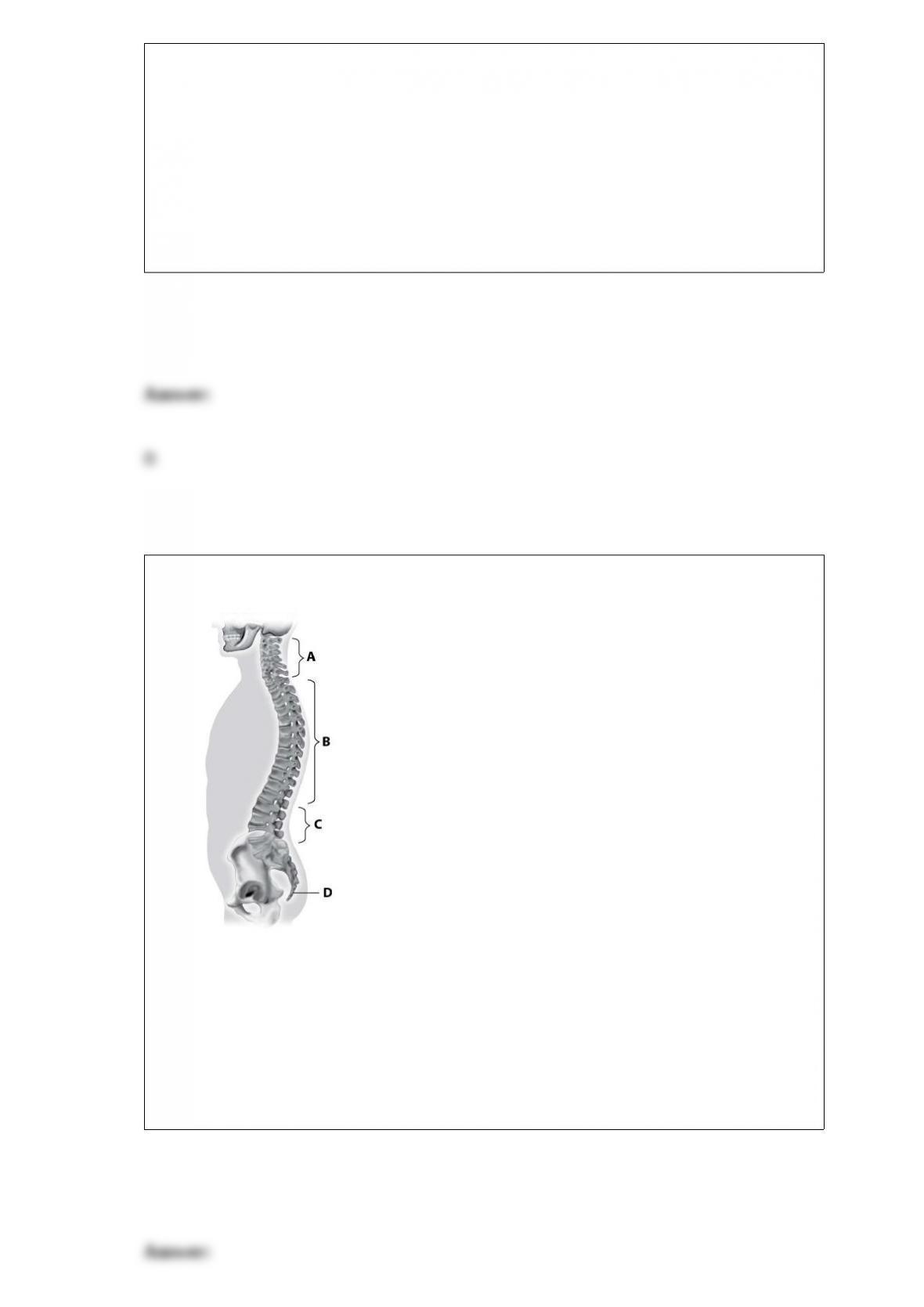
Which part of this figure depicts the thoracic vertebrae?
A) part A
B) part B
C) part C
D) part D

Reptiles are not able to eat as frequently as mammals and birds can eat. This is due to a
trait that mammals and birds share but that reptiles do not have. What is this trait?
A) airfoils
B) endothermy
C) amniotic egg
D) teeth
Which organelle is involved in the catabolism of fatty acids and the detoxification of
alcohol?
A) peroxisome
B) Golgi apparatus
C) smooth ER
D) ribosomes

Feeling tired after a long day of work, you walk across a parking lot at night to get to
your car. As you approach the car you see a shadow extending behind the back of the
car. You immediately feel a rush of energy, your heart starts pounding, and you feel
wide awake and alert. You are experiencing
A) an allergic reaction.
B) a surge in blood glucose.
C) the fight-or-flight response.
D) effects of endocrine disruptors.
The number of proteins in humans
A) is approximately equal to the number of genes.
B) cannot be determined because the human genome is too complex.
C) is less than half the number of genes.
D) is much greater than the number of genes.
Scientists interested in knowing the best way to restore an area after a temporary road
was built through it completed a study comparing two treatments: (1) restoring the
contour of an area so that there was no longer a depression or cut-through where the
road was previously and (2) simply abandoning the area to allow vegetation to return on

its own. They wanted to know whether either or both of these treatments would return
the aboveground vegetation and the belowground soil properties to their original state,
as seen in a similar area where there had never been a road.
In this experiment, the area that had never had a road is useful to the experiment
because
A) at least three samples are necessary to have a valid experiment.
B) the area never roaded serves as a control for the experimental variables of
recontoured and abandoned.
C) the researchers need to know what species of plants were common to all three areas.
D) since all three areas had existed for the same amount of time, the third area allowed
time to be controlled as a variable.
A child is born with a rare disease in which mitochondria are missing from skeletal
muscle cells. However, the muscles still function. Physicians find that
A) the muscles contain large amounts of lactate following even mild physical exercise.
B) the muscles contain large amounts of carbon dioxide following even mild physical
exercise.
C) the muscles require extremely high levels of oxygen to function.
D) the muscle cells cannot split glucose to pyruvate.

Which of the following options correctly lists the structures in the kidney in the order in
which fluid flows through them?
A) proximal tubule, Bowman’s capsule, loop of Henle, distal tubule, glomerulus
B) Bowman’s capsule, proximal tubule, loop of Henle, distal tubule, glomerulus
C) glomerulus, Bowman’s capsule, proximal tubule, loop of Henle, distal tubule
D) glomerulus, proximal tubule, distal tubule, Bowman’s capsule, loop of Henle
A theory is
A) an idea that has been proven.
B) a concept in the early stages that still needs to be tested.
C) a description of a belief that invokes the supernatural.
D) an explanation of an idea that is broad in scope and supported by a large body of
evidence.
In a hybrid zone, ________ can occur if the reproductive barrier between two species is
weak, as seen among cichlids in the murky waters of modern Lake Victoria.
A) reinforcement

B) fusion
C) allopatric speciation
D) reproductive isolation
Why are most plants green?
A) Chlorophyll a reflects green light.
B) Chlorophyll a absorbs green light.
C) Chlorophyllb primarily uses green light as the source of energy for photosynthesis.
D) Green helps plants blend into their environment as a sort of camouflage.
Which of the following is an amino group?
A) -OH
B) -NH2
C) -COOH
D) -CO

HIV does the greatest damage to
A) the adrenal glands.
B) pancreatic cells.
C) nervous tissue.
D) white blood cells.
Which highly reactive gas was probably absent from the Earth’s primitive atmosphere?
A) methane
B) carbon dioxide
C) O2 (oxygen gas)
D) water vapor

In plants, the vascular tissue made of dead cells that transport water and minerals from
the roots is called
A) xylem.
B) phloem.
C) conducting tissue.
D) meristem.
An excess of T3 and T4 in the blood is hyperthyroidism, which in its most common
form is called
A) goiter.
B) sterility.
C) Graves’ disease.
D) botulism.
Which of the following items has a shape most like a squamous epithelial cell?
A) a watermelon
B) a cupcake
C) a fried egg
D) the letter “S”
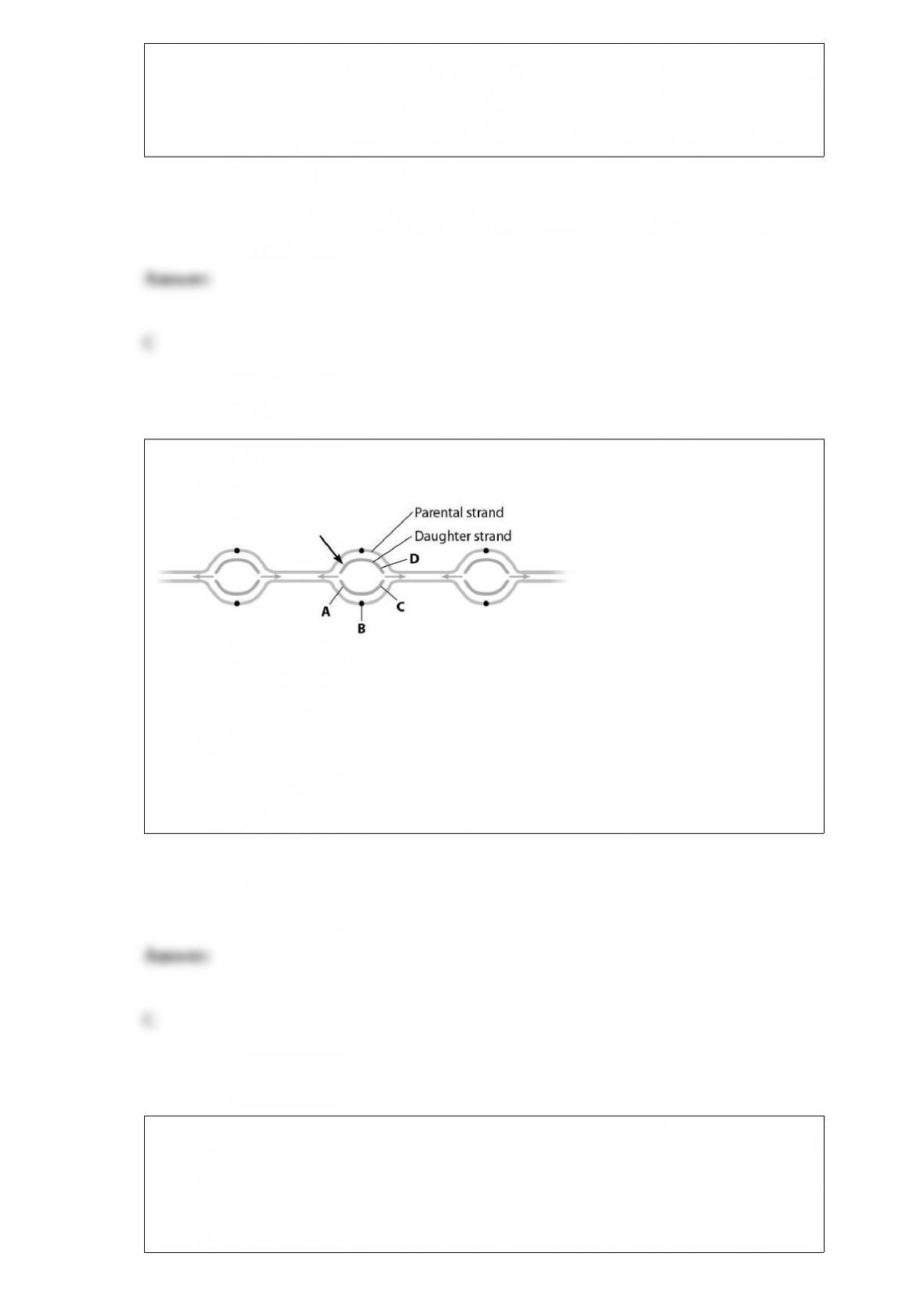
If the left end of the daughter strand indicated by the arrow in the figure is being
synthesized in one continuous piece, then
A) the DNA at point A is being synthesized in one continuous piece.
B) the DNA at point B is being synthesized in small pieces.
C) the DNA at point C is being synthesized in one continuous piece.
D) the DNA at point D is being synthesized in one continuous piece.
Which type of sensory receptors becomes more sensitive when damaged tissues
produce prostaglandins?
A) deep pressure receptors

B) utricle hair cells
C) pain receptors
D) temperature receptors
At the end of the ________, over 96% of marine species and many terrestrial species
became extinct, possibly because intense volcanic activity warmed Earth’s climate.
A) Precambrian
B) Permian
C) Cretaceous
D) Mesozoic
“Supertasters” are individuals who
A) prefer foods that are somewhat bitter, such as vegetables.
B) typically have more food dislikes.
C) have fewer fungiform papillae on their tongue.
D) tend to eat healthier and have fewer diseases.

Why can some plants be cloned from a single cell?
A) Plant cells do not differentiate even when mature, so any cell can grow into an entire
plant.
B) Plant cells can dedifferentiate and give rise to all of the specialized cells required to
produce an entire plant.
C) Plant cells can produce genes to replace those lost during development.
D) Plant cells are capable of self-renewal by utilizing cellular components from
adjacent cells.
The current rate of extinction may be as much as ________ times higher than at any
other time in the past 100,000 years.
A) 10
B) 100
C) 1,000
D) 10,000
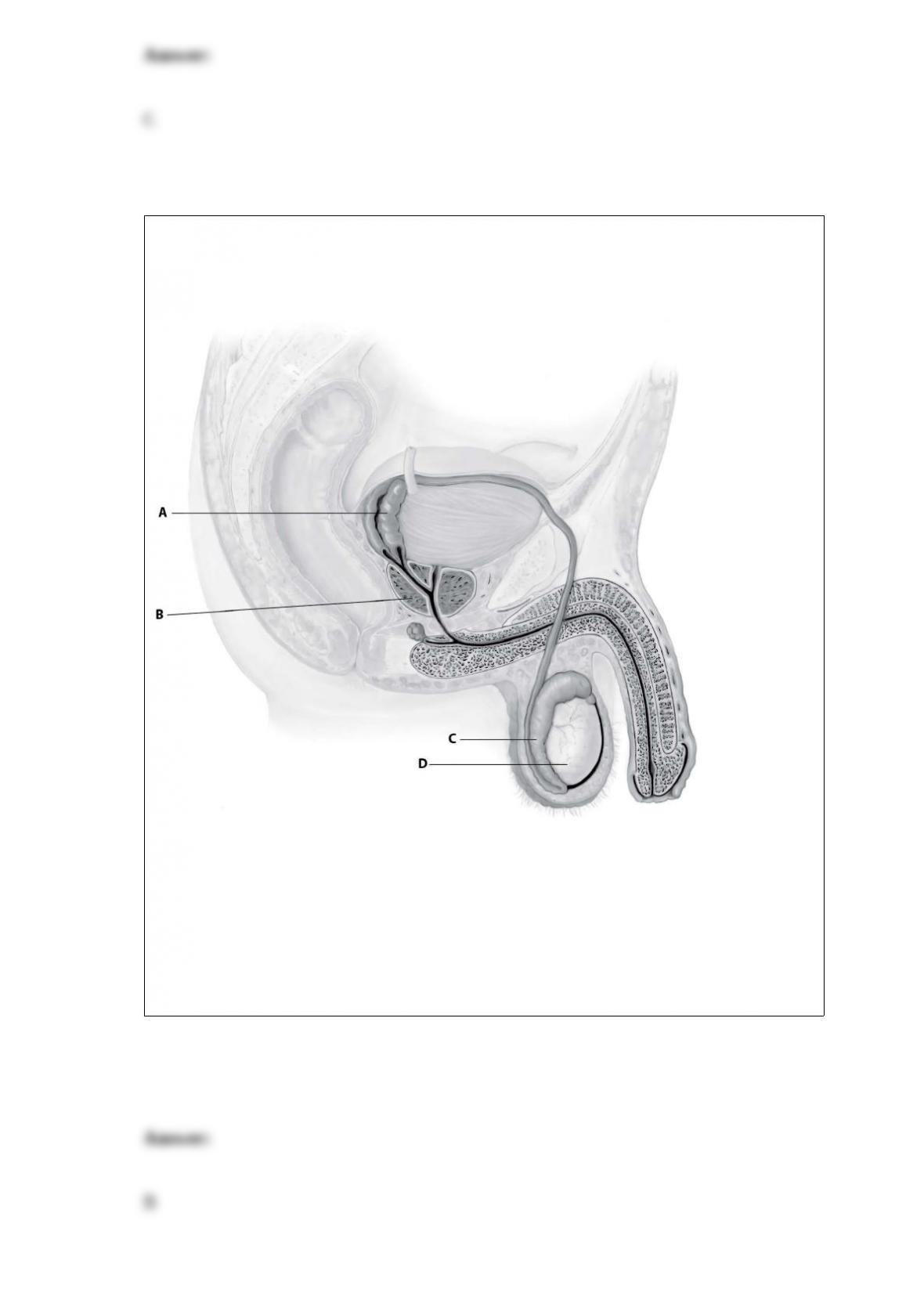
Which gland may swell due to common medical problems in older men and cause
increased frequency of urination?
A) part A
B) part B
C) part C
D) part D

In a study on human mate choice, researchers found that daughters choose mates who
look like their fathers. To determine whether they choose mates who are genetically
similar, the mate choices of adopted daughters were analyzed. Independent judges
determined that adopted daughters chose mates with facial similarities to their adoptive
father. This influence of parental image on mate choice could be considered a human
example of
A) imprinting.
B) habituation.
C) pattern recognition.
D) a dominance hierarchy.
During a summer study abroad program, you travelled to Austria to study genetics at
the University of Vienna. While you were there, a momentous discovery was made:
some of Gregor Mendel’s original lab books and notes were found to be buried outside
of the abbey where he lived. It just so happened that the professor you were working
with obtained copies of these notes and enlisted your help to decipher them.
You hired a translator to translate Mendel’s notes from Czech to English, and using your
knowledge of modern genetics (which Mendel did not have!) you were able to construct
a partial Punnett square (shown below). Because the notebook was damaged from being
buried for so long, this is the only information that you have regarding a cross that
Mendel must have performed. Your professor has tasked you with figuring out more
about this experiment.
In pea plants, round peas are dominant (R) and shriveled peas are recessive (r), and
yellow peas (shown as light gray in Punnett square) are dominant (Y) and green peas
(dark gray) are recessive (y). Using this information and the partial Punnett square
above, what genotype should be listed in the square labeled A?

A) RRYY
B) RrYy
C) rrYy
D) RRyy
The existence of a hydrostatic pressure gradient in phloem tubes can be accounted for
by
A) the fact that the leaves are higher than the roots, which means that gravity creates
pressure.
B) the diffusion of water from one sieve-tube cell to the next.
C) the loading of sugars into phloem at sources and removal of sugars at sinks.
D) the active transport of water from sugar sources to sugar sinks.
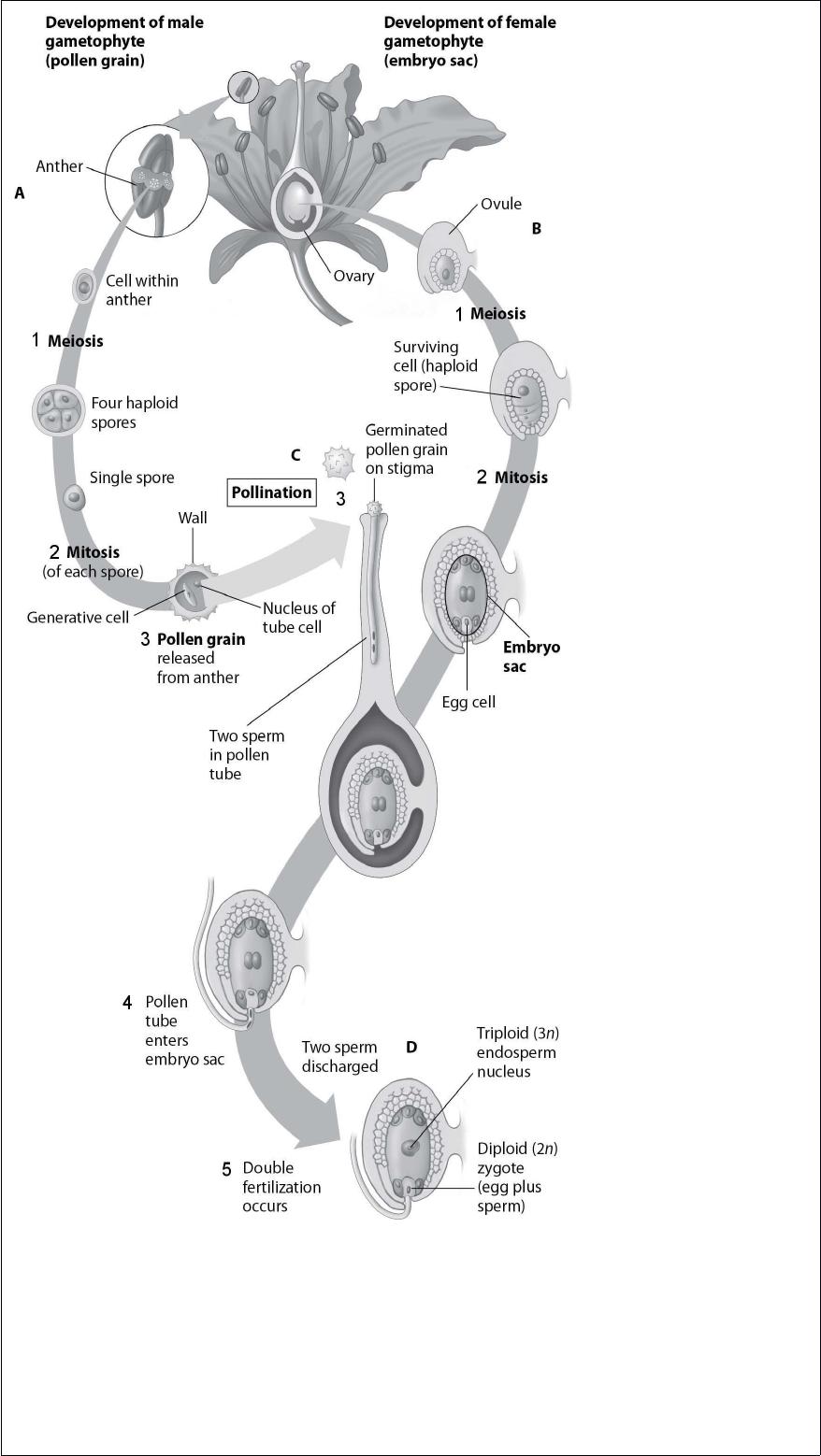
Which structure is the result of double fertilization?
A) structure A
B) structure B
C) structure C

D) structure D
In some cats, black coat color (B) is dominant over brown (B) and a striped fur pattern
(S) is dominant over a marbled fur pattern (s). You rescued a black striped cat from an
animal shelter but could not determine its exact genotype. To do so, you mated the cat
with a brown marbled cat. The mating produced 3 brown marbled, 2 brown striped, 2
black marbled, and 3 black striped. Immediately, you concluded the genotype of your
rescued cat was
A) BBSS.
B) BBSs.
C) BbSS.
D) BbSs.
Which of the following statements best describes a compound?
A) A compound is a pure element.
B) A compound contains two or more different elements in a fixed ratio.
C) A compound is exemplified by sodium.
D) A compound is a solution.

The function of the nucleolus is
A) to manufacture polypeptides.
B) to manufacture ribosomal RNA.
C) intracellular digestion.
D) to store chromatin.