
1) an extracellular matrix helps some cells to adhere to neighboring cells.
2) during the replication of dna, dna polymerase has to synthesize the daughter strand in
the 5′ to 3 direction because dna polymerase can only join nucleotides to the 3′ end of
the growing new strand.
3) each gamete carries one factor, now called an allele, for each inherited trait.
4) ribozymes are rna molecules that function as enzymes, catalyzing reactions during
rna splicing.
5) the shoot system of the plant is the aboveground portion that includes stems and
leaves for capturing the energy of sunlight.
6) complement and interferon are specific kinds of antibodies.
7) are ordinarily held in check by inhibitors.
8) phytoremediation is the use of a plants ability to uptake minerals in order to remove

pollutants from the environment.
9) a decrease in the function of the cardiovascular system due to aging can cause a
decreased ability of the body to metabolize drugs.
10) one of the earliest indications of cell differentiation is cellular movement.
11) generally, brain and nerve cells are not able to regenerate after injury because they
have left the cell cycle and are unable to return.
12) jacobs syndrome, xyy, results from nondisjunction during spermatogenesis.
13) having similar ____________ would allow tissues and organs to be transplanted
easily.
a. cell recognition proteins
b. major histocompatibility complex proteins
c. carbohydrate chains in the cell membrane
d. all of the choices are involved in tissue transplantation
14) supergroup opisthokinta includes all of the following organisms except
a. animals.

b. plants.
c. fungi.
d. choanoflagellates.
15) which of the following immunodeficiency disorders could possibly be treated or
prevented by gene therapy during the embryological stage?
a. x-linked agammaglobulinemia (xla)
b. aids
c. asthma
d. none of these disorders can be treated by gene therapy during the embryological
stage.
16) which of the following structures begins in the dermis and extends to the surface of
the epidermis?
a. oil and sweat glands
b. hair follicles and nerve fibers
c. sweat glands and hair follicles
d. oil glands and hair follicles
17) which of the following features would be used to construct a phylogenic tree?
a. homologous structures
b. fossil record data
c. dna-dna hybridization
d. amino acid sequences
e. all of the above.
18) the highlighted grouping in the cladogram is a ____________ grouping.
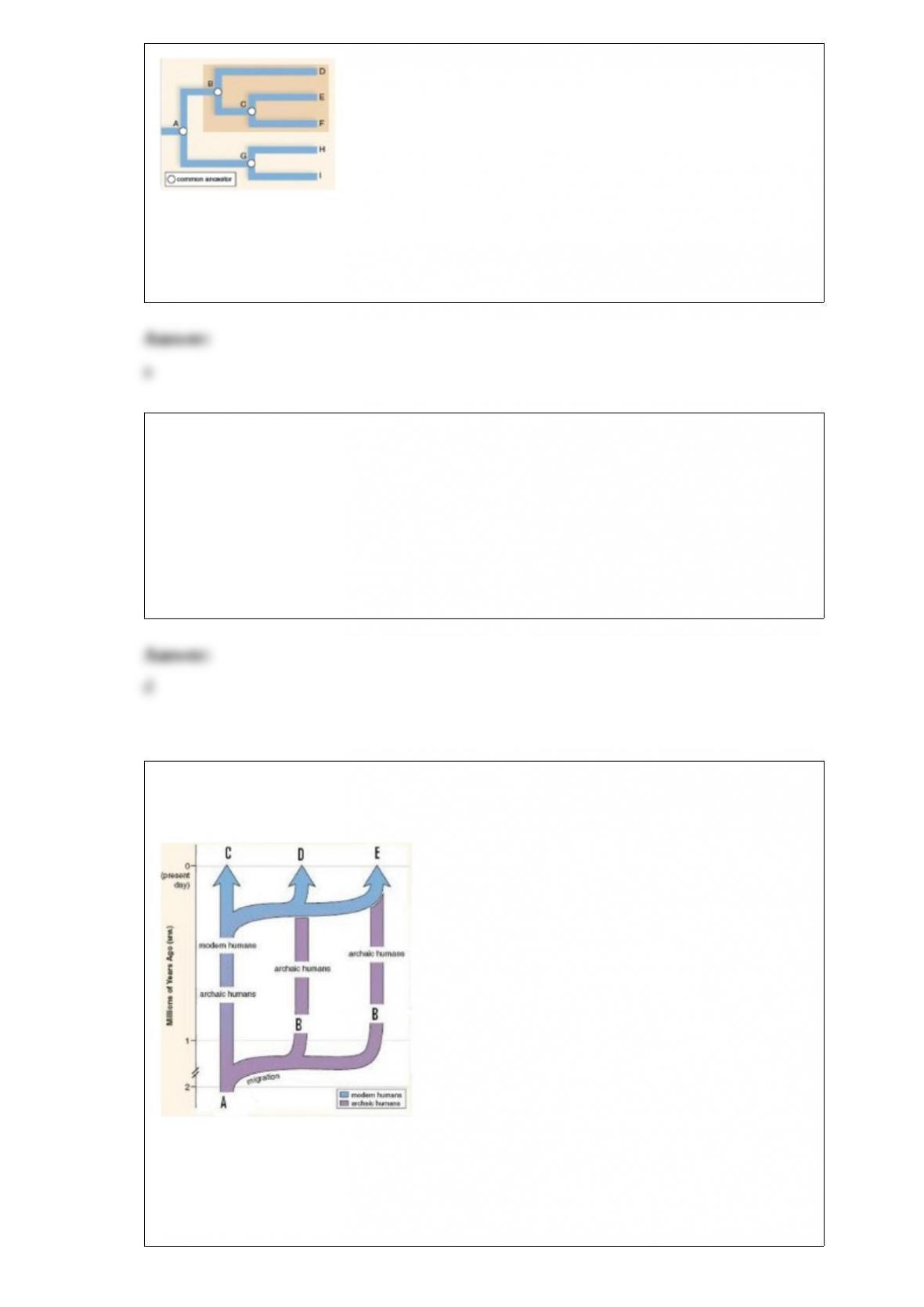
a. monophyletic
b. paraphyletic
c. polyphyletic
d. none of the above.
19) which statement is not true about the founder effect?
a. it is a form of genetic drift.
b. it produces a high frequency of some rare alleles in a small isolated population.
c. founding members contain a tiny fraction of the alleles found in the original
population.
d. the founder effect occurs when a population is subjected to near extinction and then
recovers so that only a few alleles are left in survivors.
incorrect
20) the most widely accepted model for the evolution of modern humans is pictured
here. what is this model called?
a. out-of-africa
b. replacement model
c. multiregional continuity
d. hardy-weinberg
e. out-of-africa and replacement model

21) which form of birth control is the most effective at preventing the spread of
sexually transmitted diseases?
a. abstinence
b. male condom
c. female condom
d. morning-after pills
e. intrauterine device
22) which of the following is not a characteristic of all animals?
a. animals are heterotrophic by ingestion or absorption.
b. animals produce gametes by meiosis.
c. animals digest their food internally.
d. animals are multicellular eukaryotes.
e. the adult form is diploid in an alternation of generation life cycle.
incorrect
23) ____________ occurs as ____________ builds up in the system if enzyme a is
nonfunctional because of an inherited mutation.
a. albinism; melanin
b. xeroderma pigmentosum; tyrosine
c. phenylketonuria; phenyalanine
d. androgen insensitivity; tyrosine
24) if a segment of dna has 20% adenine in its base composition, what percent thymine
is there?
a. 20%
b. 80%
c. 60%
d. 30%

25) a student proposes that left-handedness is a recessive trait that is therefore hidden in
much of the human population. a survey of a class of 36 students finds that 27 (0.75)
are right-handed and 9 (0.25) are left-handed. using the hardy-weinberg formula, what
would the expected genotypes and allele frequencies be in this theoretical population?
a. 0.75 homozygous dominant and 0.25 homozygous recessive, and a 3-to-1,
right-to-left handed allele ratio in the population.
b. 0.25 homozygous dominant, 0.50 heterozygous, and 0.25 homozygous recessive, and
a 0.75 dominant allele frequency and a 0.25 recessive allele frequency.
c. 0.25 homozygous dominant, 0.50 heterozygous, and 0.25 homozygous recessive, and
a 0.5 allele frequency for each allele.
d. 0.50 homozygous dominant, 0.25 heterozygous, and 0.25 homozygous recessive, and
a 0.5 allele frequency for each allele.
e. they cannot be estimated using these limited data.
26) a biome characterized by hot days, cold nights, and cacti is the
a. tundra.
b. desert.
c. taiga.
d. tropical rain forest.
27) pleiotropy typically
a. causes various symptoms to appear even though it only impacts a single gene.
b. causes a single symptom to appear even though it only impacts a single gene.
c. causes various symptoms to appear even though it only impacts multiple genes.
d. causes a single symptom to appear even though it only impacts multiple genes.
28) which of the following reasons helped make mendel successful with his genetic
experiments?
a. he had a strong background in mathematics
b. he was very deliberate and followed the scientific method closely while doing his
research
c. he kept very detailed records of his research

d. he was basing his research off of preexisting research
e. all are reasons mendel was successful with his genetic experiments
29) the evolutionary species concept involves the identification of certain structural
traits, called _______, to distinguish one species from another.
a. analogous traits
b. homologous traits
c. diagnostic traits
d. convergent traits
30) what body systems may be impacted if a mother drinks alcohol during pregnancy
and causes developmental problems to the endoderm?
a. the epithelial lining of the digestive and respiratory systems may not be as functional
as they should.
b. the epithelial lining of the digestive and reproductive systems may not be as
functional as they should.
c. the epidermis and the epithelial lining of the oral cavity may not be as functional as
they should.
d. the outer layers of the digestive and respiratory systems may not be as functional as
they should.
31) a hormone that causes cell division and is found in coconut milk and in dividing
root tissue is
a. abscisic acid.
b. auxin.
c. cytokinin.
d. ethylene.
e. gibberellin.