
RNA processing occurs when amino acids are removed from nascent proteins.
Which of the following organelles are involved in the general category of organelle
heredity?
A) mitochondria and chloroplasts
B) golgi and nuclei
C) lysosomes and peroxisomes
D) factors and episomes
E) golgi and rough endoplasmic reticulum
Viral genomes are always linear, double-stranded DNA.

A class of mutations that results in multiple contiguous amino acid changes in proteins
is likely to be which of the following?
A) base analog
B) transversion
C) transition
D) frameshift
E) recombinant
A bacteriophage that is capable of entering either a lytic or lysogenic cycle is called a(n)
________.
A) temperate bacteriophage
B) virulent bacteriophage
C) plasmid
D) episome
E) plaque-forming unit
Which types of phenotypic ratios are likely to occur in testcrosses when dealing with

two gene pairs for which all the genotypic combinations are of equal viability?
A) 9:3:3:1, 27:9:9:9:3:3:3:1
B) 1:2:1, 3:1
C) 1:1:1:1
D) 12:3:1, 9:7
E) 2:3, 1:2
What term is applied when two genes fail to assort independently, that is, they tend to
segregate together during gamete formation?
A) discontinuous inheritance
B) Mendelian inheritance
C) linkage
D) tetrad analysis
E) dominance and/or recessiveness
Bell-shaped distributions produced by plotting results of F2 and F3 crosses are typical
of which type of inheritance?

A) multiple-factor inheritance
B) alternation of generations
C) codominance
D) incomplete dominance
E) hemizygosity
With incomplete dominance, a likely ratio resulting from a monohybrid cross would
be ________.
A) 3:3
B) 1:2:2:4
C) 1:2:1
D) 9:3:3:1
E) 3:1
The secondary structure of a protein includes ________.

A) gamma and delta
B) alpha and gamma
C) α-helix and β-pleated sheet
D) hydrophobic clusters
E) disulfide bridges
Explain how and why the following circumstances influence characteristics of
temperature-induced DNA melting.
a) Percentage of GC base pairs
b) Urea (forms hydrogen bonds with bases)
c) Sodium chloride (neutralizes negatively charged phosphates)
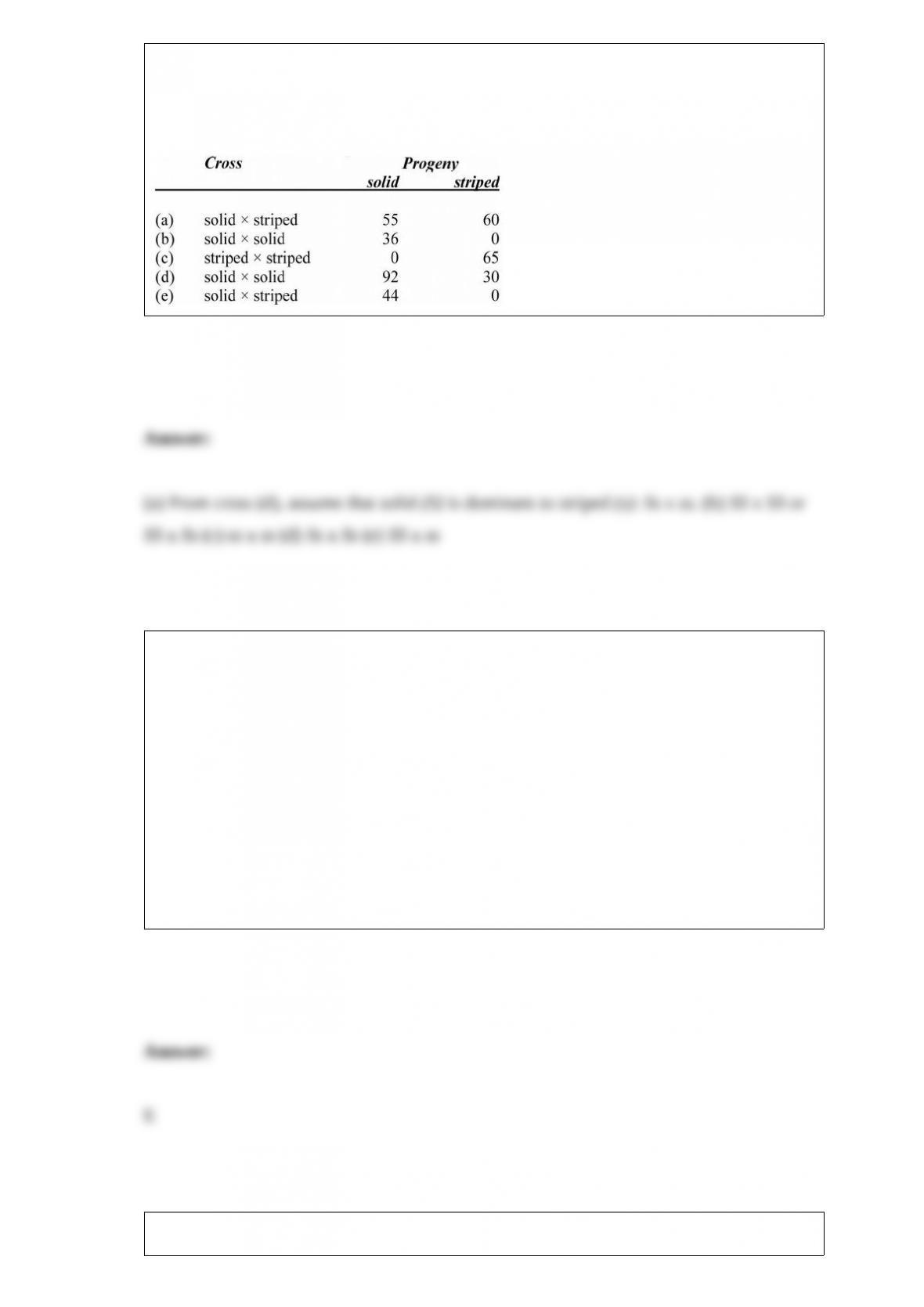
Assume that you have a garden and some pea plants have solid leaves and others have
striped leaves. You conduct a series of crosses [(a) through (e)] and obtain the results
given in the table. Define gene symbols and give the possible genotypes of the parents
of each cross.
What is one particular function that the codons (UAA, UGA, or UAG) serve during
protein synthesis?
A) UAA, UGA, and UAG are initiator codons, not termination codons.
B) They allow the mRNA to assume a variety of linear conformations.
C) These triplets cause frameshift mutations, but are not involved in termination.
D) They provide a substrate for the addition of the initiator amino acid.
E) They act in chain termination.
Hershey and Chase used labeled DNA and protein to determine that DNA is the genetic

material in bacteria.
That some organisms contain much larger amounts of DNA than are apparently
“needed” and that some relatively closely related organisms may have vastly different
amounts of DNA is more typical in ________.
A) viruses than in bacteria
B) RNA viruses than in DNA viruses
C) eukaryotes than in prokaryotes
D) the alphoid rather than the diploid family
E) prokaryotes than in eukaryotes
In the context of molecular genetics, reverse transcription PCR (RT-PCR) refers to
________.
A) assembling a DNA sequence from an mRNA
B) assembling an RNA sequence from a DNA sequence
C) translating in the 3″ to 5″ direction
D) transcribing first, then translating

E) making an amino acid sequence from a DNA sequence
A protein functions as a cell-cycle regulator that causes cell death (apoptosis) to a
damaged cell. What is the symbol given to this protein?
A) p34
B) p102
C) cyclin
D) p53
E) phosphokinase
Which of the following are among the major components of prokaryotic ribosomes?
A) 12S rRNA, 5.8S rRNA, and proteins
B) 16S rRNA, 5.8S rRNA, and 28S rRNA
C) 16S rRNA, 5S rRNA, and 23S rRNA
D) lipids and carbohydrates
E) 18S rRNA, 5.8S rRNA, and proteins
The Chi-square test involves a statistical comparison between measured (observed) and
predicted (expected) values. One generally determines degrees of freedom as
________.
A) the number of categories being compared
B) one less than the number of classes being compared
C) one more than the number of classes being compared
D) ten minus the sum of the two categories
E) the sum of the two categories
In the classic experiment conducted by Hershey and Chase, why was the pellet
radioactive in the centrifuge tube that contained bacteria with viruses?
A) The bacteria were in the pellet, and they had incorporated radioactive proteins into
their cell membranes.
B) The radioactive viruses (coats plus DNA) were in the pellet.
C) The bacteria were in the pellet, and many contained the radioactive viral DNA.
D) The radioactive protein coats of the viruses were in the pellet.
E) The radioactive viruses were in the pellet, and the bacteria were in the supernatant.

Assume that a culture of E. coli was grown for approximately 50 generations in 15N
(provided in the medium in the ammonium ion), which is a heavy isotope of nitrogen
(14N). You extract the DNA from the culture, and it has a density of 1.723 gm/cm3
(water = 1.00 gm/cm3). From the literature, you determine that DNA containing only
the common form of nitrogen, 14N, has a density of 1.700 gm/cm3. Bacteria from the
15N culture were washed in buffer and transferred to 14N medium for one generation
immediately after which the DNA was extracted and its density determined.
(a) What would be the expected density of the extracted DNA?
(b) After you heat the extracted DNA until it completely denatures (95C for 15
minutes), what would you expect the density of the DNA in the denatured extract to be?
For the purposes of this question, assume that DNA has the same density regardless of
whether it is single- or double-stranded.
(c) Assuming that the molar percentage of adenine in the extracted DNA was 20%, what
would be the expected molar percentages of the other nitrogenous bases in this DNA?
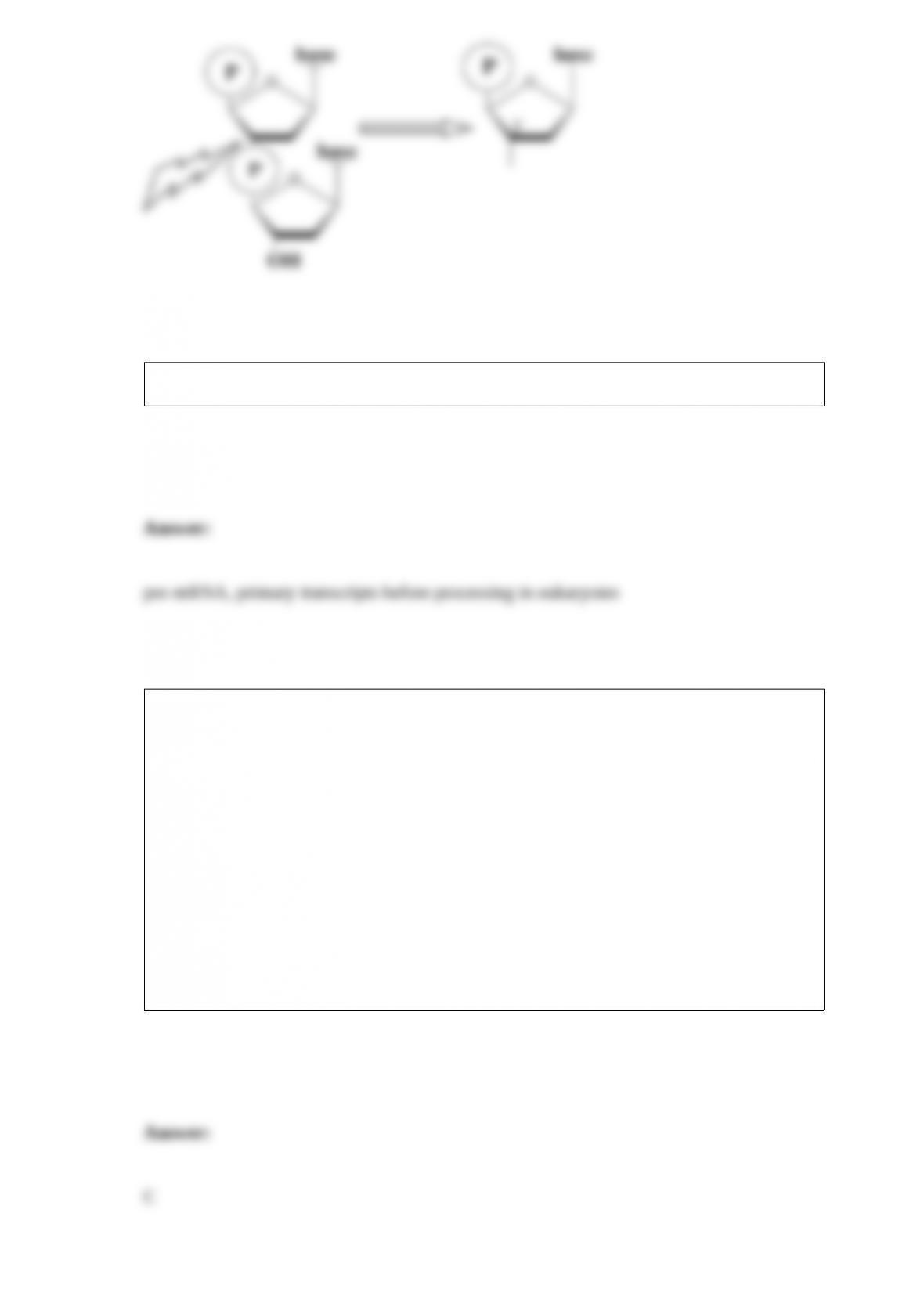
(d) Assume that a fraction of the extracted DNA was digested to completion with the
enzyme snake venom diesterase. This enzyme cleaves between the phosphate and the 3″
carbon. Present a “simplified” diagram that would illustrate the structure of the
predominant resulting molecule.
What is meant by the term heterogeneous nuclear RNA (hnRNA)?
By their experimentation using the Neurospora fungus, Beadle and Tatum were able to
propose the far-reaching hypothesis that ________.
A) prototrophs will grow only if provided with nutritional supplements
B) several different enzymes may be involved in the same step in a biochemical
pathway
C) the role of a specific gene is to produce a specific enzyme
D) genetic recombination occurred in Neurospora
E) more than one codon can specify a given amino acid

Name the general category into which double-stranded circular extrachromosomal DNA
elements such as F factors, ColE1, and R would fall.
A) capsid
B) r-determinant
C) plaque
D) partial diploid
E) plasmid
Some bacterial transposons, known as Tn elements, are larger than insertion sequences
(IS elements) and contain protein-coding genes that have human health significance.
What might such a bacterial transposon contain?
A) drug resistance
B) oncogene
C) pseudogene
D) proto-oncogene
E) dissociation element

In a population of 100 individuals, 49% are of the NN blood type. What percentage is
expected to be MN assuming Hardy-Weinberg equilibrium conditions?
A) 9%
B) 21%
C) 42%
D) 51%
E) There is insufficient information to answer this question.
In sporadic cases of retinoblastoma, how many gene mutations are thought to be
necessary in the same cell for a tumor to develop?
A) one
B) two
C) four
D) six
E) There is insufficient information to answer this question.
Albinism, lack of pigmentation in humans, results from an autosomal recessive gene
(a). Two parents with normal pigmentation have an albino child.
a) What is the probability that their next child will be albino?
b) What is the probability that their next child will be an albino girl?
c) What is the probability that their next three children will be albino?
A short segment of an mRNA molecule is shown below. The polypeptide it codes for is
also shown:
5″-AUGGUGCUGAAG-3″: methionine-valine-leucine-lysine
Assume that a mutation in the DNA occurs so that the fourth base (counting from the 5″
end) of the messenger RNA now reads A rather than G. What sequence of amino acids
will the mRNA now code for? (You do not need a copy of the genetic code to answer
the question.)
A) methionine-valine-leucine-lysine
B) methionine-lysine-leucine-lysine
C) methionine-leucine-leucine-lysine
D) methionine-valine-methionine-lysine
E) methionine-methionine-leucine-lysine
In RNA, uracil is present instead of the thymine in DNA.
In peas, gray seed color is dominant to white. For the purposes of this question, assume
that Mendel crossed plants with gray seeds with each other and the following progeny
were produced: 320 gray and 80 white.
a) What is the most probable genotype of each parent?
a) What genotypic and phenotypic ratios are expected in the progeny of such a cross?
The condition known as cri-du-chat syndrome in humans has a genetic constitution
designated as ________.
A) 45, X
B) heteroplasmy
C) 46, 5p-
D) triploidy
E) trisomy

In Drosophila, the sex of a fly with the karyotype XO:2A is ________.
What are polyribosomes?
What appears to be the range of the number of protein-coding genes per genome in
eukaryotes?
Mutation and migration introduce new alleles into populations. What is the most likely
principal force that will shift allelic frequencies within large populations?
Provide simple definitions that distinguish segregation and independent assortment.
Dosage compensation in mammals typically involves the random inactivation of one of
the two X chromosomes relatively early in development. Such X chromosome
inactivation often leads to phenotypic mosaicism. Assume that black fur in cats is due to
the X-linked recessive gene b, whereas its dominant allele B produces yellow fur. A Bb
heterozygote is a mosaic called “tortoise shell” or “calico.” Using appropriate gene
symbols, diagram a mating between a black male and a calico female. Give the
phenotypes and genotypes of all the offspring.
Name two individuals who provided the conceptual basis for our present understanding
that genes are on chromosomes.
What is the fundamental purpose of creating a knockout organism?
What term is used to describe the fact that different genes in an organism often provide
differences in observable features?
What are the genetic consequences of inbreeding?
Once DNA is separated on a gel, it is often desirable to gain some idea of its
informational content. How might this be done?
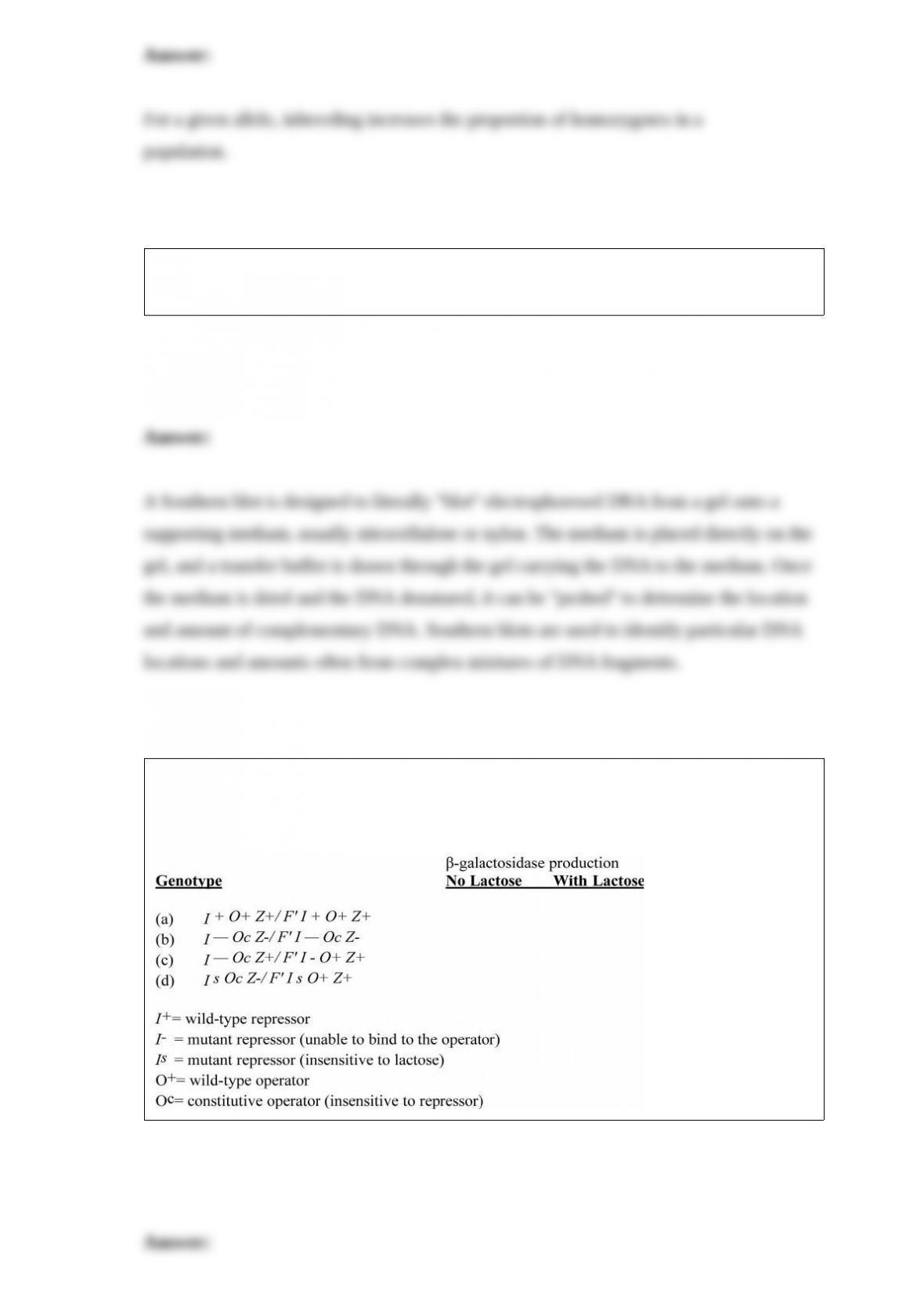
The accompanying table lists several genotypes associated with the lac operon in E.
coli. For each, indicate with a “+” or a “” whether β-galactosidase would be expected to
be produced at induced levels.
What similarities do bacterial chromosomes have with eukaryotic chromosomes?
Provide an explanation of the differences between differentiation and determination.
Provide examples of each process and indicate how each is involved in development.
In a population that meets the Hardy-Weinberg equilibrium assumptions, 81% of the

individuals are homozygous for a recessive allele. What percentage of the individuals
would be expected to be heterozygous for this locus in the next generation?