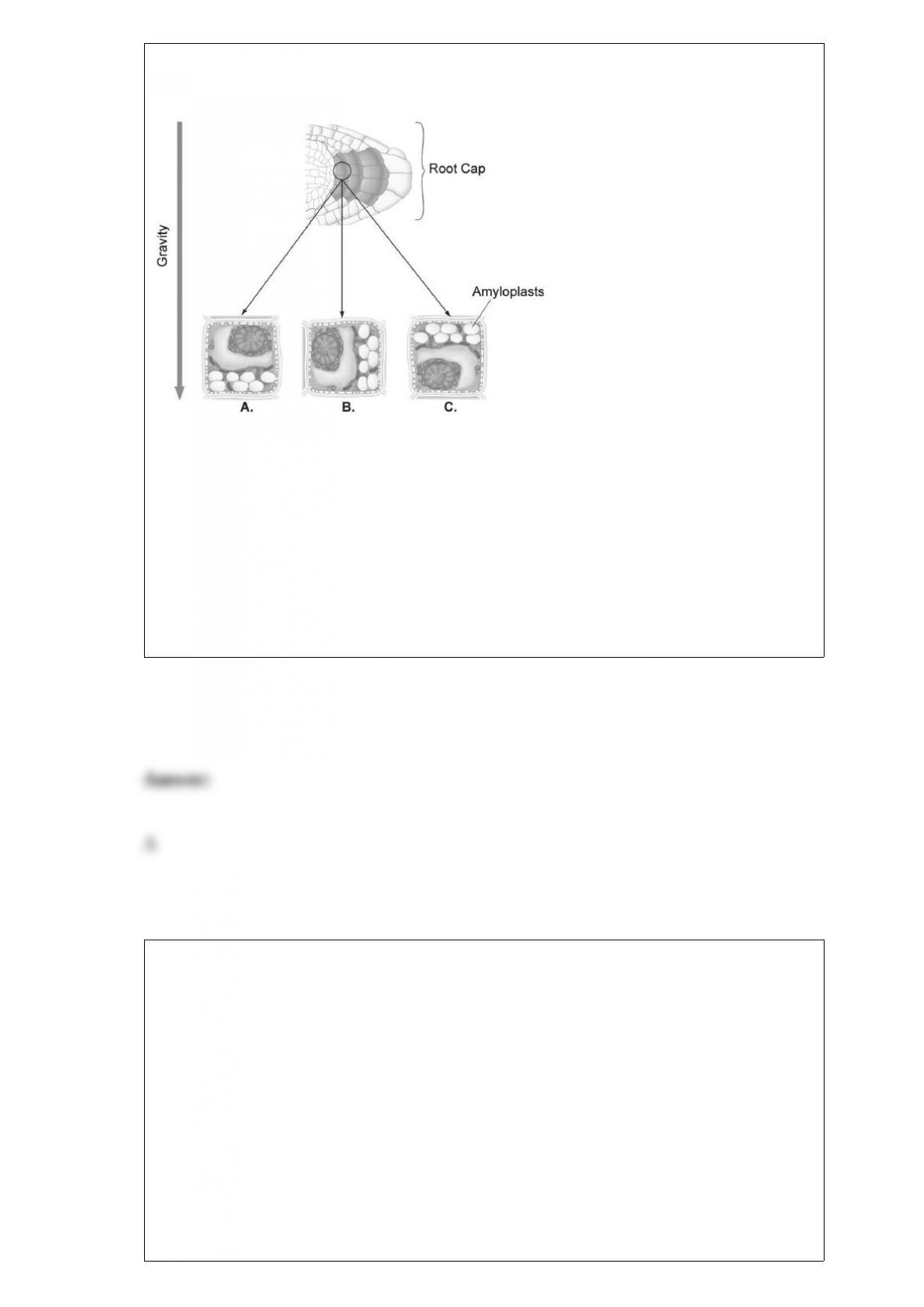
Suppose you laid a seedling on its side so that the root was parallel to the ground as
shown in the figure above. Several hours after the change in position, where in the root
cells (position A, B, or C in the figure above) would you find the amyloplasts?
A) A
B) B
C) C
Listed below are several examples of types of animal behavior. Choose the letter of the
correct term (A-E) that matches each example in the following question(s).
A. operant conditioning
B. agonistic behavior
C. innate behavior
D. imprinting
E. altruistic behavior

Upon observing a golden eagle flying overhead, a sentry prairie dog gives a warning
call to other foraging members of the prairie dog community.
A) B
B) C
C) D
D) E
Particular receptor tyrosine kinases (RTKs) that promote excessive cell division are
found at high levels on various cancer cells. A protein, Herceptin, has been found to
bind to an RTK known as HER2. HER2 is sometimes excessive in cancer cells. This
information can now be utilized in breast cancer treatment if which of the following is
true?
A) if HER2, administered by injection, causes cell division
B) if the patient’s cancer cells have excessive levels of HER2
C) if the patient’s genome codes for the HER2 receptor
D) if the patient has RTKs only in cancer cells
There are sixty-one mRNA codons that specify an amino acid, but only forty-five
tRNAs. This is best explained by the fact that _____.
A) some tRNAs have anticodons that recognize four or more different codons
B) the rules for base pairing between the third base of a codon and tRNA are flexible
C) many codons are never used, so the tRNAs that recognize them are dispensable
D) the DNA codes for all sixty-one tRNAs, but some are then destroyed
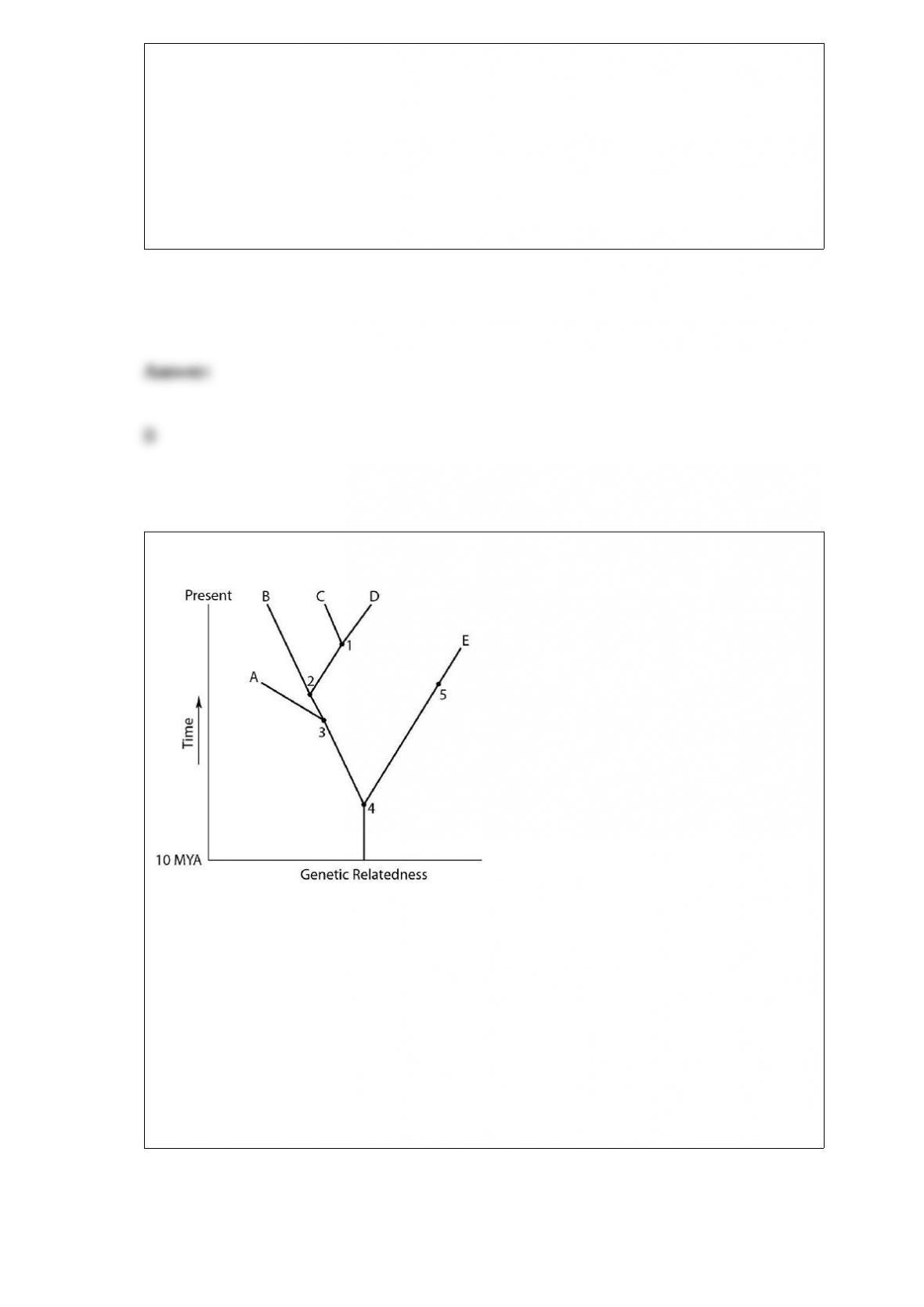
Use the figure below to answer the following question(s).
Which extinct species should be the best candidate to serve as the outgroup for the
clade whose common ancestor occurs at position 2 in the figure above?
A) A
B) B
C) C
D) E

The following question is based on information from Frank M. Frey, “Opposing Natural
Selection from Herbivores and Pathogens May Maintain Floral-Color Variation in
Claytonia virginica (Portulacaceae),” Evolution 58(11), 2004: 2426-37.
Claytonia virginica is a woodland spring herb with flowers that vary from white to pale
pink to bright pink. Slugs prefer to eat pink-flowering over white-flowering plants (due
to chemical differences between the two), and plants experiencing severe herbivory are
more likely to die. The bees that pollinate this plant also prefer pink to white flowers, so
that Claytonia with pink flowers have greater relative fruit set than Claytonia with
white flowers. A researcher observes that the percentage of different flower colors
remains stable in the study population from year to year. Given no other information, if
the researcher removes all slugs from the study population, what do you expect to
happen to the distribution of flower colors in the population over time?
A) The percentage of pink flowers should increase over time.
B) The percentage of white flowers should increase over time.
C) The distribution of flower colors should not change.
D) The distribution of flower colors should randomly fluctuate over time.
Hans Spemann and colleagues developed the concept of the organizer in amphibian
embryos while studying the _____.
A) medial cells between the optic cups
B) anterior terminus of the notochord
C) lateral margins of the neural tube
D) dorsal lip of the blastopore

In what way do the membranes of a eukaryotic cell vary?
A) Phospholipids are found only in certain membranes.
B) Certain proteins are unique to each membrane.
C) Only certain membranes of the cell are selectively permeable.
D) Some membranes have hydrophobic surfaces exposed to the cytoplasm, while others
have hydrophilic surfaces facing the cytoplasm.