
Which of the following poses the best evidence that cell-signaling pathways evolved
early in the history of life?
A) Cell-signaling pathways are seen in “primitive” cells such as bacteria and yeast.
B) Bacteria and yeast cells signal each other in a process called quorum sensing.
C) Signal transduction molecules identified in distantly related organisms are similar.
D) Most signals in all types of cells are received by cell surface receptors.
What is the oxidizing agent in the following reaction?
Pyruvate + NADH + H+ → Lactate + NAD+
A) NADH
B) NAD+
C) lactate
D) pyruvate
A chemical reaction that has a positive ΔG is best described as _____.
A) endergonic
B) enthalpic
C) spontaneous
D) exergonic
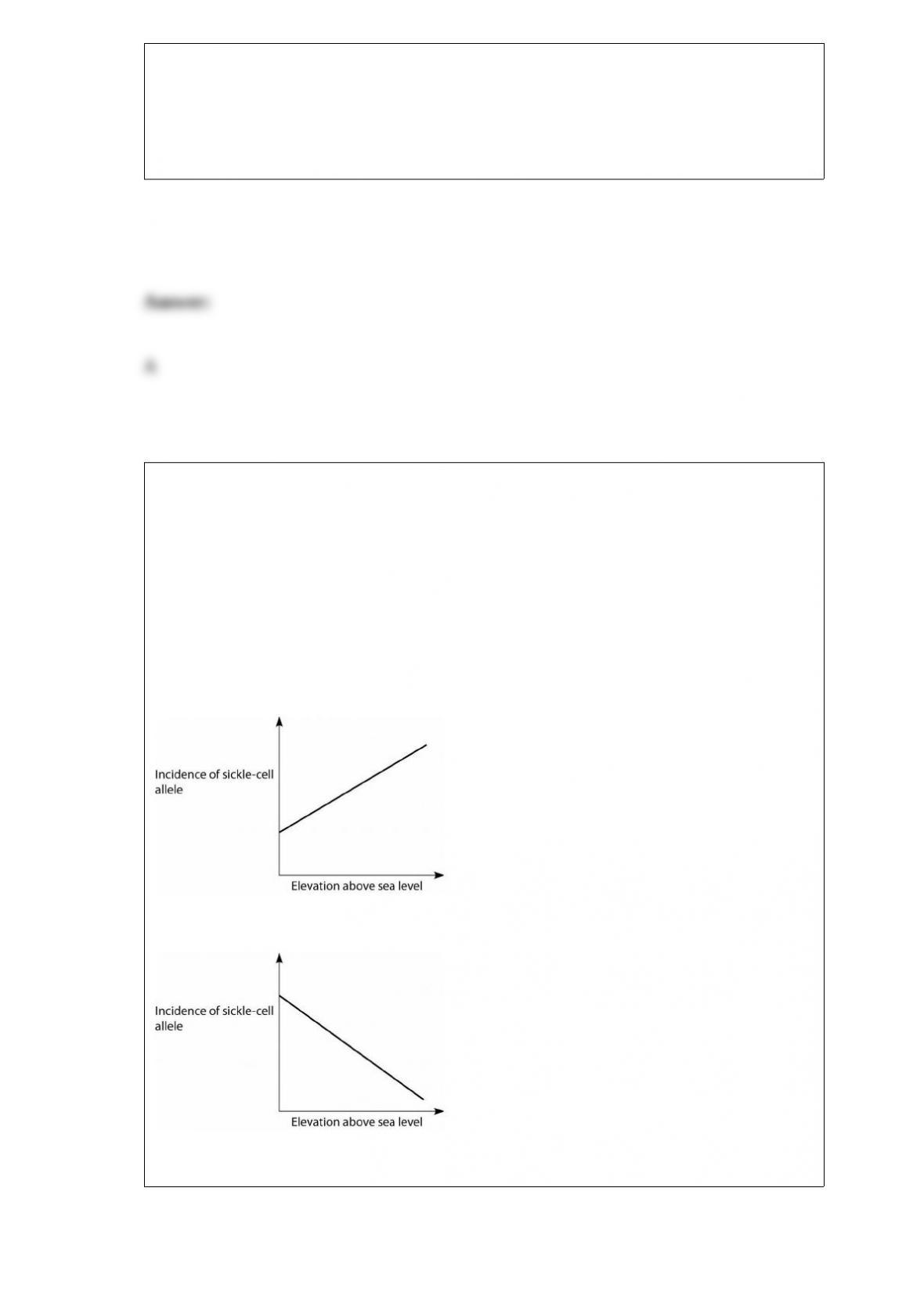
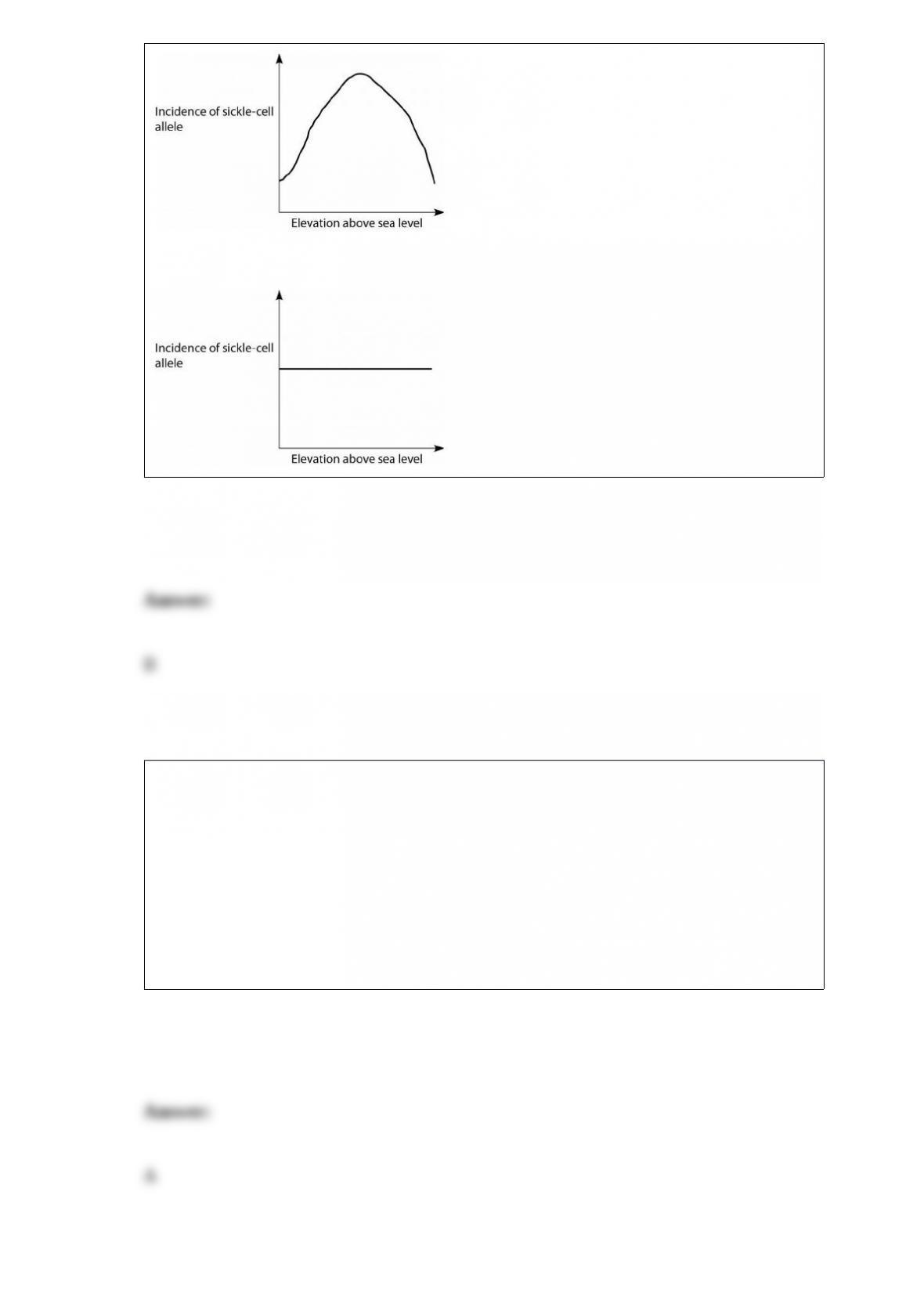
Anopheles mosquitoes, which carry the malaria parasite, cannot live above elevations
of 5900 feet. In addition, oxygen availability decreases with higher altitude. Consider a
hypothetical human population that is adapted to life on the slopes of Mt. Kilimanjaro
in Tanzania, a country in equatorial Africa. Mt. Kilimanjaro’s base is about 2600 feet
above sea level and its peak is 19,341 feet above sea level. If the incidence of the
sickle-cell allele in the population is plotted against altitude (feet above sea level),
which of the following distributions is most likely, assuming little migration of people
up or down the mountain?
A)
B)
C)
D)
Which of the following cell types retains the ability to undergo cell division?
A) a parenchyma cell near the root tip
B) a functional sieve tube element
C) a tracheid
D) a stem fiber

Which of the following observations about flagella is true and is consistent with the
scientific conclusion that the flagella from protists and bacteria evolved independently?
A) The flagella of both protists and bacteria are made of the same protein, but the
configuration is different.
B) The mechanics of movement and protein structure are the same in these flagella, but
there are significant genetic differences.
C) Although the mechanism of movement in both flagella is the same, the protein that
accomplishes the movement is different.
D) The protein structure and the mechanism of movement in protist flagella are
different from those of bacteria flagella.
Which statement about human reproduction is correct?
A) Fertilization occurs in the uterus.
B) In humans, spermatogenesis and oogenesis function best at normal, core body
temperatures.
C) A human oocyte completes meiosis after a sperm penetrates it.
D) The earliest stages of spermatogenesis occur closest to the lumen of the seminiferous
tubules.

Upon closer inspection of the leaves of “flower of stone,” one can observe tiny,
cone-like structures. Each cone-like structure emits spores of two different sizes.
Further investigation also reveals that the roots of “flower of stone” branch only at the
growing tip of the root, forming a Y-shaped structure. Consequently, “flower of
stone’should be expected to possess which other characteristics?
1. a gametophyte generation that is dominant
2. lignified vascular tissues
3. microphylls
4. filamentous rhizoids, but not true roots
5. spores that are diploid when mature
A) 1 and 2
B) 1 and 5
C) 2 and 3
D) 3, 4, and 5
The following experiment is used for the corresponding question(s).
A researcher discovered a species of moth that lays its eggs on oak trees. Eggs are laid
at two distinct times of the year: early in spring when the oak trees are flowering and in
midsummer when flowering is past. Caterpillars from eggs that hatch in spring feed on
oak flowers and look like oak flowers. But caterpillars that hatch in summer feed on
oak leaves and look like oak twigs.
How does the same population of moths produce such different-looking caterpillars on
the same trees? To answer this question, the biologist caught many female moths from
the same population and collected their eggs. He put at least one egg from each female
into eight identical cups. The eggs hatched, and at least two larvae from each female
were maintained in one of the four temperature and light conditions listed below.

In each of the four environments, one of the caterpillars was fed oak flowers, the other
oak leaves. Thus, there were a total of eight treatment groups (4 environments x 2
diets).
Refer to the accompanying figure. Recall that eggs from the same female were exposed
to each of the eight treatments used. This aspect of the experimental design tested
which of the following hypotheses?
A) The longer day lengths of summer trigger the development of twig-like caterpillars.
B) Differences in air pressure, due to elevation, trigger the development of different
types of caterpillars.
C) Differences in diet trigger the development of different types of caterpillars.
D) The differences are genetic. A female will either produce all flowerlike caterpillars
or all twig-like caterpillars.
In autotrophic bacteria, where is chlorophyll located?
A) in chloroplast membranes
B) in the ribosomes
C) in the nucleoid
D) in the infolded plasma membrane

To recycle nutrients, an ecosystem must have, at a minimum, _____.
A) producers
B) producers and decomposers
C) producers, primary consumers, and decomposers
D) producers, primary consumers, secondary consumers, and decomposers
The Brazil nut tree, Bertholletia excels (n = 17), is native to tropical rain forests of
South America. It is a hardwood tree that can grow to over 50 meters tall, is a source of
high-quality lumber, and is a favorite nesting site for harpy eagles. As the rainy season
ends, tough-walled fruits, each containing 8-25 seeds (Brazil nuts), fall to the forest
floor. Brazil nuts are composed primarily of endosperm. About $50 million worth of
nuts are harvested each year. Scientists have discovered that the pale yellow flowers of
Brazil nut trees cannot fertilize themselves and admit only female orchid bees as
pollinators. The agouti (Dasyprocta spp.), a cat-sized rodent, is the only animal with
teeth strong enough to crack the hard wall of Brazil nut fruits. It typically eats some of
the seeds, buries others, and leaves still others inside the fruit, which moisture can now
enter. The uneaten seeds may subsequently germinate.
The agouti is most directly involved with the Brazil nut tree’s dispersal of _____.
A) female gametophytes
B) sporophyte embryos
C) sporophyte megaspores

D) female gametes
Pseudohypertrophic muscular dystrophy is a human disorder that causes gradual
deterioration of the muscles. Only boys are affected, and they are always born to
phenotypically normal parents. Due to the severity of the disease, the boys die in their
teens. Is this disorder likely to be caused by a dominant or recessive allele? Is its
inheritance sex-linked or autosomal?
A) dominant, sex-linked
B) recessive, autosomal
C) recessive, sex-linked
D) incomplete dominant, sex-linked
You are given the task of designing an aerobic, mixotrophic protist that can perform
photosynthesis in fairly deep water (for example, 250 meters deep) and can also crawl
about and engulf small particles. With which two of the following structures would you
provide your protist?
1. hydrogenosome
2. apicoplast
3. pseudopods

4. chloroplast from red alga
5. chloroplast from green alga
A) 1 and 2
B) 2 and 3
C) 3 and 4
D) 4 and 5
When ATP releases some energy, it also releases inorganic phosphate. What happens to
the inorganic phosphate in the cell?
A) It is secreted as waste.
B) It is used only to regenerate more ATP.
C) It may be used to form a phosphorylated intermediate.
D) It enters the nucleus and affects gene expression.
Plant growth regulators _____.
A) only act by altering gene expression
B) often have a multiplicity of effects
C) function independently of other hormones
D) affect the division and elongation, but not the differentiation, of cells
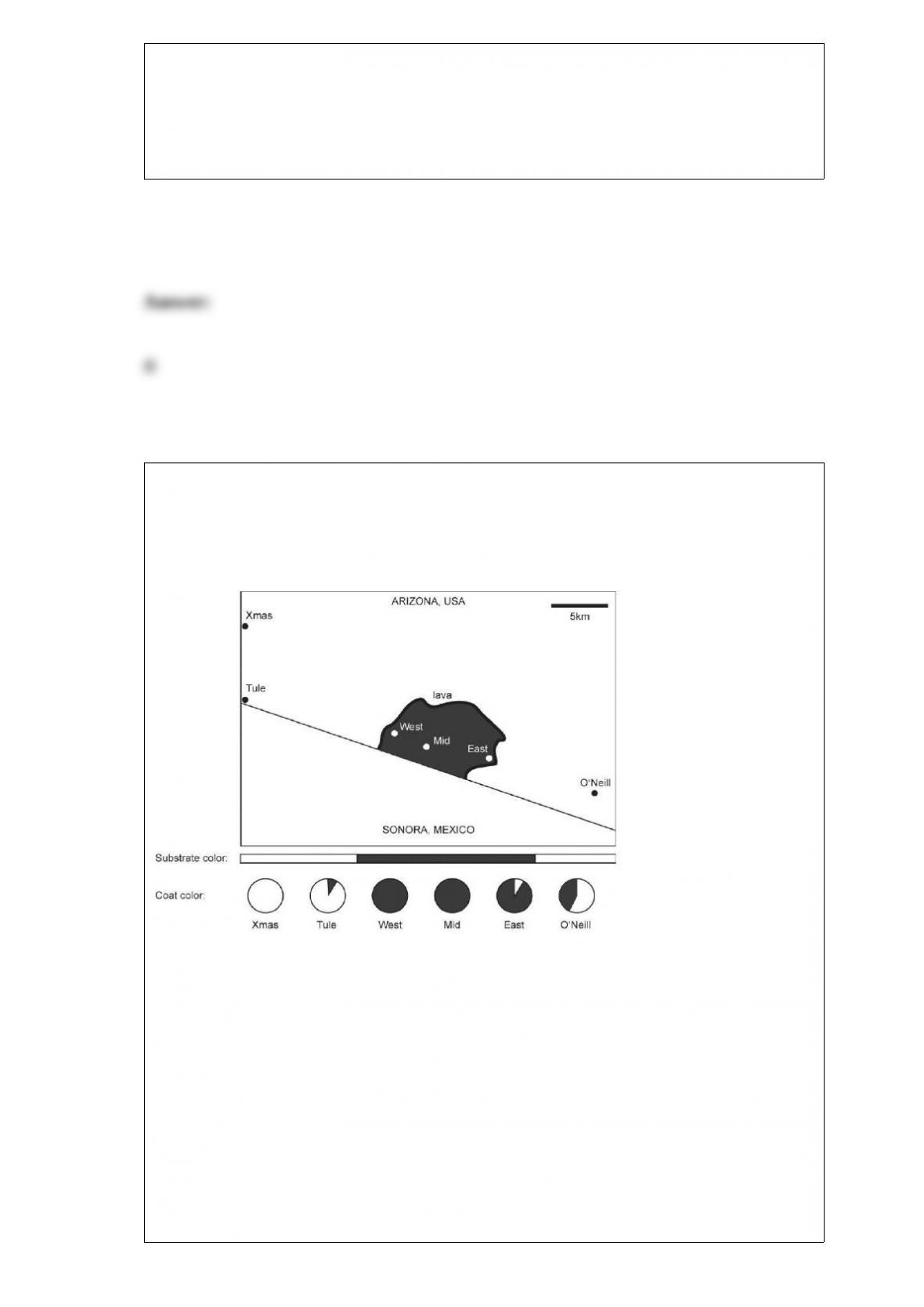
The following question(s) are based on information in Hopi E. Hoekstra, Kristen E.
Drumm, and Michael W. Nachman, “Ecological Genetics of Adaptive Color
Polymorphism in Pocket Mice: Geographic Variation in Selected and Neutral Genes,”
Evolution 58(6), 2004: 1329-41.
Refer to the figure above. In their investigation of natural selection on Mc1r alleles (the
gene that determines coat color) in Arizona pocket mice, Hoekstra et al. determined the
frequency of the D and d alleles in each population. They also determined the frequency
of alleles for two neutral mitochondrial DNA genes (genes that do not affect and are not
linked to coat color). Why did the researchers include the mitochondrial DNA genes as
part of their experimental design?
A) Allele change for the neutral mitochondrial genes serves as an experimental group
and gives information on any general background genetic difference among these
populations.
B) Allele change for the neutral mitochondrial genes serves as a control and determines

coat-color differences among these populations.
C) Allele change for the neutral mitochondrial genes serves as an experimental group
and gives information on coat-color differences among these populations.
D) Allele change for the neutral mitochondrial genes serves as a control and gives
information on any general background genetic difference among these populations.
On the Bahamian island of Andros, mosquitofish populations live in various,
now-isolated, freshwater ponds that were once united. Currently, some predator-rich
ponds have mosquitofish that can swim in short, fast bursts; other predator-poor ponds
have mosquitofish that can swim continuously for a long time. When placed together in
the same body of water, the two kinds of female mosquitofish exhibit exclusive
breeding preferences.
Which two of the following have operated to increase divergence between mosquitofish
populations on Andros?
1. improved gene flow
2. bottleneck effect
3. sexual selection
4. founder effect
5. natural selection
A) 1 and 3
B) 2 and 3
C) 2 and 4
D) 3 and 5

The Brazil nut tree, Bertholletia excels (n = 17), is native to tropical rain forests of
South America. It is a hardwood tree that can grow to over 50 meters tall, is a source of
high-quality lumber, and is a favorite nesting site for harpy eagles. As the rainy season
ends, tough-walled fruits, each containing 8-25 seeds (Brazil nuts), fall to the forest
floor. Brazil nuts are composed primarily of endosperm. About $50 million worth of
nuts are harvested each year. Scientists have discovered that the pale yellow flowers of
Brazil nut trees cannot fertilize themselves and admit only female orchid bees as
pollinators. The agouti (Dasyprocta spp.), a cat-sized rodent, is the only animal with
teeth strong enough to crack the hard wall of Brazil nut fruits. It typically eats some of
the seeds, buries others, and leaves still others inside the fruit, which moisture can now
enter. The uneaten seeds may subsequently germinate.
The same bees that pollinate the flowers of the Brazil nut trees also pollinate orchids,
which are epiphytes (in other words, plants that grow on other plants); however, orchids
cannot grow on Brazil nut trees. These observations explain _____.
A) the coevolution of Brazil nut trees and orchids
B) why Brazil nut trees do not set fruit in monoculture plantations
C) why male orchid bees do not pollinate Brazil nut tree flowers
D) why male orchid bees are smaller than female orchid bees
Rank the following one-base point mutations (from most likely to least likely) with
respect to their likelihood of affecting the structure of the corresponding polypeptide.
1. insertion mutation deep within an intron
2. substitution mutation at the third position of an exonic codon
3. substitution mutation at the second position of an exonic codon

4. deletion mutation within the first exon of the gene
A) 1, 2, 3, 4
B) 4, 3, 2, 1
C) 2, 1, 4, 3
D) 3, 1, 4, 2
A researcher is trying to construct a molecular-based phylogeny of the entire animal
kingdom. Assuming that none of the following genes is absolutely conserved, which of
the following would be the best choice on which to base the phylogeny?
A) genes involved in chitin synthesis
B) collagen genes
C) β-catenin genes
D) genes involved in eye-lens synthesis
During a one-year study, researchers found no difference in treehopper populations in
any of their control and experimental groups. What could they measure during the
second year to gain information about why this might have occurred?

A) Measure the number of ant females.
B) Measure the relative sizes of the treehoppers.
C) Measure the relative abundance of jumping spiders.
D) Measure the relative sizes of different ant species.
Why do moderate levels of disturbance result in an increase in community diversity?
A) Habitats are opened up for less competitive species.
B) Competitively dominant species infrequently exclude less competitive species after a
moderate disturbance.
C) The resulting uniform habitat supports stability, which in turn supports diversity.
D) Less-competitive species evolve strategies to compete with dominant species.
According to our current knowledge of plant evolution, which group of organisms
should feature cell division most similar to that of land plants?
A) unicellular green algae
B) cyanobacteria
C) charophytes
D) red algae
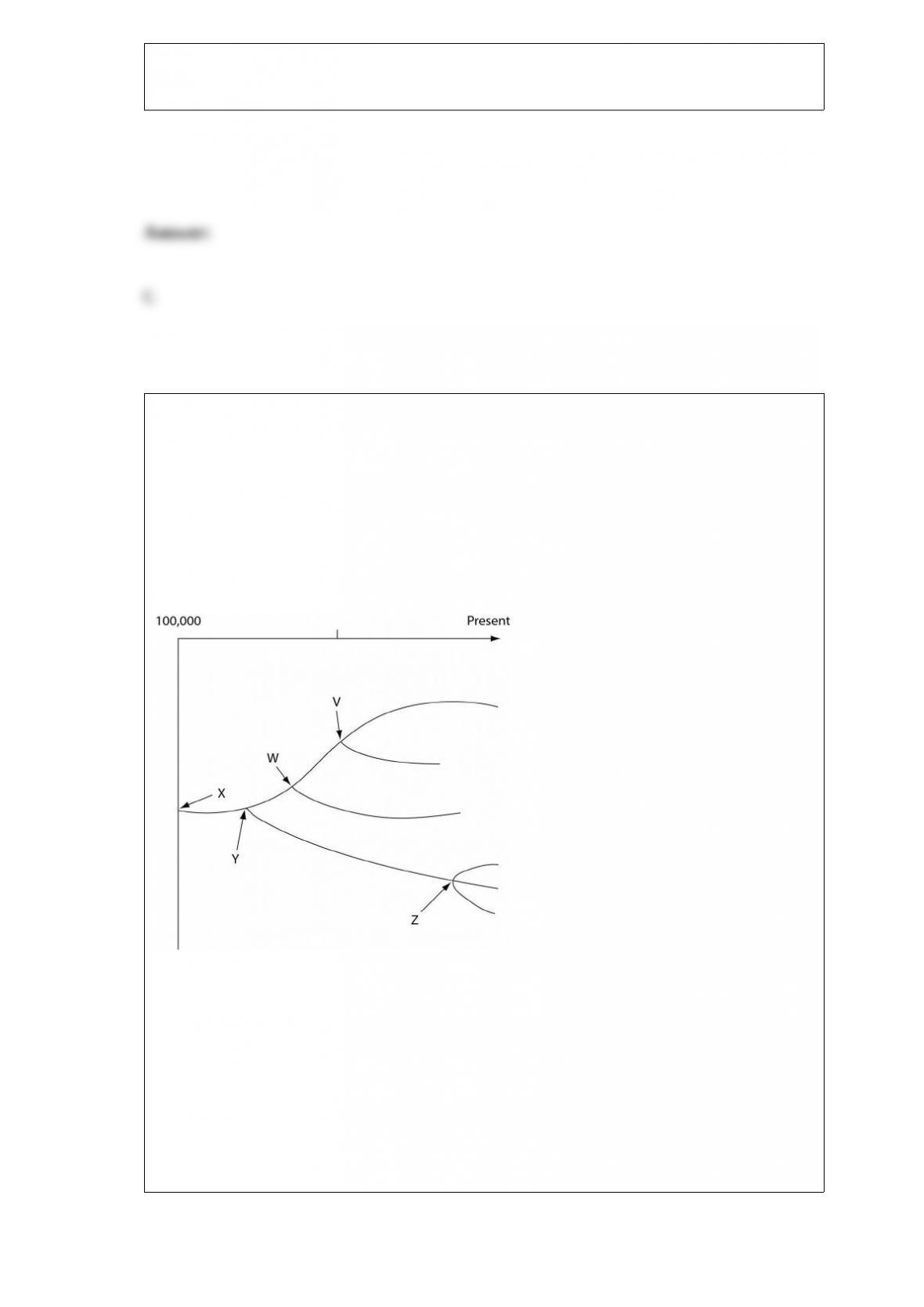
The following questions refer to the evolutionary tree in the figure below.
The horizontal axis of the cladogram depicted below is a timeline that extends from
100,000 years ago to the present; the vertical axis represents nothing in particular. The
labeled branch points on the tree (V-Z) represent various common ancestors. Let’s say
that only since 50,000 years ago has there been enough variation between the lineages
depicted here to separate them into distinct species, and only the tips of the lineages on
this tree represent distinct species.
How many distinct species, both living and extinct, are depicted in this tree?
A) five
B) six
C) nine
D) eleven

Which of the following are maternal effect genes that control the orientation of the egg
and thus the Drosophila embryo?
A) homeotic genes
B) segmentation genes
C) egg-polarity genes
D) morphogens
Which of the following is the strongest evidence that protein structure and function are
correlated?
A) Proteins function best at certain temperatures.
B) Proteins have four distinct levels of structure and many functions.
C) Enzymes tend to be globular in shape.
D) Denatured (unfolded) proteins do not function normally.

Which of the following characteristics evolved independently in mammals and birds?
A) amniotic eggs
B) jaws
C) bone
D) endothermy
Motor proteins require which of the following to function in the movement of
chromosomes toward the poles of the mitotic spindle?
A) intact centromeres
B) a microtubule-organizing center
C) ATP as an energy source
D) synthesis of cohesin
A moth preparing for flight on a cold morning may warm its flight muscles via _____.
A) acclimatization

B) torpor
C) evaporative cooling
D) shivering thermogenesis
With what other idea of his time was Cuvier’s theory of catastrophism most in conflict?
A) the scala naturae
B) the fixity of species
C) island biogeography
D) uniformitarianism
Dog breeders maintain the purity of breeds by keeping dogs of different breeds apart
when they are fertile. This kind of isolation is most similar to which of the following
reproductive isolating mechanisms?
A) temporal isolation
B) behavioral isolation
C) habitat isolation
D) gametic isolation

Sexual reproduction in eukaryotes increases genetic variation. In prokaryotes,
transformation, transduction, and conjugation are mechanisms that increase genetic
variation. A fundamental difference between the generations of genetic variation in the
two domains is:
A) Eukaryotes are able to generate mutations in response to environmental stress while
prokaryotes only generate random variation.
B) Eukaryotic variation occurs primarily within a single generation while prokaryotic
variation occurs over many generations.
C) Crossing over is a major mechanism in creating genetic variation in prokaryotes
while independent assortment is a major mechanism is eukaryotes.
D) Eukaryotic genetic variation occurs with vertical gene transfer while prokaryotic
genetic variation occurs with horizontal gene transfer.
Use the following diagram to answer the question(s) below.
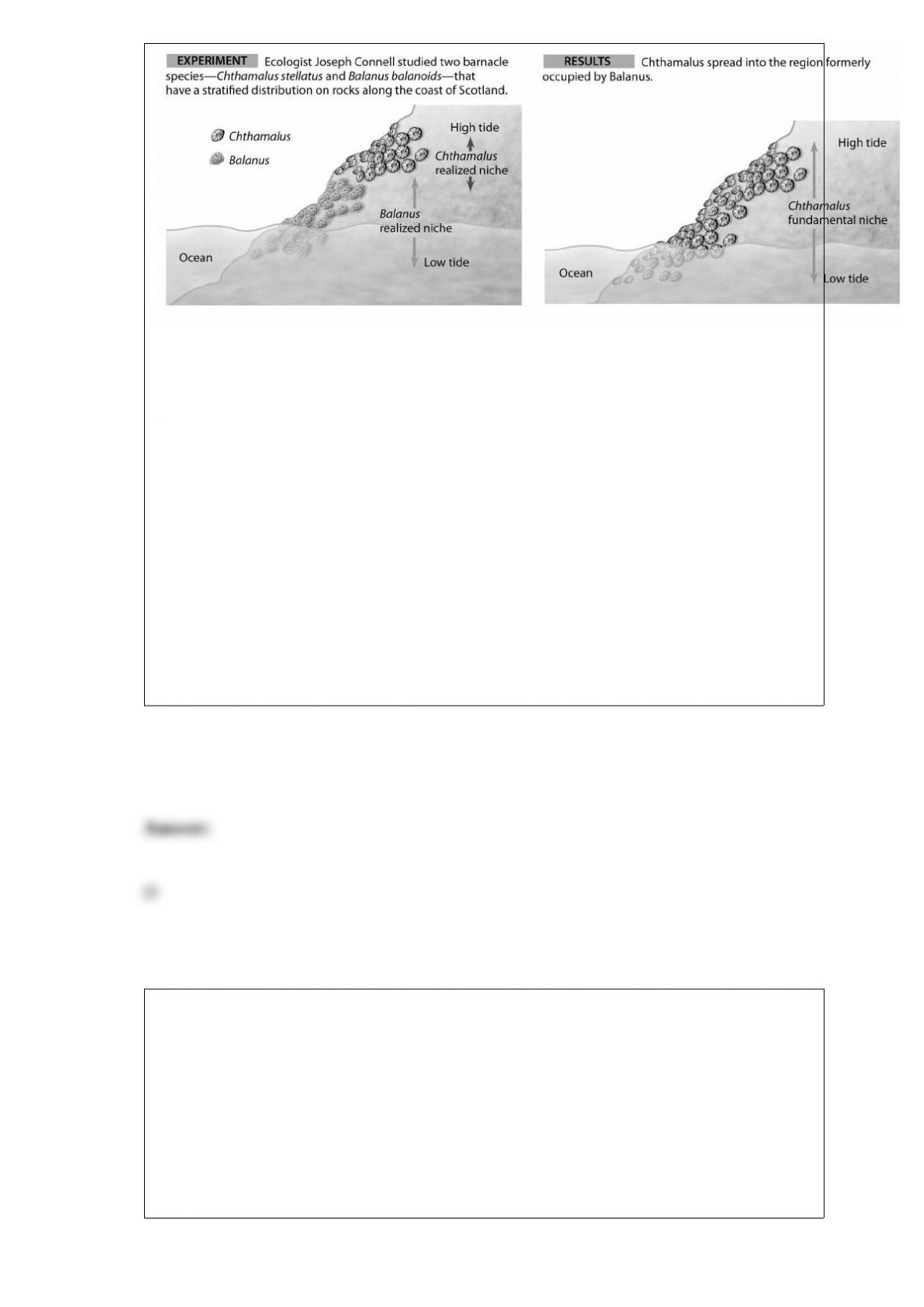
In this experiment, Balanus was removed from the habitat shown on the left.
Which of the following statements is a valid conclusion of this experiment?
A) Balanus can survive only in the lower intertidal zone because it is unable to resist
desiccation.
B) Balanus is inferior to Chthamalus in competing for space on rocks lower in the
intertidal zone.
C) The two species of barnacles do not compete with each other because they feed at
different times of day.
D) The removal of Balanus shows that the realized niche of Chthamalus is smaller than
its fundamental niche.
What component of amino acid structure varies among different amino acids?
A) the long carbon-hydrogen tails of the molecule
B) the presence of a central C atom
C) the components of the R-group
D) the glycerol molecule that forms the backbone of the amino acid