
A pathologist who wants to examine a patient’s liver cells to determine if the
mitochondria have an internal structural defect will likely need to use a
A) light microscope.
B) transmission electron microscope.
C) scanning electron microscope.
D) chromatin stain.
Which of the following statements about cellular metabolism is false?
A) Cellular metabolism includes different processes that require different conditions.
B) Cellular metabolism can occur within organelles.
C) Cellular metabolism occurs in animal but not plant cells.
D) Cellular metabolism often occurs on the surfaces of internal membranes.
Which of the following statements concerning the role of redox reactions in
photosynthesis and cellular respiration is true?
A) Photosynthesis involves only reductions, whereas respiration involves only
oxidations.

B) Photosynthesis involves only oxidations, whereas respiration involves only
reductions.
C) In photosynthesis, carbon dioxide is oxidized to form sugar, whereas in respiration,
sugar is reduced to form carbon dioxide.
D) In photosynthesis, carbon dioxide is reduced to form sugar, whereas in respiration,
sugar is oxidized to form carbon dioxide.
Which of the following represents the male gametophyte of a conifer?
A) pollen grain
B) sperm
C) pollen cone
D) tree
What part of the brain sorts incoming information, such as touch signals from your
hand, into categories before relaying it to the cerebral cortex?
A) thalamus
B) hypothalamus
C) pons

D) hippocampus
The vertebrate kidney helps to keep the acidity of body fluids constant by varying the
amount of hydrogen ions (H+) it secretes into the urine. You can confidently predict that
this aspect of kidney function will be controlled by
A) a positive feedback mechanism.
B) a negative feedback mechanism.
C) nerve impulses from the brain.
D) a hormone produced in the kidney itself.
Bronchitis can be easily acquired by individuals with immunodeficiency disorders. In
these situations, bronchitis is an example of
A) a virus.
B) an opportunistic infection.
C) adaptive immunity.
D) an autoimmune disorder.

Oxytocin is a hormone produced by the posterior pituitary gland that causes female
uterine muscles to contract during childbirth and female mammary glands to eject milk
during nursing. Oxytocin also occurs naturally in males and is involved in movement of
sperm and production of testosterone. It has been given the common name of “the love
hormone” because oxytocin is linked to human behaviors including sexual arousal and
trust.
In 2012, The Atlantic (a popular news source) published a brief online news summary
that explained that when scientists in Germany gave men who were in a monogamous
relationship with a woman a nasal spray containing oxytocin, the men were less
attracted to an attractive female stranger than men who were given a nasal spray with
no oxytocin. While The Atlantic provided a link to the original scientific study, they
drew conclusions and stated implications of it that included the following:
1. In men, oxytocin promotes monogamous relationships because it keeps them from
communicating with women who are attractive to them.
2. If a man is unable to obtain a nasal spray with oxytocin, there are other means by
which oxytocin release can be stimulated during a monogamous relationship: sexual
intercourse, hand-holding, and touching.
Biologically, why might oxytocin have the nickname “the love hormone?”
A) because it has a role in reproductive behavior of males only
B) because it has a role in reproductive behavior of females only
C) because it has a role in reproductive behavior of both males and females
D) because it has a role in androgen development

Human DNA and chimpanzee DNA
A) differ by about 1%.
B) differ by about 3%.
C) differ by more than 10%.
D) differ by the same amount that human DNA differs from orangutan DNA.
Crop plants can have higher densities of stomata on the underside of their leaves than
on the surfaces of their leaves. Some scientists hypothesize that that the evolution of
this adaptation enhanced the ability of these plants to regulate the rate of CO2 uptake
for each surface.
Suppose you wanted to test this hypothesis using sunflower plants. Which of the
following would be the best procedure regarding the groups you use in your
experiment?
A) Choose two equal-size groups of sunflower plants. One would be the experimental
group and one would be the control group.
B) Choose equal-size groups of sunflower plants and zinnia plants. The sunflower
plants would be the experimental group and the zinnia plants would be the control
group.
C) Choose two groups of sunflower plants. The experimental group would have twice
as many plants as the control group.
D) Choose two groups of sunflower plants. The experimental group would have half as
many plants as the control group.

A tennis player serving the ball uses fast muscle fibers. The ATP needed to accomplish
this comes from
A) anaerobic fermentation.
B) aerobic respiration.
C) conversion of lactic acid to ATP.
D) conversion of Ca2+ to ATP.
A seed develops from a(n)
A) pollen grain.
B) fruit.
C) ovary.
D) ovule.
Which of the following cell structures are associated with the breakdown of harmful
substances?
A) chloroplasts
B) mitochondria
C) peroxisomes
D) centrioles
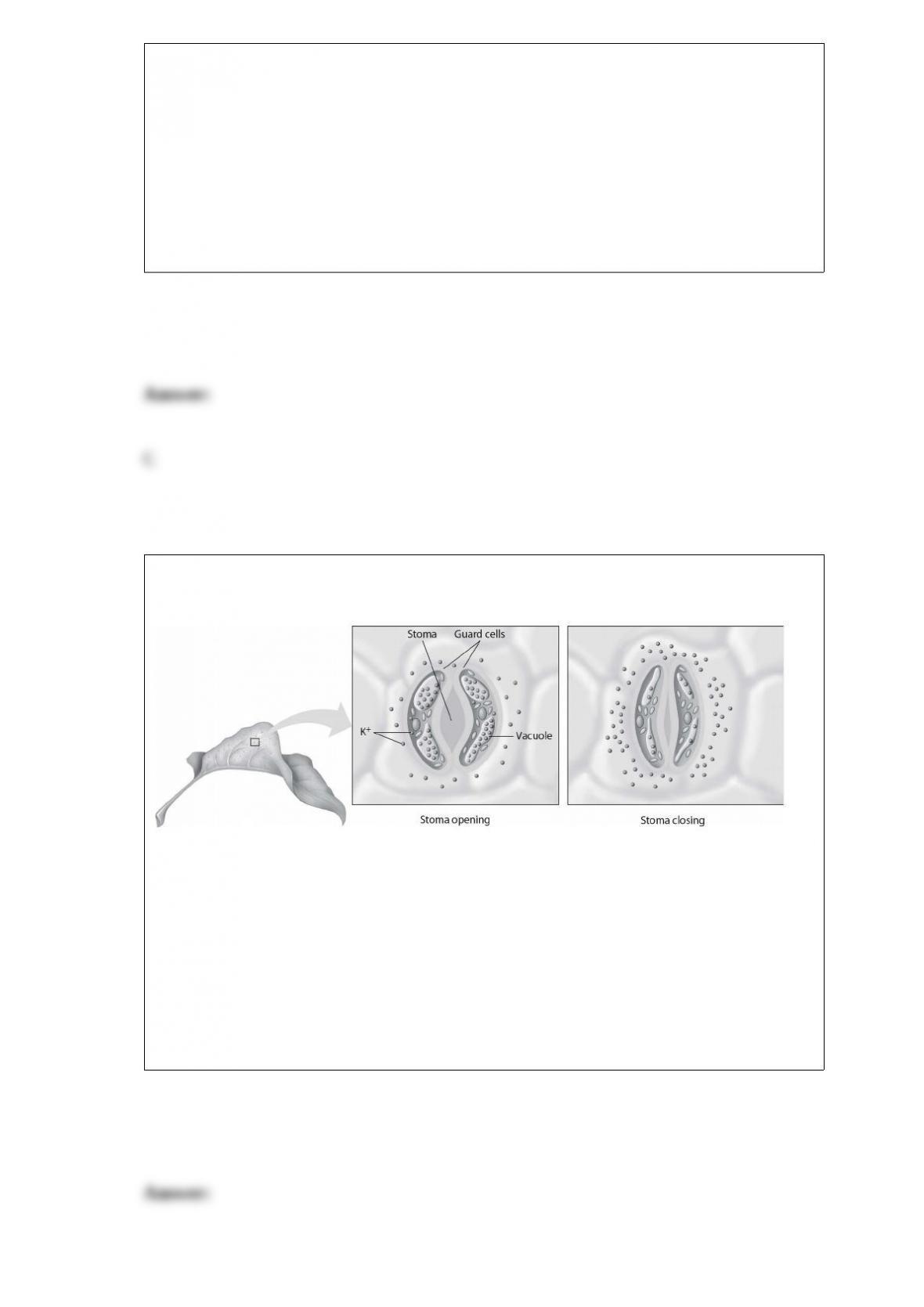
What is true of the guard cells shown in the right-hand panel of this figure?
A) Their turgor pressure is increasing.
B) Potassium (K) is entering these cells.
C) These cells are hypertonic to their immediate surroundings.
D) These cells are hypotonic to their immediate surroundings.

To repair and heal a broken bone, physicians will
A) graft new bone to the region.
B) exercise the area of the broken bone.
C) prescribe a regime of bed rest and calcium supplements.
D) return the broken bone parts to their natural position and then immobilize them.
Put the following steps of the Calvin cycle in the correct order:
1. Carbon fixation
2. Regeneration of RuBP
3. Release of G3P
4. Reduction
A) 1, 2, 3, 4
B) 1, 3, 4, 2
C) 1, 4, 3, 2
D) 4, 1, 2, 3

Although birds and mammals descended from different ancestors, they both have a
four-chambered heart. This is the result of
A) the simplification of the cardiovascular system.
B) the necessity for rapid movement of blood.
C) convergent evolution.
D) genetic aberrations that resulted from mistakes in somatic cell division.
The genetic material is duplicated during
A) the mitotic phase.
B) G1.
C) the S phase.
D) G2.
Which part of the body is likely to be much more diverse in mammals compared to that

in other groups?
A) the teeth
B) the structure of the vertebrae
C) the structure of the limbs
D) the jawbone
Which of the following organisms was the first to introduce oxygen into Earth’s
atmosphere?
A) cyanobacteria
B) early protozoans
C) plants
D) green algae
Which of the following statements about archaea is false?
A) Some archaea have mitochondria like those of eukaryotic cells.
B) Archaea are abundant in the oceans.

C) Some archaea are adapted to extreme environments such as extremely salty or
extremely hot habitats.
D) Some archaea live in the digestive tracts of cattle.
Proteins cannot be denatured by
A) heat.
B) changes in pH.
C) changes in salt concentration.
D) freezing.
Which of the following terms refers to a situation where a single phenotypic character
is determined by the additive effects of two or more genes?
A) incomplete dominance
B) codominance
C) pleiotropy
D) polygenic inheritance

The network of neurons that extends through the core of the brainstem and selects
information that reaches the cerebral cortex during sleep is the
A) medulla.
B) limbic system.
C) reticular formation.
D) brainstem core.
In the water relations of vascular plants, the cohesive property of water is most
important in the
A) epidermis.
B) xylem.
C) internal air spaces.
D) stomata.

An antibiotic kills 99.9% of a bacterial population. You would expect the next
generation of bacteria
A) to be just as susceptible to that antibiotic as was the previous generation.
B) to be more resistant to that antibiotic.
C) to die out due to the drastic decrease in population size.
D) to be more contagious than the prior generation.
Which of the following assumptions or observations is not part of Darwin’s idea of
natural selection?
A) Whether an organism survives and reproduces is almost entirely a matter of random
chance.
B) Heritable traits that promote successful reproduction should gradually become more
common in a population.
C) Populations produce more offspring than their environment can support.
D) Organisms compete for limited resources.
Chaparral vegetation occurs around much of the central valley of central and southern

California. This biome is very similar to that found
A) in the Australian interior.
B) in the Mediterranean region.
C) on the southeast coast of the United States.
D) in central Asia.
In 1942 a scientist testing part of a radar system discovered that a candy bar in his
pocket had melted. Intrigued, he tried placing an egg near the system he was working
on; it exploded and splattered him with hot egg. In this way it was discovered that part
of the radar system could be used to cook foods, which led to the development of the
microwave oven. When this kind of repurposing occurs in biological systems, it is
called
A) paedomorphosis.
B) mutation.
C) exaptation.
D) adaptive radiation.
Rod-shaped bacteria are called

A) cocci.
B) bacilli.
C) spirochetes.
D) vibrios.
Which of the following is a function of fruits?
A) production of food for the developing embryo
B) pollen dispersal
C) seed dispersal
D) attracting pollinators
In 1865, a biologist, St. George Jackson Mivart, constructed an evolutionary tree of
existing primate species with many branches based on analysis of spinal columns. But
to his dismay, another tree based on limb comparison was quite different. Which of the
following analyses would be best to include today to determine which tree is more
accurate?
A) comparison of genes that control development
B) comparison of eyes of primates

C) comparison of DNA sequences of primates
D) examination of evolutionary trees constructed by others.
Which of the following structures is most like an exoskeleton?
A) the wood frame of a house
B) a water balloon
C) a suit of armor
D) the hair covering the surface of a bear
During an experiment assessing the development of a fly embryo, a scientist artificially
turns on a homeotic gene that controls eye development in somatic cells that develop
into the wings. Which of the following is the most likely outcome of this experiment?
A) A normal adult fly will develop.
B) A mutant adult fly will develop that has eyes on its wings.
C) A mutant adult fly will develop that has legs on its head.
D) A mutant adult fly will develop that has no eyes on its head but has eyes on its
wings.