
1) which of the following structures is a stem adaptation instead of a root adaptation?
a. stolons
b. rhizomes
c. tubers
d. corms
e. all are stem adaptations
2) a person working in a rice paddy in asia becomes infected with the liver fluke by
a. eating infected snails.
b. drinking water contaminated with eggs.
c. eating infected fish that was undercooked or raw.
d. swimming or wading in infected water, where the cercariae enter the skin.
3) what was darwin’s main purpose during his time aboard the h.m.s. beagle?
a. to serve as the ships naturalist.
b. to develop evidence that could be used to support the theory of evolution.
c. to document evidence that would support the concept of natural selection.
d. darwin was a simple sailor with not specific purpose aboard the h.m.s. beagle.
correct
4) uncommonly large feet, hands, chin, nose, and eyebrow ridges on a normal-sized
body are characteristic of the condition ______, that is caused by ______.
a. cushing’s syndrome; adrenal cortex hormones
b. addison’s disease; atrial natriuretic hormone
c. gigantism; overproduction of growth hormone in children
d. pituitary dwarfism; hyposecretion of growth hormone in children
e. acromegaly; overproduction of growth hormone in adults
5) the deposits of chalky fossils that built the white cliffs of dover were formed by
a. amoebozoans.

b. rhizarians.
c. excavates.
d. opisthokonts.
e. chromalveolates.
6) the purpose of therapeutic cloning is:
a. to produce an individual to the donor of the nucleus
b. to produce specialized tissue cells
c. to stimulate cells that have been arrested in the s phase
d. none of the above
7) it could be said that males are able to provide gametes with more genetic diversity
than females for reproduction. one main reason would be:
a. males provide more genes in sperm than females provide in eggs.
b. crossing over occurs more often in the formation of sperm than in eggs.
c. spermatogenesis in males results in four functional sperm while oogenesis in females
results in only one egg and three structures that contain genetic information that is lost
when they disintegrate.
d. sperm that contain a recombination of genes are usually more successful in fertilizing
an egg.
8) which of the following statements about extinction is true?
a. overexploitation by hunting and fishing is the major threat to tropical animals and
plants.
b. without human activity, all species would survive and there would be no extinctions.
c. endangered wild species often become extinct due to different combinations of
factors.
d. commercial hunting and fishing are careful not to deplete animal reserves.
e. introduction of new exotic species helps preserve biodiversity and slow extinction.
9) which endocrine gland is directly responsible for the secretion of the glucocorticoid
cortisol?

a. adrenal cortex
b. hypothalamus
c. adrenal medulla
d. anterior pituitary
e. thyroid gland
10) where in the human male does spermatogenesis occur?
a. ovaries
b. prostate gland
c. epididymus
d. testes
11) where on this phylogenetic tree of primate evolution do you find the first primates
to diverge from the common ancestor of the primates?
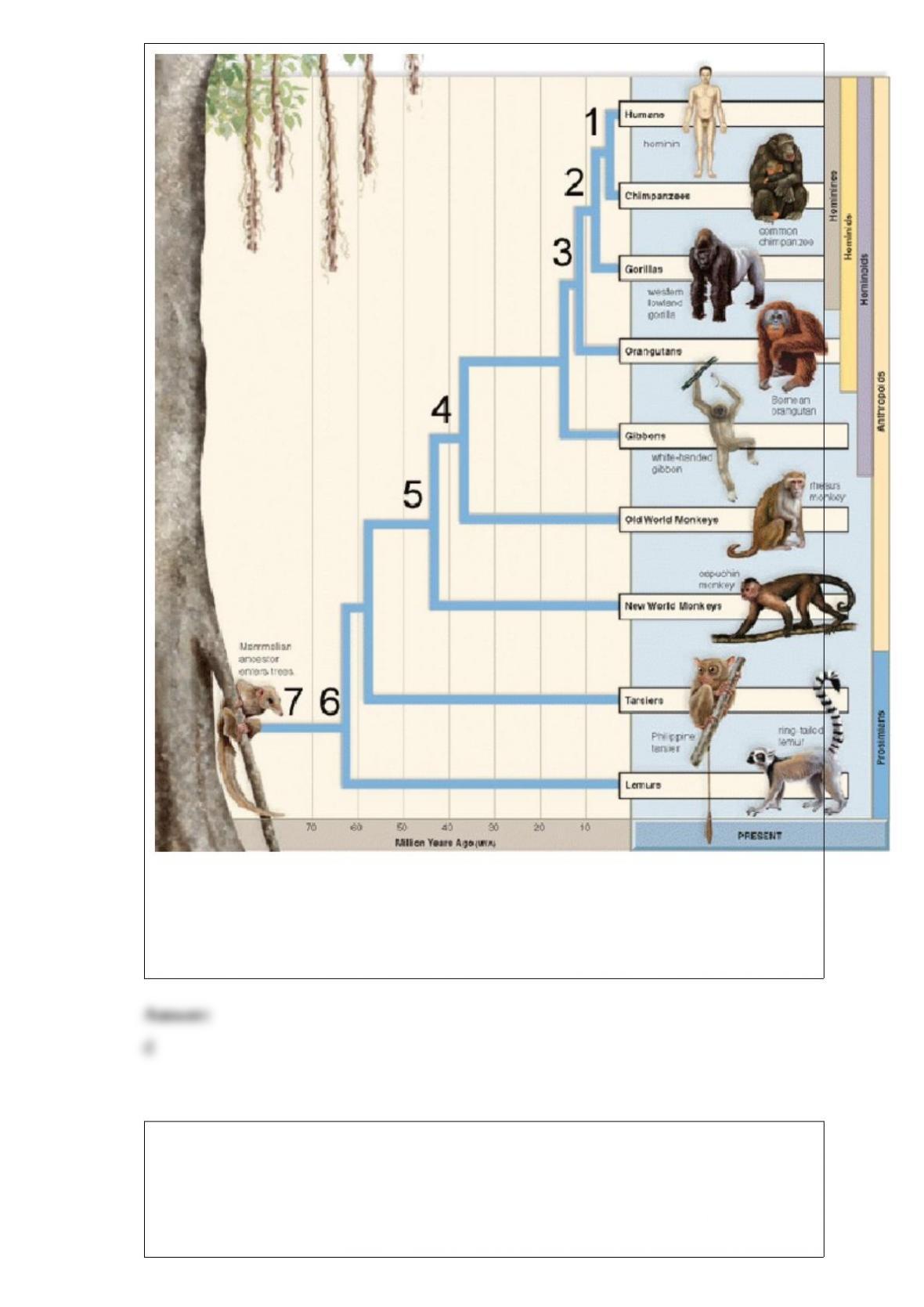
a. no. 1
b. no. 4
c. no. 5
d. no. 6
e. no. 7
12) which hypothesis is supported by the fact that stomates open when exposed to white
light, a mixture of all colors of light?
a. supports both hypothesis i and ii.
b. supports only hypothesis i.
c. supports only hypothesis ii.

d. supports neither hypothesis.
13) if a pea plant shows a recessive phenotype,
a. the genotype may be tt or tt.
b. the genotype may be tt or tt.
c. the genotype can only be tt.
d. the genotype can only be tt.
e. the genotype may be tt, tt, or tt.
14) anaphylactic shock
a. is characterized by a sudden and life-threatening drop in blood pressure.
b. occurs when the allergen has entered the bloodstream.
c. is an immediate allergic reaction.
d. all of the above are true.
e. none of these are true.