1)
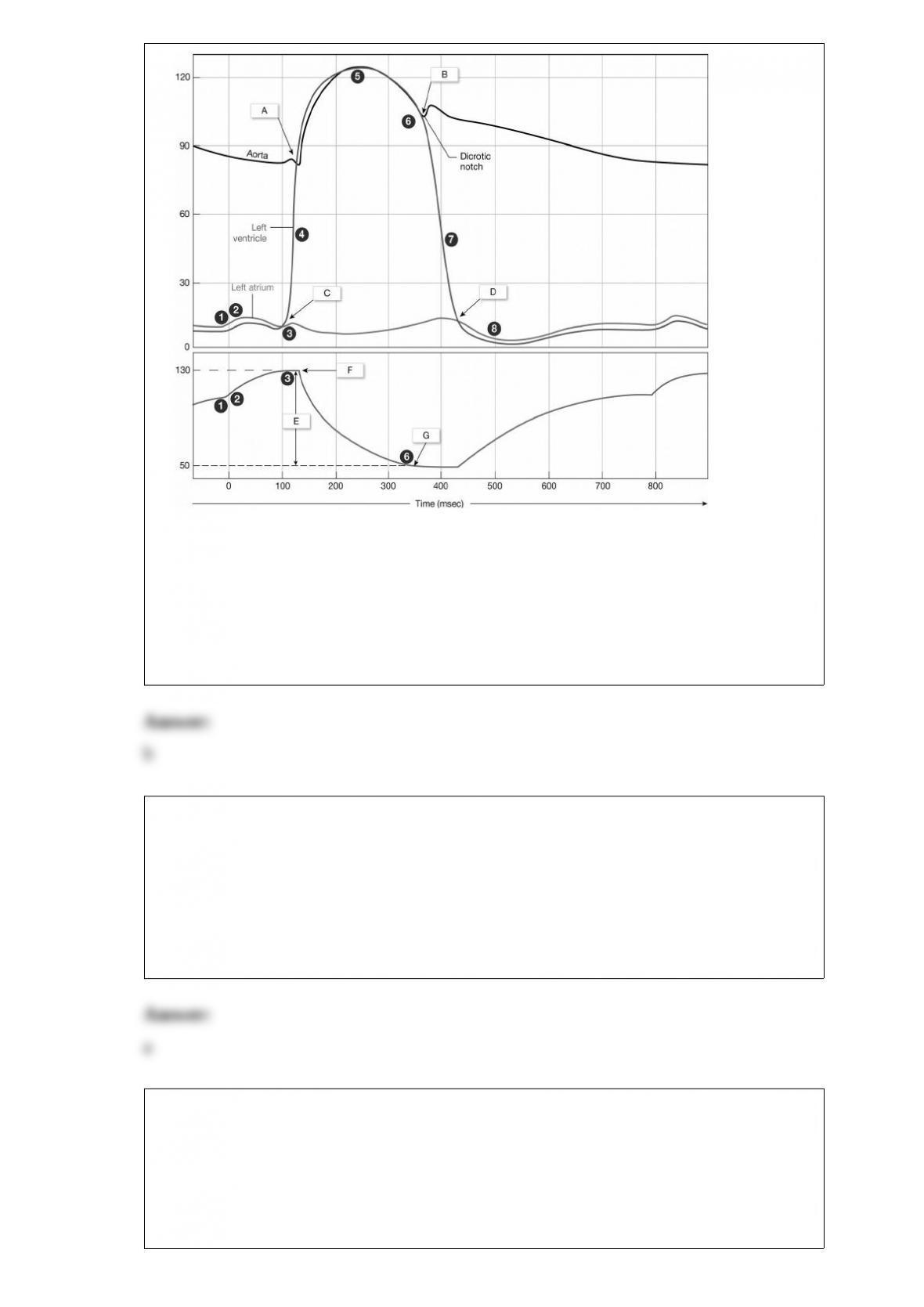
figure 20-2 cardiac cycle
what is occurring in the left atrium at the circle labeled “2” on the graph?
a) left atrium is pressurizing the left ventricle
b) left atrium is in systole
c) left atrial pressure is decreasing
d) left atrium is in diastole
e) left atrium is receiving pressure from the left ventricle
2) the vitamin that plays a role in maintaining epithelia and is required for the synthesis
of visual pigments is vitamin
a) a.
b) b.
c) c.
d) d.
e) e.
3) which of the following does not originate or insert on the hyoid bone?
a) digastric
b) geniohyoid
c) omohyoid
d) sternohyoid
e) sternothyroid

4) hallucinogenic drugs, such as lsd, function by
a) stimulating receptors for norepinephrine.
b) blocking acetylcholine receptors.
c) increasing the production of gaba.
d) stimulating serotonin receptors.
e) mimicking the action of dopamine.
5) plicae circulares are
a) ridges in the wall of the stomach.
b) circumferential folds in the mucosa and submucosa of the small intestine.
c) fingerlike projections on the surface of the mucosa of the small intestine.
d) sacculations in the colon.
e) abnormal structures formed by excessive pressure in the small intestine.
6) conversion of a short-term memory to a long-term memory is called
a) memory conversion.
b) anterograde amnesia.
c) memory programming.
d) memory consolidation.
e) memory engraving.
7) the average life span of a red blood cell is
a) 24 hours.
b) 1 month.
c) 4 months.
d) about 1 year.
e) many years.
8) each heme ring in hemoglobin encloses an atom of

a) magnesium.
b) calcium.
c) iron.
d) sodium.
e) copper.
9) the intervertebral disc joint is called a
a) synarthrosis.
b) glide joint.
c) condylar joint.
d) synchondrosis.
e) symphysis.
10) excess fluid in the ________ causes cardiac tamponade.
a) pericardial cavity
b) visceral pericardium
c) apex of heart
d) left ventricle
e) both atria
11)
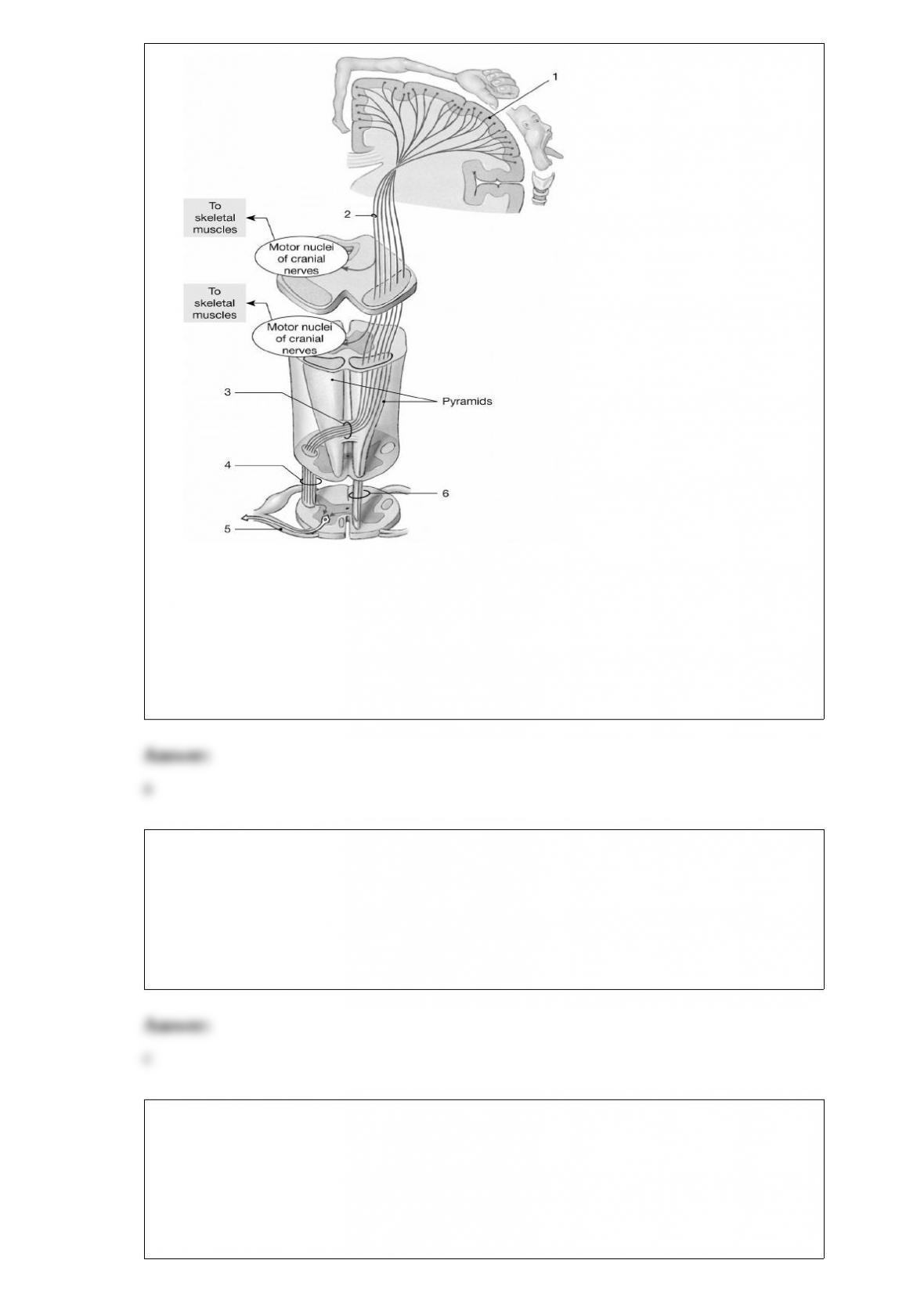
figure 15-2 the corticospinal pathway
identify the type of information that travels along the structure labeled “4”
a) motor commands to skeletal muscles
b) proprioception to the cerebral cortex
c) fine touch to the cerebral cortex
d) pain and crude touch sensations
e) visceral motor commands to smooth muscle
12) infection with the hiv virus occurs through
a) eating contaminated food.
b) airborne droplets from coughs and sneezes.
c) intimate contact with an infected person’s body fluids.
d) casual contact with an infected individual.
e) sharing clothes with an infected individual.
13) of the list below, which has the highest concentration of hydroxide ions?
a) ph 1
b) ph 14
c) ph 7
d) ph 10
e) ph 2

14) the primary motor cortex is the surface of the
a) insula.
b) precentral gyrus.
c) postcentral gyrus.
d) arcuate gyrus.
e) corpus callosum.
15) in an aqueous solution, sodium ions would move toward
a) a negative terminal.
b) a positive terminal.
c) a ph terminal.
d) an organic terminal.
e) the bottom.
16) accumulations of fluid within the epidermis or between the epidermis and the
dermis are called _______.
17) in a(n) ________ a portion of the stomach is forced into the pleural cavity.
18) a procedure in which a length of the patient’s vein or artery is used to create a
detour around an obstruction in a coronary artery is called ________.
19) electrons whirl around the center of the atom at high speed, forming a(n) ________.

20) a person suffering from ________ can see distant objects more clearly than those
that are close.
21) damage to a bone because of extreme load, sudden impact, or stresses applied from
an unusual direction is called a(n) ________.
22) the nasal cavity opens into the nasopharynx through a connection known as the
________.