A.Explain the difference between the Rotarix and the RotaTeq vaccines used to protect
against rotavirus infections.
B.Which vaccine provides broader protection?
C.Why is this important?
Forty-four-year old Danielle Bouvier is on the waiting list for a kidney transplant and is
receiving weekly dialysis. Her HLA type is: HLA-A: 0101/0301; HLA-B: 0702/0801;
HLA-DRB1: 0301/0701. Today, Danielle’s physician informed her that several potential
kidney donors are available. Which of the following would be the most suitable?
a.A: 0301/0201; B: 4402/0801; DRB1: 0301/0403
b.A: 0301/2902; B: 1801/0801; DRB1: 0301/0701
c.A: 2902/0201; B: 0702/0801; DRB1: 0301/13011
d.A: 0101/0101; B: 5701/0801; DRB1: 0701/0701
e.A: 0101/0301; B: 0702/5701; DRBA: 0403/0301.
Which of the following cytokines is not secreted by TH2 cells? (Select all that apply.)
a.IFN-
b.IL-4
c.IL-5
d.IL-10
e.TGF-
f.lymphotoxin (LT).
To mount the most effective antibody response that results in the synthesis of high-affinity
antibodies, which of the following must occur? (Select all that apply.)
a.recognition of thymus-independent (TI) antigens
b.isotype switching
c.increased expression of TLR9 by B cells
d.affinity maturation
e.decreased expression of CD40 by B cells.
Epstein-Barr virus-infected cells are poor targets for CD8 T-cell killing because _____.
a.the virus inhibits MHC class I expression
b.the virus escapes from the phagosome into the cytosol
c.infected cells do not express any viral proteins during latency
d.the proteasome cannot generate viral peptides for presentation by MHC class I
molecules.
At 42 years old, Stephanie Goldstein developed occasional blurred and double vision,
numbness and “pins and needles” in her arms and legs (paresthesia), and bladder
incontinence. After a month of these symptoms she went to her doctor, who sent her to the
neurology specialist. An MRI scan revealed areas of demyelination in the central nervous
system (CNS), and Stephanie was diagnosed with the autoimmune disease multiple
sclerosis (MS). Which of the following best explains why some people are susceptible to
the development of MS?
a.Negative selection of autoreactive T cells occurs during T-cell development.
b.Apoptosis of autoreactive B cells occurs in the bone marrow during B-cell development.
c.An inability to produce immunological tolerance toward CNS-derived constituents
results in the generation of self-reactive lymphocytes.
d.An immunodeficiency inhibiting somatic recombination of immunoglobulins and T-cell
receptors results in impaired lymphocyte development.
e.Regulatory T cells fail to activate autoreactive T cells in secondary lymphoid organs.

All of the following use gene conversion to avoid immune detection except _____.
a.Salmonella typhimurium
b.Trypanosoma brucei
c.Treponema pallidum
d.Neisseria gonorrhoeae.
_____ is a highly variable type III autoimmune disease in which immune complexes form
and may cause glomerulonephritis of the kidney, arthritis of the joints, and vasculitis of the
face.
a.pemphigus vulgaris
b.systemic lupus erythematosus
c.rheumatoid arthritis
d.multiple sclerosis
e.Goodpasture’s syndrome.
Unlike B cells, T cells do not engage in any of the following processes except
a.alternative splicing to produce a secreted form of the T-cell receptor
b.alternative splicing to produce different isoforms of the T-cell receptor
c.isotype switching
d.somatic hypermutation
e.somatic recombination
1. group O; 2. group A; 3. group B; 4. group AB
a. group O; b. group A; c. group B, d. group AB.
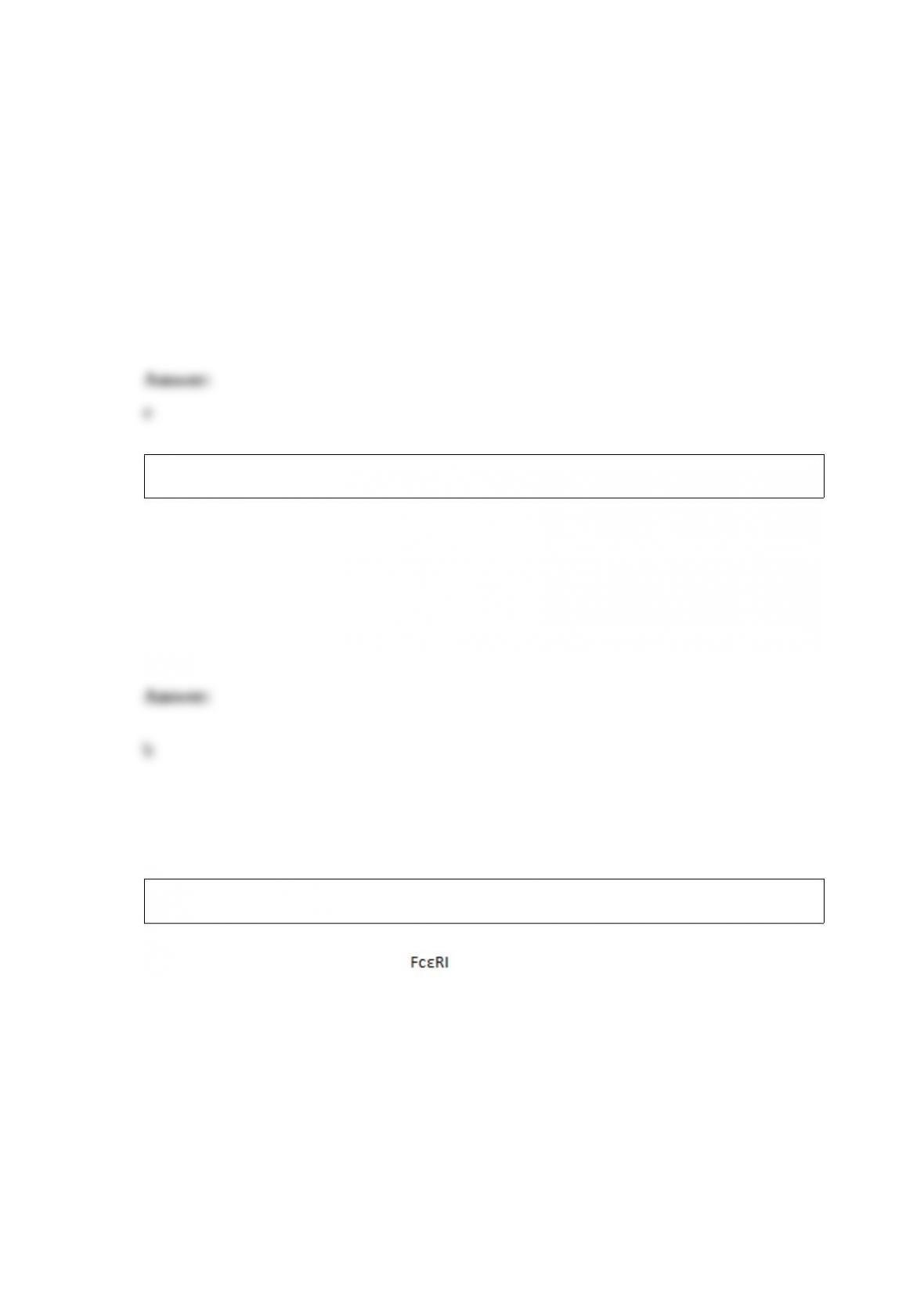
Which of the following regarding is false?
a.It is expressed on the surface of mast cells and basophils.
b.It is a low-affinity receptor involved in type I hypersensitivity reactions.
c.It binds to IgE in the absence of antigen.
d.It is a membrane-bound tetramer.
e.It contains signaling components that re activated following antigen cross-linking.

Scavenger receptor SR-B recognizes _____.
a.lipopolysaccharides
b.teichoic acid
c.filamentous hemagglutinin
d.CpG-rich bacterial DNA
e.lipids.