
Retaining the zygote on the living gametophyte of land plants _____.
A) protects the zygote from herbivores
B) evolved concurrently with pollen
C) helps in dispersal of the zygote
D) allows it to be nourished by the parent plant
Why might the cricket genome have eleven times as many base pairs as that of
Drosophila melanogaster?
A) Crickets have higher gene density.
B) Drosophila are more complex organisms.
C) Crickets must have more noncoding DNA.
D) Crickets must make many more proteins.
An example of antagonistic hormones controlling homeostasis is _____.
A) thyroxine and parathyroid hormone in calcium balance
B) insulin and glucagon in glucose metabolism

C) progestins and estrogens in sexual differentiation
D) epinephrine and norepinephrine in fight-or-flight responses
The virus genome and viral proteins are assembled into virions (virus particles) during
_____.
A) the lytic cycle and the lysogenic cycle in all known host organisms
B) the lysogenic cycle only
C) the lytic cycle only
D) the lytic cycle in all host organisms but the lysogenic cycle only in bacteria
A current view of how the human and chimpanzee can share most of their nucleotide
sequence yet exhibit significant phenotypic differences is that many of the most
important sequence differences alter _____.
A) structural genes
B) the number of repeated sequences
C) regulatory sequences
D) environmental factors
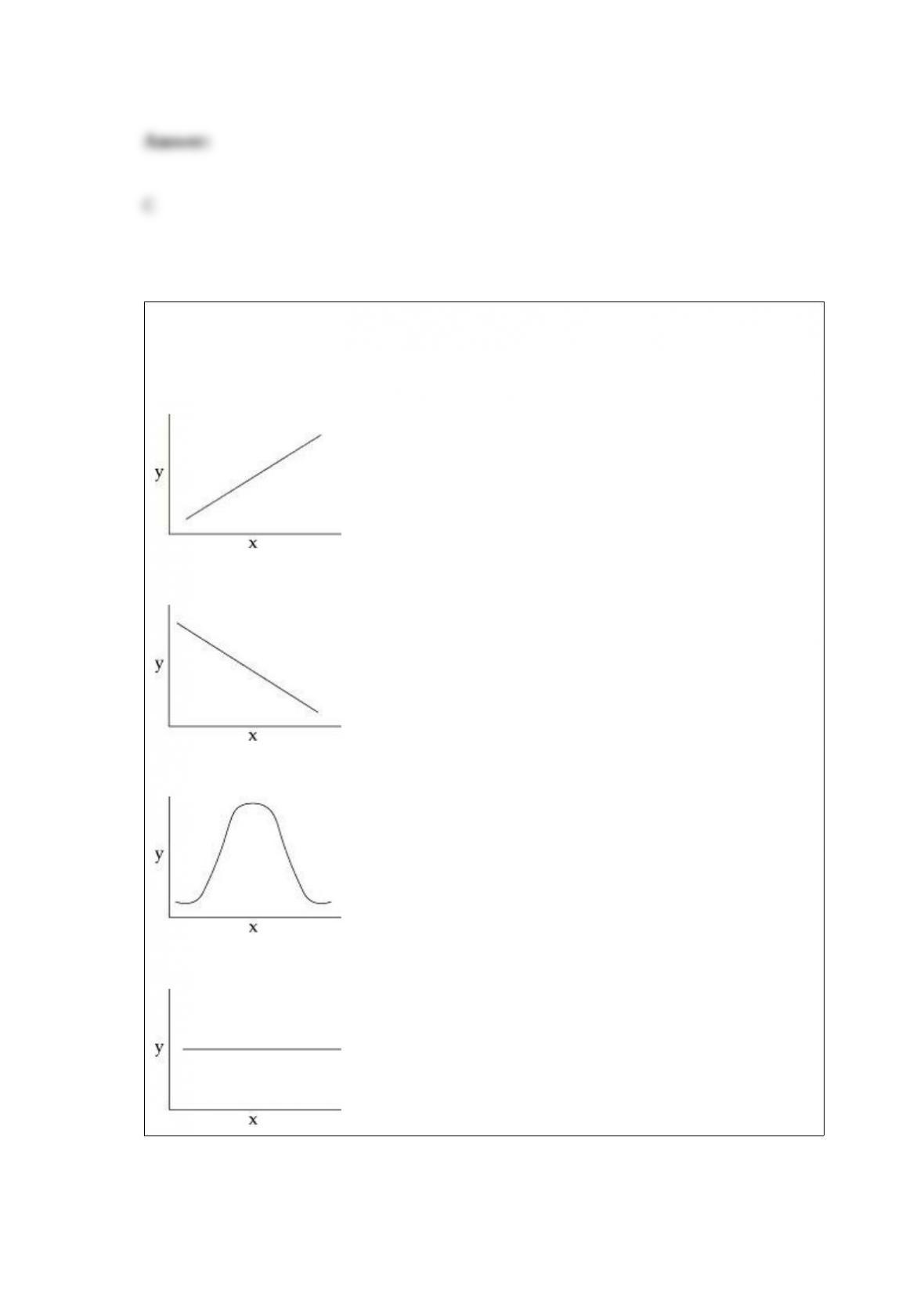
You collect data on the effect of pH on the function of the enzyme catalase in human
cells. Which of the following graphs would you expect?
A)
B)
C)
D)

You are the lucky student of a wacky professor who develops a time machine. He asks
if you will test it with him. You get in and there is an immediate glitch”the date readout
fails so that when you land you are not sure what era you are in. As your time machine
lands, you see an unusual landscape before you. As you open the door you realize you
cannot breathe. You quickly shut the door, realizing you are in the _____.
A) Archaean eon
B) Cambrian period
C) Cenozoic era
D) Mesozoic era
A researcher notices that in a certain moth species, some females prefer to feed and lay
eggs on domesticated solanaceous plants like potatoes and tomatoes. Other females
prefer to feed and lay eggs on wild solanaceous plants like Datura. Both male and
female moths primarily use scent to find these plants from afar. Females tend to mate
where they feed, and the researcher finds a genetic basis for scent preference in these
moths. Based on the above information, what might be occurring in this moth species?
A) divergence in sympatry
B) divergence due to habitat fragmentation
C) postzygotic isolation
D) polyploidization

A water molecule could move all the way through a plant from soil to root to leaf to air
and pass through a living cell only once. This living cell would be a part of which
structure?
A) a guard cell
B) the root epidermis
C) the endodermis
D) the root cortex
An immune response to a tissue graft will differ from an immune response to a
bacterium because _____.
A) MHC molecules of the donor may stimulate rejection of the graft tissue, but bacteria
lack MHC molecules
B) the tissue graft, unlike the bacterium, is isolated from the circulation and will not
enter into an immune response
C) a bacterium cannot escape the immune system by replicating inside normal body
cells
D) the graft will stimulate an autoimmune response in the recipient

All animals with eyes or eyespots that have been studied so far share a gene in
common. When mutated, the gene Pax–6 causes lack of eyes in fruit flies, tiny eyes in
mice, and missing irises (and other eye parts) in humans. The sequence of Pax-6 in
humans and mice is identical. There are so few sequence differences with fruit fly
Pax-6 that the human/mouse version can cause eye formation in eyeless fruit flies, even
though vertebrates and invertebrates last shared a common ancestor more than five
hundred million years ago.
Fruit-fly eyes are of the compound type, which is structurally very different from the
camera-type eyes of mammals. Even the camera-type eyes of molluscs, such as octopi,
are structurally quite different from those of mammals. Yet, fruit flies, octopi, and
mammals possess very similar versions of Pax-6. The fact that the same gene helps
produce very different types of eyes is most likely due to _____.
A) the few differences in nucleotide sequence among the Pax-6 genes of these
organisms
B) variations in the number of Pax-6 genes among these organisms
C) the independent evolution of this gene at many different times during animal
evolution
D) differences in the control of Pax-6 expression among these organisms
Nitrifying bacteria participate in the nitrogen cycle mainly by _____.
A) converting nitrogen gas to ammonia
B) releasing ammonium from organic compounds, thus returning it to the soil
C) converting ammonium to nitrate, which plants absorb
D) incorporating nitrogen into amino acids and organic compounds

Action potentials in the heart move from one contractile cell to the next via _____.
A) chemical synapses using acetylcholine
B) chemical synapses using norepinephrine
C) electrical synapses using gap junctions
D) non-myelinated motor neurons
Which of the following is true of metabolism in its entirety in all organisms?
A) Metabolism depends on a constant supply of energy from food.
B) Metabolism uses all of an organism’s resources.
C) Metabolism consists of all the energy transformation reactions in an organism.
D) Metabolism manages the increase of entropy in an organism.

What is the biggest problem with selecting a site for a preserve?
A) Making a proper selection is difficult because currently the environmental
conditions of almost any site can change quickly.
B) Keystone species are difficult to identify in potential preserve sites.
C) Only lands that are not useful to human activities are available for preserves.
D) Most of the best sites are inaccessible by land transportation, so making roads to
them is often prohibitively expensive.
In the formula for determining a population’s genotype frequencies, the “pq” in the term
2pq is necessary because _____.
A) the population is diploid
B) heterozygotes can come about in two ways
C) the population is doubling in number
D) heterozygotes have two alleles
An unlabeled signaling diagram for steroid hormones: Fig. 11.8 p. 213, Campbell 8e.

A steroid hormone, like estrogen, passes through the plasma membrane and binds to an
intracellular protein as shown in the diagram below. This activates a signal-transduction
pathway which results in an increased production of a specific protein.
Which of the following statements would explain what would occur as a result of the
signal pathway represented by the diagram?
A) Transfer RNA (t-RNA) would accumulate in high levels because it is not required
for protein synthesis.
B) Ribosomal RNA (r-RNA) levels would increase because ribosomes are specific for
the messenger RNA (m-RNA) with which they bind during transcription of the
polypeptide.
C) DNA levels would increase in the nucleus as a result of the binding of the
hormone-receptor complex with the DNA.
D) Messenger RNA (m-RNA) levels would increase in order to be translated into the
protein required by the cell.
What compound provides the reducing power for Calvin cycle reactions?
A) ATP
B) NADH
C) NADP+
D) NADPH

What makes sexually reproduced offspring genetically different from their parents?
A) genetic recombination during meiosis
B) genetic recombination during mitosis
C) crossing over during mitosis
D) Sexual reproduction does not produce genetically different offspring.
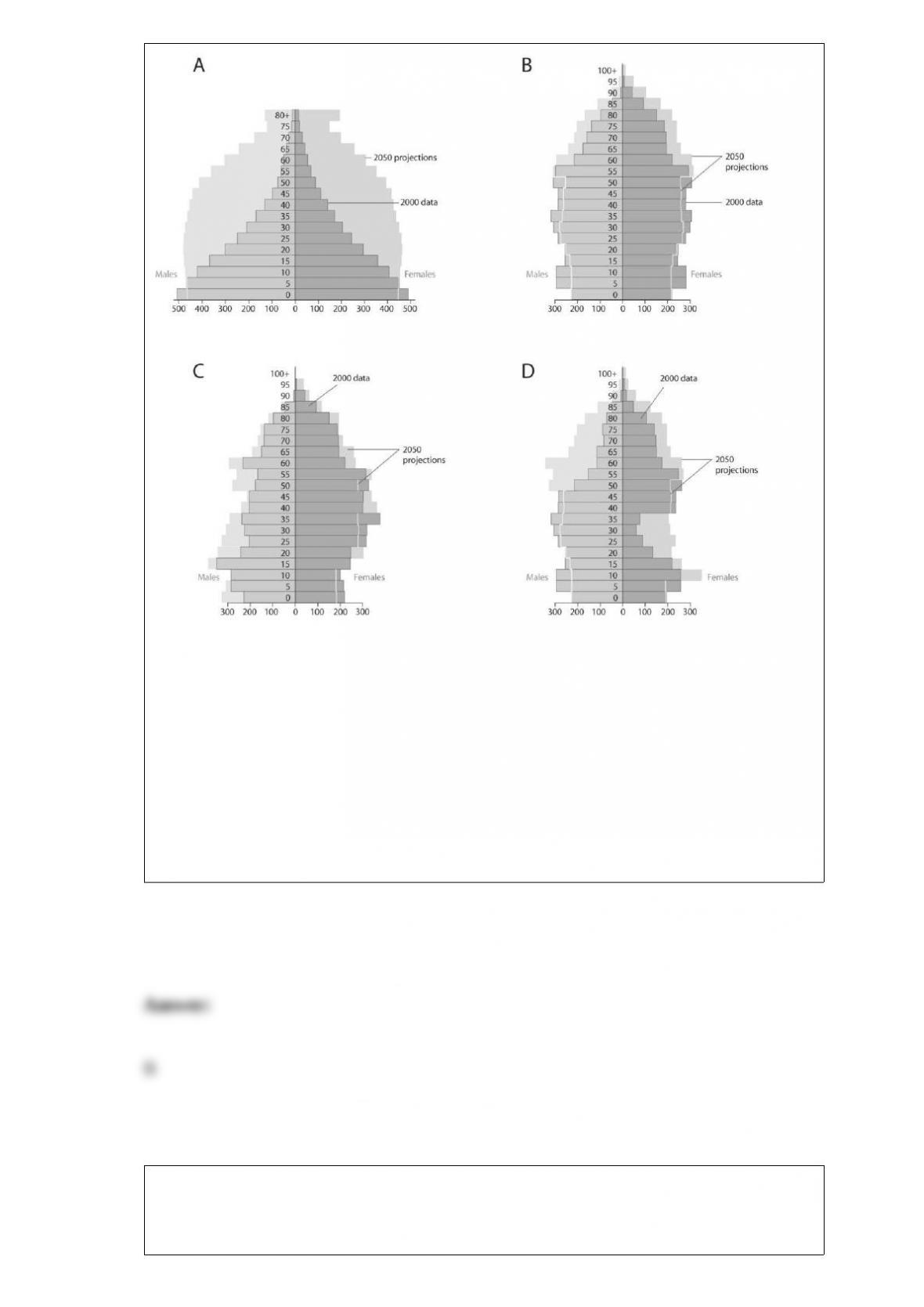
Based on the diagrams in the figure above and on the large population of baby boomers
in the United States, which graph best reflects U.S. population in twenty years?
A) A
B) B
C) C
D) D
Scarlet gilia (Ipomopsis aggregata) usually has red flowers in an inflorescence of up to
250 flowers. In certain populations in the Arizona mountains, however, the flowers
range from red to pink to white. In early summer, most of the flowers were red. Six to

eight weeks later, the same individual plants were still present; the flowers ranged from
pink to white, and few red flowers were present. The major pollinators early in the
season were two species of hummingbirds active during the day; they emigrated to
lower elevations, and the major pollinator later in the season was a hawk moth (a type
of moth). The hawk moth was most active at sunset and later, and it preferred light pink
to white flowers after dark. When hummingbirds were present, more red flowers than
white flowers produced fruit. When only hawk moths were present, more white flowers
produced fruit (K. N. Paige and T. G. Whitham. 1985. Individual and population shifts
in flower color by scarlet gilia: A mechanism for pollinator tracking. Science
227:315-17).
Refer to the paragraph on scarlet gilia. Late in the season, when only hawk moths were
present, researchers painted the red flowers white. What would you expect?
A) Unpainted red flowers would produce more fruits than white flowers would.
B) Red flowers painted white would produce more fruits than red flowers would.
C) Red and white flowers would produce the same numbers of fruits.
The greatest distance among the three genes is between a and c. What does this mean?
A) Gene c is between a and b.
B) Genes are in the order: abc.
C) Gene a is not recombining with c.
D) Gene a is between b and c.

In the fall, the leaves of some trees change color. This happens because chlorophyll
breaks down and the accessory pigments become visible. What hormone is responsible
for this?
A) phototropin
B) abscisic acid
C) cytokinin
D) ethylene
In the fractionation of homogenized cells using centrifugation, the primary factor that
determines whether a specific cellular component ends up in the supernatant or the
pellet is the _____.
A) relative solubility of the component
B) size and weight of the component
C) percentage of carbohydrates in the component
D) presence or absence of lipids in the component
Cilia and flagella bend because of _____.
A) conformational changes in ATP that thrust microtubules laterally
B) a motor protein called radial spokes
C) the quick inward movements of water by osmosis.
D) a motor protein called dynein
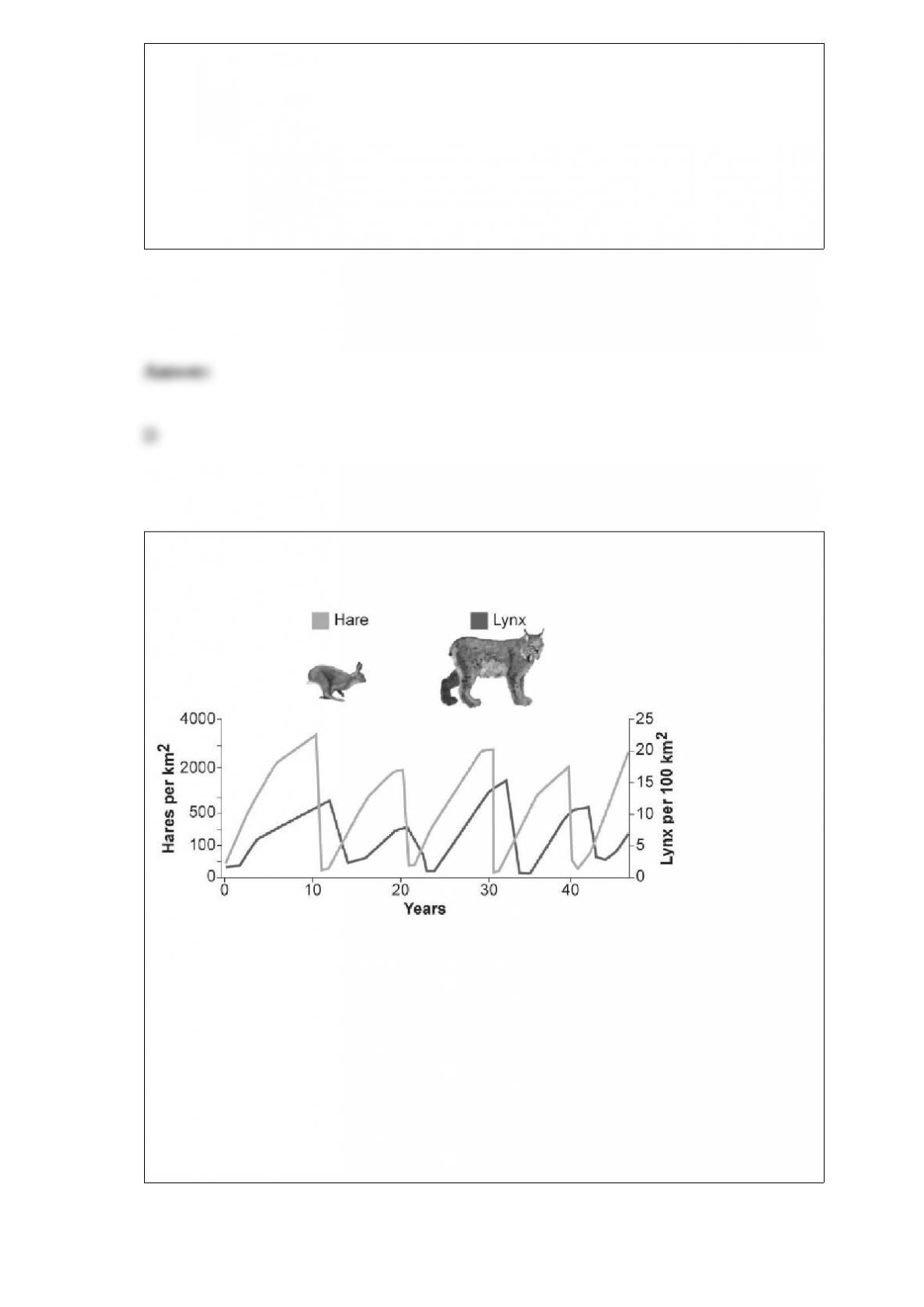
What conclusion can you draw from the figure above?
A) Hares control lynx population size.
B) Lynx control hare population size.
C) Lynx and hare populations are independent of each other.
D) The relationship between the populations cannot be determined only from this
graph.

Excessive formation of uric acid crystals in humans leads to _____.
A) a condition called diabetes, where excessive urine formation occurs
B) a condition of insatiable thirst and excessive urine formation
C) gout, a painful inflammatory disease that primarily affects the joints
D) osteoarthritis, an inevitable consequence of aging
The following questions refer to the evolutionary tree in the figure below.
The horizontal axis of the cladogram depicted below is a timeline that extends from
100,000 years ago to the present; the vertical axis represents nothing in particular. The
labeled branch points on the tree (V-Z) represent various common ancestors. Let’s say
that only since 50,000 years ago has there been enough variation between the lineages
depicted here to separate them into distinct species, and only the tips of the lineages on
this tree represent distinct species.
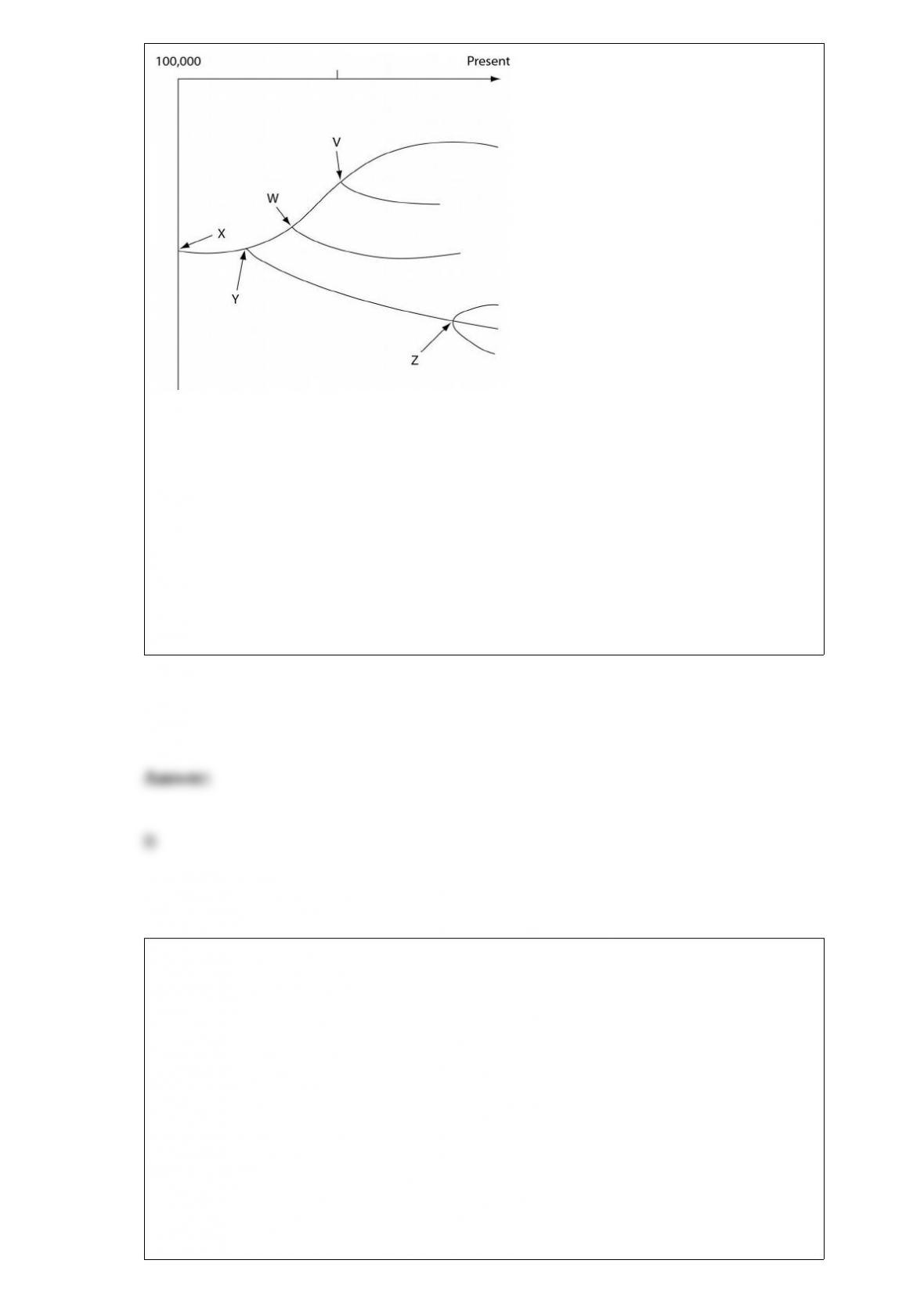
Which pair of scientists below would probably have agreed with the process that is
depicted by this tree?
A) Cuvier and Lamarck
B) Lamarck and Wallace
C) Aristotle and Lyell
D) Wallace and Linnaeus
Arrange these groups in order from most inclusive (most general) to least inclusive
(most specific).
1. lobe-fins
2. amphibians
3. gnathostomes
4. osteichthyans
5. tetrapods

A) 4, 3, 1, 5, 2
B) 4, 3, 2, 5, 1
C) 3, 4, 1, 5, 2
D) 3, 4, 5, 1, 2
Why are lipids and proteins free to move laterally in membranes?
A) The interior of the membrane is filled with liquid water.
B) Lipids and proteins repulse each other in the membrane.
C) Hydrophilic portions of the lipids are in the interior of the membrane.
D) There are only weak hydrophobic interactions in the interior of the membrane.
Which of the following statements is true of linkage?
A) The closer two genes are on a chromosome, the lower the probability that a
crossover will occur between them.
B) The observed frequency of recombination of two genes that are far apart from each
other has a maximum value of 100%.
C) All of the traits that Mendel studiedseed color, pod shape, flower color, and othersare

due to genes linked on the same chromosome.
D) Linked genes are found on different chromosomes.
After surgical removal of an infected gallbladder, a person must be especially careful to
restrict dietary intake of _____.
A) protein
B) sugar
C) fat
D) water
You are given an unknown organism to identify. It is unicellular and heterotrophic. It is
motile, using many short extensions of the cytoplasm, each featuring the 9 + 2 filament
pattern. It has well-developed organelles and two nuclei, one large and one small. This
organism is most likely to be a _____.
A) foraminiferan
B) radiolarian
C) ciliate
D) kinetoplastid