
Secretion is the movement of substances such as drugs or toxic molecules from the
________ into the ________.
A) nephron tubule; glomerulus
B) glomerulus; nephron tubule
C) blood; filtrate
D) urinary bladder; outside
The function of coenzyme A in the citric acid cycle is most like
A) a limousine driver dropping off a couple at the school prom.
B) a frog that turns into a prince.
C) a kid jumping up and down on a trampoline.
D) throwing a baited hook into a lake and catching a fish.
The pattern of distribution for a certain species of kelp is clumped. The pattern of
distribution for a population of snails that live on the kelp would be
A) clumped.
B) homogeneous.

C) random.
D) uniform.
Which of the following statements about fruit fly development is false?
A) One of the earliest development events is the determination of the head and tail ends
of the egg.
B) The location of the head and tail ends of the egg is primarily determined by the
location of sperm entry during fertilization.
C) Homeotic genes regulate batteries of other genes that direct the anatomical identity
of body parts.
D) Cascades of gene expression routinely direct fruit fly development.
If a woman has reached or passed her due date (the date that a woman is expected to
give birth), her obstetrician may inject her with hormones to help initiate labor. Which
of the following hormones would assist the most in the initiation of labor?
A) HCG
B) FSH
C) progesterone

D) oxytocin
Prokaryotes are classified into
A) domain Protista and domain Archaea.
B) kingdom Bacteria and kingdom Archaea.
C) domain Bacteria and domain Archaea.
D) kingdom Protista and kingdom Bacteria.
The earliest hominin to be found outside of Africa belongs to which species?
A) Australopithecus afarensis
B) Homo habilis
C) Homo erectus
D) Homo sapiens

Interestingly, most herbivorous animals do not have the ability to digest the cellulose in
plants. However, in the absence of this ability, a mechanism has evolved that allows
them to survive despite eating only plant matter, namely,
A) production of saliva containing amylase.
B) digestion by symbiotic microorganisms.
C) avoidance of plants containing cellulose.
D) converting cellulose to other carbohydrates.
The phenotypic ratio resulting from a dihybrid cross of two heterozygote individuals
showing independent assortment is expected to be
A) 1:2:1
B) 3:1
C) 9:1:1:3
D) 9:3:3:1

Which of the following statements regarding glycolysis is false?
A) Glycolysis is considered to be an ancient metabolic process because it does not
require oxygen.
B) Glycolysis is considered to be an ancient metabolic process because it is not located
in a membrane-bound organelle.
C) Glycolysis is considered to be an ancient metabolic system because it occurs
universally.
D) Glycolysis is considered to be an ancient metabolic system because it is the most
efficient metabolic pathway for ATP synthesis.
The eyes of a planarian provide
A) a three-dimensional image, but in black and white.
B) a two-dimensional image.
C) a higher degree of resolution than human eyes.
D) information about light intensity and direction.
The Pasteur effect shows that yeast consume glucose at a higher rate under anaerobic

conditions than under aerobic conditions. Which of the following statements correctly
explains this observation?
A) Yeast are obligate anaerobes, so aerobic conditions will kill yeasts.
B) Yeast are photosynthetic, so they are able to produce their own oxygen.
C) Less ATP is made under anaerobic conditions, so more glucose must be consumed to
produce an equivalent amount of ATP.
D) This observation is incorrect. Aerobic conditions mean that cells make more ATP
and use more glucose.
Which respiratory structure likely has the largest surface area for gas exchange to
occur?
A) the body surface of a worm
B) the alveoli of a pig
C) the tracheal system of a house fly
D) the gills of a trout
The rate of energy consumption by an animal is called
A) metabolism.
B) digestion.
C) metabolic rate.
D) glycolysis.
You are a member of an African family that has been displaced from their home by civil
war, so you are trying to select a new country in which to settle to gain better economic
opportunities. You know that Nigeria is a large country with rich natural resources, so
you are considering it for your new home. Among the data you find while researching
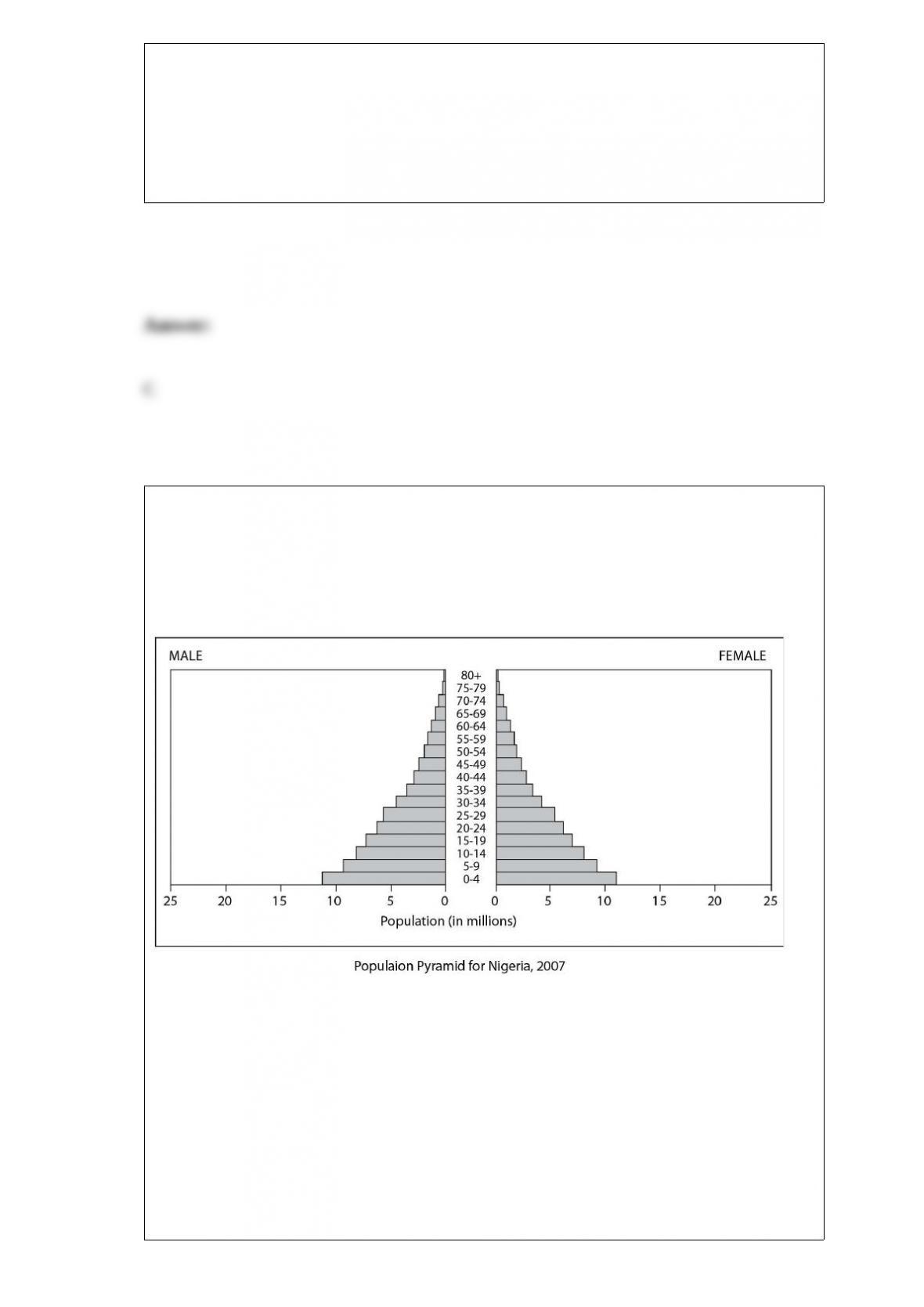
Nigeria is the following diagram of the current age structure of the country.
Based on the age structure of the country, which of the following situations would be
most likely to occur over the next 20 years?
A) strong economic gains stimulated by population growth
B) an increased demand for resources based on population growth
C) a decreased demand for medical services due to the small number of elderly citizens
D) a decline in housing prices based on lack of demand

An organ represents a higher level of structure than the tissue composing it and
performs functions that the tissues cannot perform alone. This is an example of the
principle of
A) structural adaptations.
B) cellular regulation.
C) emergent properties.
D) biotechnology.
Organisms that are nocturnal are more likely to communicate using
A) sight and sound.
B) sight and smell.
C) smell and sound.
D) touch and taste.

Lions are not always successful hunters and may go days between meals. What
evolutionary adaptation helps the lion survive periods of famine?
A) formation of a two-chambered stomach
B) an extended cecum
C) an expandable stomach
D) a rich microbial flora in the colon
Which of the following statements regarding birth control is true?
A) The most widely used birth control pills contain a combination of FSH and LH.
B) Natural family planning is generally reliable.
C) Morning-after pills taken within three days of unprotected intercourse prevent
fertilization or implantation about 75% of the time.
D) Birth control pills work primarily by preventing fertilization and implantation.

You lose track of your friend in a store and start looking for her. Which of the following
strategies represents the use of a search image?
A) You ask a woman if she has seen anyone around this part of the store.
B) You think about what color clothing your friend is wearing and look for that color.
C) You go to the department in the store where your friend most likes to shop.
D) You return to the last place you saw your friend.
Genetically modifying ________ cells may directly affect future generations.
A) bone marrow
B) somatic
C) gamete-forming
D) photoreceptor
In populations of the greater prairie chicken in Illinois, genetic diversity was
A) lost through mutation and restored by natural selection.
B) lost through genetic drift and restored by natural selection.

C) lost through gene flow and restored by mutation.
D) lost through genetic drift and restored by gene flow.
Which of the following experiments would be best for testing the hypothesis that the
enzymes did not perform as expected because the temperature was too high?
A) Produce one batch of blue jeans with twice as much enzyme as another batch of blue
jeans while keeping the temperature the same, then compare how the lightness of the
blue jeans varies between batches.
B) Produce multiple batches of blue jeans at several different temperatures but with the
same enzyme concentration and then compare how the lightness of the blue jeans varies
between batches.
C) Produce multiple batches of blue jeans at several different temperatures and with
different enzyme concentrations and then compare how the lightness of the blue jeans
varies between batches.
D) Produce one batch of blue jeans at a high temperature without the enzyme and
another batch of blue jeans at a low temperature with the enzyme and then compare
how the lightness of the blue jeans varies between batches.
Which of the following statements is false?
A) Translation consists of initiation, elongation, and termination.

B) During polypeptide initiation, an mRNA molecule, the first amino acid attached to
its tRNA, and the two subunits of a ribosome are brought together.
C) The start codon can be different depending on what kind of protein is to be
translated.
D) During the first step of initiation, an mRNA molecule binds to a small ribosomal
subunit.
Which of the following statements regarding DNA is false?
A) Long stretches of repetitive DNA are prominent at centromeres and ends of
chromosomes.
B) Human and E. coli genomes contain approximately the same proportions of
noncoding DNA.
C) Current estimates are that there about 21,000 genes in the human genome.
D) Telomeres seem to have a structural function.
Offering nutritious lunches in public schools is a popular health topic. School lunches
have had to meet new nutrition standards since the fall of 2012. In 2013, the USDA
(United States Department of Agriculture) reviewed data from the 2005 School
Nutrition and Dietary Assessment to investigate whether students in schools that were
already following the new standards (school group A) and that therefore offered more
fruits and vegetables than other schools (school group B) actually ate more of them.

You will be presented with some of the overall findings of the review and will then be
asked questions related to these conclusions.
Finding #2: An unexpected finding was that if students came from economically poor
homes or homes that did not have adequate food, they did not have greater fruit and
vegetable consumption in school. What hypothesis were the researchers likely testing
that produced this finding?
A) Students who come from families with high incomes are more likely to eat greater
amounts of fruits and vegetables than students from families with low incomes.
B) Students who come from families with adequate access to fruits and vegetables are
more likely to eat greater amounts of these foods than students from families with low
access to fruits and vegetables.
C) Students who have families with their own gardens will be less likely to eat greater
amounts of fruits and vegetables.
D) Students who lack a high family income or who have low access to fruits and
vegetables are more likely to eat greater amounts of these foods than students from
families with a moderate income or who have adequate access to fruits and vegetables.
Enzymes are required to help digest the four large macromolecules found in the foods
we eat. Which of the following is not a true representation of the enzymes that digest
these macromolecules?
A) Polysaccharides are hydrolyzed by pancreatic amylase to maltose, which is then
hydrolyzed by maltase to form monosaccharides.
B) Polysaccharides are hydrolyzed by nucleases to maltose, which is then hydrolyzed
by lipase to form monosaccharides.
C) Polypeptides are hydrolyzed by trypsin to small polypeptides, which are then
hydrolyzed by peptidases to form amino acids.
D) Fat globules are hydrolyzed by bile salt fat droplets, which are then hydrolyzed by
lipase to form fatty acids and glycerol.

Our sense of taste results from receptors organized into taste buds
A) in the upper portions of nasal passages.
B) on the tongue.
C) that are also responsible for smell.
D) with long cilia that are constantly in motion.
Reproductive systems with external fertilization are most common in
A) terrestrial animals.
B) populations with many more males than females.
C) animals that are widely dispersed.
D) aquatic animals.

A spot where two continental plates are sliding past one another may be prone to
A) volcanoes.
B) earthquakes.
C) tsunamis.
D) wildfires.
Which of the following statements about the Galpagos finches is false?
A) The Galpagos finch species differ in their feeding habitats.
B) Each island in the Galpagos chain has one and only one isolated, unique species of
Darwin’s finch.
C) Most speciation events of the Galpagos finches occurred when some finches made it
to another island, evolved in isolation, and accumulated enough changes to become a
new species.
D) The evolution of the Galpagos finches is an excellent example of adaptive radiation.
Fatty acids are

A) composed of carbon, hydrogen, and oxygen in a 1:2:1 ratio.
B) composed of carbon, hydrogen, glycerol, and a phosphate group.
C) hydrophobic.
D) composed of four linked rings.
Which of the following statements about the functional groups of organic compounds is
false?
A) Functional groups may help make organic compounds hydrophilic.
B) Many biological molecules have two or more functional groups.
C) Functional groups participate in chemical reactions.
D) All functional groups include a carbon atom.
Physicians routinely give their patients pulmonary function tests in order to measure
characteristics of lung function. The most common of these tests, spirometry, measures
both the volume and the speed of air entering and exiting the lungs. In this test, a person
first breathes normally while breathing into a spirometer, a machine that measures air
volume and air speed. Then the person takes the deepest breath possible and exhales as
hard as possible for 6 seconds into the spirometer. The resulting data are plotted on a
graph of volume (y axis) versus time (x axis). Spirometry is useful not only for
assessing lung function in healthy patients but also for characterizing patients with lung
conditions such as pulmonary fibrosis, asthma, or emphysema.
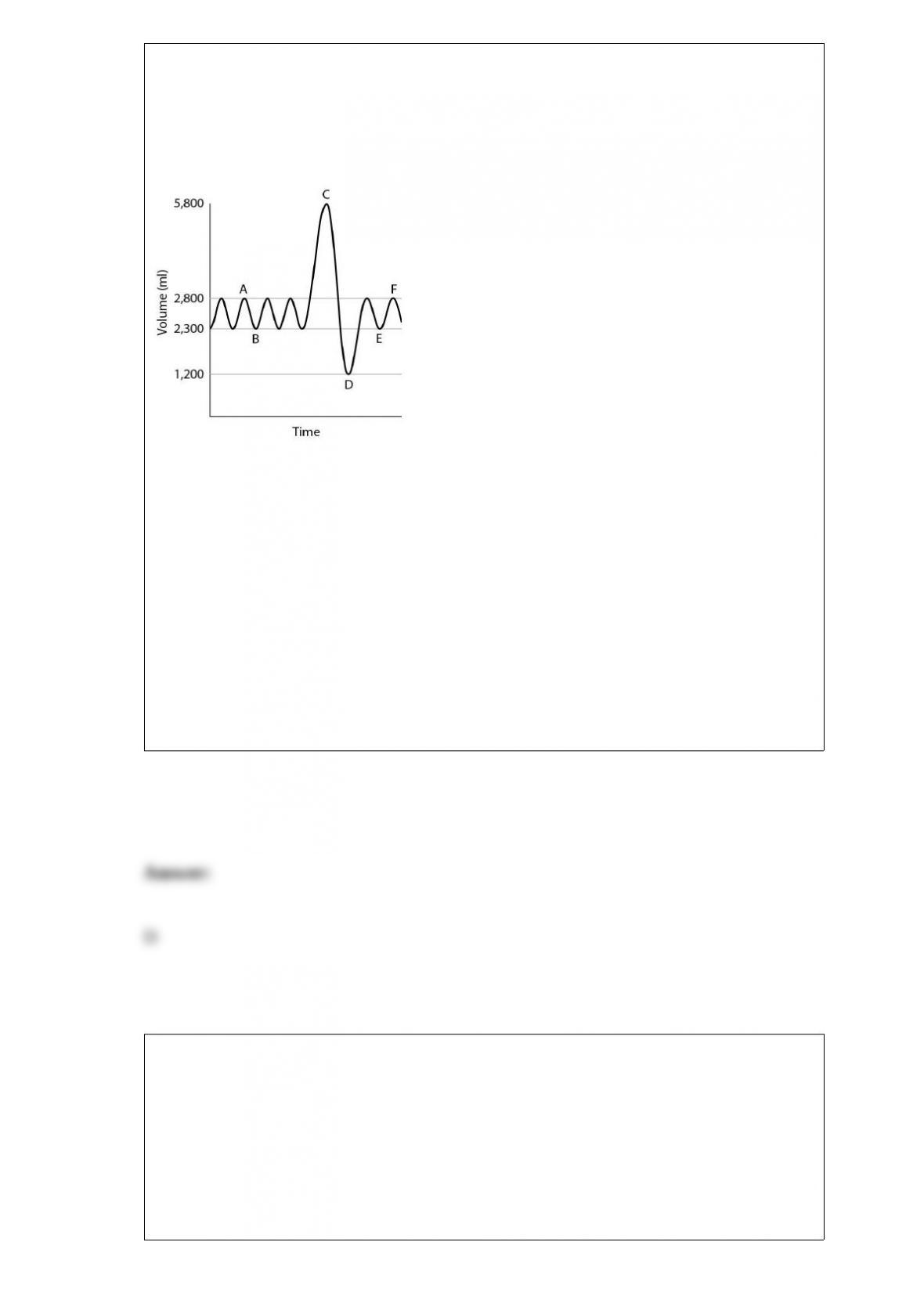
A sample graph for a healthy adult male is shown below. Normal breathing occurs
between points A and B, a maximal inhalation occurs at point C, and a maximal
exhalation occurs at point D. Normal breathing resumes between points E and F.
Patients with emphysema have lungs that are less elastic than normal. As a result, they
cannot exhale as much air as a healthy person can, thereby leaving additional residual
volume in the lungs. How would the preceding graph differ if an emphysema patient’s
data were plotted instead of a healthy person’s?
A) The difference in volume between points A and B would be larger.
B) The difference in volume between points C and D would be larger.
C) Point A would be at a smaller volume.
D) Point D would be at a larger volume.
According to the fossil record, the genus Homo first arose in
A) North America.
B) Europe.
C) Asia.

D) Africa.