
Salmon eggs hatch in freshwater. The fish then migrate to the ocean (a hypertonic
solution) and, after several years of feeding and growing, return to freshwater to breed.
How can these organisms make the transition from freshwater to ocean water and back
to freshwater?
A) The rectal gland functions in the ocean water, and chloride cells function in
freshwater.
B) Different gill cells are involved in osmoregulation in freshwater than in salt water.
C) Salmon in freshwater excrete dilute urine, and salmon in salt water secrete
concentrated urine.
D) Their metabolism changes in salt water to degrade electrolytes.
It is more difficult to identify eukaryotic genes than prokaryotic genes because in
eukaryotes _____.
A) the proteins are larger than in prokaryotes
B) the coding portions of genes are shorter than in prokaryotes
C) there are no start codons
D) there are introns
Which of the following ecological locations has the greatest species diversity?

A) deciduous forests
B) tropical rain forest
C) grasslands
D) islands
Human sperm cells first arise in the _____.
A) prostate gland
B) vas deferens
C) seminiferous tubules
D) epididymis
Which of these would a paleontologist most likely do to determine if a fossil represents
a reptile or a mammal?
A) Look for the presence of milk-producing glands.
B) Look for the mammalian characteristics of a four-chambered heart and a diaphragm.
C) Use molecular analysis to look for the protein keratin.

D) Examine the teeth.
Two researchers experimentally formed tetraploid frogs by fertilizing diploid eggs from
Rana porosa brevipoda with diploid sperm from Rana nigromaculata. When they
mated these tetraploid frogs with each other, most of the offspring that survived to
maturity were tetraploid, with chromosome sets of both diploid parent species. Based
on these results, if this type of tetraploid formed in the wild, what would be the result?
(Y. Kondo and A. Kashiwagi. 2004. Experimentally induced autotetraploidy and
allotetraploidy in two Japanese pond frogs. Journal of Herpetology 38(3):381-92.)
A) The two parent species would interbreed and fuse into one species.
B) The two parent species would recognize each other as mates.
C) The tetraploids would be reproductively isolated from both parent species.
D) The tetraploids would be selected against.
For several decades now, amphibian species worldwide have been in decline. A
significant proportion of the decline seems to be due to the spread of the chytrid fungus,
Batrachochytrium dendrobatidis (Bd). Chytrid sporangia reside within the epidermal
cells of infected animals, animals that consequently show areas of sloughed skin. They
can also be lethargic, which is expressed through failure to hide and failure to flee. The
infection cycle typically takes four to five days, at the end of which zoospores are
released from sporangia into the environment. In some amphibian species, mortality
rates approach 100%; other species seem able to survive the infection.

If infection primarily involves the outermost layers of adult amphibian skin, and if the
chytrids use the skin as their sole source of nutrition, then which term best applies to the
chytrids?
A) anaerobic chemoautotroph
B) aerobic chemoautotroph
C) anaerobic chemoheterotroph
D) aerobic chemoheterotroph
When adenylyl cyclase is activated ________.
A) cAMP is created
B) cAMP is destroyed
C) G proteins bind to cAMP
D) steroid hormones pass through the lipid bilayer
The interrelationships between the endocrine and the nervous systems are especially
apparent in a _____.
A) steroid-producing cell in the adrenal cortex

B) neurosecretory cell in the hypothalamus
C) brain cell in the cerebral cortex
D) cell in the pancreas that produces digestive enzymes
Which of the following statements best describes the effect of climate on biome
distribution?
A) Average annual temperature and precipitation are sufficient to predict which biome
will be found in an area.
B) Seasonal fluctuation of temperature is not a limiting factor in biome distribution if
areas have the same annual temperature and precipitation means.
C) The average climate and pattern of climate are important in determining biome
distribution.
D) Correlation of climate with biome distribution is sufficient to determine the cause of
biome patterns.
The eyes and the respiratory tract are both protected against infections by _____.
A) interferons produced by immune cells
B) the secretion of complement proteins

C) the release of slightly alkaline secretions
D) the secretion of lysozyme onto their surfaces
Which statement about variation is true?
A) All phenotypic variation is the result of genotypic variation.
B) All genetic variation produces phenotypic variation.
C) All nucleotide variability results in neutral variation.
D) All new alleles are the result of nucleotide variability.
Mendel continued some of his experiments into the F2 or F3 generation to _____.
A) obtain a larger number of offspring on which to base statistics
B) observe whether or not a recessive trait would reappear
C) observe whether or not the dominant trait would reappear
D) distinguish which alleles were segregating

Substrate-level phosphorylation occurs _____.
A) in glycolysis
B) in the citric acid cycle
C) in both glycolysis and the citric acid cycle
D) during oxidative phosphorylation
Arrange the following structures, which can be found on male pine trees, from the
largest structure to the smallest structure (or from most inclusive to least inclusive).
1. sporophyte
2. microspores
3. microsporangia
4. pollen cone
5. pollen nuclei
A) 1, 4, 3, 2, 5
B) 1, 2, 3, 5, 4
C) 4, 1, 2, 3, 5
D) 4, 3, 2, 5, 1
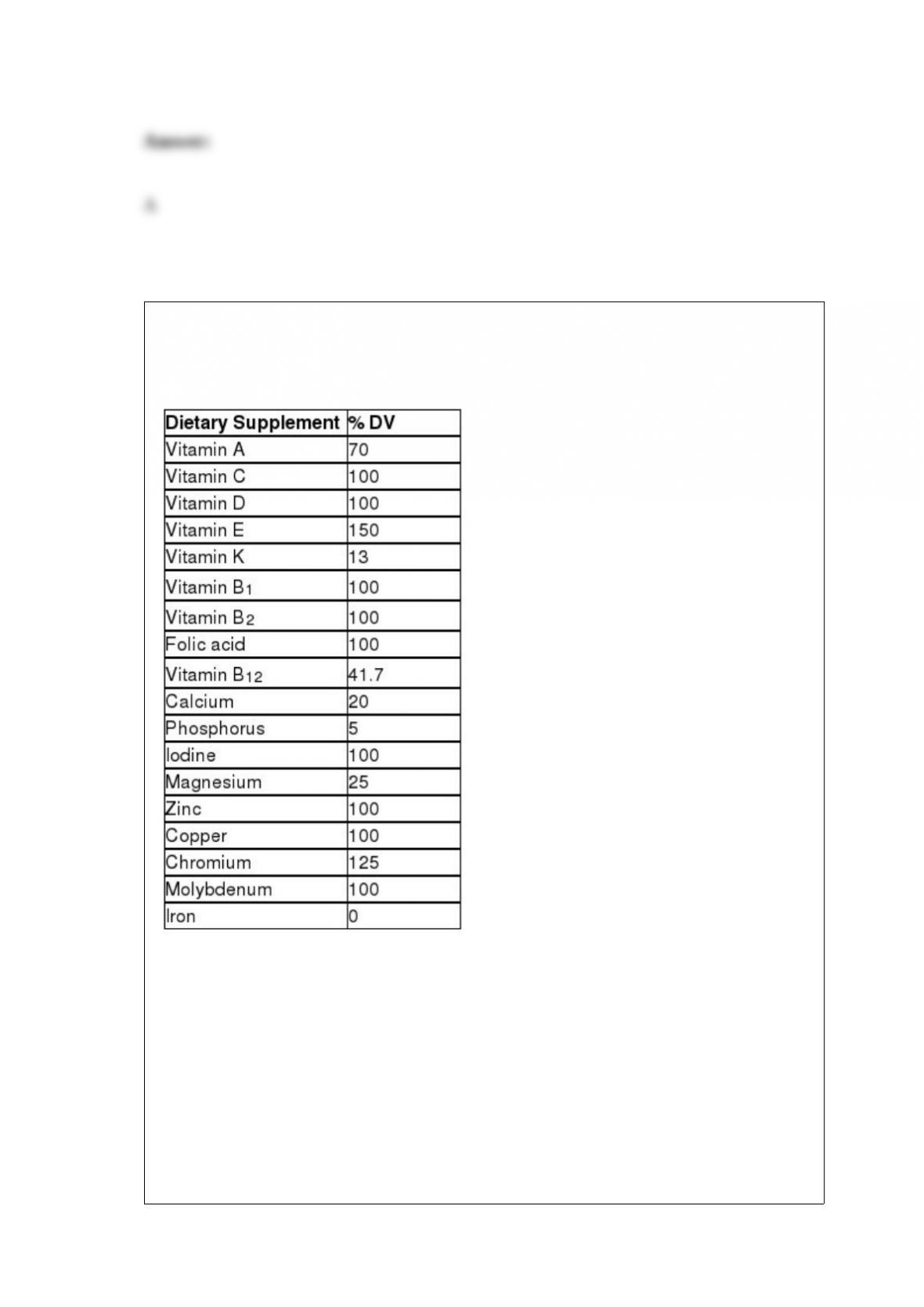
The following table shows the contents of a multivitamin supplement and its percentage
of recommended daily values (%DV).
The most likely reason that some of the vitamins and minerals in this supplement are
found at less than 100% is that _____.
A) it would be chemically impossible to add more
B) these vitamins and minerals are too large in size to reach 100%
C) it is too easy to overdose on minerals such as phosphorus and calcium
D) it is dangerous to overdose on fat-soluble vitamins such as A and K

A biologist studied a population of squirrels for fifteen years. During that time, the
population was never fewer than thirty squirrels and never more than forty-five. Her
data showed that over half of the squirrels born did not survive to reproduce, because of
both competition for food and predation. In a single generation, 90% of the squirrels
that were born lived to reproduce, and the population increased to eighty. Which
inference(s) about this most recent surge in the population size might be true?
A) The amount of available food may have increased.
B) The parental generation of squirrels developed better eyesight due to improved diet;
the subsequent squirrel generation inherited better eyesight.
C) The number of predators that prey upon squirrels may have decreased.
D) The amount of available food may have increased and/or the predators that prey
upon squirrels may have decreased.
There is a mutation in the repressor that results in a molecule known as a
super-repressor because it represses the lac operon permanently. Which of these would
characterize such a mutant?
A) It cannot bind to the operator.
B) It cannot make a functional repressor.
C) It cannot bind to the inducer.
D) It makes a repressor that binds CAP.

How can biodiversity affect the way we decontaminate industrial sites?
I) Bacteria have been found to be able to detoxify certain chemicals; perhaps there are
more.
II) Trees produce sawdust, which can be used to soak up chemicals.
III) Species evolving in contaminated areas could adapt and detoxify the area.
A) only I
B) only II
C) only III
D) only II and III
The questions below refer to the following paragraph.
HIV’s genome of RNA includes the code for reverse transcriptase (RT), an enzyme that
acts early in infection to synthesize a DNA genome off of an RNA template. The HIV
genome also codes for protease (PR), an enzyme that acts later in infection by cutting
long viral polyproteins into smaller, functional proteins. Both RT and PR represent
potential targets for antiretroviral drugs. Drugs called nucleoside analogs (NA) act
against RT, whereas drugs called protease inhibitors (PI) act against PR.
Every HIV particle contains two RNA molecules. If two genes from one RNA molecule
become detached and then, as a unit, get attached to one end of the other RNA molecule
within a single HIV particle, which of these is true?
A) There are now fewer genes within the viral particle.
B) There are now more genes within the viral particle.
C) A point substitution mutation has occurred in the retroviral genome.
D) One of the RNA molecules has experienced gene duplication as the result of
translocation.
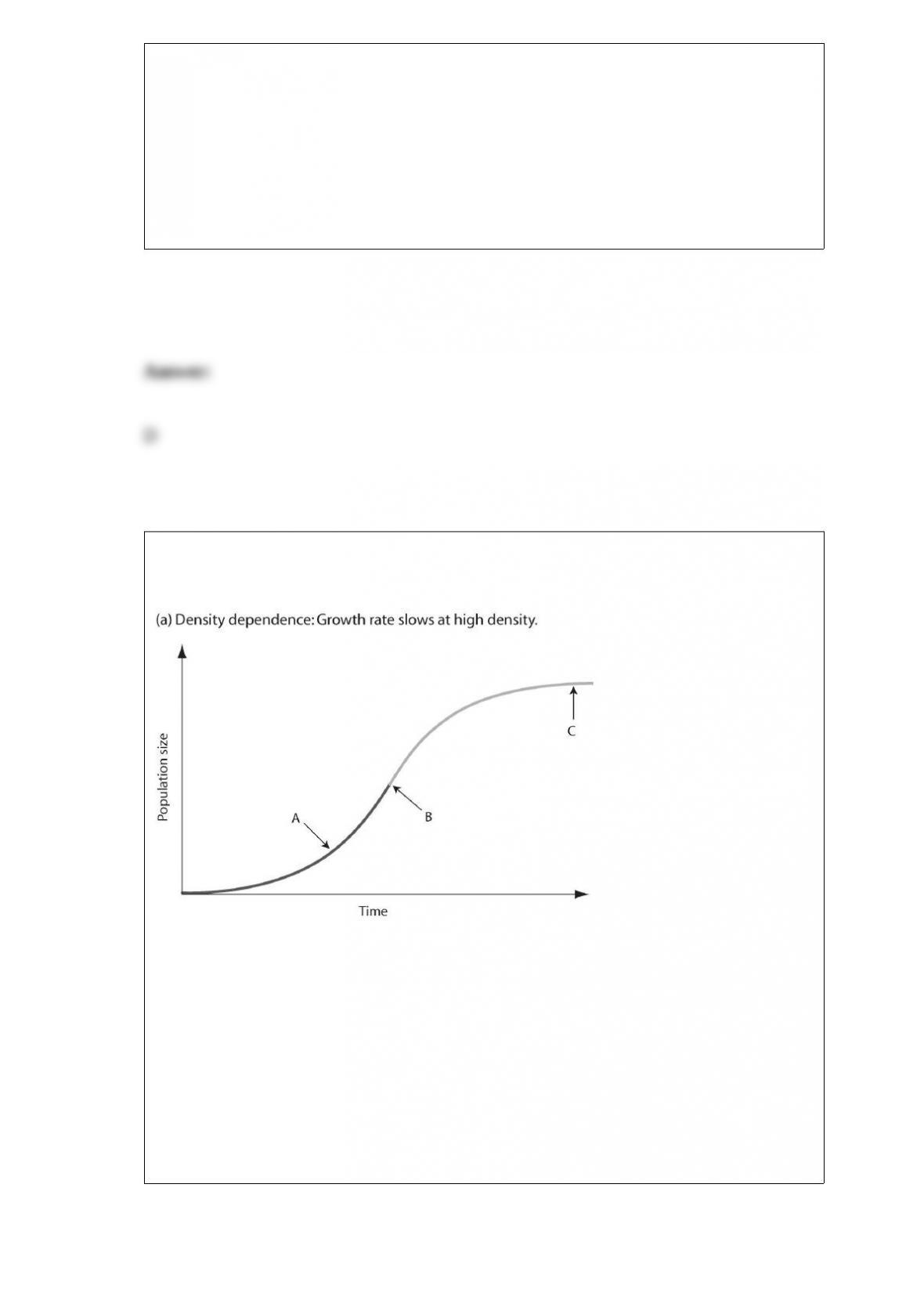
In the figure above, which of the arrows represents the carrying capacity?
A) arrow A
B) arrow B
C) arrow C
D) Carrying capacity cannot be found in the figure because species under
density-dependent control never reach carrying capacity.

If the cytoplasm of a cell is at pH 7, and the mitochondrial matrix is at pH 8, then the
concentration of H+ ions _____.
A) is 10 times higher in the cytoplasm than in the mitochondrial matrix
B) is 10 times higher in the mitochondrial matrix than in the cytoplasm
C) in the cytoplasm is 7/8 the concentration in the mitochondrial matrix
D) in the cytoplasm is 8/7 the concentration in the mitochondrial matrix
Hormones secreted by the posterior pituitary gland are made in the _____.
A) cerebellum
B) thalamus
C) hypothalamus
D) medulla oblongata

A fat (or triacylglycerol) would be formed as a result of a dehydration reaction between
_____.
A) one molecule of 9 and three molecules of 10
B) three molecules of 9 and one molecule of 10
C) one molecule of 5 and three molecules of 9
D) one molecule of 5 and three molecules of 10
You have a cube of modeling clay in your hands. Which of the following changes to the
shape of this cube of clay will decrease its surface area relative to its volume?
A) Pinch the edges of the cube into small folds.
B) Flatten the cube into a pancake shape.
C) Round the clay up into a sphere.
D) Stretch the cube into a long, shoebox shape.
The main source of water necessary for photosynthesis to occur in the leaf mesophyll is
_____.
A) soil via the xylem

B) soil via the phloem
C) the atmosphere through the cuticle and stomata
D) all of the listed responses
Hydrangea plants of the same genotype are planted in a large flower garden. Some of
the plants produce blue flowers and others pink flowers. This can be best explained by
which of the following?
A) the knowledge that multiple alleles are involved
B) the allele for blue hydrangea being completely dominant
C) the alleles being codominant
D) environmental factors such as soil pH
The common ancestor of the protostomes had a coelom. What does this suggest?
A) All lophotrochozoans have a coelom.
B) There are no pseudocoelomates within the protostomes.
C) There are no acoelomates within the protostomes.
D) The body cavity evolved before the lophophore.

The lagging strand is characterized by a series of short segments of DNA (Okazaki
fragments) that will be joined together to form a finished lagging strand. The
experiments that led to the discovery of Okazaki
fragments gave evidence for which of the following ideas?
A) DNA polymerase is a directional enzyme that synthesizes leading and lagging
strands during replication.
B) DNA is a polymer consisting of four monomers: adenine, thymine, guanine, and
cytosine.
C) DNA is the genetic material.
D) Bacterial replication is fundamentally different from eukaryotic replication. The key
shouldn”t be way longer than the distractors.
Which of the following is a statement of the first law of thermodynamics?
A) Energy cannot be created or destroyed.
B) The entropy of the universe is decreasing.
C) The entropy of the universe is constant.
D) Energy cannot be transferred or transformed.

Inheritance patterns cannot always be explained by Mendel’s models of inheritance. If a
pair of homologous chromosomes fails to separate during meiosis I, select the
choice that shows the chromosome number of the four resulting gametes with respect to
the normal haploid number (n)?
A) n+1; n+1; n-1; n-1
B) n+1; n-1; n; n
C) n+1; n-1; n-1; n-1
D) n+1; n+1; n; n
Mammals and birds eat more often than reptiles. Which of the following traits shared
by mammals and birds best explains this habit?
A) endothermy
B) ectothermy
C) amniotic egg
D) terrestrial
Most of the chemosensory neurons arising in the nasal cavity have axonal projections
that terminate in the _____.
A) gustatory complex
B) olfactory bulb
C) occipital lobe
D) posterior pituitary gland
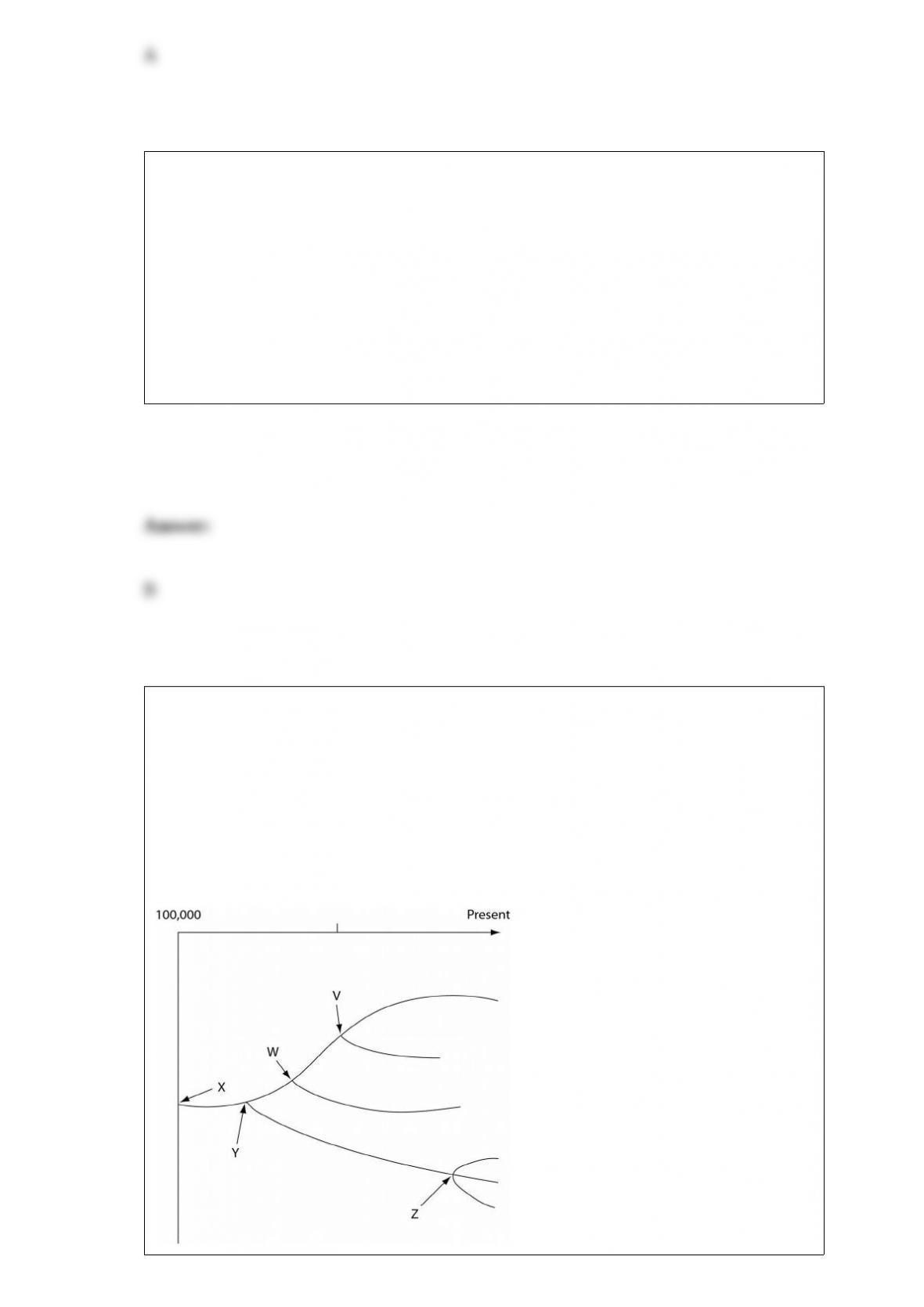
The following questions refer to the evolutionary tree in the figure below.
The horizontal axis of the cladogram depicted below is a timeline that extends from
100,000 years ago to the present; the vertical axis represents nothing in particular. The
labeled branch points on the tree (V-Z) represent various common ancestors. Let’s say
that only since 50,000 years ago has there been enough variation between the lineages
depicted here to separate them into distinct species, and only the tips of the lineages on
this tree represent distinct species.

Evolutionary trees such as this are properly understood by scientists to be _____.
A) theories
B) hypotheses
C) dogmas
D) facts
An inactivating mutation in the progesterone receptor gene would likely result in
_____.
A) the absence of secondary sex characteristics
B) the inability of the uterus to support pregnancy
C) enlarged and hyperactive uterine endometrium
D) the absence of mammary gland development