
The bile salts _____.
A) are enzymes
B) are manufactured by the pancreas
C) emulsify fats in the duodenum
D) are normally an ingredient of gastric juice
To understand the chemical basis of inheritance, we must understand the molecular
structure of DNA. This is an example of the application of which concept to the study
of biology?
A) evolution
B) emergent properties
C) reductionism
D) feedback regulation
The following figure depicts the outline of a large fairy ring that has appeared overnight
in an open meadow, as viewed from above. The fairy ring represents the furthest
advance of this mycelium through the soil. Locations A-D are all 0.5 meters below the
soil surface.
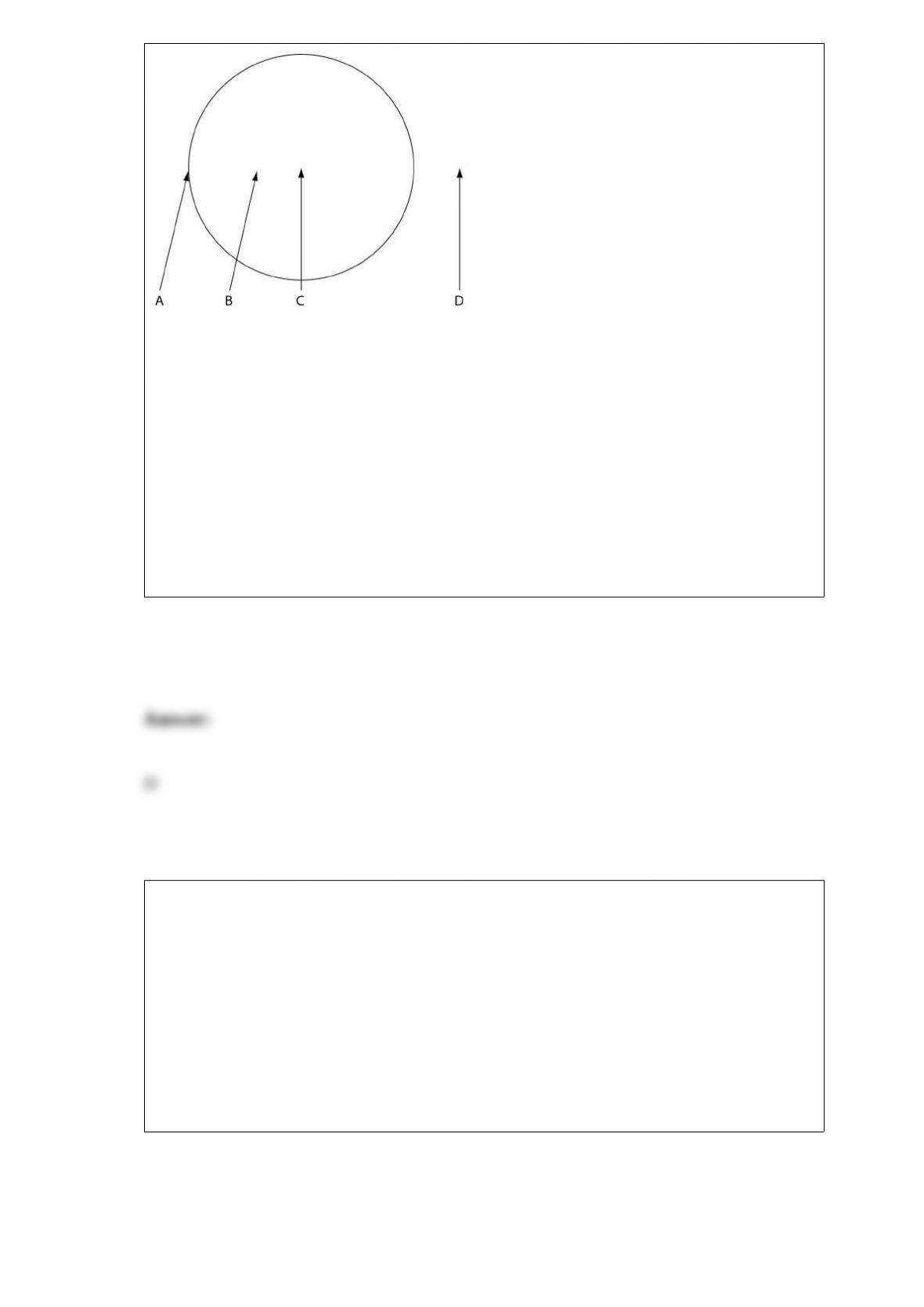
At which location should one find the lowest concentration of fungal enzymes,
assuming that the enzymes do not diffuse far from their source, and that no other fungi
are present in this habitat?
A) A
B) B
C) C
D) D
Which of the following best describes the physical relationship of the partners involved
in lichens?
A) Fungal cells are enclosed within algal cells.
B) Lichen cells are enclosed within fungal cells.
C) Photosynthetic cells are surrounded by fungal hyphae.
D) The fungi grow on rocks and trees and are covered by algae.

The coordination of groups of skeletal muscles is driven by activity in the _____.
A) cerebrum
B) cerebellum
C) thalamus
D) medulla oblongata
If you were to jog one kilometer a few hours after lunch, which stored fuel would you
probably tap?
A) muscle proteins
B) liver glycogen and muscle glycogen
C) fat stored in adipose tissue
D) blood proteins

Gene S controls the sharpness of spines in a type of cactus. Cactuses with the dominant
allele, S, have sharp spines, whereas homozygous recessive ss cactuses have dull
spines. At the same time, a second gene, N, determines whether or not cactuses have
spines. Homozygous recessive nn cactuses have no spines at all. If doubly heterozygous
SsNn cactuses were allowed to self-pollinate, the F2 would segregate in which of the
following ratios?
A) 3 sharp-spined:1 spineless
B) 1 sharp-spined:2 dull-spined:1 spineless
C) 1 sharp-spined:1 dull-spined:1 spineless
D) 9 sharp-spined:3 dull-spined:4 spineless
The beginning of anaphase is indicated by which of the following?
A) Chromatids lose their kinetochores.
B) Cohesin attaches the sister chromatids to each other.
C) Cohesin is cleaved enzymatically.
D) Spindle microtubules begin to polymerize.
Which of the following are maternal effect genes that control the orientation of the egg
and thus the Drosophila embryo?

A) homeotic genes
B) segmentation genes
C) egg-polarity genes
D) morphogens
The osmoregulatory/excretory system of a freshwater flatworm is based on the
operation of _____.
A) protonephridia
B) metanephridia
C) Malpighian tubules
D) nephrons
Which of the following is most like the formation of identical twins?
A) cell cloning
B) therapeutic cloning
C) use of adult stem cells

D) organismal cloning
You observe a species of bird that, upon hatching, has contact with its parents only
while being fed. You also never hear the parents sing during the feeding process. What
would you propose about song learning in this species of bird?
A) Song learning in this species is most likely learned.
B) The period of imprinting is likely later in the bird’s life.
C) The males will learn song when they congregate with other males of their species
during the winter.
D) Song learning in this species is most likely innate.
In a plant cell, where are the ATP synthase complexes located?
A) thylakoid membrane only
B) inner mitochondrial membrane only
C) thylakoid membrane and inner mitochondrial membrane
D) thylakoid membrane and plasma membrane

What is the role of DNA ligase in the elongation of the lagging strand during DNA
replication?
A) It synthesizes RNA nucleotides to make a primer.
B) It joins Okazaki fragments together.
C) It unwinds the parental double helix.
D) It stabilizes the unwound parental DNA.
You are hiking in a forest and come upon a mysterious plant, which you determine is
either a lycophyte sporophyte or a pterophyte sporophyte. Which of the following
would be most helpful in determining the correct classification of the plant?
A) whether or not it has true leaves
B) whether it has microphylls or megaphylls
C) whether or not it has seeds
D) its height

You have a planar bilayer with equal amounts of saturated and unsaturated
phospholipids. After testing the permeability of this membrane to glucose, you increase
the proportion of unsaturated phospholipids in the bilayer. What will happen to the
membrane’s permeability to glucose?
A) Permeability to glucose will increase.
B) Permeability to glucose will decrease.
C) Permeability to glucose will stay the same.
D) You cannot predict the outcome. You simply have to make the measurement.
In the polymerization of DNA, a phosphodiester bond is formed between a phosphate
group of the nucleotide being added and _____ of the last nucleotide in the polymer.
A) the phosphate
B) C6
C) the OH
D) a nitrogen from the nitrogen-containing base

Use the following information to answer the question(s) below.
In onions (Allium), cells of the sporophyte have 16 chromosomes within each nucleus.
Match the number of chromosomes present in each of the following onion tissues.
How many chromosomes should be in an endosperm nucleus?
A) 8
B) 16
C) 24
D) 32
A simple nervous system _____.
A) must include chemical senses, mechanoreception, and vision
B) includes a minimum of twelve effector neurons
C) has information flow in only one direction: away from an integrating center
D) includes sensory information, an integrating center, and effectors
The lactose operon is likely to be transcribed when _____.

A) there is more glucose in the cell than lactose
B) there is glucose but no lactose in the cell
C) the cyclic AMP and lactose levels are both high within the cell
D) the cAMP level is high and the lactose level is low
If a cell has completed meiosis I and is just beginning meiosis II, which of the
following is an appropriate description of its contents?
A) It has half the amount of DNA as the cell that began meiosis.
B) It has half the chromosomes but twice the DNA of the originating cell.
C) It has one-fourth the DNA and one-half the chromosomes as the originating cell.
D) It is identical in content to another cell formed from the same meiosis I event.
Movement (wildlife) corridors can be harmful to certain species because they _____.
A) increase inbreeding
B) spread disease and parasites
C) increase genetic diversity

D) allow seasonal migration
Bagworm moth caterpillars feed on evergreens and carry a silken case or bag around
with them in which they eventually pupate. Adult female bagworm moths are larval in
appearance; they lack the wings and other structures of the adult male and instead retain
the appearance of a caterpillar even though they are sexually mature and can lay eggs
within the bag. This is a good example of _____.
A) allometric growth
B) paedomorphosis
C) sympatric speciation
D) adaptive radiation
Which of the following is the correct sequence that describes the excitation and
contraction of a skeletal muscle fiber?
1. Tropomyosin shifts and unblocks the cross-bridge binding sites.
2. Calcium is released and binds to the troponin complex.
3. Transverse tubules depolarize the sarcoplasmic reticulum.
4. The thin filaments are ratcheted across the thick filaments by the heads of the myosin
molecules using energy from ATP.

5. An action potential in a motor neuron causes the axon to release acetylcholine, which
depolarizes the muscle cell membrane.
A) 1 → 2 → 3 → 4 → 5
B) 2 → 1 → 3 → 5 → 4
C) 2 → 3 → 4 → 1 → 5
D) 5 → 3 → 2 → 1 → 4
Water molecules can form hydrogen bonds with _____.
A) compounds that have polar covalent bonds
B) oils
C) oxygen gas (O2) molecules
D) chloride ions
Which of the following correctly describes a difference between spermatogenesis and
oogenesis?
A) Spermatogenesis results in four mature sperm cells, while oogenesis results in one
mature egg cell.

B) Spermatogenesis results in one mature sperm cell, while oogenesis results in four
mature egg cells.
C) In spermatogenesis, mitosis occurs twice and meiosis once, while in oogenesis,
mitosis occurs once and meiosis twice.
D) Spermatogenesis results in four mature sperm cells, while oogenesis results in one
mature egg cell. In spermatogenesis, mitosis occurs twice and meiosis once, while in
oogenesis, mitosis occurs once and meiosis twice.
Mutations that occur in one member of a gene pair that arose from gene duplication
may create _____.
A) a pseudogene
B) a gene with a new function
C) a gene family with two distinct but related members
D) a pseudogene, a gene with a new function, and a gene family with two distinct but
related members
Recall the caterpillar experiment in which caterpillars born in the spring looked like
flowers, and caterpillars born in the summer looked like twigs. What is the most likely
selective advantage for this difference in body shape?
A) Looking like their food sources allows the caterpillars to move through their
environment more efficiently.
B) Development into the adult moth form is faster for caterpillars shaped like twigs
than like flowers.
C) Looking like their food source lets the caterpillars blend into their surroundings,
reducing predation.
D) Looking like their food source will increase the caterpillars’ feeding efficiency; this
would increase their growth rate and survival rate.
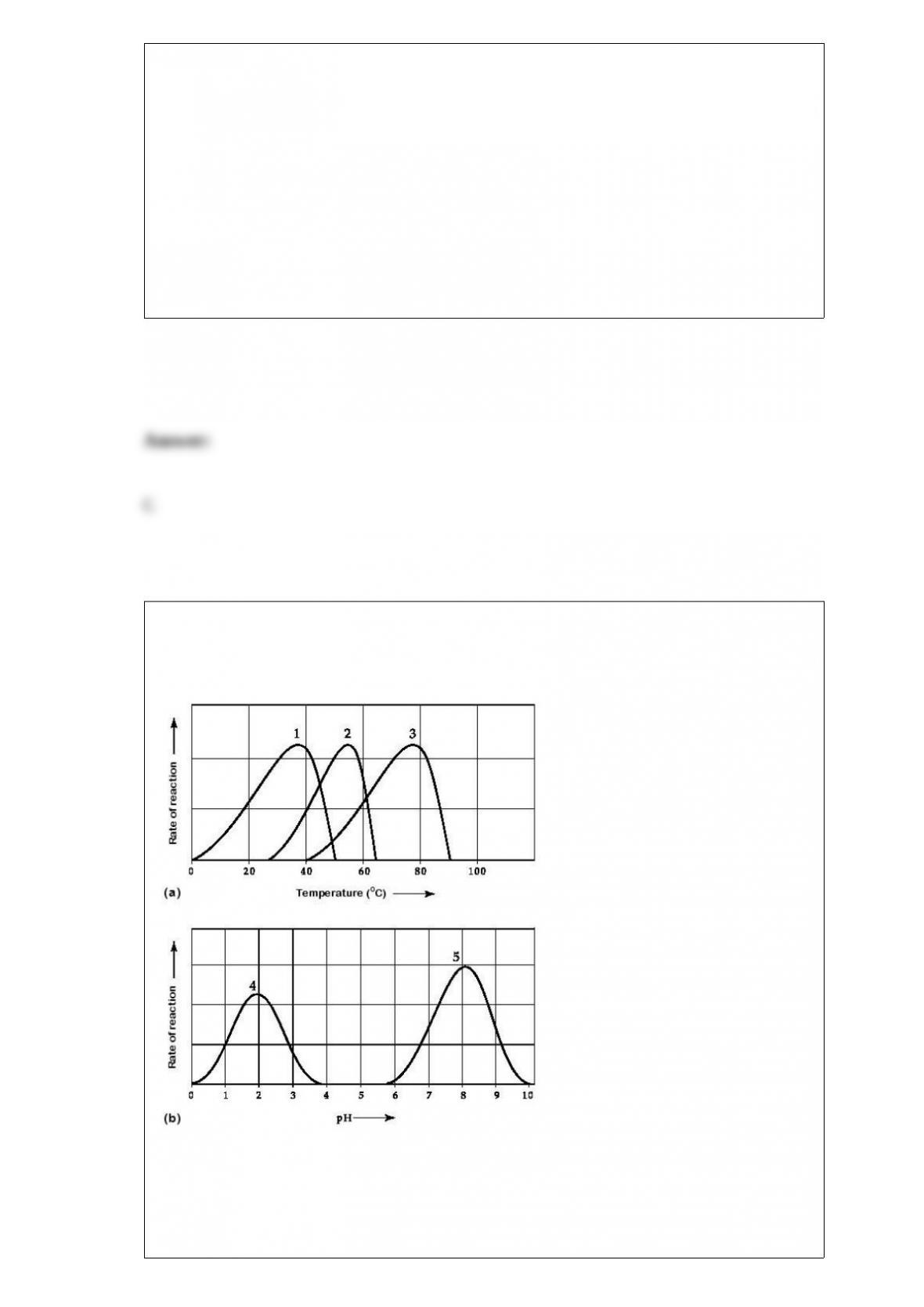
Activity of various enzymes at various temperatures (a) and at various pH (b).
Which temperature and pH profile curves on the graphs were most likely generated
from analysis of an enzyme from a human stomach where conditions are strongly acid?

A) curves 1 and 4
B) curves 1 and 5
C) curves 2 and 4
D) curves 3 and 4
Antidiuretic hormone (ADH) and the renin-angiotensin-aldosterone system (the RAAS)
work together in maintaining osmoregulatory homeostasis through which of the
following ways?
A) ADH regulates the osmolarity of the blood by altering renal reabsorption of water,
and the RAAS maintains the osmolarity of the blood by stimulating Na+ and water
reabsorption.
B) ADH and the RAAS work antagonistically; ADH stimulates water reabsorption
during dehydration and the RAAS causes increased excretion of water when it is in
excess in body fluids.
C) Both stimulate the adrenal gland to secrete aldosterone, which increases both blood
volume and pressure via its receptors in the urinary bladder.
D) ADH and the RAAS combine at the receptor sites of proximal tubule cells, where
reabsorption of essential nutrients takes place.
Feather color in budgies is determined by two different genes, Y and B, one for pigment

on the outside and one for the inside of the feather. YYBB, YyBB, or YYBb is green;
yyBB or yyBb is blue; YYbb or Yybb is yellow; and yybb is white. A blue budgie is
crossed with a white budgie. Which of the following results is NOTpossible?
A) green offspring only
B) yellow offspring only
C) blue offspring only
D) green and yellow offspring
Which of the following is the most likely explanation for hypothyroidism in a patient
whose iodine level is normal?
A) greater production of T3 than of T4
B) hyposecretion of thyroid-stimulating hormone (TSH)
C) hypersecretion of thyroid-stimulating hormone (TSH)
D) a decrease in the thyroid secretion of calcitonin
Endosymbiosis is an evolutionary theory that explains the origin of eukaryotes and
suggests a specific order in which this might have occurred. Ancestral cells engulfed
and then began to use the metabolic processes of the smaller cells. Based on shared core
processes and features, which statement most accurately describes the order, the theory

and the evolutionary implications for all organisms within domain Eukarya?
A) Ancestral heterotrophic eukaryotes most likely engulfed both a heterotrophic and an
autotrophic prokaryote, whereas ancestral photosynthetic eukaryotes probably provided
the host cell for the first mitochondria. Over time, natural selection favored these
relationships and these cells became ancestors of all eukaryotes.
B) All ancestral eukaryotes would have most likely consumed a nucleus-like prokaryote
that eventually became the eukaryotic nucleus. These new eukaryotic cells would have
had an advantage over prokaryotic cells by acquiring a nuclear command center for
regulating cellular activities.
C) As carbon dioxide levels were increasing over time, natural selection would have
favored organisms that acquired a photosynthetic prokaryote to convert carbon dioxide
into sugars. These would have likely been the first eukaryotic cells. At which point,
these ancestral cells engulfed mitochondria-like prokaryotes that would have provided
an even greater advantage for cells in this environment.
D) As Earth was becoming more aerobic, mitochondria would have provided an
advantage to host cells by converting “toxic” oxygen into energy for heterotrophic cells.
Since mitochondria are found in all eukaryotes, these combinations likely evolved first.
Photosynthetic eukaryotes probably acquired an autotrophic prokaryote, which
developed an advantageous symbiotic relationship with the host cell.
If the experimental population of E. coli lacks an F factor or F plasmid, and if
bacteriophages are excluded from the bacterial cultures, then beneficial mutations might
be transmitted horizontally to other E. coli cells via _____.
A) sex pili
B) transduction
C) conjugation
D) transformation

The polarity of a plant is established when _____.
A) cotyledons form at the shoot end of the embryo
B) the shoot-root axis is established in the embryo
C) the primary root breaks through the seed coat
D) the shoot first breaks through the soil into the light as the seed germinates