26) Which of the following techniques is NOT used to introduce recombinant DNA into plants?
A) gene guns
B) protoplast fusion
C) Ti plasmids and Agrobacterium
D) microinjection
E) electroporation
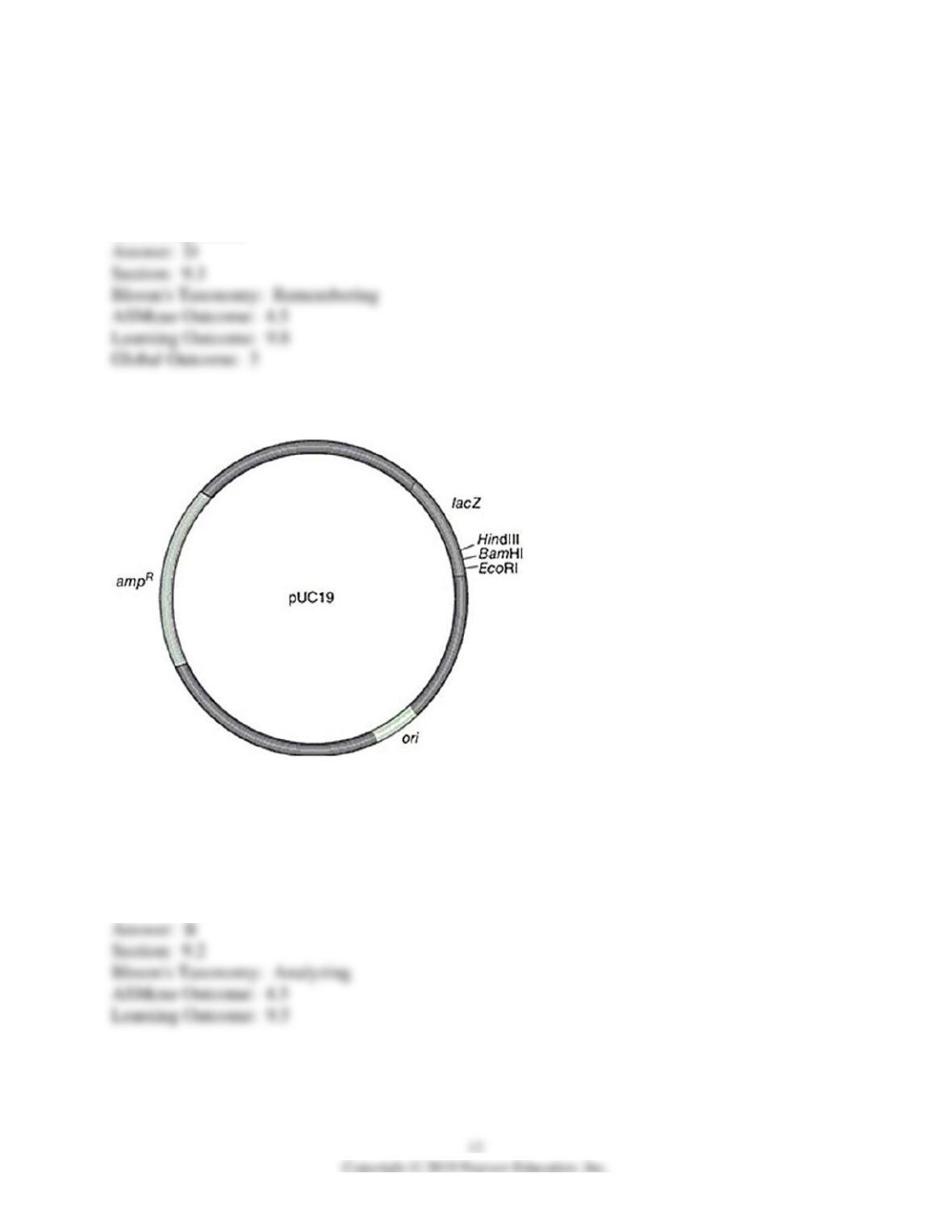
Figure 9.5
27) In Figure 9.5, the marker genes used for selecting recombinant DNA are
A) HindIII, BamHI, and EcoRI.
B) ampR and lacZ.
C) ori.
D) ampR and ori.
E) lacZ and ori.

28) In Figure 9.5, the gene that allows the plasmid to be self-replicating is
A) HindIII.
B) ampR.
C) ori.
D) EcoRI.
E) lacZ.
29) Which of the following methods would be used to introduce the plasmid shown in Figure 9.5
into E. coli?
A) microinjection
B) transformation
C) gene guns
D) Ti plasmids and Agrobacterium
30) A source of heat-stable DNA polymerase is
A) Agrobacterium tumefaciens.
B) Thermus aquaticus.
C) Saccharomyces cerevisiae.
D) Bacillus thuringiensis.
E) Pseudomonas.
31) The Pap test for cervical cancer involves microscopic examination of cervical cells for
cancerous cells. A new, rapid diagnostic test to detect human papilloma virus (HPV) DNA
before cancer develops is done without microscopic exam. The steps involved in this FastHPV
test are listed below. What is the second step?
A) Add an RNA probe for HPV DNA.
B) Lyse human cells.
C) Add enzyme-linked antibodies against DNA-RNA.
D) Add enzyme substrate.
E) The order is unimportant.
32) Accomplishments of rDNA methods for agriculture include
A) antisense DNA to prevent softening of tomatoes.
B) Pseudomonas expressing Bt toxin.
C) disease resistant food animals.
D) antisense DNA and disease resistant food animals.
E) antisense DNA, Bt-expressing Pseudomonas and disease resistant food animals.
33) You want to determine whether a person has a certain mutant gene. The process involves
using a primer and a heat-stable DNA polymerase. This process is
A) translation.
B) restriction mapping.
C) transformation.
D) PCR.
E) site-directed mutagenesis.

34) Which of the following are used by the Centers for Disease Control and Prevention to track
outbreaks of foodborne disease?
A) DNA fingerprints
B) restriction fragment length polymorphisms
C) reverse-transcriptase PCR (rtPCR)
D) DNA fingerprints and restriction fragment length polymorphisms
E) DNA fingerprints, restriction fragment length polymorphisms, and reverse-transcriptase
PCR(rtPCR)
35) Assume you have discovered a cell that produces a lipase that works in cold water for a
laundry additive. You can increase the efficiency of this enzyme by changing one amino acid.
This is done by
A) irradiating the cells.
B) site-directed mutagenesis.
C) enrichment.
D) selective breeding.
E) selection.
36) The use of an antibiotic-resistance gene on a plasmid used in genetic engineering makes
A) replica plating possible.
B) direct selection possible.
C) the recombinant cell dangerous.
D) the recombinant cell unable to survive.
E) All of the answers are correct.

37) The following steps must be performed to make a bacterium produce human
protein X.
1-Translation
2-Restriction enzyme
3-Prokaryotic transcription
4-DNA ligase
5-Transformation
6-Eukaryotic transcription
7-Reverse transcription
Which of the following places the steps in the correct order?
A) 5, 2, 3, 4, 7, 6, 1
B) 1, 2, 3, 5, 4, 7, 6
C) 6, 7, 2, 3, 4, 5, 1
D) 6, 7, 2, 4, 5, 3, 1
E) 6, 2, 1, 3, 4, 5, 7
38) The use of “suicide” genes in genetically modified organisms is designed to
A) prevent the growth of the modified organisms in the environment.
B) kill the modified organisms before they are released in the environment.
C) delete genes necessary for modified organism’s growth.
D) provide for resistance of the modified organisms to pesticides.
E) provide a means to eliminate non-modified organisms.
39) A restriction fragment is
A) a gene.
B) a segment of DNA.
C) a segment of mRNA.
D) a segment of tRNA.
E) cDNA.

40) In the Southern blot technique, which of the following is NOT required?
A) transfer of DNA to nitrocellulose
B) addition of a labeled probe to identify the gene of interest
C) restriction enzyme digestion of DNA
D) electrophoresis to separate fragments
E) addition of heat-stable DNA polymerase to amplify DNA
41) Which of the following processes is NOT involved in making cDNA?
A) reverse transcription
B) RNA processing to remove introns
C) transcription
D) translation
42) PCR can be used to identify an unknown bacterium because
A) the DNA primer is specific to particular target DNA sequences.
B) DNA polymerase will replicate any bacterial DNA.
C) DNA can be electrophoresed.
D) all cells have DNA.
E) all cells have RNA.
43) The random shotgun method is used in
A) amplification of unknown DNA.
B) transforming plant cells with recombinant DNA.
C) genome sequencing.
D) RFLP analysis.
E) forensic microbiology.

44) Restriction enzymes function as
A) bacterial enzymes that splice DNA.
B) bacterial enzymes that destroy phage DNA.
C) animal enzymes that splice RNA.
D) viral enzymes that destroy host DNA.
45) The study of genetic material taken directly from the environment is
A) bioinformatics.
B) proteomics.
C) reverse genetics.
D) forensic microbiology.
E) metagenomics.
46) Choose the best pair to complete the following sentence. While ________ is/are responsible
for the diversity of life, ________ is/are responsible for shaping a population with organisms
possessing characteristics that enhance survival.
A) vectors; rDNA.
B) microbes; DNA.
C) properties; vectors.
D) selection; mutations.
E) mutations; selection.
47) One advantage of a viral vector over a plasmid vector is that the
A) viral vector can accept much larger pieces of DNA.
B) plasmid vector is circular.
C) viral vector can accept a PCR fragment.
D) viral vector can harbor a selection marker.
E) the viral vector can accept larger pieces of DNA and the plasmid vector is circular.

48) An advantage of using Saccharomyces cerevisiae over Escherichia coli to produce a human
protein is that
A) it will be more likely to continuously secrete the protein.
B) it will be less likely to express the protein.
C) it has a genome only 4 times larger than E. coli.
D) its genome is well understood unlike E. coli.
E) it can be engineered to produce human proteins unlike E. coli.
49) RNAi technology involves
A) introducing a vector with an siRNA sequence into a cell.
B) stimulating reverse transcriptase to produce mRNA.
C) preventing protein production by destroying specific mRNA.
D) sequencing small pieces of the genome and assembling them with a computer.
E) both introducing siRNA into a cell and destroying specific mRNA.
50) The fact that people continue to be concerned about the safety of DNA technology can be
attributed to the following:
A) It is impossible to prove something is safe under all conceivable conditions.
B) Science can definitively disprove hypotheses but can only provide supporting evidence for
hypotheses.
C) People are suspicious of science, in general.
D) There is mounting scientific evidence that DNA technology is unsafe.
E) Both that it is impossible to prove something is safe under all conditions and that science can
only provide supporting evidence for hypotheses.

9.2 True/False Questions
1) The term biotechnology refers exclusively to the use of genetically engineered organisms for
the production of desired products.
2) In recombinant DNA technology, a vector is a self-replicating segment of DNA, such as a
plasmid or viral genome.
3) The practice of breeding plants and animals for desirable traits, such as high crop yield, is
called natural selection.
4) A shuttle vector is a plasmid that is used to move pieces of DNA among organisms, such as
bacterial, fungal, and plant cells.
5) Nearly all cells, including E. coli and yeast, naturally take up DNA from their surroundings
without chemical treatment.
6) The disadvantage of genomic libraries over cDNA libraries is that genomic libraries contain
gene introns.
7) One of the first commercial successes of recombinant DNA technology was the production of
human insulin using genetically engineered E. coli.
8) Bioinformatics is the use of computer technology to compare and analyze genome sequence.
9) The Ti plasmid isolated from Agrobacterium can be used to insert DNA into any type of plant.
10) The Bt toxin derived from Bacillus thuringiensis has been introduced into some crop plants
to make them resistant to insect destruction.
9.3 Essay Questions
1) The local public health agency has received reports of an outbreak of Salmonella
gastroenteritis among attendees at a city-sponsored chili cook-off. What techniques from
recombinant DNA technology would the agency likely use to investigate this outbreak? Describe
the expected results from these techniques.

2) Pseudomonas syringae is found naturally in the soil. Sold as Snomax, it is used to make snow
at ski resorts. The same bacterium with a gene deletion (Ice-minus) is used to prevent ice
formation on plants. Should Snomax and Ice-minus be considered modified organisms and
subject to precautions of releasing genetically modified organisms? Explain why or why not.
3) Your research group is investigating the possible use of genetically-engineered cells to
produce a vaccine for malaria. List the pros and cons of using E. coli, Saccharomyces, and
animal cells to produce the vaccine.
4) The development of DNA technology is bringing profound changes to science, agriculture and
healthcare. Provide one example of a DNA technology and provide at least one advantage and
one example of a concern or problem associated with its use.