Microbiology with Diseases by Body System, 5e (Bauman)
Chapter 9 Controlling Microbial Growth in the Environment
9.1 Multiple Choice Questions
1) Washing dishes in the dishwasher with detergent and hot water is a ________ process.
A) antiseptic
B) disinfecting
C) sterilizing
D) sanitizing
E) degerming
2) Which of the following statements is TRUE of disinfectants?
A) They are effective in destroying endospores.
B) They are used on living tissue.
C) They are used for sterilization.
D) They are used on inanimate surfaces.
E) They are only effective for short periods of time (seconds to minutes).
3) You notice a sign in a public restroom that states “Sanitized for your safety.” This means
A) sterilizing chemicals have been used in cleaning.
B) antiseptics have been used to clean the area.
C) degerming methods only have been used to clean the restroom.
D) methods of disinfection that meet minimum standards of microbial removal have been used.
E) only “organic” chemicals were used in the cleaning process to reduce microbial numbers.
4) Which of the following is an example of pasteurization?
A) A public toilet is treated with disinfectants.
B) A surgeon washes her hands before surgery.
C) Heat is used to kill potential pathogens in apple juice.
D) An autoclave is used to prepare nutrient agar.
E) A nurse prepares an injection site with an alcohol swab.
5) Aseptic means
A) sterile.
B) free of all microbes.
C) clean.
D) sanitized.
E) free of pathogens.
6) Methods of microbial control called ________ arrest the growth of microbes.
A) microbicial
B) microbistatic
C) sanitizing
D) degerming
E) antiseptic
7) Antimicrobial agents that damage nucleic acids also affect
A) the cell wall.
B) the cell membrane.
C) the viral envelope.
D) endospores.
E) protein synthesis.
8) A chemical agent that dissolves lipids can damage
A) cells.
B) bacterial endospores.
C) enveloped viruses.
D) nonenveloped and enveloped viruses.
E) cells and enveloped viruses.
9) An instrument that will come into contact with only the skin of a patient should be disinfected
with a(n)
A) high-level germicide.
B) low-level germicide.
C) intermediate-level germicide.
D) degerming agent only.
E) germistatic agent only.
10) Which of the following is the most difficult to inactivate?
A) enveloped viruses
B) fungus spores
C) bacterial endospores
D) nonenveloped viruses
E) protozoan cysts
11) Which of the following describes flash pasteurization?
A) heating at 63°C for 30 minutes
B) heating at 72°C for 15 seconds
C) heating at 72°C for 15 minutes
D) heating at 134°C for one second
E) passing liquid through steam at 140°C
12) Which of the following is bacteriostatic?
A) heating in an oven at 171°C for an hour
B) freezing below 0°C
C) filtration
D) autoclaving
E) flash pasteurization
13) Boiling water for 10 minutes is effective in ridding it of
A) actively growing bacteria.
B) enveloped viruses.
C) bacterial endospores.
D) protozoan cysts.
E) both growing bacteria and enveloped viruses.
14) Which of the following is NOT a feature associated with filtration?
A) nitrocellulose or plastic membrane filters
B) sterilization of heat-sensitive materials
C) varying thicknesses of membrane filters used
D) use of HEPA filters to filter air
E) ability of some filters to trap viruses and proteins
15) Ultra-high-temperature sterilization effectively
A) reduces microbes that cause spoilage.
B) removes only mesophilic microbes.
C) reduces microbes that cause disease.
D) removes all microbes that cause diseases or spoilage.
E) reduces microbes that cause disease or spoilage.
16) Which of the following types of radiation is nonionizing and has the shortest wavelength?
A) ultraviolet light
B) infrared radiation
C) microwaves
D) X rays
E) gamma rays
17) Which of the following is used for microbial control in fresh fruits and vegetables?
A) X rays
B) ultraviolet light
C) electron beams
D) microwaves
E) gamma rays
18) Which of the following can be used to reduce microbes in the air of a patient’s room?
A) HEPA filters
B) ethylene oxide
C) ultraviolet light
D) both HEPA filters and ultraviolet light
E) both ethylene oxide and ultraviolet light
19) Silvadene, a topical treatment for burns, contains 1% silver. What category of chemical
control agent is in Silvadene?
A) halogens
B) heavy metals
C) oxidizing agents
D) aldehydes
E) surfactants
20) Which of the following is the most appropriate pairing of microbe and biosafety level?
A) E. coli, BSL-3
B) anthrax, BSL-1
C) Ebola, BSL-2
D) methicillin-resistant Staphylococcus aureus (MRSA), BSL-2
E) tuberculosis, BSL-1
21) The use of lysozyme during the preparation of cheeses and wines is effective in reducing the
numbers of
A) fungi.
B) viruses.
C) bacteria.
D) prions.
E) all microbes.
22) Seventy percent alcohol is effective against
A) enveloped viruses.
B) nonenveloped viruses.
C) bacterial endospores.
D) protozoan cysts.
E) prions.
23) Which of the following is a sterilizing agent?
A) ozone
B) hydrogen peroxide
C) peracetic acid
D) dish soap
E) ozone and hydrogen peroxide
24) Quaternary ammonium compounds are disinfectants effective against
A) endospores.
B) mycobacteria.
C) nonenveloped viruses.
D) Pseudomonas aeruginosa.
E) enveloped viruses.
25) Which of the following is used to sterilize items that should not, or cannot, be exposed to
heat or water?
A) ethylene oxide
B) formaldehyde
C) hydrogen peroxide
D) calcium hypochlorite
E) triclosan
26) What effect do aldehydes have on microbial organisms?
A) They disrupt cytoplasmic membranes.
B) They inhibit enzymes.
C) They damage nucleic acids.
D) They disrupt membranes and enzyme function.
E) They damage proteins and DNA.
27) Disinfecting agents naturally produced by microorganisms are
A) aldehydes.
B) antibiotics.
C) halogens.
D) quaternary ammonium compounds.
E) triclosans.
28) A chemical agent that kills pathogenic microbes in general is a(n)
A) sanitizer.
B) germicide.
C) disinfectant.
D) fungicide.
E) antiseptic.
29) Which of the following is NOT a desirable characteristic of an ideal antimicrobial agent?
A) It is inexpensive.
B) It is stable during storage.
C) It is harmless to humans.
D) It only arrests growth of vegetative cells.
E) It acts quickly.
30) Why are endospores used to measure the effectiveness of autoclave sterilization?
A) Endospores are easy to store in the lab until needed.
B) Endospores are very simple structures and easy to detect.
C) Endospores are very hard to kill.
D) Endospores are composed of all the molecules found in living cells.
E) Endospores of different bacteria are destroyed at different temperatures and can be used to
calibrate autoclave temperatures.
31) A scientist develops a new medication that is a protein compound and that must be
administered by injection. Which of the following would be the most effective and safest means
of preparing a sterile solution of the new medication?
A) autoclaving
B) filtration
C) dilution with alcohol
D) lyophilization
E) ultraviolet irradiation
32) Which of the following procedures is currently the standard test used in the United States for
evaluating the efficiency of antiseptics and disinfectants?
A) use-dilution test
B) microbial death rate
C) in-use test
D) Kelsey-Sykes capacity test
E) phenol coefficient
33) Which of the following would be used to sterilize a mattress?
A) autoclaving
B) formaldehyde
C) ethylene oxide
D) heavy metals
E) non-ionizing radiation
34) Disinfectants that damage membranes include
A) alcohol.
B) phenolics.
C) iodine.
D) hydrogen peroxide.
E) both alcohol and phenolics.
35) Which of the following antimicrobial agents is the most toxic to humans?
A) 70% alcohol
B) ethylene oxide
C) quaternary ammonium compounds
D) chloramines
E) iodophors
36) The process of filtration is a(n)
A) disinfectant method.
B) sterilizing method.
C) sanitization method.
D) antiseptic procedure.
E) ineffective method for removing microbes.
37) Hydrogen peroxide is an effective
A) sterilizing agent.
B) disinfectant.
C) antiseptic.
D) disinfecting and sterilizing agent.
E) antiseptic and disinfectant.
38) The process of incineration is used for
A) sterilization.
B) degerming.
C) disinfection.
D) sanitization.
E) both disinfection and sanitization.
39) Alcohols are used for
A) disinfection.
B) sterilization.
C) antisepsis.
D) both sterilization and disinfection.
E) both antisepsis and disinfection.
40) Quaternary ammonium compounds (“quats”) are used for
A) antisepsis.
B) disinfection.
C) sterilization.
D) quantifying antimicrobial activity.
E) both antisepsis and disinfection.
41) The compound ethylene oxide is used in
A) sanitization.
B) sterilization.
C) antisepsis.
D) degerming.
E) disinfection.
42) Formalin (37% formaldehyde) is used for
A) antisepsis.
B) disinfection.
C) sterilization.
D) sanitization.
E) both disinfection and sterilization.
43) Betadine contains what type of chemical agent?
A) alcohol
B) aldehyde
C) halogen
D) heavy metal
E) phenolic
44) Gamma irradiation is effective for sterilization because it
A) damages molecules irreversibly.
B) is non-ionizing.
C) penetrates well.
D) destroys protein function, although DNA is undamaged.
E) is penetrating and causes extensive molecular damage.
45) Desiccation, a time-honored method of preserving food, is effective because the
A) heat of the process kills microbes.
B) freezing step of the process kills microbes.
C) salt concentration is too low to support metabolic function.
D) UV light used in the process of sun drying penetrates effectively.
E) water content is too low to support metabolic function.
9.2 True/False Questions
1) Using an alcohol pad before taking a blood sample is an example of antisepsis.
2) Protozoan cysts are resistant to many disinfection methods.
3) Refrigeration is an effective germicidal method.
4) Antimicrobial agents usually work best at high temperatures and high pH levels.
5) The phenol coefficient is one of the most widely used measurements of an antimicrobial
agent’s effectiveness.
6) Lysozyme is effective against nearly all disease causing agents.
7) The decimal reduction time is the time required to kill all the microbes in a given sample.
8) Slow freezing is more damaging to microbial cells than quick freezing.
9) The cell walls of mycobacteria make them vulnerable to water soluble chemical agents.
10) By themselves, soaps have only degerming activity, not antimicrobial activity.
9.3 Short Answer Questions
1) The process of freeze-drying microbes to preserve them is
(denaturation/desiccation/lyophilization).
2) Natural antiseptics such as pine or clove oil are examples of antimicrobial compounds called
(alcohols/phenolics/detergents).
3) The microbial death rate is (constant/nonlinear/variable) over time.
4) Disinfectants known as (alcohols/oxidizers/aldehydes) have the chemical group -CHO, which
reacts with and damages both proteins and nucleic acids.
5) The lowest temperature that kills all cells in a broth in 10 minutes is known as the
(microbial/terminal/thermal) death point.
6) The amount of time needed to sterilize materials using moist heat is (more/less) than the time
needed to sterilize using dry heat.
7) Microbial growth in jellies is inhibited by the (acidic/hypotonic/hypertonic) condition of the
food.
8) The deadliest, most contagious microbes are studied under conditions of (BSL-4/BSL-3/BSL-
2/BSL-1) containment.
9) Ultraviolet light penetrates (more/less) effectively than gamma rays.
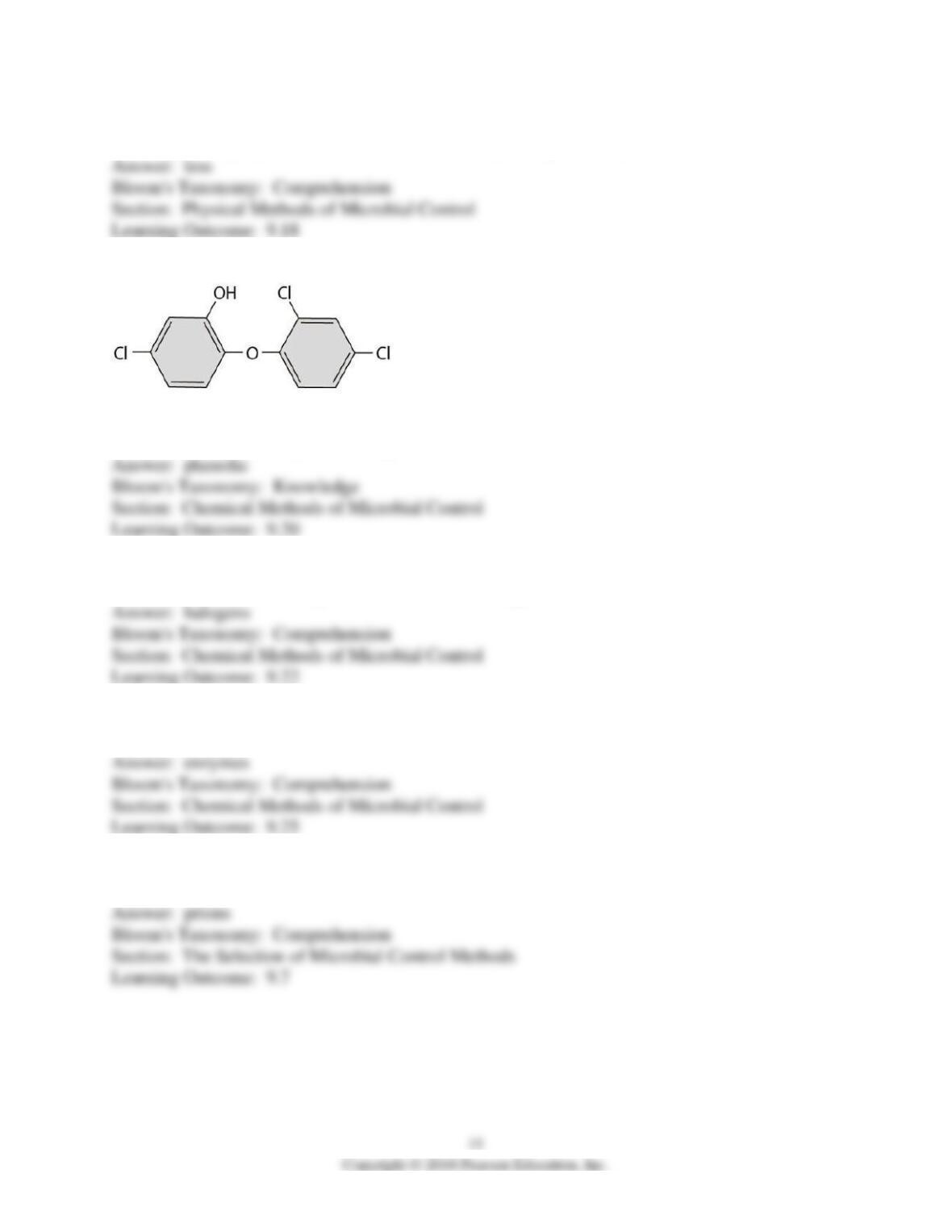
10)
The antimicrobial chemical pictured above in Figure 9.1 is a(n) (phenolic/surfactant/enzyme)
compound found in many consumer products.
11) Elements such as iodine, chlorine, and bromine are examples of (oxidizers/halogens/metals),
which are the basis for many effective antimicrobial agents.
12) Heavy metal and oxidizing agent disinfectants damage (DNA/enzymes/membranes),
interfering with microbial metabolism.
13) The (endospores/cysts/prions) are the infectious agents most resistant to antimicrobial agents
or processes.
14) Long-term storage of milk is made possible by ultra-high-temperature
(pasteurization/sanitization/sterilization).
15) The physical removal of microbes is called (antisepsis/degerming/disinfection).
9.4 Essay Questions
1) Some sterilization procedures do not kill all the microbes that may be present. Explain how
these procedures may, for practical purposes, still be considered sterilization.
2) Compare and contrast the different uses of heat to reduce microbial contamination, including
their relative efficacy.
3) What is the in-use test, and why is it more useful than other methods of evaluating
disinfectants?
4) Design an experiment to compare the effectiveness of a physical and a chemical method of
disinfection.
5) A student is shopping for antibacterial hand cleansers and is trying to decide which one to
buy. One is a “waterless” hand gel containing 70% isopropanol, the second is an “antibacterial”
hand soap containing triclosan (a phenolic), and the third is a wipe that lists benzethonium
chloride (a synthetic quaternary ammonium salt) as the active ingredient. Compare and contrast
these cleansers in terms of the action of the antimicrobial ingredient and the level of disinfection
(degerming, germistatic, germicidal).