
Microbiology: An Introduction, 13e (Tortora et al.)
Chapter 9 Biotechnology and DNA Technology
9.1 Multiple-Choice Questions
1) The following are steps used to make DNA fingerprints. What is the third step?
A) Collect DNA.
B) Digest with a restriction enzyme.
C) Perform electrophoresis.
D) Lyse cells.
E) Add stain.
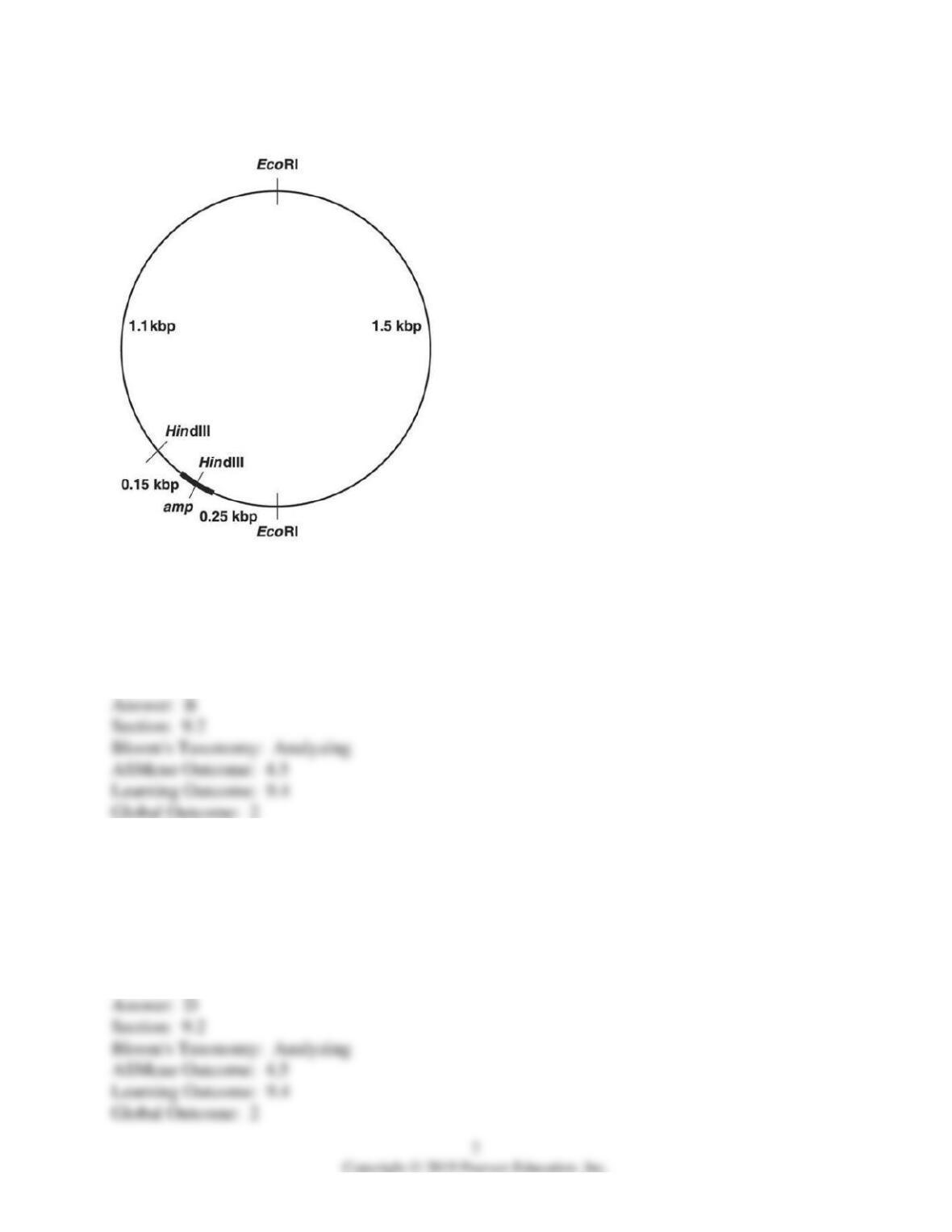
Figure 9.1
2) How many pieces will EcoRI produce from the plasmid shown in Figure 9.1?
A) 1
B) 2
C) 3
D) 4
E) 5
3) In Figure 9.1, after digestion with the appropriate restriction enzyme, what is the smallest
piece containing the entire ampicillin-resistance (amp) gene?
A) 0.17 kbp
B) 0.25 kbp
C) 1.08 kbp
D) 1.50 kbp
E) 3.00 kbp
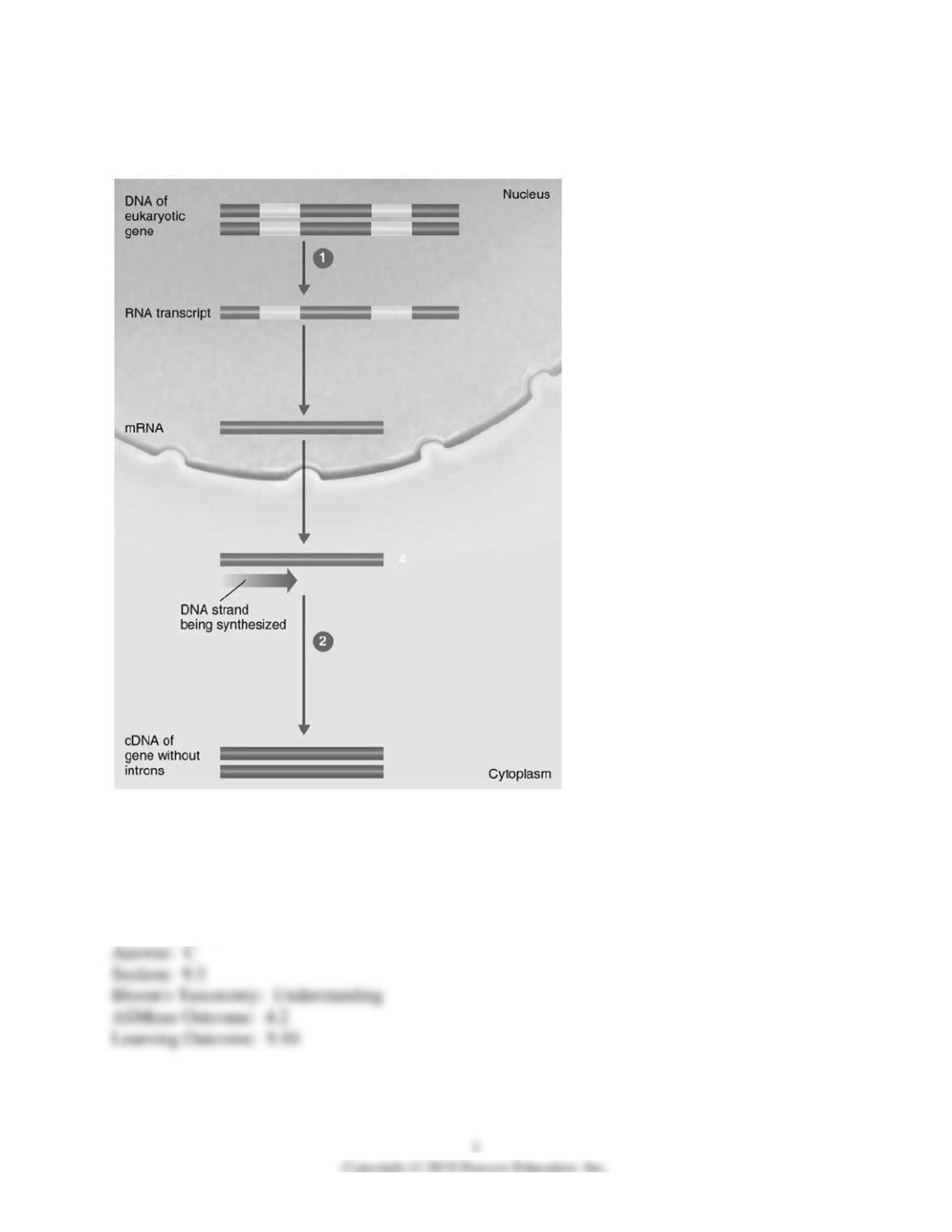
Figure 9.2
4) In Figure 9.2, the enzyme in step 1 is
A) DNA polymerase.
B) DNA ligase.
C) RNA polymerase.
D) reverse transcriptase.
E) spliceosome.

5) In Figure 9.2, the enzyme in step 2 is
A) DNA polymerase.
B) DNA ligase.
C) RNA polymerase.
D) reverse transcriptase.
E) spliceosome.
6) The reaction catalyzed by reverse transcriptase is
A) DNA → mRNA.
B) mRNA → cDNA.
C) mRNA → protein.
D) DNA → DNA.
E) tRNA → mRNA.
7) Which of the following is an advantage of using E. coli to make a human gene product?
A) Endotoxin may be in the product.
B) It does not secrete most proteins.
C) Its genes are well known.
D) It cannot process introns.
E) Endotoxin may be in the product and it does not secrete most proteins.

8) Which of the following is NOT an agricultural product made by DNA techniques?
A) frost retardant
B) Bacillus thuringiensis insecticide
C) nitrogenase (nitrogen fixation)
D) glyphosate-resistant crops
E) pectinase
9) If you have inserted a gene in the Ti plasmid, the next step in genetic engineering is
A) transformation of E. coli with Ti plasmid.
B) splicing T DNA into a plasmid.
C) transformation of an animal cell.
D) inserting the Ti plasmid into Agrobacterium.
E) inserting the Ti plasmid into a plant cell.
10) Biotechnology involves the
A) use of microorganisms to make desired products.
B) use of animal cells to make vaccines.
C) development of disease-resistant crop plants.
D) use of microorganisms to make desired products and the use of animal cells to make vaccines.
E) use of microorganisms to make desired products, the use of animal cells to make vaccines,
and the development of disease-resistant crop plants.
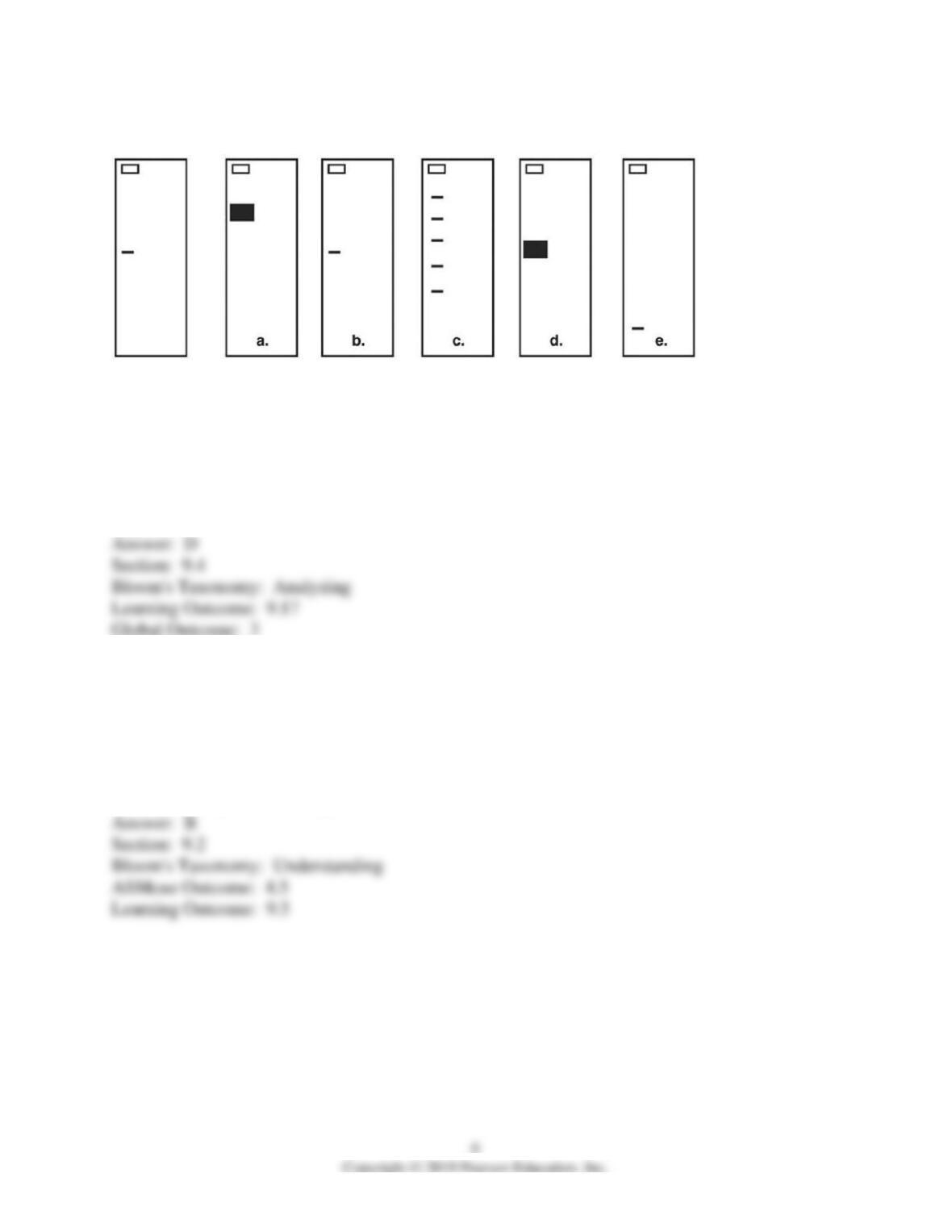
11) Figure 9.3
The figure at the left in Figure 9.3 shows a gene identified by Southern blotting. What will a
Southern blot of the same gene look like after PCR?
A) a
B) b
C) c
D) d
E) e
12) Which of the following is NOT a desired characteristic of DNA vectors used in gene cloning
procedures?
A) self-replication
B) large size
C) has a selectable marker
D) circular form of DNA or integrates into the host chromosome
E) may replicate in several species
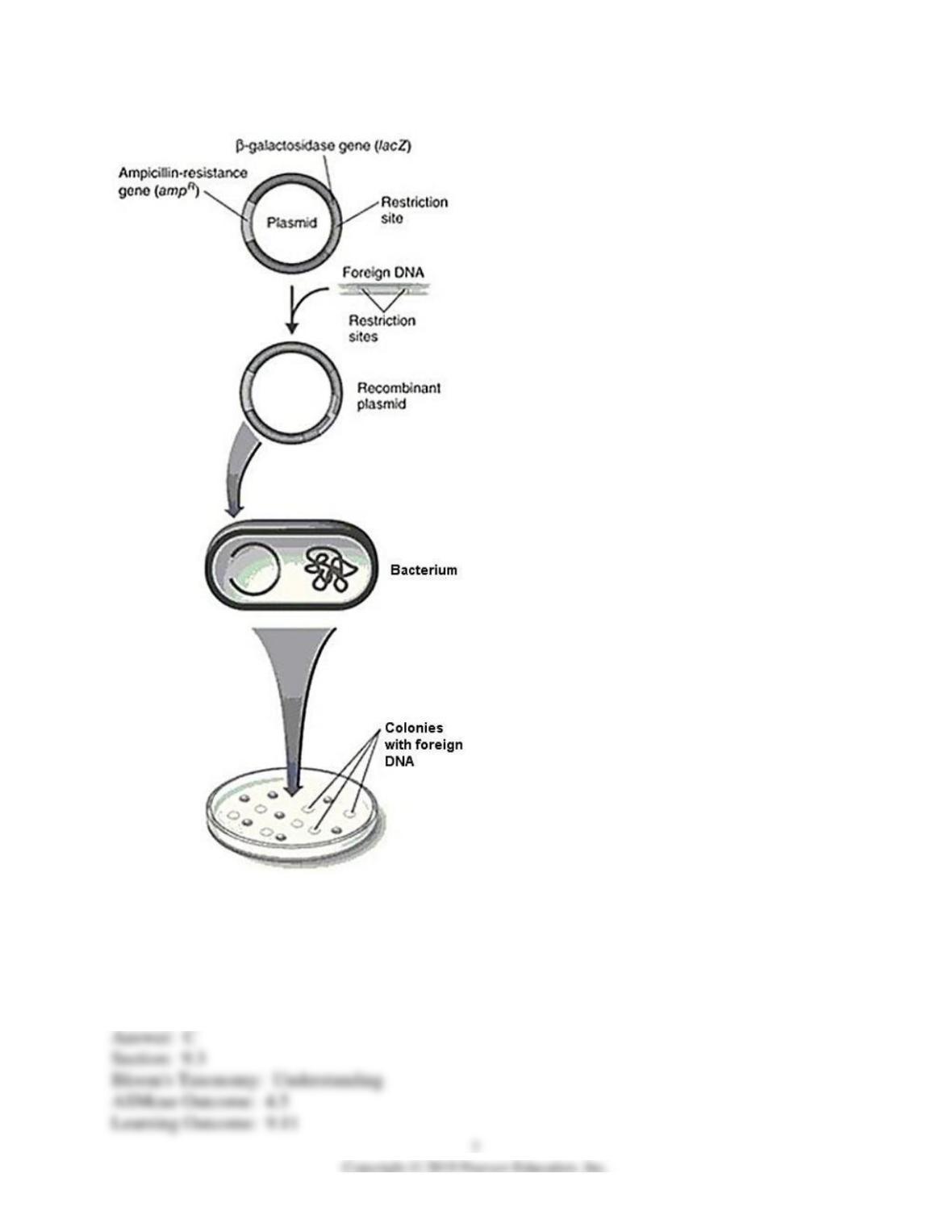
13) Figure 9.4
In Figure 9.4, the bacteria transformed with the recombinant plasmid and plated on media
containing ampicillin and X-gal will
A) form blue, ampicillin-resistant colonies.
B) form blue, ampicillin-sensitive colonies.
C) form white, ampicillin-resistant colonies.
D) form white, ampicillin-sensitive colonies.
E) not grow.

14) The most important property of a DNA vector is
A) its ability to replicate within the cell.
B) the size of the vector.
C) the fact that it contains a marker.
D) that it contains an ability to integrate into the chromosome.
E) that the inserted genes that lack exons.
15) An advantage of cDNA over genomic DNA is that it
A) lacks exons.
B) lacks introns.
C) contains selectable markers.
D) can form very large DNA segments.
E) is very easy to isolate.
16) The restriction enzyme EcoRI recognizes the sequence G↓AATTC. Which of the following
is TRUE of DNA after it is treated with EcoRI?
A) All of the DNA fragments will have single-stranded regions ending in AA.
B) All of the DNA fragments will have single-stranded regions ending in G.
C) Some of the DNA will have single-stranded regions ending in AA and others will end in G.
D) All of the DNA will have blunt ends.
E) All of the DNA will be circular.

17) Which enzyme would cut this strand of DNA?
GCATGGATCCCAATGC
A)
Enzyme Recognition
BamHI G↓GATCC
CCCTAG↑G
B)
Enzyme Recognition
EcoRI G↓AATTC
CTTAA↑G
C)
Enzyme Recognition
HaeIII GG↓CC
CC↑GG
D)
Enzyme Recognition
HindIII A↓AGCTT
TTCGA↑A
E)
Enzyme Recognition
Pst ICTGC↓G
G↑ACGTC
18) Place the steps of constructing a genomic library in order.
I. Digest phage with restriction enzyme.
II. Lyse cells of interest and precipitate DNA.
III. Introduce constructs via transformation into competent E. coli cells.
IV. Perform ligation reaction with genome fragments and phage.
V. Digest genomic DNA with restriction enzyme.
A) V, IV, I, III. II.
B) I, II, III, IV, V.
C) II, I, III, V, IV.
D) II, V, I, IV, III.
E) IV, II, III, I, V.

19) A population of cells carrying a desired plasmid is called a
A) library.
B) clone.
C) vector.
D) Southern blot.
E) PCR.
20) Self-replicating DNA used to transmit a gene from one organism to another is a
A) library.
B) clone.
C) vector.
D) Southern blot.
E) PCR.
21) The Human Genome Project, which was completed in 2003, was focused on
A) identifying all of the genes in the human genome.
B) determining the nucleotide sequence of the entire human genome.
C) determining all of the proteins encoded by the human genome.
D) finding a cure for all human genetic disorders.
E) cloning all of the genes of the human genome.
22) The field of proteomics concerns itself with
A) identifying an organism that makes improved enzymes.
B) discovering the function of genes from a genetic sequence.
C) determining all of the proteins expressed by a cell.
D) synthesizing proteins from altered genetic sequences.
E) identifying pathogens using RFLPs.

23) You have a small gene that you wish replicated by PCR. After 3 replication cycles, how
many double-stranded DNA molecules do you have?
A) 2
B) 4
C) 8
D) 16
E) thousands
24) Which of the following places the steps in the PCR procedure in the correct order?
1) Incubate at 94°C to denature DNA strands;
2) Incubate at 72°C for DNA synthesis;
3) Incubate at 60°C for primer hybridization.
A) 1, 2, 3
B) 3, 2, 1
C) 1, 3, 2
D) 2; 1; 3
E) 3; 1; 2
25) Which of the following are used to silence specific genes and hold promise for treating
cancer or viral diseases, such as hepatitis B?
A) RNA interference (RNAi)
B) complementary DNA (cDNA)
C) reverse transcriptase PCR (rtPCR)
D) tumor-inducing plasmids (Ti plasmids)
E) DNA fingerprinting